Is WHOOP Worth It for Runners? An Evidence-Based Answer
Is WHOOP worth $199-$359 a year for runners? Independent testing says it depends where you wear it — upper arm cuts heart-rate error to a third.
Key Takeaways
- Wear it on the upper arm for runs — three identical WHOOP 4.0 units tested side by side: 5.95% treadmill heart-rate error at the wrist vs 1.92% on the upper arm.
- No independent study validates the Recovery score — the only published support is WHOOP-authored. Trust the 7-day trend, not one red morning.
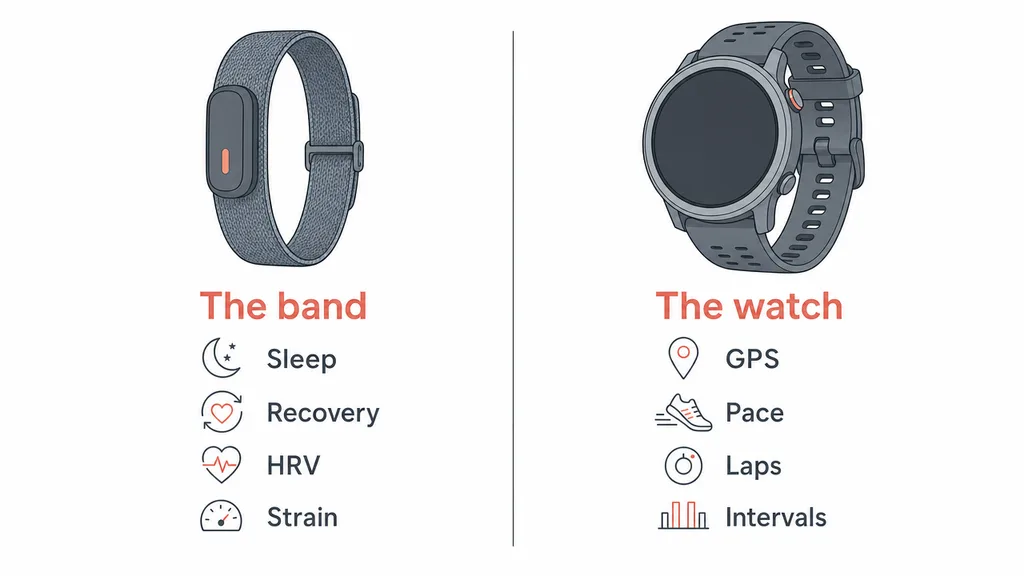
- It will not replace a running watch — no GPS, no pace, no laps, no intervals. Runners who like WHOOP wear it alongside a watch, not instead of one.
- The real price is $199-$359 every year — hardware included, but it stops working if you cancel. Three years of Peak: $717; subscription-free CIRQA: $199.99 once.
Ask runners who actually wear WHOOP how they use it and the same pattern keeps coming back: the band handles sleep and recovery, the watch handles the run. That division of labor is the honest starting point for the question most people are really asking — is a screenless strap with a $199-$359 yearly subscription worth adding to a runner's kit? The answer below leans on independent research rather than marketing — including the one wearing decision that changes it.
What WHOOP does for runners — and what it doesn't
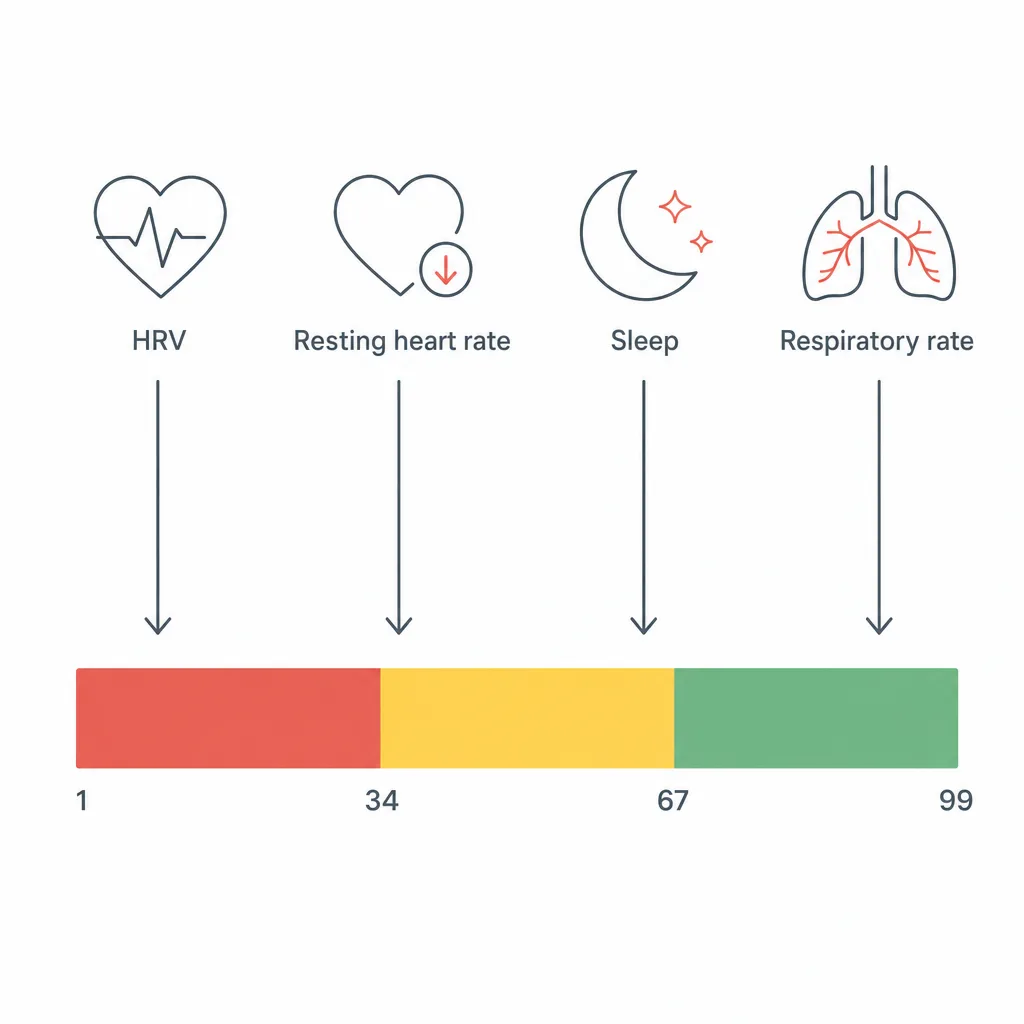
WHOOP 5.0 and WHOOP MG (released May 2025) are screenless bands built for 24/7 wear, with a claimed 14+ day battery. Everything they produce flows into three scores: Sleep, Strain (0-21 cardiovascular load) and Recovery (a 1-99% score computed each morning from exactly four inputs: heart-rate variability, resting heart rate, sleep, and respiratory rate). For a runner, that makes it a recovery and sleep instrument — and nothing else.
The list of standard running features it does not have is long, and worth seeing in one place:
- No built-in GPS. WHOOP's own support pages are direct that the sensor has no built-in GPS. Distance and pace come from your phone carried on the run, or imported from a watch via Strava.
- No laps or splits — live pace only through your phone's screen, and a single average afterwards.
- No structured intervals, no pace targets, no cadence, no race predictor.
- No screen, so no mid-run heart-rate check without pulling out your phone.
What it can do mid-run is broadcast live heart rate over Bluetooth to a watch, bike computer or treadmill (there is no ANT+ support). Worn that way it doubles as a heart-rate strap for zone-based training — which matters more than it sounds, because of where accuracy comes from.
Accuracy depends on where you wear it
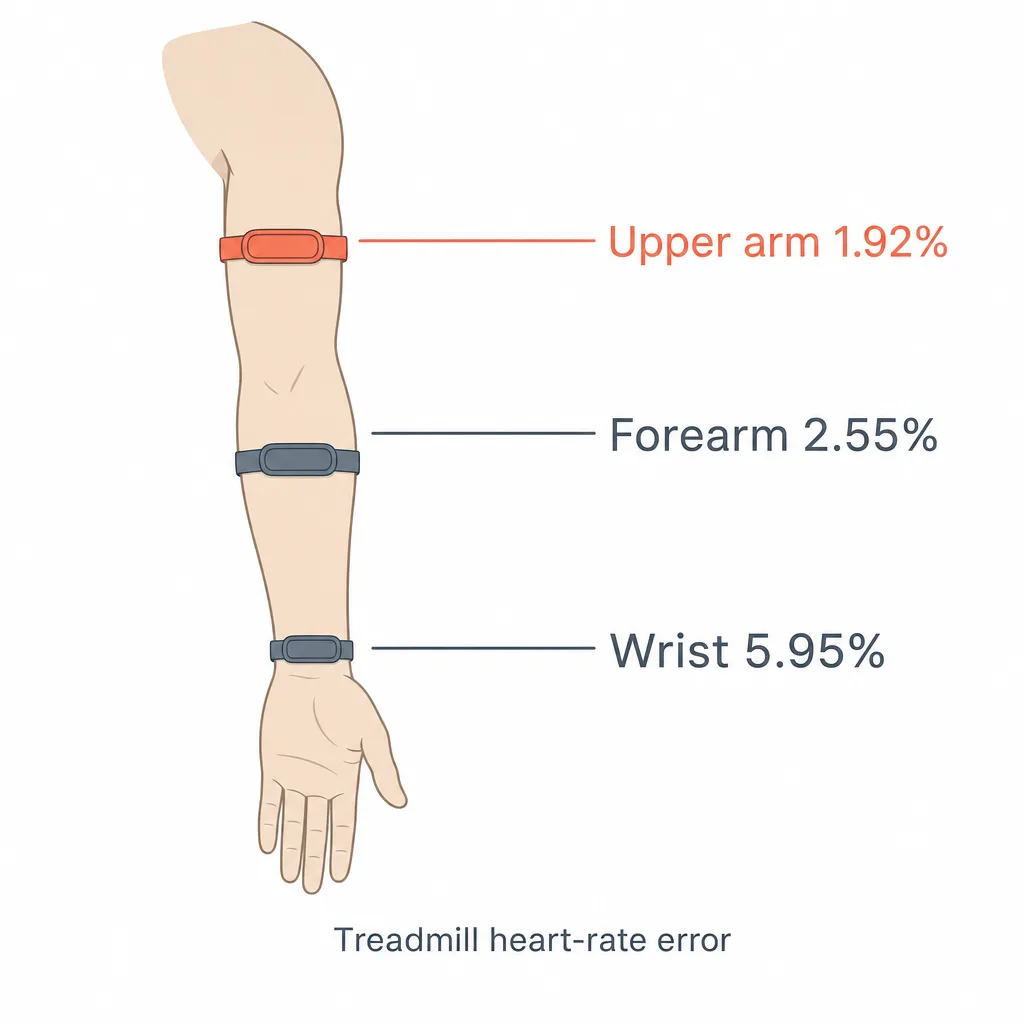
A 2025 study in Sensors did something unusually clean: it put three identical WHOOP 4.0 units on the same 28 people at once — wrist, forearm and upper arm — against a chest-strap reference, through rest, burpees and a graded treadmill test. Same hardware, same body, same minutes. Only the placement differed.
| Placement (same WHOOP unit) | Treadmill heart-rate error (MAPE) |
|---|---|
| Wrist (how most people wear it) | 5.95% |
| Forearm | 2.55% |
| Upper arm | 1.92% |
| Reference: arm-band optical sensor (Polar Verity Sense) | 1.89% |
| Reference: wrist GPS watch (Garmin Forerunner) | 4.29% |
The authors' conclusion: "anatomical placement alone significantly affects accuracy." On the upper arm, WHOOP matched a dedicated optical arm band; on the wrist, it was the least accurate position tested. Two caveats keep this honest. First, high-intensity work broke every position — during all-out burpees even the upper arm averaged 12% error, and a separate ECG study found WHOOP least reliable exactly during rapid heart-rate transitions, which is what the first minute of every interval rep looks like. Second, every published test used older hardware (WHOOP 2.0-4.0); the current 5.0 and MG have zero peer-reviewed validations, and WHOOP rewrote its heart-rate algorithm in February 2026 with no independent retest since.
The Recovery score: a useful signal without a validation study
The morning Recovery percentage is WHOOP's core product: green at 67% and above, yellow from 34%, red below. Here is the part almost no review mentions: as of August 2026 there is no independent study validating the Recovery score itself — the only published support is a paper authored entirely by WHOOP employees. The inputs are measurable; the score's meaning remains independently untested.
The inputs also carry more noise than the clean daily percentage suggests. A 536-night ECG comparison found WHOOP's nightly HRV readings averaged 8.17% error — with a standard deviation larger than the average, meaning some nights are far off. An earlier validation (on 2018-era WHOOP 2.0 hardware) found the device's HRV measurement error approached or exceeded the smallest physiologically meaningful change — so a day-to-day difference can be pure noise. And a three-month study of daily life found the disconnect runs deeper than measurement: on days people reported feeling energized, their HRV was actually lower, leading the authors to caution against HRV-guided recommendations. Feeling and score disagreeing is normal, not a defect in you.
One more failure mode matters for high-mileage runners: green does not mean you aren't overtraining. Hard aerobic training tends to lower resting heart rate and can hold HRV up — long-term users report their greenest streaks arriving deep in overreach. The score reads freshness signals, not accumulated training load — track that separately.
What it costs, correctly
WHOOP has three membership tiers, and the hardware is included: One at $199/yr (WHOOP 5.0, wired charger), Peak at $239/yr (5.0 plus wireless power pack, health alerts, stress monitor) and Life at $359/yr (the medical-grade MG with ECG and blood-pressure features). Those are the prices on WHOOP's July 2026 membership page, unchanged since launch in May 2025 — worth stating precisely because prices on third-party review pages drift; check WHOOP's own membership page before deciding. Two structural points: cancel, and the band stops working with your history behind the paywall; and the free trial ships a certified pre-owned unit.
The comparison that actually decides this for many runners arrived in July 2026: Garmin's CIRQA band — screenless, wrist or upper-arm wear, sleep staging, HRV status and Training Readiness — costs $199.99 once, with no subscription and a 10-day battery. Three years of WHOOP Peak runs $717; three years of CIRQA stays $199.99 (prices as of the companies' July 2026 pages). WHOOP's counterargument is a deeper recovery ecosystem and, worn on the upper arm, heart-rate accuracy that matched a dedicated optical arm band in independent testing. Whether that is worth roughly $500 more over three years is the real question, and it depends on how much of the ecosystem you will actually use.
Using it in a marathon build
Strain, WHOOP's 0-21 effort scale, is logarithmic — by WHOOP's own example a marathon lands around 20.4, and running a second race that day would only nudge it to 20.6. So Strain is not mileage and can't be chased like weekly volume; treat it as a same-day intensity note, nothing more. Sleep is where the band earns its keep in a build: the average member sleeps 7 h 11 min a night and carries a 43-minute sleep debt by WHOOP's own accounting — a gap that widens as training load rises. If the band gets you to protect sleep during heavy weeks, it is doing the one job with the strongest evidence behind it. Pair it with the sleep recovery calculator to see what your mileage actually demands.
Race week is where trust gets tested. Pre-race nerves reliably wreck the night before — runners post finishes on scores as low as 22% after anxious sleep, and WHOOP's own team describes recovery as "a signal, not a stop sign." The cautionary tale that circulates in the community makes the opposite point: one runner lined up for a half marathon three days after knee pain had cut a training run short, on about 2.5 hours of sleep, discovered their first-ever 1% recovery day after the race — and the knee gave out at 14 km. The top reply — listen to your body first, not the band — cuts both ways: the score was right that morning, and their body had already said the same thing. Red plus symptoms is information; red alone, on race morning, usually isn't.
So is it worth it?
Worth it if:
- You will actually change behavior on sleep data — earlier nights, alcohol timing, protected sleep in big weeks. This is the benefit long-term users cite most, and the one with the strongest evidence.
- You want 24/7 recovery tracking but won't wear a chunky watch to bed — the screenless band is genuinely comfortable to sleep in.
- You're stacking high training load and want an independent morning signal alongside your training log.
Skip it if:
- You want anything that guides the run itself — pacing, intervals, GPS. That is a watch's job, and WHOOP doesn't attempt it.
- You already wear a recent Garmin: its built-in Training Readiness answers the same morning question using your actual training load, at no extra cost.
- You'd rather pay once — CIRQA at $199.99 covers the screenless-recovery-band job without the subscription.
WHOOP's hardware holds up well in independent testing — though its sleep staging rated only "fair" against lab polysomnography, below the devices that study's authors recommended; its running features are close to nonexistent, and the subscription compounds every year. The runners who keep it are the ones using it to change what they do at night — not the ones expecting it to coach what they do on the road.
Sources & References
- (2025). Impact of Anatomical Placement on the Accuracy of Wearable Heart Rate Monitors During Rest and Various Exercise Intensities. Sensors.
- (2025). A performance validation of six commercial wrist-worn wearable sleep-tracking devices for sleep stage scoring compared to polysomnography. Sleep Advances.
- (2025). Validation of nocturnal resting heart rate and heart rate variability in consumer wearables. Physiological Reports.
- (2021). Wrist-Based Photoplethysmography Assessment of Heart Rate and Heart Rate Variability: Validation of WHOOP. Sensors.
- (2026). Disconnection Between Self-Reported Wellbeing and Heart Rate Variability from Wearables. Sensors.