
Supercompensation Theory for Runners — When to Train Next
When should you train hard again? 48h after speed work, 72-96h after tempo or long runs — supercompensation timing by workout type for runners.
Key Takeaways
- Training breaks you down; recovery builds you up — Supercompensation only occurs when adequate recovery follows a training stimulus; without rest, fitness stagnates or declines.
- Different systems, different timelines — Neuromuscular recovery takes 48-72 hours, metabolic recovery 48-96 hours, and musculoskeletal recovery up to 120 hours; session spacing must respect the slowest system.
- The taper is peak supercompensation — Reducing volume 40-60% over 2-3 weeks while maintaining intensity lets fatigue drop while fitness persists, yielding 2-3% performance improvements.
- Recovery weeks prevent overtraining — A 20-40% volume reduction every 3-4 weeks allows accumulated fatigue to dissipate while preserving fitness gains from the loading block.
- Performance = Fitness minus Fatigue — The fitness-fatigue model explains why hard training blocks feel terrible (high fatigue) but produce race-day breakthroughs after adequate recovery.
What Is Supercompensation?
Supercompensation is the foundational principle of all athletic training. First described by Soviet sports scientists in the 1950s and formalized by Nikolai Yakovlev, the theory explains how your body does not simply return to its previous state after a training stimulus — it rebuilds to a level above baseline, anticipating that the same stress will occur again.
The supercompensation cycle has four distinct phases:
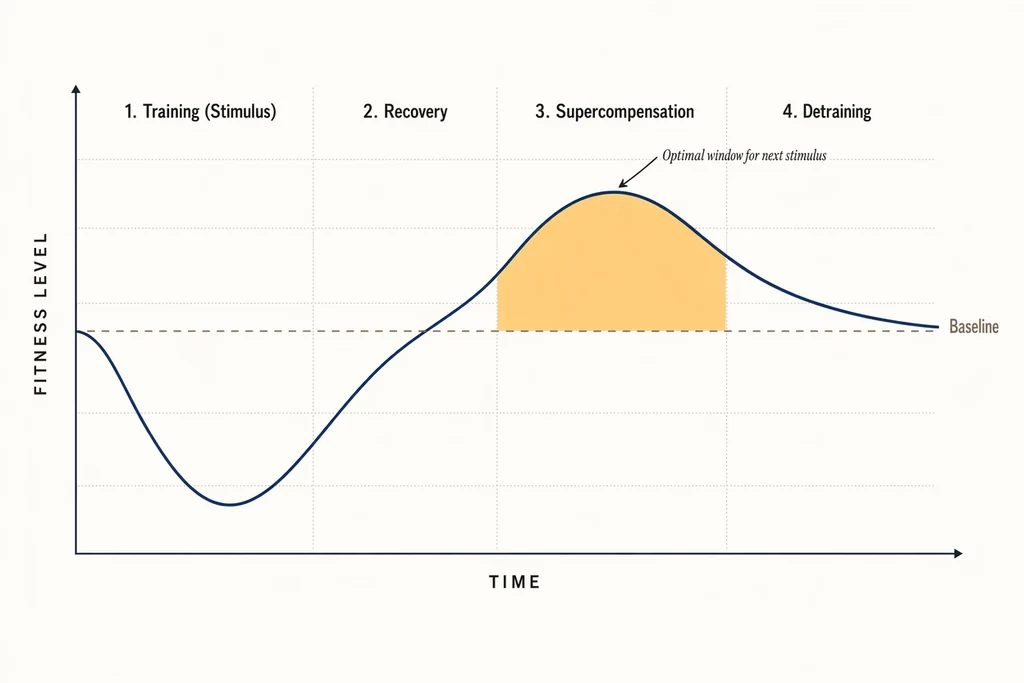
- Training (Stimulus): You run a hard workout, depleting glycogen, damaging muscle fibers, and fatiguing your neuromuscular system. Fitness temporarily drops below baseline.
- Recovery: Your body begins repairing the damage. Glycogen is resynthesized, muscle fibers are rebuilt, and hormonal balance is restored. Fitness returns toward baseline.
- Supercompensation: Your body overshoots baseline, building greater capacity than before. Glycogen stores are elevated, muscle fibers are stronger, and mitochondrial density increases. This is the window of opportunity for your next hard session.
- Detraining: If no new stimulus is applied during the supercompensation window, fitness gradually returns to baseline as the body sees no reason to maintain the elevated capacity.
The art of training is timing your next hard session to land within the supercompensation window — after full recovery but before fitness returns to baseline. This is why recovery is not optional; it is half of the training equation.
The Fitness-Fatigue Model
While the classic supercompensation model is useful for understanding single workouts, real-world training involves overlapping stimuli and recovery cycles. The fitness-fatigue model (Banister, 1991) provides a more nuanced framework.
Two Competing Forces
Every training session produces two simultaneous responses:
- Fitness (positive): A slow-building, long-lasting elevation in your performance capacity. Fitness gains accumulate gradually over weeks and months and persist for weeks after training stops.
- Fatigue (negative): A rapid-onset, shorter-duration reduction in your ability to perform. Fatigue peaks immediately after training and dissipates within days.
Your observable performance at any moment is the difference between your accumulated fitness and your accumulated fatigue: Performance = Fitness - Fatigue.
Why This Model Matters for Training
This dual-factor model explains several training phenomena that the simple supercompensation model cannot:
- Bad workouts on good fitness: You can have excellent underlying fitness but perform poorly because acute fatigue is high — this is normal during heavy training blocks
- The taper effect: When you reduce training volume before a race, fatigue drops rapidly (days) while fitness decays slowly (weeks), creating a performance peak. Use the Taper Calculator to time your pre-race volume reduction.
- Overtraining: When fatigue accumulates faster than fitness, performance chronically declines despite continued training
- Deload weeks: Periodic volume reductions allow fatigue to dissipate while preserving most fitness, creating mini-supercompensation peaks
Track your fitness and fatigue trends using the Training Load Calculator to visualize how your training load affects your readiness to perform.
Supercompensation Timelines for Different Systems
Different physiological systems recover and supercompensate at different rates. This is crucial for programming training:
Neuromuscular System (24-72 hours)
Explosive power, coordination, and muscle recruitment patterns recover relatively quickly. After a speed session (intervals, strides), neuromuscular supercompensation typically occurs within 48-72 hours. This is why most training plans place speed work with at least 2 days before the next hard session.
Metabolic System (48-96 hours)
Glycogen replenishment takes 24-48 hours with adequate nutrition. The enzymes and mitochondria that power aerobic metabolism require 48-96 hours to complete the supercompensation response after a depleting effort like a long run or tempo workout. This explains the common pattern of scheduling long runs 5-7 days apart.
Musculoskeletal System (48-120 hours)
Muscle fiber repair and strengthening takes 48-72 hours for moderate efforts and up to 5 days for very hard sessions or eccentric-heavy work (downhill running). Tendon and ligament adaptation is even slower — collagen synthesis peaks at 24 hours post-exercise and remains elevated for 72+ hours, but full structural adaptation takes weeks of repeated stimulus-recovery cycles.
Hormonal System (24-96 hours)
Cortisol and testosterone balance, growth hormone secretion patterns, and thyroid function can be disrupted by hard training. Most hormonal recovery occurs within 48-72 hours of a hard session if sleep and nutrition are adequate. Chronic hormonal disruption indicates non-functional overreaching. Monitor your recovery status with the Recovery Planner.
Recovery Timing by Workout Type (Practical Reference)
The physiological timelines above can be mapped to the workout types you actually plan. This is the table most runners want:
- Easy run (60-70% max HR): 12-24 hours. Can be run daily without blocking supercompensation from the prior hard session.
- Strides / plyometrics: 24-48 hours. Minimal glycogen impact; primarily CNS recovery.
- Interval / VO2max workout (30s-5min at ~95% HR): 48-72 hours. Neuromuscular plus significant metabolic stress.
- Threshold / tempo run (20-60 min at lactate threshold): 48-72 hours. Metabolic system dominant; fatigue lingers into day 2.
- Depleting long run (>90 min or 30+ km): 72-96 hours. Full glycogen resynthesis plus structural repair.
- Marathon race or time trial (near-max effort >2h): 5-10 days. Multi-system depletion; musculoskeletal damage often dominates.
- Steep downhill running (eccentric-heavy): 72-120 hours. Eccentric contractions cause extended muscle fiber damage.
If you are asking when can I run hard again? — map your last workout to this table. A Tuesday VO2max session means your next hard effort should land Thursday-Friday at the earliest. A Sunday long run means Wednesday-Thursday is the practical minimum before the next threshold workout.
Applying Supercompensation to Your Training
Within a Week: Session Sequencing
The classic 7-day training week can be understood as overlapping supercompensation cycles. A well-designed week sequences sessions to allow each system to supercompensate before the next hard stimulus:
- Monday: Rest or easy run (recovery from weekend long run)
- Tuesday: Hard workout (intervals/tempo) — placed when neuromuscular system has supercompensated from Sunday's long run
- Wednesday: Easy run (active recovery from Tuesday's session)
- Thursday: Moderate effort or second quality session — placed 48+ hours after Tuesday's hard effort
- Friday: Rest or very easy run (recovery before weekend efforts)
- Saturday: Moderate-hard effort (marathon pace, progressive run)
- Sunday: Long run — the biggest stimulus of the week, placed with maximum recovery before Monday's rest
Generate a personalized week structure using the Training Plan Calculator.
Within a Mesocycle: Loading and Recovery Weeks
The 3:1 or 4:1 loading pattern applies supercompensation at the mesocycle (multi-week) level:
- Weeks 1-3 (Loading): Progressive increase in training stress. Each week builds on the supercompensation from the previous week's recovery. Mileage typically increases 5-10% per week.
- Week 4 (Recovery): Volume reduced by 20-40%, intensity maintained at reduced volume. This week allows accumulated fatigue to dissipate while preserving the fitness gains from weeks 1-3. The supercompensation from this recovery week sets the new baseline for the next loading block.
Without recovery weeks, fatigue accumulates faster than fitness, eventually leading to non-functional overreaching. The recovery week is not wasted training time — it is when the deep adaptations from the loading block actually consolidate.
Within a Macrocycle: Periodization
Periodization applies supercompensation across an entire training season (typically 16-24 weeks for a marathon cycle):
- Base Phase (4-8 weeks): Build aerobic foundation with high volume, low intensity. Supercompensation targets: mitochondrial density, capillary development, fat oxidation
- Build Phase (4-6 weeks): Introduce race-specific intensity. Supercompensation targets: lactate threshold, running economy, neuromuscular power
- Peak Phase (2-4 weeks): Highest combined volume and intensity. Maximum overreaching before taper.
- Taper Phase (2-3 weeks): Dramatic volume reduction with maintained intensity. This is macrocycle-level supercompensation — fatigue dissipates while the fitness accumulated over months is preserved and expressed. Estimate your optimal taper with the Taper Calculator.
The Taper: Supercompensation's Grand Finale
The pre-race taper is the most dramatic application of supercompensation in distance running. Research by Mujika and Padilla (2003) found that an optimal taper can improve performance by 2-3% — equivalent to 2-5 minutes in a marathon.
Why Tapering Works
During heavy training, your fitness is high but your fatigue is also high. The taper reduces training volume by 40-60% over 2-3 weeks while maintaining some intensity (to preserve neuromuscular adaptations). Because fatigue dissipates much faster than fitness, your performance curve rises dramatically:
- Week 1 of taper: Volume drops 20-30%. Fatigue begins clearing. You may feel sluggish as your body adjusts.
- Week 2 of taper: Volume drops 40-60%. Glycogen stores are fully replenished. Muscle damage is repaired. Energy levels rise.
- Race week: Volume drops 60-80%. You feel light, powerful, and possibly anxious (phantom fatigue from training less). This is peak supercompensation.
Common Taper Mistakes
- Cutting volume too late: Starting the taper less than 10 days before a marathon does not allow sufficient fatigue dissipation
- Eliminating all intensity: Running only easy during the taper causes neuromuscular detraining. Include 2-3 short speed sessions (strides, short intervals) to maintain leg turnover
- Adding "bonus" workouts: Anxiety during the taper leads many runners to add extra runs that accumulate unnecessary fatigue
- Changing nutrition: Carb-loading without practice or dramatically changing diet can cause GI issues on race day
Practical Tools for Monitoring Supercompensation
You do not need a sports science lab to apply supercompensation principles. These practical indicators help you gauge where you are in the cycle:
- Morning resting heart rate: A return to your baseline (or 1-2 bpm below) suggests recovery is complete. Elevated HR suggests ongoing fatigue.
- Subjective readiness: Rate your energy, motivation, and muscle soreness on a 1-10 scale each morning. A 7+ indicates readiness for a hard session.
- Performance in easy runs: When your usual easy pace feels effortless and your legs feel springy, you are likely in the supercompensation window.
- HRV trends: Rising HRV trends indicate recovering parasympathetic tone and readiness for training stimulus.
- Sleep quality: Normalized sleep patterns (falling asleep easily, sleeping through the night, waking refreshed) indicate recovered nervous system.
The best recovery tool is consistency — consistent sleep, consistent nutrition, consistent training patterns. Learn more about optimizing the recovery side of the equation in our Rest Days Guide and Sleep and Recovery Guide.
Use the VO2max Calculator to track your fitness progression over time and verify that your training-recovery balance is producing the expected supercompensation gains.
Sources & References
- (2003). The Fitness-Fatigue Model Revisited: Implications for Planning Short- and Long-Term Training. Strength and Conditioning Journal.
- (2019). Periodization: Theory and Methodology of Training. Human Kinetics.
- (2003). Scientific Bases for Precompetition Tapering Strategies. Medicine and Science in Sports and Exercise.
- (2010). A Conceptual Framework for Periodization and Recovery in Sport. Sports Medicine.