New York Running Routes: Central Park 9.7K, Hudson +4 More
NYC running guide: Central Park 9.7K loop, Hudson Greenway 13mi, NYRR 9+1 path to the marathon, Armory winter intervals, and the 5-borough race calend...
Read City Guide →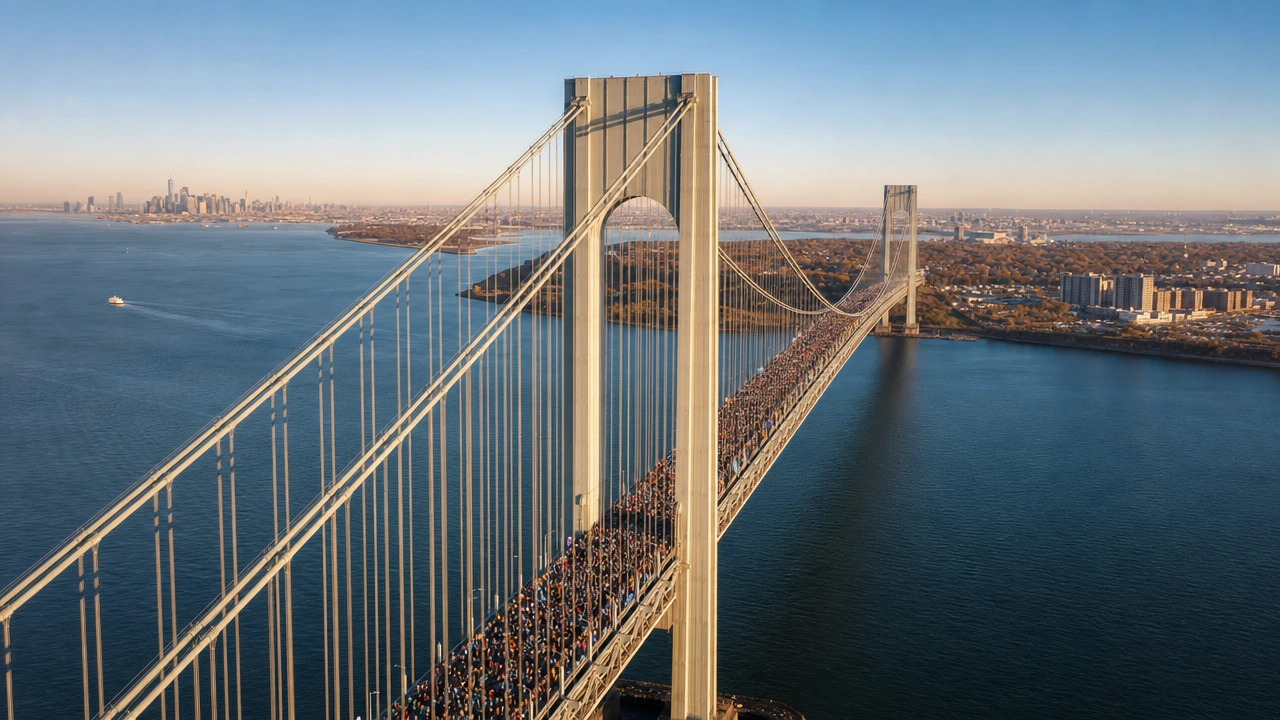
Want personality modes & weather integration? Try the full countdown experience
See entry dates for other marathons →
| Race | 2026 NYC Marathon - Nov 1 |
|---|---|
| City | New York |
| Date | 2026-11-01 at 09:00 |
| Field Size | ~59,000 runners |
| Time Limit | 8 hours |
| Cutoff pace | 11:23/km |
| Course speed |
Fast courseSpeed index 0.92 — median of the last 5 winners' times against the global same-year median. Winner times track elite fields and prize money, so this reads the course as a proxy, not a pure measurement. |
| Timezone | America/New_York |
| Official Site | New York Road Runners (NYRR) |
| Average Temperature | 12.1°C / 54°F |
|---|---|
| Humidity | 78% |
| Peak Wind | 26.9 km/h |
| Rain Chance | 27% |
| Typical Conditions | Cool autumn weather with moderate wind |
What to Prepare: Bridge crossings are windy — tuck behind other runners. The Queensboro Bridge at mile 15 is notoriously windy and uphill. Bring warm throwaway clothes for the Staten Island start.
Based on historical averages for race week. Use our Weather Score Calculator and What to Wear Guide for personalized advice.
Winds peaking around 26.9 km/h — the typical daily maximum for this date — can affect your pace by 5-15 seconds per kilometer in exposed stretches. Headwinds slow you down exponentially: a 20 km/h wind costs more than twice a 10 km/h wind.
Calculate your wind-adjusted pace →Based on 20 years of race-week weather (2005-2024), MERRA-2 reanalysis
| Cooler | Typical | Warmer | |
|---|---|---|---|
| Temperature | 7.8°C | 12.1°C | 16.4°C |
| Dew point | 2.6°C | 8.1°C | 14.4°C |
Recent actuals: 2023 11.3°C / 2024 7°C / 2025 8.5°C (morning avg)
Data: NASA POWER (MERRA-2 reanalysis), NASA Langley Research Center
| Course Type | Point-to-point |
|---|---|
| Elevation Gain | 250m |
| Terrain | Road |
| Profile | Challenging hilly course through all five NYC boroughs over multiple bridges. Significant climbs on bridges and in Central Park. Not a PR course — run for the experience. |
| Boston Qualifier | Yes — Check your BQ time |
| Year | Finishers | vs prev. |
|---|---|---|
| 2021 | 25,010 | — |
| 2022 | 47,839 | +91.3% |
| 2023 | 51,402 | +7.4% |
| 2024 | 55,646 | +8.3% |
| 2025 | 59,226 | +6.4% |
Runners who crossed the line, not the registered field size.
The 2026 TCS New York City Marathon on Nov 1 marks the 50th anniversary of the five-borough course, which debuted in 1976 for the U.S. Bicentennial. Runners start at Fort Wadsworth on Staten Island and finish in Central Park near Tavern on the Green, crossing five bridges (Verrazzano-Narrows, Pulaski, Queensboro, Willis Avenue, Madison Avenue) and every borough in 26.2 miles.
With 246 m / 810 ft of elevation gain concentrated in bridge climbs rather than continuous hills, NYC is not a PR course. In 2023, only 1 of the top 25 men ran a negative split (course-record holder Tamirat Tola). Amateur runners typically finish 5-10 minutes slower at NYC than at Berlin or Chicago off equivalent fitness.
Demand is record-breaking: 240,000+ applications for the 2026 drawing, with less than 1% accepted. The field — projected at 55,000+ finishers following 2025's world-record 59,226 — splits roughly evenly across drawing, 9+1 guaranteed entries, international tour operators, and charity runners. 670+ official charity partners support a $100 million fundraising target, both all-time highs.
Runners enter Fort Wadsworth in three color-coded villages (Orange / Blue / Green) and wait 1-2 hours in 5-12°C cold — throwaway gear is mandatory; bag check closes ~2 hours before gun time. Wave 1 starts at 9:10 AM ET, last wave at 11:30 AM, after the professional fields at 8:00-9:05 AM. Daylight Saving Time ends the same morning, so clocks fall back overnight.
Mile 1 climbs 150 ft over the Verrazzano-Narrows Bridge at ~4% grade — exposed to wind, no spectators allowed on the bridge. Expect to run 30-45 sec/mile slower than goal pace here; do not try to make it back on the descent. The eerie silence — broken only by helicopter rotors and Sinatra's "New York, New York" echoing back from Fort Wadsworth — is a hallmark opening no other Major has.
The Brooklyn touchdown at mile 3 is where 1 million spectators erupt. 4th Avenue (miles 4-8) is flat with slight downhill stretches and crowds 10-deep through Sunset Park and Park Slope — the most common pacing mistake is running 10-15 sec/mile under goal here. Around mile 11, the course passes through Hasidic Williamsburg; observant residents traditionally watch in silence, creating the famous "Silent Mile" before secular Williamsburg's DJs and live bands return at mile 12.
The Pulaski Bridge at mile 13.1 marks halfway and the Queens entry. Crowd density thins; the next big test waits two miles ahead.
The Queensboro Bridge (miles 15-16) is the psychological turning point — a 102-ft climb with no spectators allowed on the bridge, dropping from Queens roar into total silence right at the classic 30K wall. A sub-3:10 finisher's 2024 race report recorded his two slowest kilometers here; first-timer reports universally call this where "everyone walks."
Exiting onto First Avenue (miles 16-19) is the loudest moment in any WMM — a straight shot from 59th to 125th Street, crowds 15-deep, with the sound described as physical pressure on the chest. This is the biggest pacing trap of the race. The downhill feel masks subtle rises; runners who blow up on First Avenue pay on 5th Avenue at mile 22. Take the Maurten gel at mile 18, but hold goal pace.
Across the Willis Avenue Bridge (mile 20) into the Bronx — Latin music, gospel choirs in Harlem at miles 21-22, "shouting uncles on folding chairs" — and back via the Madison Avenue Bridge (mile 21), the course climbs 5th Avenue from mile 22 to 24, a sustained 2% grade over 1.4 km. The Bronx-side bridges produce cramping on the descents; the 5th Avenue drag ends most sub-3 attempts. Even Tola slowed here.
The Central Park finish is not flat: rolling hills from mile 24, a brief descent at Engineers' Gate, then a final 0.5-mile uphill to the Tavern on the Green finish line. Use our Negative Split Planner to model bridge-by-bridge pacing.
Pacing: Treat NYC as a course to survive on the bridges and harvest on the flats. Slow ~30 sec/km on Verrazzano, Queensboro, and 5th Avenue; resist surging on First Avenue. A 2-3 minute positive split is normal — even elites fade 1-3% in the back half. Negative splits at NYC are nearly impossible.
Fueling: Aid stations every mile from miles 3-25 except miles 5, 7, and 9, with water and Gatorade Endurance. Maurten gels appear only at miles 12 and 18 — most runners need to carry their own gels for miles 6, 9, 15, and 22. Bananas at mile 21. Plan your gel placement with our Energy Gel Calculator.
Weather: Nov 1 averages 12°C / 54°F with 59% humidity, but recent years have ranged from 4°C (2025) to 25°C and 80% humidity (2022). Sunrise is ~7:25 AM after clocks fall back. Throwaway layers are non-negotiable for the 4-hour pre-race standing window. Check race-morning conditions with our Weather Score Calculator.
Post-race: Walk 0.5-1 mile to exit Central Park, longer if you checked bags. Allow 2-3 hours from finish line to hotel shower. Hotels along Central Park West, in Lincoln Square, or near Columbus Circle save you the worst of the Sunday-afternoon subway crowds.
Arriving early? Explore daily running routes and local tips.
NYC running guide: Central Park 9.7K loop, Hudson Greenway 13mi, NYRR 9+1 path to the marathon, Armory winter intervals, and the 5-borough race calend...
Read City Guide →Use our free training tools to get race-ready:
Free running pace calculator for 5K, 10K, half marathon, and marathon. Get min/km or min/mile, your ...
Use Calculator →Free printable pace band for marathon, half marathon, or custom distance. Choose even, negative, or ...
Use Calculator →7 AM race, wake at 3:45 AM? Enter the gun time; we work backward through meal, gear, bathroom, warm-...
Use Calculator →London ~1.5%, Chicago ~35%, Berlin ~30%, Tokyo ~10%, NYC ~1-3% (2026 ballots) — real odds and wait t...
Use Calculator →How much does a headwind actually slow you down? This free calculator turns wind speed and direction...
Use Calculator →How much will hills slow you down? Enter elevation gain, loss, and distance to see adjusted pace, di...
Use Calculator →The 2026 drawing closed Feb 25 and was drawn Mar 4, but four entry paths remain: 9+1 guaranteed entry (complete 9 NYRR races + 1 volunteer shift in 2025 for the 2026 race), time qualifier (NYRR-hosted marathon or half-marathon time — non-NYRR halves are no longer accepted as of 2026), official charity partner ($3,000-$6,500 fundraising minimum across 670+ partners), or international tour operator package ($2,500-$6,000+). Entry fees are $255 for NYRR members and $315 for non-members. Apply through NYRR.org.
Marathon standards for runners 18-34: men 2:53:00, women / nonbinary 3:13:00; standards loosen by ~5 minutes per 5-year age band. Half-marathon standards (NYRR-hosted halves only): men 1:21:00, women / nonbinary 1:32:00 for 18-34. Critical 2026 change: half-marathon times from non-NYRR races are no longer accepted — only NYRR-hosted halves like the United Airlines NYC Half qualify. Marathon qualifiers from any USATF-certified race remain valid. Even meeting the standard isn't guaranteed acceptance: the 2026 non-NYRR marathon cutoff required a 22:52 buffer below the standard due to oversubscription.
Five bridges (Verrazzano mile 1, Pulaski mile 13, Queensboro mile 15, Willis Ave mile 20, Madison Ave mile 21), 246 m of elevation concentrated in those climbs, and a Central Park finish with rolling hills place NYC among the toughest WMM courses (alongside Boston and the newly admitted Sydney Marathon). Amateur runners typically finish 5-10 minutes slower at NYC than at Berlin or Chicago off the same fitness. Pick NYC for the experience, the crowds, and the borough-to-borough cultural mosaic — not for a PR. Compare WMM tradeoffs with our Berlin vs NYC and Chicago vs NYC guides.
Three options run on race morning: Staten Island Ferry (free, from Whitehall Terminal at South Ferry, Manhattan → free shuttle bus to Fort Wadsworth, recommended for all waves), dedicated bus from 42nd Street & 5th Avenue (last buses depart ~6:30 AM, recommended for Waves 1-2), or NYC Ferry from East 35th Street. Target the ferry or bus 3 hours before your wave start. The total wake-to-gun window is 4-5 hours for most runners.
Water and Gatorade Endurance at every mile from miles 3 through 25, except miles 5, 7, and 9. Maurten gels at miles 12 and 18 only — carry your own gels for the early miles and the long stretch from mile 18 to the finish. Bananas at mile 21. Wet sponges in warm years. Toilets are positioned at every aid station; expect lines after the start when bridge-crossing bladder relief becomes an issue.
Plan to sit in 5-12°C cold for 1-2 hours at Fort Wadsworth before your wave. Bring throwaway gear: an old sweatshirt or cheap fleece, throwaway gloves, a garbage-bag poncho, and a beanie. NYRR donates discarded clothing to local charities. Bag check closes ~2 hours before gun time for Wave 1, so you'll be exposed for at least 90 minutes after dropping bags. The cannon firing at gun time + the Verrazzano headwind make the first 10 minutes feel even colder than the forecast.
The finish funnel inside Central Park stretches from 67th to ~85th Street — you cannot meet family at the actual finish line. Plan 0.5 mile to exit the park if you didn't check bags, 1+ mile if you collected a bag at Central Park West. Ponchos are provided (or, if you pre-purchased, a checked bag). Hotels within walking distance of the park finish — Upper West Side, Columbus Circle, Lincoln Square — save you the worst of the Sunday-afternoon subway crowds. Plan 2-3 hours from finish line to hotel shower, plus a separate trip the next day if you want your medal engraved (expect 1-2 hour lines).
Hangzhou · 2026-11-01

Indianapolis · 2026-11-07
Athens · 2026-11-08
Richmond · 2026-11-14

Nanjing · 2026-11-22

Suzhou · 2026-11-15