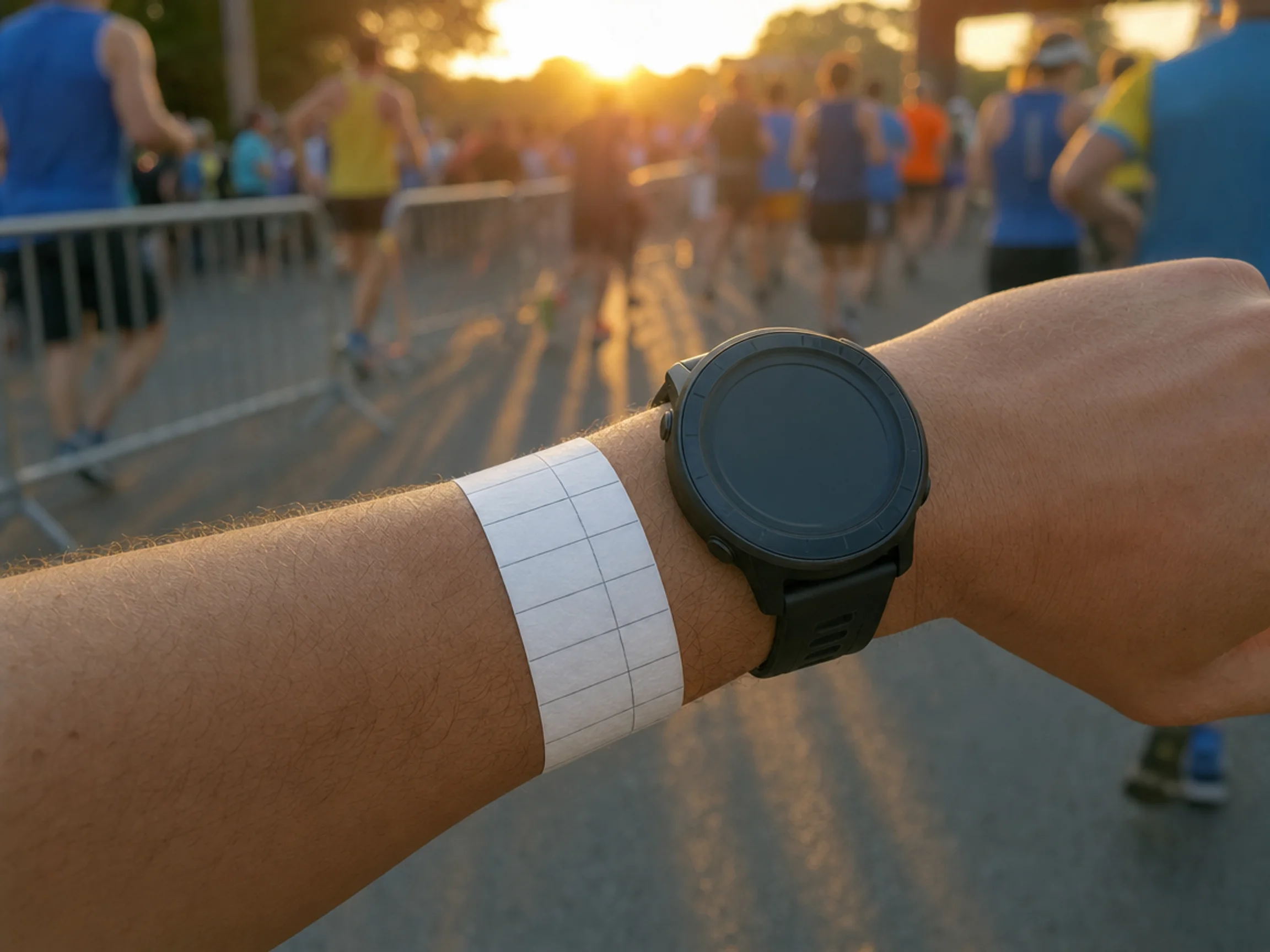
How to Use the Pace Band Generator
The RunDida Pace Band Generator creates a personalized, printable pace chart designed to wrap around your wrist on race day. Follow these steps to generate and use your pace band:
- Select your race distance. Choose Full Marathon (42.195 km), Half Marathon (21.0975 km), or enter a custom distance. The generator defaults to full marathon — the distance where pace bands deliver the most value.
- Enter your target finish time. Be honest with yourself — base this on recent training, not wishful thinking. A good rule of thumb from Pete Pfitzinger: your realistic marathon pace is roughly your tempo run pace plus 45-60 seconds per kilometer.
- Choose your split interval. "Every 5 km" is the most common for marathons and matches distance markers on most major courses including Berlin, Tokyo, and Shanghai. Select "Every mile" if your race uses mile markers (common in US races like Boston and New York).
- Select your pacing strategy. Even split is the safest choice for most runners. Negative split is optimal for experienced runners willing to hold back early. Positive split is realistic for hilly courses.
- Click "Generate Pace Band" to see your split table. Review the numbers — do they feel achievable? If not, adjust your target time.
- Click "Print Pace Band" to open a print-optimized view. The printout is formatted as a compact strip with high-contrast text designed for readability in rain, sweat, and low light. Cut along the dashed lines, waterproof with clear tape, and wrap around your wrist.
Pro tip: generate two copies — one for each wrist or one as a spare in your race belt. Also generate a version with a 5-minute slower target time as your "Plan B" pace band in case conditions are tougher than expected.
Understanding Split Strategies
A split strategy determines how you distribute effort across the race distance. The choice between even, negative, and positive splits can make the difference between a triumphant finish and a painful death march. Here is how each strategy works mathematically and physiologically.
Even Split Pacing
Even splits mean running every segment at the same pace. If your target is a 4:00:00 marathon (5:41/km), every 5 km segment takes approximately 28:25. This is the default strategy in the Pace Band Generator and the one most coaches recommend for first-time marathoners.
The physiological advantage of even pacing is predictable energy expenditure. Your body burns glycogen at a steady rate, your heart rate stays in a consistent zone, and your muscles experience uniform stress. Research by Abbiss and Laursen (2008) in Sports Medicine showed that even pacing minimizes total oxygen cost over a given distance, making it the most metabolically efficient strategy.
Example: for a 4:00:00 marathon, even 5 km splits are: 5 km at 28:25, 10 km at 56:50, 15 km at 1:25:15, 20 km at 1:53:41, 25 km at 2:22:06, 30 km at 2:50:31, 35 km at 3:18:56, 40 km at 3:47:21, finish at 4:00:00.
Negative Split Pacing
Negative splits run the second half 1-2% faster than the first half. In the Pace Band Generator, this translates to a gradual, linear acceleration — not a sudden speed change at halfway. Your first 5 km might be at 5:46/km while your final segment runs at 5:35/km.
The physiological rationale is glycogen preservation. By running slightly conservatively in the first half, you delay the point at which your body shifts from efficient carbohydrate metabolism to less efficient fat oxidation. The result: you have energy reserves for the final 10 km when most positive-splitters are hitting the wall.
Nearly all marathon world records feature negative or even splits. Eliud Kipchoge's 2:01:09 world record in Berlin (2022) had a first half of 60:34 and a second half of 60:35 — virtually perfect even pacing with a slight negative trend in the final kilometers.
Positive Split Pacing
Positive splits run the first half 2-3% faster than the second half. This is what happens to most recreational marathoners by default — they start too fast and slow down. But there are legitimate reasons to choose this strategy deliberately.
On courses with significant downhill in the first half (like Boston, which drops 140 meters in the first 25 km), running faster early takes advantage of gravity. On hot days, banking time in the cooler morning hours provides a buffer for the inevitable slowdown as temperatures rise. And for honest racers who know their fitness fades after 30 km, a positive-split pace band provides realistic targets that avoid the demoralizing experience of falling further behind with every split.
The Pace Band Generator distributes the positive split as a smooth deceleration — not a cliff — so your final 10 km targets are achievable rather than aspirational.
Race Day Pacing Tips from Coaches
The best pace band in the world is useless without the discipline to follow it. Here is hard-won pacing wisdom from some of the most respected coaches in distance running.
Pete Pfitzinger: Bank Time with Your Legs, Not Your Pace
In Advanced Marathoning, Pfitzinger warns against "banking time" by running faster than goal pace in the early miles. "Every second you bank in the first half will cost you two seconds in the second half," he writes. His recommendation: treat the first 8 km as a warm-up. Run 10-15 seconds per km slower than goal pace through the first 5 km, settle into goal pace by 8 km, and hold it until at least 30 km before considering any acceleration. Your pace band should feel easy to stay ahead of in the first half — that's the point.
Jack Daniels: Know Your VDOT
Daniels' Running Formula uses VDOT values to predict marathon performance from shorter race results. A runner with a recent 50-minute 10K (VDOT 39) has a predicted marathon time of approximately 4:06. Setting a 3:45 pace band based on wishful thinking, when your VDOT predicts 4:06, is a recipe for a painful final 10 km. Generate your pace band based on what your training supports, not what you hope for. Use the Pace Calculator to verify your goal pace aligns with your recent race performances.
Renato Canova: The Importance of Specific Endurance
Legendary coach Renato Canova, who has trained multiple Olympic marathoners, emphasizes that race-day pacing confidence comes from specific preparation. If your pace band says 5:00/km, you should have multiple training sessions at exactly 5:00/km in your legs before race day. His recommendation: practice your marathon pace during long runs of 30-35 km, running the final 15-20 km at goal pace. Print your pace band and wear it during these training runs to rehearse the act of checking your wrist and adjusting effort — the same way a pianist rehearses performing under stage conditions, not just practicing scales.
Practical Tips for Race Morning
- Prepare your pace band the night before. Don't leave this to race morning when nerves and logistics compete for your attention.
- Wear it on your non-watch wrist. Watch on the left, pace band on the right (or vice versa). This prevents fumbling and lets you compare both at a glance.
- Account for corral time. If you're in a back corral and it takes 2 minutes to cross the start line, your watch will read 2 minutes ahead of the pace band targets for the entire race. Start your watch when you cross the mat, not when the gun fires.
- Ignore the first split. The first 5 km of any major marathon is chaotic — crowds, adrenaline, weaving around slower runners. Don't panic if your first split is off by 30-60 seconds. You have 37 km to correct it.
- Trust the band, not the crowd. When everyone around you is surging at km 15, check your pace band. If you're on target, let them go. You'll see most of them again after km 35.
Why Pace Bands Work: The Science of Cognitive Offloading
A pace band is more than a convenience — it's a cognitive offloading device that frees mental resources for the physical task of running. Research in cognitive psychology, particularly the work of Risko and Gilbert (2016) published in Trends in Cognitive Sciences, demonstrates that humans regularly use external tools to reduce the demands on working memory, attention, and decision-making.
During a marathon, your brain is simultaneously managing pain signals, regulating body temperature, processing crowd noise, monitoring hydration, and maintaining running form. Adding mental arithmetic ("I'm at 21 km in 1:47:23 — am I on pace for sub-4?" ) introduces a cognitive load that competes with these essential processes. The result is what psychologists call decision fatigue — the deterioration of decision quality after sustained mental effort.
A pace band eliminates this calculation entirely. The math was done in advance, in a calm state, by a computer. All your mid-race brain has to do is compare two numbers: the time on your watch and the time on your wrist. This binary comparison (ahead or behind) takes less than one second of conscious attention.
Dr. Samuele Marcora's psychobiological model of endurance, published in Sports Medicine (2008), shows that perceived effort is the primary limiter of endurance performance — not physiological capacity. Anything that reduces perceived mental effort (like offloading calculations to a pace band) can directly improve physical performance by preserving the mental resources that regulate pacing, pain tolerance, and the decision to continue or stop.
This is why elite runners, who could certainly do the math themselves, still use split sheets and pace bands. Haile Gebrselassie, Eliud Kipchoge, and virtually every world-record performance in the marathon has involved pre-calculated split targets — the runner's only job is to execute, not to calculate.