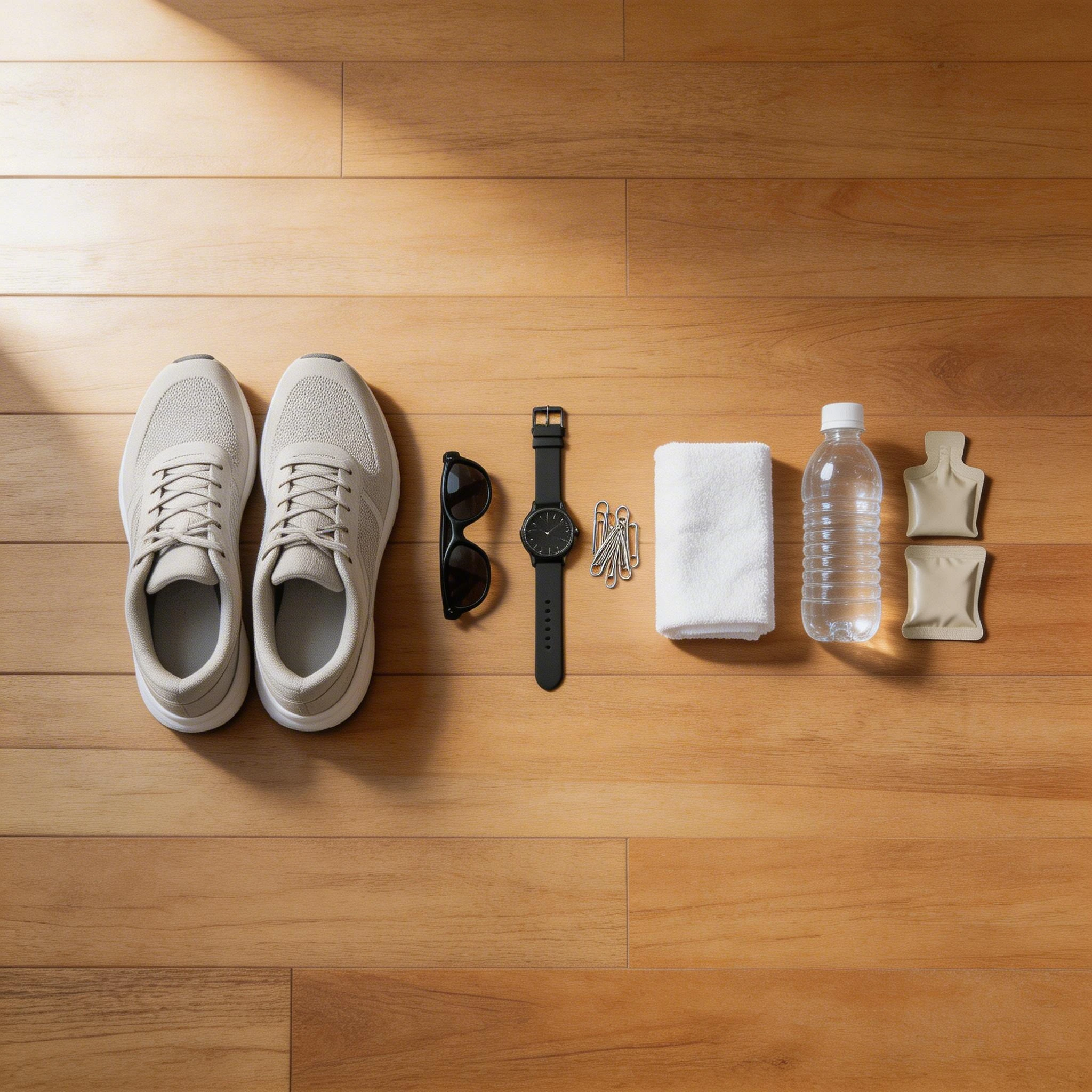
Race Day Preparation: Marathon Checklist
What should you do the morning of your marathon? Alarm timing, pre-race meal, gear checks, warm-up, and mental prep in one checklist.
Key Takeaways
- Prepare everything the night before — Lay out gear, pin your bib, charge your watch, and set two alarms to eliminate morning chaos.
- Eat a tested pre-race meal — Consume 1-4g carbs per kg body weight 3-4 hours before start, using only foods practiced in training.
- Dress for mid-race, not the start — Conditions at km 30 will be warmer; use a disposable layer and discard after 2-3 km.
- Control your first kilometer — Adrenaline tempts you to start too fast; check your watch at km 1 and actively slow down if ahead of target.
You have trained for months. You have tapered. Your body is ready. Now you just need to survive the 3-4 hours between your alarm clock and the starting gun without making a mistake that ruins your race. This guide covers every detail of race morning, from the moment you wake up to the moment the gun fires.
The Night Before
Race day preparation actually begins the evening before. Here is your pre-race evening checklist:
Logistics
- Lay out everything — shoes, socks, shorts, singlet, watch, gels, bib number, safety pins. Use our Packing List Generator to ensure nothing is forgotten.
- Pin your bib to your shirt — do this now, not in the dark at 5 AM with cold fingers
- Charge your watch — fully charged, with your race activity loaded
- Check weather — use the What to Wear Calculator to finalize your clothing choice
- Set two alarms — 3-4 hours before gun time. Use a backup alarm on a different device.
Dinner
Eat a familiar, carbohydrate-rich, low-fiber dinner 12-14 hours before the race. Classic choices: pasta with tomato sauce, rice with a simple protein, pizza with moderate toppings. Avoid anything new, spicy, high-fiber, or excessively fatty. Drink water but do not overhydrate. Read our nutrition guide for the full picture, or jump straight to the carb loading calculator for a day-by-day plan.
Mental Preparation
- Review your pace plan. Know your target splits for 5K, 10K, half, 30K, and finish.
- Print your pace band if you have not already
- Visualize the race — imagine yourself running strong through the middle kilometers and finishing with a kick
- Set your intention: what does this race mean to you?
Race Morning: 3-4 Hours Before Start
Wake Up
Your alarm should go off 3-4 hours before the gun time. This allows time for your pre-race meal to digest and for your body to fully wake up. If the race starts at 7 AM, your alarm should be at 3:30-4:00 AM. Use the Race Morning Planner to create a minute-by-minute timeline.
Pre-Race Meal
Eat your pre-race meal within 30 minutes of waking:
- Target: 1-4g carbohydrates per kg of body weight
- Good options: Oatmeal with banana and honey, white toast with jam, bagel with thin peanut butter layer, rice with a small piece of chicken
- Avoid: High fiber (whole grains, fruit with skin), high fat (eggs with cheese, heavy cream), large protein portions
- Hydrate: 500ml water or sports drink with your meal
This meal should be something you have tested multiple times during training long runs. Race morning is not the time for culinary experiments.
Race Morning: 2 Hours Before Start
Bathroom
Visit the bathroom at home before leaving. The combination of early morning coffee and race-day nerves will have most things moving. Leaving early enough to use the bathroom again at the venue before the porta-potty lines become biblical.
Getting to the Venue
- Arrive 1.5-2 hours before gun time
- Allow extra time for security, bag check, and navigating the start area
- Know your corral assignment and how to reach it
Race Morning: 60-90 Minutes Before Start
Gear Check
Quick final equipment check:
- Bib number secure and visible
- Timing chip on shoe (if separate)
- Watch GPS locked and charged
- Gels accessible (belt, pockets, or pinned to shorts)
- Nipple guards applied (men: apply before putting on your shirt)
- Anti-chafe product on thighs, armpits, feet
Final Hydration
Sip 200-300ml of water or sports drink 60-90 minutes before the start. Stop drinking large amounts 30 minutes before the gun — you want to process this fluid before the race, not carry it in your stomach.
Race Morning: 30-45 Minutes Before Start
Warm-Up
For most marathon runners, an extensive warm-up is unnecessary and can waste energy. A brief protocol:
- 10-15 minutes of easy jogging or brisk walking
- 4-6 dynamic stretches (leg swings, hip circles, arm circles)
- 2-4 strides (20-second accelerations at planned race pace)
If you are targeting a sub-3:00 marathon, you may benefit from a slightly longer warm-up (15-20 minutes of jogging). For runners targeting 4+ hours, brisk walking and dynamic stretches are sufficient — save your energy for the race.
Check Clothing for Weather
The temperature at the start may be very different from what it will be at kilometer 30. Dress for mid-race conditions, not the start. Use the What to Wear Calculator for a temperature-specific recommendation. A disposable garbage bag or old sweatshirt can keep you warm at the start — discard it after 2-3 km when your body heat has built up.
Race Morning: 10-15 Minutes Before Start
Final Bathroom
One last bathroom visit if possible. Lines will be long — consider locations farther from the main start area.
Enter Your Corral
Find your assigned starting corral and position yourself. If you are nervous, find a spot near the edge where you have space. If you want to feel the energy, push toward the middle. Avoid starting too far forward — you will spend the first 5 km being passed by faster runners, which is psychologically demoralizing.
Mental Reset
Take 60 seconds for a final mental check:
- Take 5 deep breaths — in for 4 counts, out for 4 counts
- Remind yourself of your Goal B pace (realistic target)
- Smile — research shows that smiling reduces perceived effort by up to 2%
- Remember: the hay is in the barn. Training is done. Today is for execution and enjoyment.
The First Kilometer
The single most important kilometer of your marathon. With adrenaline surging and crowds cheering, you will feel invincible. You are not. Check your watch at the first kilometer marker. If you are running faster than your target pace, actively slow down. The energy you save in the first 5 km is energy you will desperately need after km 30.
Your pace band is your lifeline. Glance at it every 5 km and course-correct immediately if you are ahead of schedule.
Tools for Your Race Morning
- Race Morning Planner — minute-by-minute timeline
- Race Day Checklist — interactive gear list
- Packing List Generator — comprehensive travel packing
- What to Wear — weather-based clothing
- Pace Band Generator — printable wrist reference
Sources & References
- (2021). ACSM's Guidelines for Exercise Testing and Prescription. Lippincott Williams & Wilkins.
- (2009). Advanced Marathoning. Human Kinetics.
- (2018). Facial feedback influences on marathon running performance. Psychology of Sport and Exercise.