How the Pre-Race Meal Planner Works
The planner builds a personalized three-window meal timeline working backwards from your race start time. Based on your selected race distance, the calculator determines optimal total carbohydrate intake using ACSM guidelines of 1-4 g/kg body weight. It then distributes macronutrients across three eating windows: a main pre-race meal (65% of carbs, 3-4 hours before), a light top-up snack (25% of carbs, 1-2 hours before), and a final fuel boost (10% of carbs, 15-30 minutes before). The calculator adjusts timing and food suggestions for stomach sensitivity, dietary preferences (omnivore, vegetarian, vegan, or gluten-free), and whether you prefer eating earlier or later relative to the start.
The Science of Pre-Race Nutrition Timing
Why eat at all? Overnight fasting depletes liver glycogen by roughly half, leaving ~50–60 g (Coyle, 2004). The brain alone burns ~5 g/h of glucose at rest, and running multiplies systemic glucose demand. The pre-race meal's primary role is to restore liver glycogen — muscle glycogen is loaded 2–4 days earlier via carbohydrate loading (see our carb loading calculator) and is not meaningfully affected by the morning meal.
How much, when? The current ACSM / AND / DC consensus (Thomas, Erdman & Burke, 2016) recommends 1–4 g/kg carbohydrate, 1–4 hours before the start. Chryssanthopoulos et al. (2002) demonstrated experimentally that 2.5 g/kg three hours before a marathon extended time-to-exhaustion by ~9 minutes vs fasting. Stack in-race fueling on top and you gain another ~13 minutes — the morning meal compounds with the gel plan, not replaces it.
Gastric emptying drives timing. Solid meals empty at approximately 1–2 kcal/min, with carbohydrates exiting first, then protein, then fat. High-fiber meals slow transit. For runners with sensitive stomachs, semi-liquid options (smoothies, rice porridge, sports drinks) empty 1.5–2× faster than equivalent solid food (Horner et al., 2015 meta-analysis). At intensity above 70% VO₂max, gastric emptying slows further — a known driver of mid-race GI distress in 30–50% of endurance athletes (Costa et al., 2017).
The reactive hypoglycemia trap. Eating carbs 30–90 minutes before the start can trigger an insulin spike → adrenergic suppression of glucose release → blood glucose drop at the gun. About 30% of runners are sensitive (Costill 1977; Frontiers Endocrinol 2020). Two safe windows: more than 1.5 hours before, OR less than 15 minutes / right at the start (exercise-induced adrenaline then suppresses insulin). The calculator's three-window structure is designed around this constraint.
Building Your Race Morning Plate
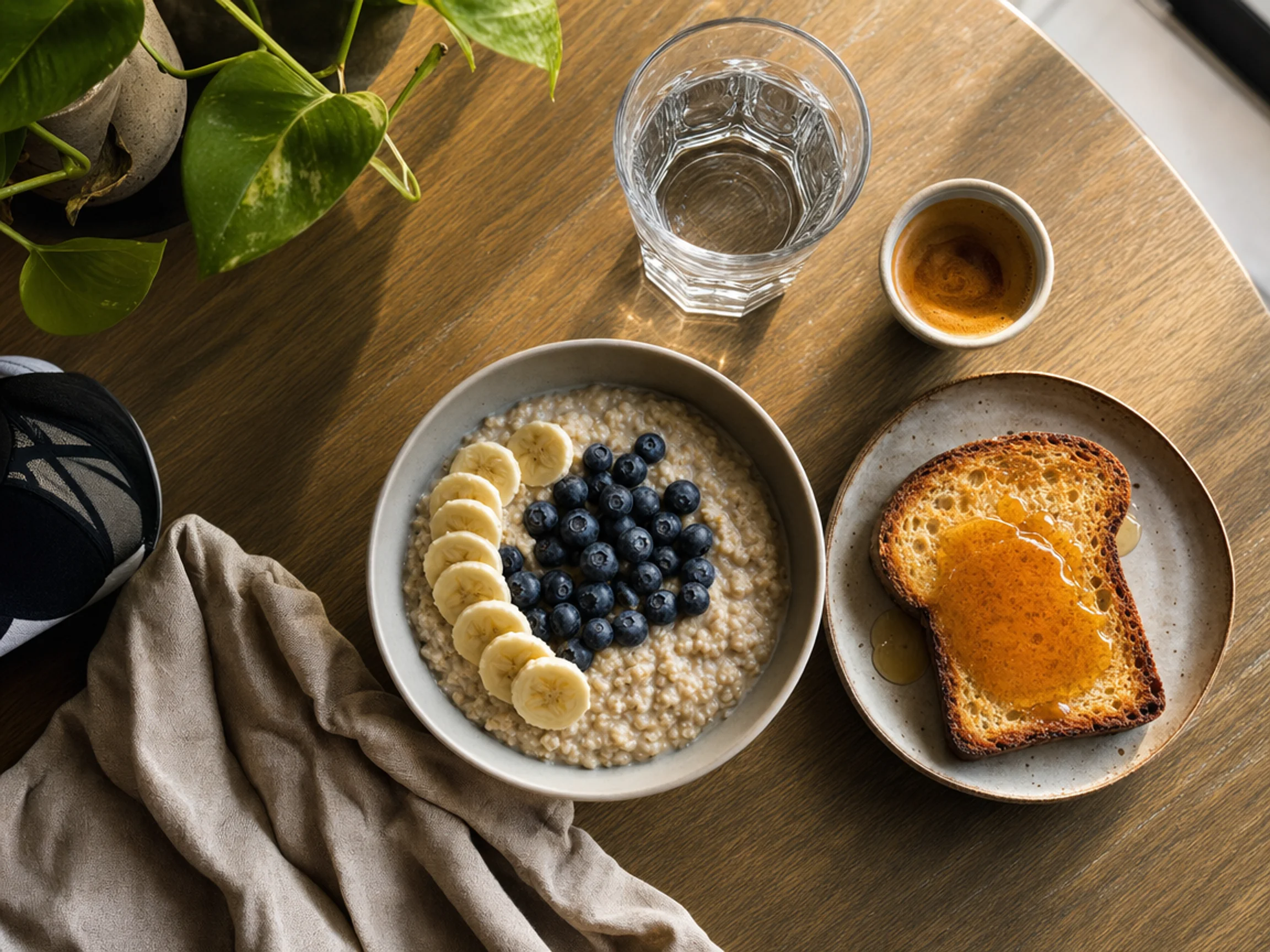
The ideal pre-race plate follows a simple formula: 70-80% carbohydrates, 10-15% protein, 5-15% fat. In practical terms, this means a large portion of a starchy base (rice, oatmeal, toast, or pancakes), a small amount of protein (one egg, a tablespoon of nut butter, or a splash of milk), and minimal added fat.
Portion sizing depends on your race distance and body weight. For a 70 kg marathon runner eating 3 hours before the gun, the main meal should provide approximately 100-115g of carbohydrate — equivalent to about 1.5 cups of cooked white rice with a banana and a tablespoon of honey. The top-up snack at 90 minutes out adds another 40-45g of carbs: a banana or a slice of white bread with jam. The final 15-20g comes from an energy gel or sports drink sips in the last 30 minutes.
For runners racing shorter distances like 5K or 10K, the total carb target is lower (70-105g for a 70 kg runner), and many runners find they perform best with just a light breakfast and a small pre-race snack. The critical rule across all distances: never eat anything on race morning that you haven't tested during training. Gastrointestinal distress affects 30-50% of endurance athletes on race day (de Oliveira et al., 2014), and the leading cause is unfamiliar foods or excessive fiber and fat intake.
What to Eat the Night Before a Race
The dinner before race day sets the foundation for your morning meal strategy. Its primary role is to top off muscle glycogen stores that were loaded during the carbohydrate-loading phase, and to ensure your digestive system is calm and settled for sleep.
A proven pre-race dinner follows a simple template: 60-70% carbohydrates, 15-20% protein, 10-15% fat, eaten 12-15 hours before the start. Practical examples include pasta with marinara sauce and a small chicken breast (80-100g carbs), white rice with teriyaki salmon (75g carbs), or a baked potato with lean ground turkey and a side of white bread (90g carbs). Keep portions at your normal dinner size or slightly above -- this is not a pasta-loading binge.
Timing matters. Eat by 7-8 PM for a morning race start, allowing 10+ hours for full digestion. This reduces the risk of overnight GI discomfort that disrupts sleep. Foods to avoid at the pre-race dinner: cruciferous vegetables (broccoli, cauliflower, Brussels sprouts) that produce gas; heavy cream sauces and fried food that slow digestion; very spicy dishes that may cause reflux when lying down; and alcohol, which impairs glycogen storage and degrades sleep quality. Stick to foods you eat regularly during training weeks. That rule is only worth following if those weeks are worth repeating — this dinner finishes off what the previous days built rather than rescuing them, so a runner already hitting 6-8 g/kg of carbohydrate on ordinary moderate-training days needs far less of a change here than race-eve folklore suggests. The runner's 7-day diet plan shows what those ordinary days look like.