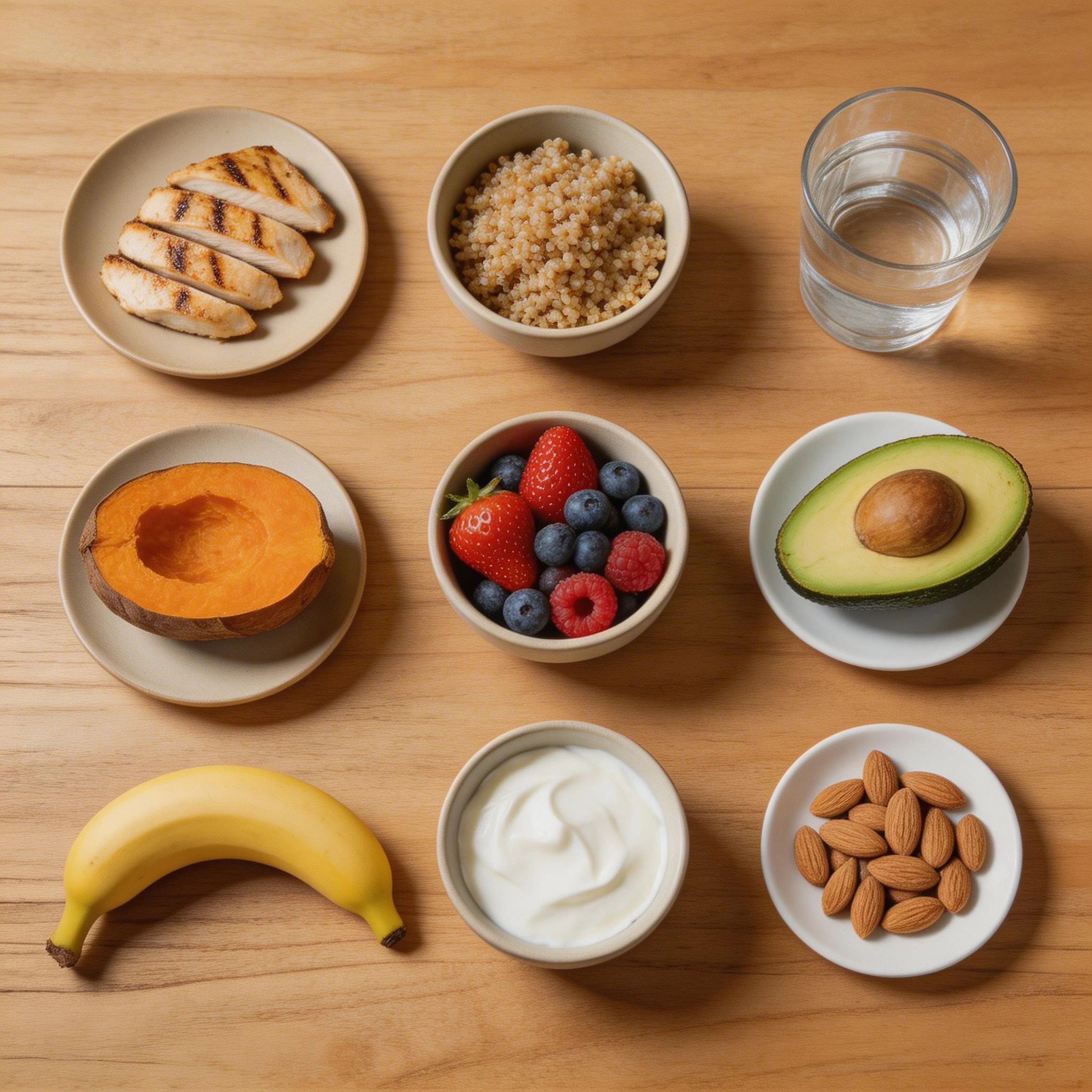
Runner's Diet Plan: Macros & 7-Day Meal Plan by Training Day
What should runners actually eat? Daily macro targets — 5-8g/kg carbs, 1.4-1.8g/kg protein — plus a real 7-day meal plan matched to your training week.
Key Takeaways
- Daily nutrition outweighs race-day nutrition — Training adaptations require the right raw materials delivered consistently over weeks.
- Runners need 5-8g carbs per kg daily — Chronically under-eating carbs impairs glycogen replenishment and workout quality.
- Eat differently on training vs. rest days — A hard day can need 1,000+ more calories than a rest day; the 7-day plan below shows what that looks like in real meals.
- Watch iron, vitamin D, and calcium — Runners deplete these micronutrients faster through footstrike hemolysis, sweat, and bone stress.
You can follow the perfect training plan, nail every interval, and sleep eight hours a night — but if your daily nutrition is off, your body is building a house on sand. What you eat every day matters more than what you eat on race morning. Training adaptations — stronger mitochondria, more capillaries, better fat oxidation — all require the right raw materials delivered consistently over weeks and months.
This guide covers the daily nutrition fundamentals that support running performance. Not a fad diet. Not a list of superfoods. Just the science of what your body needs to train hard, recover well, and stay healthy over a long running career.
How Many Calories Should a Runner Eat?
Short answer: your normal daily calories plus 60-100 calories for every kilometer you run. A 70kg runner doing 50km per week burns an extra 3,500-4,000 calories weekly and lands around 2,800-3,200 calories on training days. That is the whole equation — the rest of this guide is about where those calories should come from.
Chronically under-eating is one of the most common mistakes recreational runners make, especially those trying to lose weight while training. Relative Energy Deficiency in Sport (RED-S) is a real syndrome that leads to fatigue, poor recovery, hormonal disruption, weakened bones, and declining performance. Use our Running Calorie Calculator to estimate your true energy needs.
Macronutrient Targets for Runners
If you only remember three numbers from this guide, make it these:
| Macro | Daily target | For a 70kg runner |
|---|---|---|
| Carbohydrates | 5-8g per kg body weight | 350-560g |
| Protein | 1.4-1.8g per kg | 98-126g |
| Fat | 1.0-1.5g per kg | 70-105g |
The three macronutrients — carbohydrates, protein, and fat — each play distinct roles in running performance. Getting the ratios right matters more than obsessing over individual foods.
Carbohydrates: Your Primary Fuel
Carbohydrates are the dominant fuel source at marathon pace and above. Your muscles store glycogen (the stored form of carbohydrates) and deplete it during every run. Without adequate daily carbohydrate intake, your glycogen stores never fully replenish, and your next workout suffers.
- Light training (30-60 min/day): 5-7g per kg body weight per day
- Moderate training (1-2 hours/day): 6-8g per kg body weight per day
- Heavy training (3-5+ hours/day): 8-12g per kg body weight per day
For a 70kg runner doing moderate training, that is 420-560g of carbohydrates per day — roughly 1,680-2,240 calories from carbs alone. Best sources: rice, oats, pasta, sweet potatoes, bread, bananas, and fruit.
Those gram targets feel abstract until you put them on a plate: a cup of cooked rice is about 45g of carbs, a medium banana 27g, a medium bagel about 55g, a slice of bread 15g, a cup of cooked oatmeal 27g. Hitting 450g in a day means carbs at every meal plus snacks — which is exactly why so many runners under-eat them without noticing.
Protein: Repair and Adaptation
Every run creates microscopic muscle damage. Protein provides the amino acids your body needs to repair that damage and build back stronger. Runners need more protein than sedentary people — but less than many gym-focused diets suggest.
- Target: 1.4-1.8g per kg body weight per day
- Distribution: Spread across 4-5 meals/snacks (20-30g per serving)
- Timing: Include protein within 30-60 minutes of finishing a hard workout
A 70kg runner needs 98-126g protein daily. Best sources: eggs, chicken, fish, Greek yogurt, tofu, lentils, beans, and dairy.
Fat: Essential but Not Dominant
Fat supports hormone production (including testosterone and estrogen, both critical for performance), absorbs fat-soluble vitamins, and provides fuel during easy runs. Cutting fat too low impairs recovery and hormonal balance.
- Target: 1.0-1.5g per kg body weight per day (roughly 20-30% of total calories)
- Best sources: Olive oil, avocados, nuts, seeds, fatty fish (salmon, mackerel), eggs
- Minimize: Processed trans fats and excessive saturated fat
Training Day vs. Rest Day Eating
Your energy needs fluctuate significantly based on your training load. A rest day for a 70kg runner might require 2,200 calories; a long-run day might require 3,200+. Eating the same every day means you are either under-fueling on hard days or over-fueling on easy days.
Training Day Strategy
- Before a morning run: Light carb-rich snack 30-60 minutes prior (banana, toast with honey, or a handful of dates)
- During runs over 75 minutes: 30-60g carbohydrates per hour (gels, sports drinks, or real food)
- Within 30 minutes post-run: 1-1.2g carbs per kg + 20-30g protein (chocolate milk, smoothie, or a proper meal)
- Rest of the day: Normal balanced meals with emphasis on carbohydrate replenishment
Rest Day Strategy
- Reduce carbohydrates slightly: 4-5g per kg instead of 6-8g (your muscles are not depleting glycogen)
- Maintain protein: Your body is actively repairing — do not cut protein on rest days
- Focus on nutrient density: More vegetables, colorful produce, omega-3 fats
- Stay hydrated: Use our Hydration Calculator for daily fluid targets
Micronutrients Runners Must Watch
Even a well-balanced diet can fall short on key micronutrients that runners deplete faster than the general population.
- Iron: Runners lose iron through footstrike hemolysis, sweat, and GI losses. Ferritin levels below 30 ng/mL often cause fatigue. Include red meat, spinach, lentils, and fortified cereals. Pair plant-based iron with vitamin C for better absorption.
- Calcium + Vitamin D: Running is high-impact — strong bones are non-negotiable. Target 1,000-1,300mg calcium and 1,000-2,000 IU vitamin D daily. Dairy, fortified plant milk, leafy greens, and sunlight exposure.
- Magnesium: Lost through sweat, involved in muscle contraction and energy production. Nuts, seeds, dark chocolate, and whole grains are excellent sources.
- B Vitamins: Essential for energy metabolism. Usually covered by a varied diet, but vegetarian and vegan runners should monitor B12.
Nutrition for Vegetarian and Vegan Runners
Plant-based running is entirely viable — some elite marathoners thrive on it — but requires more intentional planning. Key considerations:
- Combine protein sources: No single plant food has a complete amino acid profile. Pair legumes with grains (rice + beans, hummus + pita) across the day.
- Supplement B12: The only nutrient absent from plant foods. Take 250mcg daily or 2,500mcg weekly.
- Monitor iron absorption: Plant-based (non-heme) iron is less bioavailable. Consume vitamin C alongside iron-rich foods and avoid tea/coffee with meals.
- Get enough omega-3s: Flaxseed, chia, walnuts, or an algae-based DHA/EPA supplement.
- Watch calorie density: Plant foods are often less calorie-dense — high-mileage vegan runners may need to eat larger volumes or add calorie-dense foods like nut butters, avocados, and oils.
A 7-Day Meal Plan Built Around Your Training Week
Most 7-day meal plans for runners ignore the one thing that changes every day: your training. A long-run day and a rest day can differ by 1,000+ calories — most of it carbs. So this plan is keyed to a typical training week: intervals Tuesday, tempo Thursday, long run Saturday. Swap days to match your own schedule — the pattern is what matters, not the calendar.
Portions fit a 70kg runner covering 40-55km per week. Carbs scale linearly with body weight, so adjust portions roughly 15% per 10kg — or anchor them to your own numbers with the Running Calorie Calculator.
Monday — Rest day (carbs low: ~4-5g/kg, 280-350g)
- Breakfast: 2-3 scrambled eggs with spinach + whole-grain toast
- Lunch: Big salad with chickpeas, feta, and olive oil + a piece of fruit
- Snack: Greek yogurt with a handful of nuts
- Dinner: Stir-fried chicken or tofu with vegetables + a small bowl of brown rice
Tuesday — Interval day (carbs up: ~6-7g/kg, 420-490g)
- Pre-run: Banana or toast with honey, 30-60 minutes before
- Post-run breakfast: Oatmeal with berries, honey, and Greek yogurt
- Lunch: Chicken rice bowl with avocado and roasted vegetables
- Snack: Apple with almond butter
- Dinner: Pasta with lean beef or lentil sauce + side salad
Wednesday — Easy run (moderate: ~5-6g/kg, 350-420g)
- Breakfast: Toast with peanut butter and banana + coffee or milk
- Lunch: Turkey or hummus sandwich on whole-grain bread + fruit
- Snack: Trail mix or a granola bar
- Dinner: Baked salmon with roasted sweet potatoes and greens
Thursday — Tempo day (carbs up: ~6-7g/kg, 420-490g)
- Pre-run: Small carb snack if running in the morning
- Breakfast: Rice porridge or oatmeal with fruit and a spoon of honey
- Lunch: Burrito bowl — rice, beans, chicken, salsa, avocado
- Snack: Banana + a few dates
- Dinner: Noodle stir-fry with shrimp or tofu and vegetables
Friday — Rest day (carbs moderate, front-loading Saturday: ~5g/kg, ~350g)
- Breakfast: Eggs with toast and tomato
- Lunch: Grain bowl with quinoa, roasted vegetables, and feta
- Snack: Fruit + yogurt
- Dinner: The classic pasta dinner — a bigger portion than usual, with a simple tomato or olive-oil sauce. This is your long-run fuel going into the tank.
Saturday — Long run (biggest day: ~7-8g/kg, 490-560g)
- Pre-run: Toast with honey + banana, 60-90 minutes before. Details in the Pre-Run Meal Planner
- During: Over 75-90 minutes? Take 30-60g of carbs per hour — gels, sports drink, or dates
- Post-run: Recovery meal within 30-60 minutes — smoothie with banana and protein, or a full breakfast
- Lunch: Rice or pasta dish with protein — portion bigger than normal
- Dinner: Burgers on whole-grain buns with oven fries, or a hearty rice dish
Sunday — Recovery jog or walk (~5g/kg, ~350g)
- Breakfast: Pancakes with berries and Greek yogurt — the weekend treat that still fuels
- Lunch: Leftovers from Saturday dinner + salad
- Snack: Nuts + fruit
- Dinner: Roast chicken with potatoes and vegetables
Do you need to follow this exactly? No. Repeat the days that work, swap ingredients you dislike, and keep the one rule that matters: carbs follow the training schedule. A grocery list of 12 staples keeps the whole week runnable: oats, rice, pasta, whole-grain bread, bananas, berries, eggs, Greek yogurt, chicken or tofu, lentils or beans, olive oil, and nuts.
Common Nutrition Mistakes Runners Make
- Under-eating during heavy training: If you feel chronically tired, are losing weight unintentionally, or getting sick often, you are probably not eating enough. Use the Calorie Calculator to check.
- Skipping post-run nutrition: The 30-60 minute window after a hard workout is when your muscles are most receptive to glycogen replenishment and protein synthesis. Do not waste it.
- Cutting carbs for weight loss: Low-carb diets impair high-intensity training performance. If your goal is a faster marathon, carbohydrates are your ally, not your enemy.
- Relying on supplements instead of food: No supplement replaces a balanced diet. Fix your meals first; then consider targeted supplements (iron, vitamin D) only if blood work shows deficiencies.
- Ignoring hydration: Many runners eat well but forget to drink consistently throughout the day. Check our Hydration Guide for daily fluid targets.
Nutrition Tools
- Running Calorie Calculator — daily energy expenditure based on mileage
- Pre-Run Meal Planner — what and when to eat before running
- Hydration Calculator — personalized daily fluid needs
- Weight-Pace Impact Calculator — how body weight affects running pace
- Carb Loading Calculator — pre-race carbohydrate targets
Daily nutrition lays the foundation, but race-day fueling requires a different strategy. See our Marathon Nutrition Guide for carb loading and race-day fueling plans. For staying properly hydrated day to day, our Hydration Guide for Runners covers sweat rate testing and electrolyte management.
Sources & References
- (2016). Nutrition and Athletic Performance. Medicine & Science in Sports & Exercise.
- (2011). IOC consensus statement on sports nutrition 2010. Journal of Sports Sciences.
- (2011). Dietary protein for athletes: from requirements to optimum adaptation. Journal of Sports Sciences.