Boston Running Routes: 6 Best, River Loops & Heartbreak Hill
Charles River bridge loops (3.1–17 mi), Heartbreak Hill, Jamaica Pond and the Seaport Harborwalk — Boston running routes with exact distances and surf...
Read City Guide →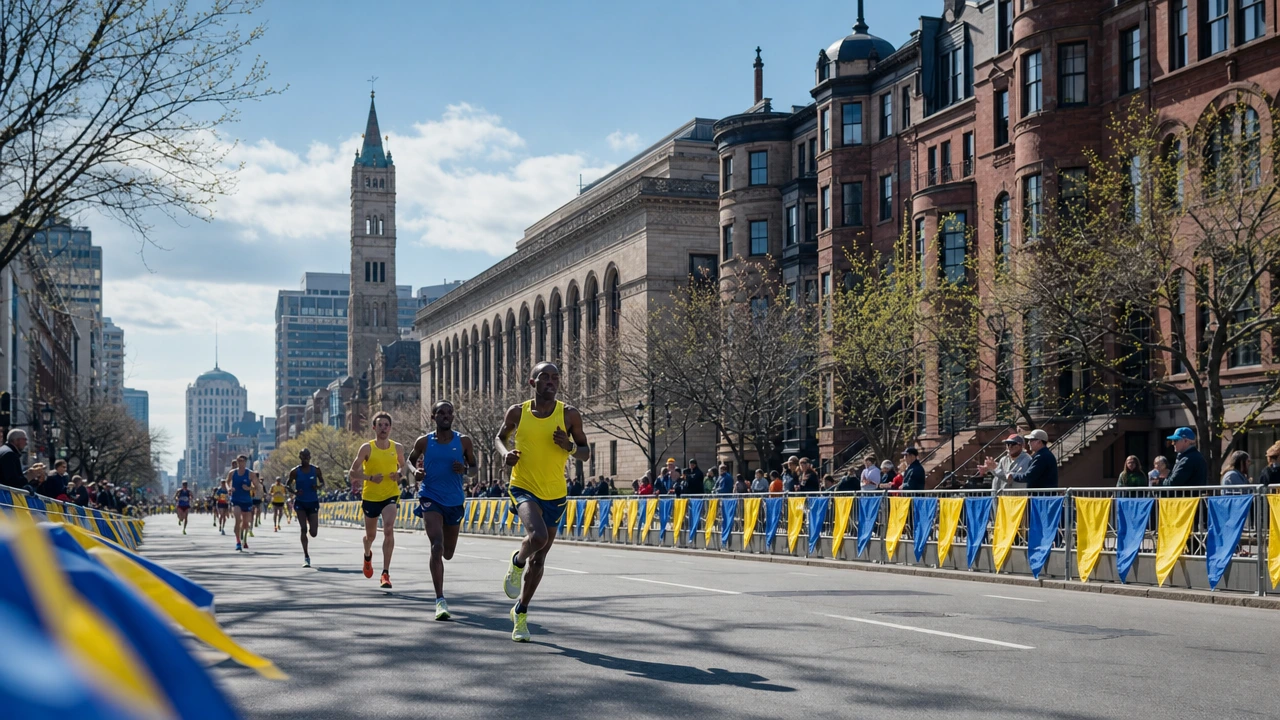
Want personality modes & weather integration? Try the full countdown experience
See entry dates for other marathons →
| Race | 2027 Boston Marathon - Apr 19 |
|---|---|
| City | Boston |
| Date | 2027-04-19 at 10:00 |
| Field Size | ~30,000 runners |
| Time Limit | 6 hours |
| Cutoff pace | 8:32/km |
| Course speed |
Fast courseSpeed index 0.91 — median of the last 4 winners' times against the global same-year median. Winner times track elite fields and prize money, so this reads the course as a proxy, not a pure measurement. |
| Timezone | America/New_York |
| Official Site | Boston Athletic Association (B.A.A.) |
| Fee trend | 2022 $2052023 $2252024 $2302025 $2502026 $260(4-yr +26.8%)· in line with industry (+4.3% vs +4.8%/yr) |
The published qualifying time only gets you into the applicant pool. This is how much faster than that standard you actually needed to run to be accepted, and how many qualifiers were still turned away.
| Year | Faster than standard | Turned away |
|---|---|---|
| 2014 | 1:38 | 2,976 |
| 2015 | 1:02 | 1,947 |
| 2016 | 2:28 | 4,562 |
| 2017 | 2:09 | 2,957 |
| 2018 | 3:23 | 5,062 |
| 2019 | 4:52 | 7,384 |
| 2020 | 1:39 | 3,161 |
| 2021 | 7:47 | 9,215 |
| 2022 | No cutoff | 0 |
| 2023 | No cutoff | 0 |
| 2024 | 5:29 | 11,039 |
| 2025 | 6:51 | 12,324 |
| 2026 | 4:34 | 8,887 |
Source: Boston Athletic Association (B.A.A.), official cutoff announcements
| Average Temperature | 8.8°C / 48°F |
|---|---|
| Humidity | 78% |
| Peak Wind | 13.2 km/h |
| Rain Chance | 35% |
| Typical Conditions | Cool and breezy with changeable conditions |
What to Prepare: Mid-April in Boston is unpredictable — prepare for anything from a cold rain to warm sun. The prevailing westerly wind is a tailwind for the east-bound course on a typical year, but an easterly nor'easter (as in 2018) turns the second half into a sustained headwind.
Based on historical averages for race week. Use our Weather Score Calculator and What to Wear Guide for personalized advice.
Winds peaking around 13.2 km/h — the typical daily maximum for this date — can affect your pace by 5-15 seconds per kilometer in exposed stretches. Headwinds slow you down exponentially: a 20 km/h wind costs more than twice a 10 km/h wind.
Calculate your wind-adjusted pace →Based on 20 years of race-week weather (2005-2024), MERRA-2 reanalysis
| Cooler | Typical | Warmer | |
|---|---|---|---|
| Temperature | 4.6°C | 8.7°C | 13°C |
| Dew point | -0.1°C | 4.5°C | 9.9°C |
Recent actuals: 2024 11.1°C / 2025 8.4°C / 2026 5.6°C (morning avg)
Data: NASA POWER (MERRA-2 reanalysis), NASA Langley Research Center
| Course Type | Point-to-point |
|---|---|
| Elevation Gain | 148m |
| Terrain | Road |
| Profile | Net downhill from Hopkinton to Boylston Street (about 140 m / 459 ft of net drop), but famously demanding thanks to the Newton Hills, capped by Heartbreak Hill between miles 16-21. Fast, quad-pounding early downhills can be deceptive. |
| Boston Qualifier | Yes — Check your BQ time |
| Year | Finishers | vs prev. |
|---|---|---|
| 2021 | 15,385 | — |
| 2022 | 24,918 | +62.0% |
| 2023 | 26,623 | +6.8% |
| 2024 | 25,554 | -4.0% |
| 2025 | 28,409 | +11.2% |
Runners who crossed the line, not the registered field size.
The Boston Marathon is the world's oldest annual marathon (first run in 1897) and one of the seven Abbott World Marathon Majors. The 131st edition runs Monday, April 19, 2027 — Patriots' Day, a Massachusetts state holiday. The point-to-point road course covers 26.2 miles from the village of Hopkinton east into downtown Boston, finishing on Boylston Street at Copley Square.
On paper it looks fast: the start in Hopkinton sits at roughly 490 ft elevation, the Boylston finish at just 10 ft — a net drop of about 460 ft (140 m). In practice it is one of the hardest major marathons in the world, because of where that drop is distributed. Roughly 300 ft is given away in the first 10 km, and about 288 ft of climbing waits between miles 16 and 21 in the Newton Hills cluster. The April 2026 race confirmed the course is also genuinely fast on the right day — John Korir broke Geoffrey Mutai's 15-year course record with 2:01:52 in cool conditions with a westerly tailwind, and Jessica McClain reset the American women's course record at 2:20:49. Entry is by qualifying time plus a cutoff margin, and the bar tightened five minutes for the 2026 race and stays at the new standard for 2027.
The biggest single mistake in Boston is run in the first 5 km. The opening descent off Hopkinton High School drops 142 ft in the first 0.51 mi at a 5.3% grade — the steepest sustained descent of the day, with you locked into a packed two-lane chute on East Main Street. The course continues to shed about 300 ft over the first 10 km through Ashland and Framingham. Pace feels effortless. The damage is silent: every eccentric quad contraction on this descent is being banked against the climbs at mile 16. Coaches have documented the same pattern for decades — runners who go just 30 seconds per mile faster than goal pace in Hopkinton consistently collapse between miles 18 and 22.
Terrain rolls through Framingham (mile 5-8) and Natick (mile 10, large crowds at the town green), then climbs gently into Wellesley. The famous Wellesley Scream Tunnel at the Wellesley College campus runs roughly mile 12.5 to 13 on the runners' left and coincides with the half-marathon mark. Stay to the right side of the road unless you want the kisses on the signs; finishers consistently rate the volume here as louder than the Boylston finish itself.
After Wellesley the course delivers its biggest single drop — about 100 ft of descent at -4.4% grade into Newton Lower Falls around mile 15. This is the second trap: the free downhill speed feels generous, but you are about to need every fiber in your quads. At mile 16 the course climbs the Route 128 (I-95) overpass for a long, exposed half-mile gain. The bridge deck has no tree cover; wind, rain, and heat all feel worse here. This is the start of the Newton Hills cluster.
Four climbs across roughly six miles, totaling ~288 ft of ascent: Hill 1 is the overpass itself (+59 ft); Hill 2 (Firehouse Hill, mile 17.5, +50 ft) features a sharp right turn onto Commonwealth Avenue at the Newton firehouse; Hill 3 (mile 19, +53 ft) passes Newton City Hall. Heartbreak Hill is the fourth and final climb — mile 20.5 to 21, roughly 0.4 mi (600 m) long, with 88 ft (27 m) of total ascent. The gradient depends on how you measure: about 2.5% averaged over the full segment, up to 4.4% on the steepest stretch. The name dates to the 1936 race, when defending champion Johnny Kelley caught leader Tarzan Brown on this climb and patted him on the shoulder — Brown surged back to break Kelley's heart on the hill. Strava analysis of the 2024 field shows about 56% of amateurs and 47% of pros slow significantly on this single climb. At the crest the Boston College crowd delivers one of the loudest sound walls on the course, and the Prudential Tower comes into view for the first time.
Immediately off Heartbreak the road tips down again at roughly -4.5% past Boston College and Cleveland Circle into Brookline. This descent is punishing precisely because it is downhill — wrecked quads bear the full eccentric load with no flat recovery. The course rolls along Beacon Street through Brookline; watch for the train-track crossings that catch tired feet. Boston University fills Commonwealth Avenue with the second loudest crowd wall of the day.
The Citgo sign over Kenmore Square — visible from roughly mile 25 — is the traditional 'one mile to go' landmark. On Patriots' Day the Fenway Park afternoon game lets out just in time for fans to spill into Kenmore. A short bridge incline at the Mass Pike crossing — barely a bump on fresh legs — feels like a small mountain this far into the race. Then the most quoted six words in American road running: 'right on Hereford, left on Boylston.' Hereford is two short ~1.9% uphill blocks (Commonwealth → Newbury → Boylston); the left onto Boylston opens onto a wide four-block straightaway with the finish gantry visible from the turn and crowds 8-deep. Many finishers report Hereford as harder than any Newton Hill — the legs simply have nothing left after 25.5 miles of cumulative eccentric load.
Pacing. Boston rewards patience more than any other major. Strava data from the 2024 field is the clearest summary: only 1.4% of amateurs ran a negative split, and 39% slowed by more than 10% over the final 10K. The fix is not subtle — hold goal pace or even 5-10 sec/mi slower through Hopkinton and Ashland, then absorb the Newton Hills at roughly 12-15 sec/mi per 1% grade slower than flat-pace target, then race the final 5 km. The temptation to bank time on the first 10 km of net downhill is exactly the trap that produces the typical Boston positive split.
Weather year-types. A westerly tailwind is the prevailing April pattern in Boston and turns the course into one of the fastest in the world — that is what produced the 2011 race (Mutai 2:03:02) and the 2026 course record (Korir 2:01:52, ~38-54°F start-to-finish with a steady ~10 mph tailwind). The nightmare scenario is an easterly nor'easter — 2018 brought a 38°F start, 20 mph sustained headwind with gusts to 45 mph, and Yuki Kawauchi won the men's race in 2:15:58. There is no relief on a point-to-point heading east. Hot years (2012 at 87°F, 2017 around 71°F) are equally costly. Check the forecast 72 hours out and adjust your target accordingly.
2027 entry context. The qualifying window opened September 13, 2025 and closes during Registration Week in September 2026. Standards are 5 minutes faster than the pre-2026 cycle, and a new net-downhill index adds 5 minutes to qualifying times run on courses with 1,500-2,999 ft of net drop, 10 minutes on 3,000-5,999 ft, and disallows courses dropping 6,000+ ft. The 2026 race accepted only runners 4:34 faster than the standard (33,249 applicants → 24,362 accepted, ~73%); community projections for 2027 trend toward a 5:00-5:30 cutoff. Practical implication: target a qualifying time at least 5 minutes under your age-group standard to be safe. Check your time against the 2027 standards and the new downhill adjustment with our Boston Qualifier (BQ) Calculator.
Arriving early? Explore daily running routes and local tips.
Charles River bridge loops (3.1–17 mi), Heartbreak Hill, Jamaica Pond and the Seaport Harborwalk — Boston running routes with exact distances and surf...
Read City Guide →Use our free training tools to get race-ready:
Free running pace calculator for 5K, 10K, half marathon, and marathon. Get min/km or min/mile, your ...
Use Calculator →Free printable pace band for marathon, half marathon, or custom distance. Choose even, negative, or ...
Use Calculator →7 AM race, wake at 3:45 AM? Enter the gun time; we work backward through meal, gear, bathroom, warm-...
Use Calculator →See the full 2027 BQ standards by age and gender — plus the real cutoff most tables miss: 2026 neede...
Use Calculator →How much does a headwind actually slow you down? This free calculator turns wind speed and direction...
Use Calculator →Free running shoe finder quiz. Answer 6 questions, get 3 spec-matched picks from 15 brands (155 SKUs...
Use Calculator →The 131st Boston Marathon is held on Monday, April 19, 2027 — Patriots' Day, the third Monday of April and a Massachusetts state holiday. It is a wave start from Hopkinton: wheelchair and elite divisions go off first in the morning, with the first open wave starting at approximately 10:00 a.m. ET and later waves following through roughly 11:30 a.m. Your wave and corral are assigned by your submitted qualifying time, so faster runners start earlier.
The 2027 standards keep the tightened times that the B.A.A. first applied to the 2026 race — five minutes faster than the old standards for every age group under 60. The headline benchmarks are 2:55:00 for men 18-34 and 3:25:00 for women 18-34. From there: 35-39 is 3:00:00 (men) / 3:30:00 (women); 40-44 is 3:05:00 / 3:35:00; 45-49 is 3:15:00 / 3:45:00; 50-54 is 3:20:00 / 3:50:00; 55-59 is 3:30:00 / 4:00:00, then standards ease for 60+. Non-binary standards match the women's column. Hitting the standard is the entry ticket, not a guarantee — see the cutoff question below. Check your target with our Boston Qualifier (BQ) Calculator.
Brand new for the 2027 cycle: the B.A.A. now applies a net-downhill index adjustment to the qualifying race you ran. A course with a net elevation loss of 1,500-2,999 ft adds +5:00 to your finish time, 3,000-5,999 ft adds +10:00, and a course dropping 6,000 ft or more is no longer eligible for qualifying at all. Importantly, this affects which qualifying races count — it does not penalize Boston itself. Boston's own course loses only about 140 m (459 ft) net from Hopkinton to the finish, well under the 1,500 ft threshold, so running fast at Boston carries no index. The qualifying window for 2027 opened September 13, 2025.
Registration for the 2027 Boston Marathon runs September 14-18, 2026 in the B.A.A.'s Athletes' Village platform, with all applicants notified by early October. Boston is not first-come, first-served: all qualified applicants apply during the same window, then the B.A.A. accepts the fastest qualifiers first until the field is full. In recent years simply meeting the standard has not been enough — accepted runners for the 2026 race had to be 4:34 faster than their standard, and for 2025 the cutoff was 6:51. New for 2027: the Boston Qualifier Selection randomly draws about 1,000 entries from applicants who met their standard but missed the cut-off — every below-cutoff applicant is automatically in the draw. Still, plan a comfortable buffer rather than counting on the draw, and pace your qualifier with our Pace Calculator.
Boston is deceptively tough. The point-to-point route drops sharply out of Hopkinton, and those early downhills shred your quads if you go out too fast. The real test is the Newton Hills between miles 16 and 21 — four rolling climbs that arrive exactly when your legs are already trashed. The last and most infamous is Heartbreak Hill near mile 20, a roughly half-mile climb of about 27 m (88 ft). It is not steep, but it lands at the marathon's hardest moment. After Heartbreak it is a net downhill into Boston, finishing on Boylston Street. Race it conservatively early and save your legs for Newton.
Patriots' Day weather is notoriously variable. Average conditions are cool — around 9°C (48°F) — but the race has seen everything from a 38°F nor'easter with sustained headwind (2018) to 87°F heat (2012) to a tailwind-aided course record day (2026: ~50°F finish with a steady westerly ~10 mph tailwind). The prevailing April wind in Boston is westerly, which is a tailwind for the east-bound course; the danger is an easterly system rotating in. Dress in disposable throwaway layers for the long wait in Hopkinton's Athletes' Village, and check the forecast on race morning with our Weather Score Calculator.
The qualifier entry fee has risen steadily — it was $250 in 2025 and $260 in 2026; the official 2027 fee is confirmed during Registration Week in September 2026 and is non-refundable and non-transferable. If you do not have a qualifying time, the main alternative is an official charity (invitational) entry, which guarantees a bib in exchange for a fundraising commitment (recently around $8,500-$10,000). Some runners also enter through authorized international tour operators or Abbott World Marathon Majors programs.
First run in 1897, Boston is the world's oldest annual marathon and one of the seven Abbott World Marathon Majors. Its prestige comes from a single fact: for most runners it is the one Major you cannot simply enter or win a lottery for — you have to earn your place with a qualifying time, and in most years beat the cutoff as well (from 2027 roughly 1,000 qualifiers who missed the cutoff also get in through the random Qualifier Selection). Add the Patriots' Day tradition, the point-to-point Hopkinton-to-Boston course, Heartbreak Hill, and the legendary Boylston Street finish, and a Boston finish is one of the most coveted achievements in amateur distance running.

Paris · 2027-04-04
Rome · 2027-03-14

Toronto · 2026-10-18

Ottawa · 2027-05-30

Vancouver · 2027-05-02

Montreal · 2026-10-11