Chicago Running Routes: 6 Picks — Lakefront, 606, Riverwalk
Six Chicago running routes: the 18.5-mile car-free Lakefront Trail, the elevated 606, and the downtown Riverwalk, plus night and winter running tips.
Read City Guide →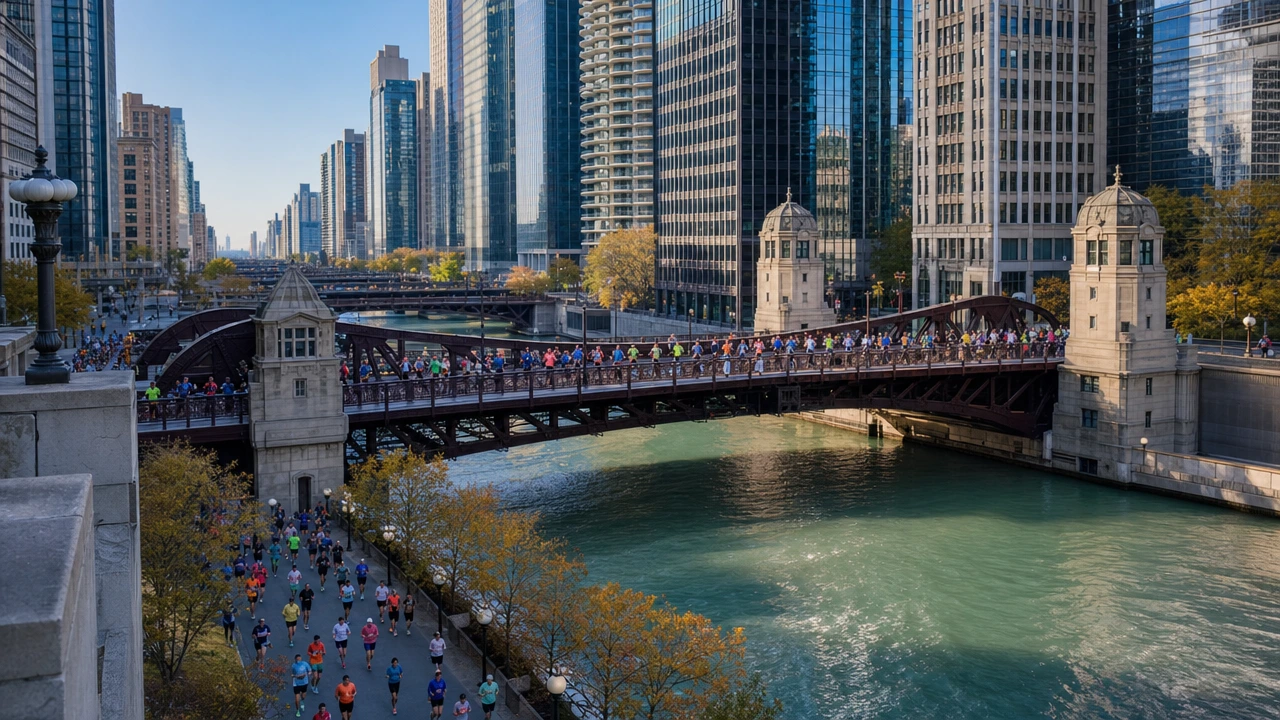
Want personality modes & weather integration? Try the full countdown experience
See entry dates for other marathons →
| Race | 2026 Chicago Marathon - Oct 11 |
|---|---|
| City | Chicago |
| Date | 2026-10-11 at 07:30 |
| Field Size | ~55,000 runners |
| Time Limit | 6 hours 30 min |
| Cutoff pace | 9:15/km |
| Course speed |
Fast courseSpeed index 0.88 — median of the last 5 winners' times against the global same-year median. Winner times track elite fields and prize money, so this reads the course as a proxy, not a pure measurement. |
| Timezone | America/Chicago |
| Official Site | Chicago Event Management |
| Fee trend | 2022 $2302024 $2402025 $2452026 $250(4-yr +8.7%)· below industry avg (+2.1% vs +4.8%/yr) |
| International | $260 · 1× domestic |
A full-marathon time on a certified course, at or under the standard for your age on race day, guarantees entry.
| Age group | Men | Women & non-binary |
|---|---|---|
| 16–34 | 2:50:00 | 3:20:00 |
| 35–39 | 2:55:00 | 3:25:00 |
| 40–44 | 3:00:00 | 3:30:00 |
| 45–49 | 3:10:00 | 3:40:00 |
| 50–54 | 3:15:00 | 3:50:00 |
| 55–59 | 3:25:00 | 3:55:00 |
| 60–64 | 3:40:00 | 4:15:00 |
| 65–69 | 3:55:00 | 4:30:00 |
| 70–74 | 4:15:00 | 4:45:00 |
| 75–79 | 4:30:00 | 5:00:00 |
| 80+ | 4:50:00 | 5:20:00 |
High Performance Program: Open M 2:25:00 / W 2:45:00 · Masters 40+ M 2:35:00 / W 2:50:00
Source: chicagomarathon.com, official qualifying standards · verified 2026-08-17
| Average Temperature | 14.1°C / 57°F |
|---|---|
| Humidity | 75% |
| Peak Wind | 29 km/h |
| Rain Chance | 33% |
| Typical Conditions | Cool with strong Lake Michigan wind |
What to Prepare: Despite the 'Windy City' name, this is an inland street course, not a lakefront run — the lake is only loosely parallel in the early miles. October is usually cool and dry, with a median ~52°F (11°C) start and a 15–20°F rise during the race. Westerly or northwesterly wind creates crosswinds on the north–south streets and a headwind around miles 13–15; a southerly flow gives a tailwind on the northbound opening and closing miles.
Based on historical averages for race week. Use our Weather Score Calculator and What to Wear Guide for personalized advice.
Winds peaking around 29 km/h — the typical daily maximum for this date — can affect your pace by 5-15 seconds per kilometer in exposed stretches. Headwinds slow you down exponentially: a 20 km/h wind costs more than twice a 10 km/h wind.
Calculate your wind-adjusted pace →Based on 20 years of race-week weather (2005-2024), MERRA-2 reanalysis
| Cooler | Typical | Warmer | |
|---|---|---|---|
| Temperature | 9°C | 14.2°C | 18.8°C |
| Dew point | 3.4°C | 9.5°C | 15.6°C |
Recent actuals: 2023 9.6°C / 2024 14.5°C / 2025 13.2°C (morning avg)
Data: NASA POWER (MERRA-2 reanalysis), NASA Langley Research Center
| Course Type | Loop |
|---|---|
| Elevation Gain | 35m |
| Terrain | Road |
| Profile | A fast, flat loop through 29 Chicago neighborhoods, starting and finishing in Grant Park. Essentially zero net elevation change — among the flattest Major courses — broken only by the small Mount Roosevelt rise just before the line at mile 26. |
| Boston Qualifier | Yes — Check your BQ time |
| Year | Finishers | vs prev. |
|---|---|---|
| 2021 | 26,112 | — |
| 2022 | 39,420 | +51.0% |
| 2023 | 48,398 | +22.8% |
| 2024 | 52,150 | +7.8% |
| 2025 | 54,351 | +4.2% |
Runners who crossed the line, not the registered field size.
The Bank of America Chicago Marathon is one of the seven Abbott World Marathon Majors and one of the fastest courses on Earth. The 48th running falls on Sunday, October 11, 2026, with the professional fields off at 7:30 a.m. and the first mass wave (Wave 1) at 7:35 a.m. from Grant Park. It is a loop course — start and finish both in Grant Park — that travels through 29 Chicago neighborhoods over a mostly flat 26.2 miles, divided into a north, a west, and a south section before returning downtown.
This is the flattest-feeling Major. Net elevation change is roughly zero, making it the second-flattest Major after Berlin by most accounts. There is exactly one notable hill — the small bridge over Roosevelt Road, nicknamed 'Mount Roosevelt,' which arrives in the final half-mile near mile 26. Everything else is firm, flat city pavement.
The flatness shows up in the record book. Chicago has hosted multiple world records, and the women's marathon world record — Ruth Chepngetich's 2:09:56, set here in October 2024 — still stands as both the world and course record. The men's course record is Kelvin Kiptum's 2:00:35 from 2023. In 2025, American Conner Mantz ran 2:04:43 on this course to break a long-standing US men's record. If the weather cooperates, few places are faster.
From Grant Park the course heads north through the Loop, River North, Old Town, Lincoln Park, and Lakeview/Boystown, then turns back south through Wells and Greektown into the West Loop, Little Italy and the UIC Medical District. It continues through Pilsen, Chinatown, Armour Square and Bronzeville, then up Michigan Avenue to the Grant Park finish. The early miles run roughly parallel to Lake Michigan but inland — despite the 'Windy City' reputation, this is a downtown and neighborhoods street course, not a lakefront run. The race was historically barred from the parks and the shoreline path, so you spend the day in the city's canyons and side streets, not on the waterfront.
Those canyons create the day's biggest pacing trap. Downtown skyscrapers block and reflect GPS signals, and the effect is worst in miles 1–5 and 24–26, exactly where you most want clean data. The result is that watches read long — many runners finish with 26.4 to 26.8 miles recorded, and reports put the GPS error in the first mile alone at roughly 0.4 miles. As one running magazine bluntly put it, most GPS watches are effectively useless by the first mile marker.
The defense is built into the course. A single blue line is painted along the entire route marking the certified tangents — the exact 26.2-mile racing line. Hold that line and trust the painted mile markers and your effort, not your watch's pace field. With roughly 25 turns (more than most marathons) and heavy crowding around the 90-degree corners, runners who drift wide of the tangents add real distance — which is the other reason watches show 26.5-plus at the finish.
Chicago's 'Windy City' name and the early lake-parallel miles make runners brace for a brutal lakefront gale. The reality is milder and more nuanced. Average race-day wind is about 6–10 mph, and because the course winds through downtown streets rather than along the open shoreline, you are sheltered for most of it. The most exposed stretch is the early northbound section near the lake; the rest is broken up by buildings.
Direction matters more than the name suggests. About 72% of years bring a westerly or southerly flow. West or northwest wind (roughly 39% of years) produces a crosswind on most of the north–south segments and a headwind around miles 13–15; a southerly or southwesterly flow (about 33%) hands you a tailwind on the northbound opening miles 1–8 and again on the closing miles 23–26.2. Either way, the wind rarely decides your race the way the nickname implies.
Temperature is the real variable. The October median start is about 52°F (11°C) with a typical 15–20°F rise during the race — cool, dry, and close to ideal. But Chicago is on average the warmest Major, and history is a warning: 2007 hit 88°F with high humidity and the race was halted at about 3.5 hours after heat casualties, while 2009 started near 33°F and ran fast in the cold. Recent editions (2023–2025) all ran cool, in the 45–68°F range. A cool October Sunday is one of the fastest marathon days anywhere; a warm one is punishing.
The course's emotional climax sits at Chinatown, around mile 21, reached through an almost 180-degree turn at the Chinatown Gate. Lion and dragon dancers and drummers make it one of the loudest points on the route — and it lands almost exactly where many runners hit the wall. Earlier, Pilsen's mariachi bands around mile 19 and the Boystown party near miles 7–9 are the other marquee spectator zones, but Chinatown is the one that arrives when you need it most.
From there the route runs north through Bronzeville and the South Loop back toward downtown. The surface is 100% firm city pavement for the entire race — flat and fast, but unforgiving: on a dead-flat course the same muscle fibers fire over and over with no change in load, which can accelerate late-race fatigue more than rolling terrain. The miles feel relentless precisely because they never change.
The single hill comes at the very end. 'Mount Roosevelt' is the bridge over Roosevelt Road near mile 26 — about 25 feet of climb in the final half-mile, and on trashed legs it feels far bigger than it is. Crest it, turn left onto Columbus Drive, and a short downhill of a few hundred meters drops you to the finish line in Grant Park. After 26 flat miles, that little rise is the last thing standing between you and the medal.
Pacing. Chicago rewards even, disciplined effort. The flatness is a gift and a trap: with no hills to force a rhythm change, it is easy to drift fast early and pay for it after mile 20. Ignore your watch's pace field in the downtown canyons — trust the blue tangent line, the painted mile markers, and feel. The free official Pace Team runs groups from 2:55 to 6:00, and locking onto a pacer removes the GPS guesswork entirely. Build your splits on the certified 26.2 with our Pace Calculator, and budget for a watch reading 26.4–26.8 at the line so the long final 'miles' don't rattle you.
Weather plan. Because temperature is the decisive variable, check the forecast in race week and adjust your goal. A cool, dry day is a green light to chase a PR on the world's flattest-feeling Major; a warm, humid one means easing your target rather than fighting it. Gauge race-morning conditions with our Weather Score Calculator. Note the cutoff: the course time limit is 6 hours 30 minutes, measured by net time from when you cross the start, at roughly a 15-minute-per-mile pace.
Entry math. There are several ways in. The non-guaranteed drawing (lottery) is the cheapest path but uncertain — for the 2026 race the application window ran October 21 to November 18, 2025, with drawing results announced December 11, 2025. The time-qualifier path is a true guarantee if you hit the standard (unlike Boston, there is no fastest-first cutoff). The 2026 headline benchmarks are 2:50:00 for men 16–34 and 3:20:00 for women and non-binary 16–34, with slower standards for older age groups; the qualifying result must come from a certified full marathon. Other guaranteed routes include the legacy program (five-plus finishes in 10 years), official charity, and the international tour operator program. For 2026 every route has now closed: the drawing long ago, tour-operator applications on August 16, 2026, and the charity program — the last door — on September 15, 2026; by September 18 every team in the official Charity Index showed 'Registration Closed.' The entry fee is $250 for US residents and $260 internationally, plus a processing fee. The 2025 race set an attendance record with 54,351 finishers, and the event has announced 2026 as its largest field yet at more than 55,000 participants. Missed 2026? The 2027 race is on Sunday, October 10, 2027, and this time the application window opens before race day instead of after it: 8 a.m. CT on Thursday, October 8, 2026, closing at 2 p.m. CT on Thursday, October 29, with drawing results on December 8. If a fast flat course is what you want, see how your goal compares to the qualifying tiers with our Boston Qualifier & Good For Age tool.
Arriving early? Explore daily running routes and local tips.
Six Chicago running routes: the 18.5-mile car-free Lakefront Trail, the elevated 606, and the downtown Riverwalk, plus night and winter running tips.
Read City Guide →Use our free training tools to get race-ready:
Free running pace calculator for 5K, 10K, half marathon, and marathon. Get min/km or min/mile, your ...
Use Calculator →Free printable pace band for marathon, half marathon, or custom distance. Choose even, negative, or ...
Use Calculator →7 AM race, wake at 3:45 AM? Enter the gun time; we work backward through meal, gear, bathroom, warm-...
Use Calculator →London ~1.5%, Chicago ~35%, Berlin ~30%, Tokyo ~10%, NYC ~1-3% (2026 ballots) — real odds and wait t...
Use Calculator →How much does a headwind actually slow you down? This free calculator turns wind speed and direction...
Use Calculator →Free running shoe finder quiz. Answer 6 questions, get 3 spec-matched picks from 15 brands (155 SKUs...
Use Calculator →The 48th Bank of America Chicago Marathon is on Sunday, October 11, 2026. Start order (all times Central): pro wheelchairs 7:20/7:21 a.m., handcycles 7:23, the men's and women's professional fields 7:30 a.m., the High Performance Program 7:32, then three mass waves — Wave 1 at 7:35 a.m. (Corrals A–E, estimated finish under 3:36), Wave 2 at 8:00 a.m. (F–J, 3:36–4:19:59) and Wave 3 at 8:35 a.m. (K–N, 4:20 and slower). Wave 1 has gone at 7:35 since 2025; through 2024 it shared the 7:30 gun with the pros, which is why older guides still say 7:30. Gear check and the corrals open at 5:30 a.m.; corrals close at 7:20, 7:45 and 8:10 respectively. Your wave and corral come from the qualifying or estimated finish time you submitted.
Only at the Abbott Health & Fitness Expo at McCormick Place, and only before race day: Thursday, October 8 (10 a.m.–6 p.m.) and Friday–Saturday, October 9–10 (9 a.m.–6 p.m.). Packets are not handed out on race day, are not mailed, and no one can pick one up on your behalf. The Expo is in the North Building, Level 3 – Hall B1; the organizers give 2301 S. Martin Luther King Drive as the address for driving and parking and suggest the East Building as the rideshare drop-off.
Bring the Packet Pick-up Ticket emailed to your registration address on September 30, 2026 (on your phone or printed) and a government-issued photo ID in the name you registered with — a driver's license, state ID or passport. If your ID doesn't match that name, go straight to the Participant Services Booth. Every attendee goes through a security screening and large bags or luggage are discouraged, so drop your suitcase at the hotel first and book travel that gets you to McCormick Place before 6 p.m. on Saturday.
Yes, within limits: handheld bottles, soft flasks, fuel belts and running vests with front-pocket carry are allowed, but hydration backpacks (CamelBak-style) and any running vest with a hydration bladder are not.
New for 2026, four Culligan Water Refill Stations sit immediately before Aid Station 4 (Mile 5.7), Aid Station 7 (Mile 10.1), Aid Station 12 (Mile 15.7) and Aid Station 16 (Mile 20.3), where you refill your own approved bottle or flask with filtered water. Security may ask you to empty your containers before you enter Grant Park; water and Gatorade are available at the start hydration areas inside.
You can also run with nothing: all 20 aid stations, roughly one to two miles apart, serve Gatorade Endurance Formula (lemon-lime) and water, and Aid Stations 16–18 (Miles 20.2–23) add Chiquita bananas. Gels are the real gap. Maurten hands out Gel 100 (25 g of carbohydrate, caffeinated or not) at just two spots — Mile 12.4 near Aid Station 9 and Mile 18.1 near Aid Station 14 — and asks runners to take only one per station. That is 50 g at most over 26.2 miles, so carry the rest of your fuel and work out how much with our Energy Gel Calculator.
Yes on both counts. Net elevation change across the full 26.2 miles is roughly zero — one of the flattest Majors, second only to Berlin by most accounts — and the only notable hill is 'Mount Roosevelt,' the bridge over Roosevelt Road near mile 26, which climbs about 25 feet in the final half-mile before a short downhill to the finish.
Flat, firm pavement, wide roads, big crowds and typically cool October weather have produced multiple world records. The women's marathon world record for a mixed race — Ruth Chepngetich's 2:09:56, set in Chicago in October 2024 — still stands as the world and course record; the men's course record is Kelvin Kiptum's 2:00:35 from 2023, and in 2025 Conner Mantz ran 2:04:43 here to break a long-standing US men's record. The one caveat is heat: Chicago is on average the warmest Major, so a cool day is fast and a warm one is not.
Downtown Chicago's skyscrapers create 'urban canyons' that block and reflect GPS signals, with the worst interference in miles 1–5 and 24–26. This makes watches measure extra distance — many runners finish with 26.4 to 26.8 miles recorded, and the error in the first mile alone can be around 0.4 miles. The course is certified at exactly 26.2 miles along a painted blue tangent line, so trust that line, the official mile markers, and your effort rather than your watch's pace field. Budgeting for a long-reading watch keeps the final miles from panicking you.
No — despite the 'Windy City' reputation, this is an inland downtown and neighborhoods street course, not a lakefront run. The race was historically barred from the parks and the Lake Michigan shoreline path; the early miles only run loosely parallel to the lake, which is mostly not visible. Average race wind is a modest 6–10 mph, and the surrounding buildings shelter you for much of the route. A westerly or northwesterly flow brings crosswinds and a headwind around miles 13–15, while a southerly flow gives a tailwind on the northbound opening and closing miles.
The course time limit is 6 hours 30 minutes, which works out to roughly a 15-minute-per-mile pace. It is measured by net time from when you cross the start line, not gun time, so later corrals are not penalized for the wait. An event vehicle follows the final starter at that 15-minute-per-mile pace and signals when each segment reopens to traffic; runners who fall behind it may be moved to the sidewalks, lose full aid-station support, and may not be recorded as official finishers. The free official Pace Team runs groups from 2:55 all the way to 6:00 to help you stay ahead of the cutoff.
The 2026 race is closed to new entries, so your next chance is the 2027 race on Sunday, October 10, 2027 — and its application window opens before this year's race: 8 a.m. CT on Thursday, October 8, 2026, closing at 2 p.m. CT on Thursday, October 29. That is three weeks, down from four last cycle, and drawing applicants hear their result by email on Tuesday, December 8. The race does not publish drawing odds; press estimates for recent cycles put them at roughly one in three. Charity was the last 2026 door to shut: entries were first-come, first-served until September 15, 2026, and by September 18 every team in the official Charity Index showed 'Registration Closed.'
For 2027 you choose between the non-guaranteed drawing (lottery) — the cheapest route but uncertain — and guaranteed routes. A time-qualifier entry is a true guarantee if you hit the standard (unlike Boston, there is no fastest-first cutoff). The standards are unchanged: 2:50:00 for men 16–34 and 3:20:00 for women and non-binary 16–34, slower for older groups, from a certified full marathon run between January 1, 2025 and October 29, 2026 — so a qualifying time at this year's race still counts if you apply by the deadline.
Other guaranteed routes include legacy (five-plus Chicago finishes in 10 years), a cancelled 2026 entry, finishing the 2026 Chicago Distance Series, official charity and the international tour operator program. The 2027 fee stays at $250 for US residents and $260 for international runners. Charity entries cost $325/$335, the fundraising minimum rises to $2,500 (from $2,200 in 2026), and charity places run first-come until September 10, 2027 or until each team fills.
The 2026 entry fee is $250 for United States residents and $260 for international runners, plus a processing fee; optional refundable registration costs 17.024% of your purchase (about $43 on a $250 entry). The 2025 race set an event attendance record with 54,351 finishers, up from 52,150 in 2024. The event has since announced 2026 as its largest field yet, at more than 55,000 participants. All entry fees are non-refundable. If you can't make it, you can cancel through October 7, 2026 in your participant account, which secures a guaranteed entry for 2027 — but you still have to apply in the October 8–29 window and pay the 2027 fee again, so it is a cancellation, not a postponement of the same entry.
Long Beach · 2026-10-11
Detroit · 2026-10-18

Columbus · 2026-10-18
Xi'an · 2026-10-18

Munich · 2026-10-11
Amsterdam · 2026-10-18