Running Pace Calculator — Min/km, Finish Time & Pace Chart
Free running pace calculator for 5K, 10K, half marathon, and marathon. Get min/km or min/mile, your ...
Use Calculator →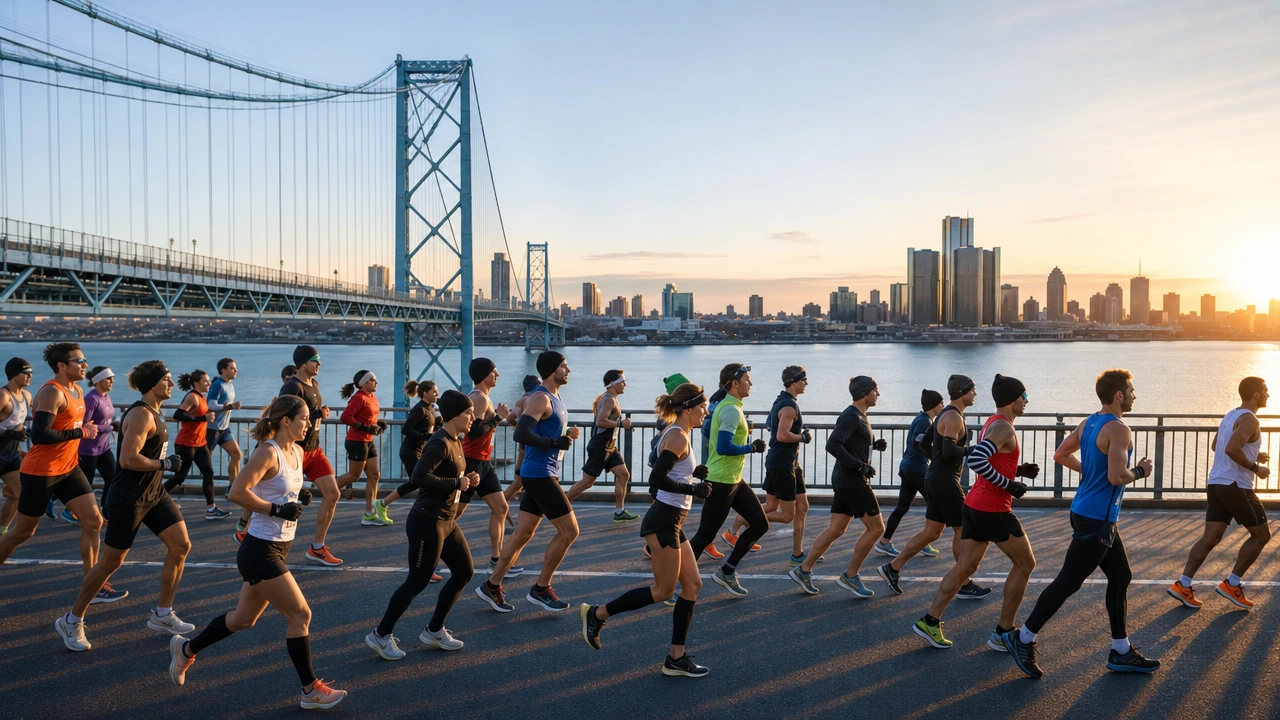
Race completed
Next-edition alertSee entry dates for other marathons →
| Race | 2026 Detroit Free Press Marathon |
|---|---|
| Location | Detroit |
| Date | |
| Field Size | ~3,569 runners |
| Time Limit | 6 hours 30 min · average 9:15/km |
| Course speed | Typical pace1 |
| Official site | Detroit Free Press Marathon official website |
| Entry fee |
$170 · 2026 general entry
|
| Course Type | International loop (two border crossings) |
|---|---|
| Elevation Gain | 118m |
| Terrain | Road (city streets, international bridge and tunnel) |
| Profile | The headline is the border: the Detroit Free Press Marathon is the only U.S. marathon that crosses an international boundary, sending runners over the Ambassador Bridge into Windsor, Ontario, Canada around mile 3, then back to Detroit through the Detroit-Windsor Tunnel — the world's only official underwater international mile, the famous 'Underwater Mile' beneath the Detroit River. A valid passport or other WHTI-compliant travel document is required to run. The route is otherwise mostly flat and fast: about +388 ft (118 m) of total climbing against -397 ft of descent, the gain concentrated in the one-mile bridge ascent and the half-mile climb out of the tunnel. After the international section the course tours Woodbridge, the District Detroit, Eastern Market and the Dequindre Cut before finishing at Campus Martius downtown. USATF-certified and a Boston qualifier. |
| Boston Qualifier |
Use our free training tools to get race-ready:
Free running pace calculator for 5K, 10K, half marathon, and marathon. Get min/km or min/mile, your ...
Use Calculator →Free printable pace band for marathon, half marathon, or custom distance. Choose even, negative, or ...
Use Calculator →Free marathon predictor — convert your 5K, 10K, or half marathon time into race-day estimates from R...
Use Calculator →Predict your race finish time from pace, or set a goal time to find required pace. Free instant calc...
Use Calculator →What heart rate should you train at? Enter your age and resting HR to get personalized 5-zone traini...
Use Calculator →The full marathon is on Sunday, October 18, 2026, starting at 7:00 a.m. ET in downtown Detroit (the Adaptive Athlete division starts a couple of minutes earlier). It is part of a full race weekend on October 16–18 and traditionally runs on the third Sunday in October.
Yes. Because the course crosses into Canada and back, every full-marathon and International Half runner must carry a WHTI-compliant travel document, and you must show it at packet pickup. For U.S. citizens that means a valid passport, passport card, Enhanced Driver's License (issued by MI, MN, NY, VT or WA), or a Trusted Traveler card such as NEXUS. A standard driver's license or REAL ID is not accepted for the border crossing. Running across the border counts as crossing the border.
Registration is open entry (no lottery) through the official EnMotive platform, and the 2026 full marathon is sold out. Online entry for the international races was set to close September 8, 2026 in any case, and only the U.S.-only races can reopen at the expo, so there is no marathon entry on race weekend. 2026 pricing was tiered from $120 (January 1–6) through $140, $150 and $160 to $170 (July 8–September 8). The marathon also sold out in each of the previous two years (it filled by early March in 2025), so for 2027 register as soon as entry opens in January.
It is rated mostly flat and fast — about +388 ft (118 m) of total climbing against roughly 397 ft of descent, so it is close to net-flat. The notable climbs are the one-mile ascent of the Ambassador Bridge early on and the half-mile rise out of the Detroit-Windsor Tunnel on the way back; the rest of the route through downtown Detroit is fast and gentle.
After crossing the Ambassador Bridge into Windsor, Ontario around mile 3, runners return to Detroit through the Detroit-Windsor Tunnel, which runs beneath the Detroit River. That stretch is billed as the only official underwater international mile in the world — the 'Underwater Mile' — and is the most talked-about moment of the race. The tunnel closes to vehicles (roughly 6:15–10:30 a.m.) so runners can pass through.
Yes. The course is USATF-certified and recognized by the B.A.A. for Boston qualifying. Its mostly-flat profile makes it a reasonable BQ option, though the bridge and tunnel climbs mean it is not a pure speed course. Check the time you need with our Boston Qualifying Calculator.
The full marathon has a 6-hour-30-minute course limit (about a 14:53 per-mile pace); the course reopens on that schedule and the finish line closes around 2:00 p.m. Because the international section depends on the bridge and tunnel reopening to traffic, runners need to keep ahead of the early-course cutoffs to complete the border crossing.
The full marathon draws around 3,500 finishers (3,569 in 2025), while the International Half, Motor City Half, relay and shorter races push the wider weekend well into the tens of thousands. The course starts and finishes downtown, with the finish line at Campus Martius, after touring Woodbridge, the District Detroit, Eastern Market and the Dequindre Cut.
Daily values within 7 days either side of 18 Oct, 2005–2024. Wet days had at least 1 mm of rain.
| Cooler | Typical | Warmer | |
|---|---|---|---|
| Temperature | 5.7°C | 10°C | 15.7°C |
| Dew point | 0.8°C | 5.8°C | 12.4°C |
Data: NASA POWER (MERRA-2 reanalysis), NASA Langley Research Center
Osaka · 2027-02-28

Seoul · 2027-03-21

Nagoya · 2027-03-14
This race scores 1.04. For men and women separately, we compare up to five recent winning times with the median winning time for the same year in our database. We take the median of those ratios for each group, then average the two. A score of 0.95 or lower earns the “Fast course” label.
The series needs five recorded editions and at least three valid comparisons per group. Each annual comparison needs 60 results for that group. Shortened courses are excluded. Elite field strength, prize money and race conditions can influence winning times, so the score describes elite results and cannot predict an individual finish time.
Back to Course speed