Sydney Running Routes: 7 Best — Bondi-Coogee, Bay Run, CBD
Sydney running routes: 7 of the best — Bondi-Coogee, Bay Run, Centennial, the harbour foreshore & a CBD loop. Plus WMM marathon, City2Surf & UV tips.
Read City Guide →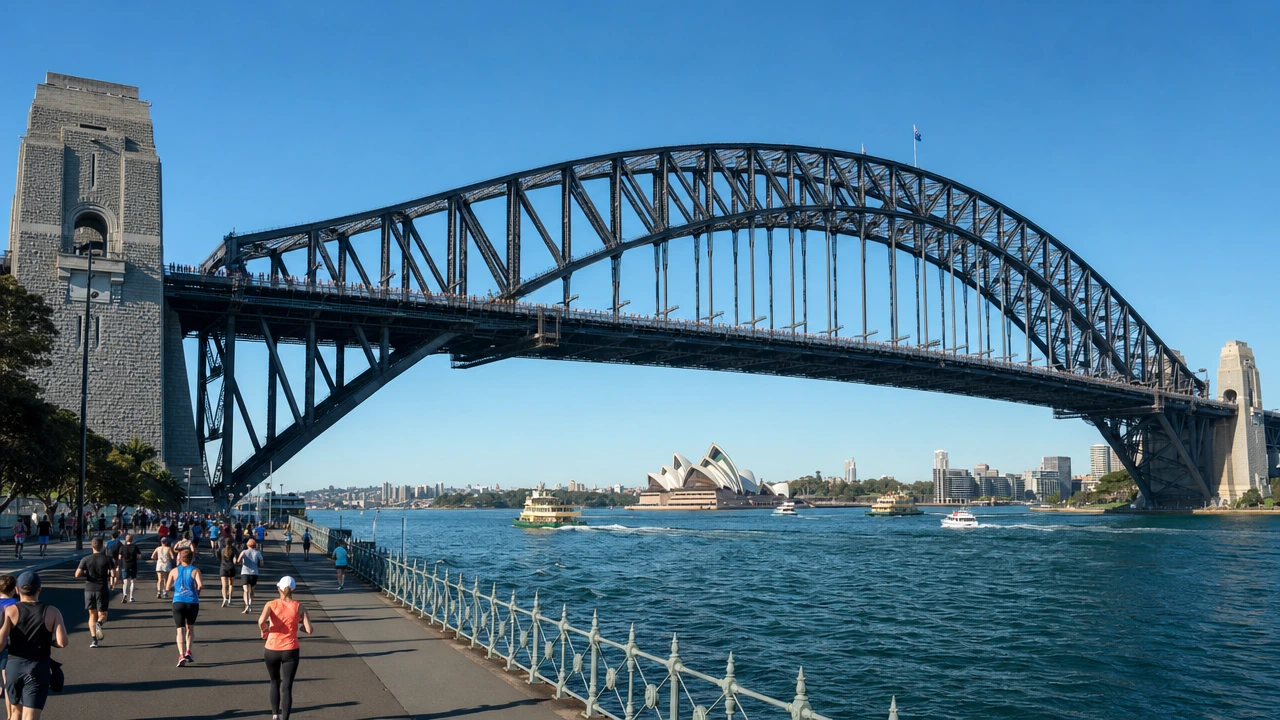
Want personality modes & weather integration? Try the full countdown experience
See entry dates for other marathons →
| Race | 2027 TCS Sydney Marathon - Aug 29 |
|---|---|
| City | Sydney |
| Date | 2027-08-29 at 06:30 |
| Field Size | ~40,000 runners |
| Time Limit | 7 hours |
| Cutoff pace | 9:57/km |
| Timezone | Australia/Sydney |
| Official Site | TCS Sydney Marathon |
| Fee trend | 2026 A$2802027 A$285(1-yr +1.8%) |
| International | A$340 · 1.2× domestic |
| Average Temperature | 15.5°C / 60°F |
|---|---|
| Humidity | 71% |
| Peak Wind | 19 km/h |
| Rain Chance | 27% |
| Typical Conditions | Cool late-winter morning, warming through the race |
What to Prepare: Late August in Sydney: 7-8°C at dawn, rising to about 18°C by midday. The Harbour Bridge is exposed to wind — dress for gusts. Arm sleeves recommended at the start; be ready to shed layers by 15 km.
Based on historical averages for race week. Use our Weather Score Calculator and What to Wear Guide for personalized advice.
Winds peaking around 19 km/h — the typical daily maximum for this date — can affect your pace by 5-15 seconds per kilometer in exposed stretches. Headwinds slow you down exponentially: a 20 km/h wind costs more than twice a 10 km/h wind.
Calculate your wind-adjusted pace →Based on 20 years of race-week weather (2005-2024), MERRA-2 reanalysis
| Cooler | Typical | Warmer | |
|---|---|---|---|
| Temperature | 13.4°C | 15.4°C | 17.9°C |
| Dew point | 6.6°C | 10.1°C | 13.1°C |
Data: NASA POWER (MERRA-2 reanalysis), NASA Langley Research Center
| Course Type | Point-to-Point |
|---|---|
| Elevation Gain | 313m |
| Terrain | Road |
| Profile | The hilliest World Marathon Major — 313m cumulative elevation gain from North Sydney to the Opera House. Rolling course crosses the Harbour Bridge, grinds through Anzac Parade and Centennial Park, and finishes with the demanding Mrs Macquarie's Chair climb at km 38-40. |
| Boston Qualifier | Yes — Check your BQ time |
| Year | Finishers | vs prev. |
|---|---|---|
| 2024 | 20,272 | — |
| 2025 | 32,976 | +62.7% |
Runners who crossed the line, not the registered field size.
The TCS Sydney Marathon is the 7th Abbott World Marathon Major — the first Major in the Southern Hemisphere, elevated in November 2024 after passing two consecutive annual assessments. The 2027 edition runs on Sunday 29 August 2027 from North Sydney to the Opera House Forecourt, accumulating 313 meters of elevation gain, which makes it the hilliest and arguably most demanding of all seven Majors.
Demand now runs far ahead of supply. The organiser publishes 123,000+ applications for the 2026 edition against 40,000+ starting positions, and 36,295 participants from 140+ countries took part that year. That is why 2027 entry is settled by a free random ballot rather than a click-speed scramble, and why the Travel and Charity routes deserve a place in your plan before the draw, not after it.
Runners start on Miller Street in North Sydney, near North Sydney Oval — a nod to the 2000 Olympic Marathon. The opening kilometer is a steep downhill that tempts an aggressive start. Resist it: the adrenaline, the downhill grade, and the packed field create a dangerous cocktail of overexertion.
At km 2 you cross the Sydney Harbour Bridge — one of the very few chances to run on the main deck of one of the world's most iconic bridges, closed to runners every other day of the year (the same morning's 10K crosses it too). The climb averages +2.5% gradient before a -3% descent into the CBD. Wind is the defining variable: the deck is fully exposed over the harbour with nothing to break a southerly. Run by effort, not pace. This is where you protect your race, not prove your fitness.
The first 15 km through Pyrmont, Darling Harbour, and the CBD are relatively flat and shaded by buildings. Crowd energy builds at The Rocks (km 12) and Martin Place (km 13), but the stretch between can feel quiet — absorb the rare silence of empty city streets at dawn.
The terrain shifts after km 15 with the Oxford Street climb (+3% grade), the first real test of your legs. From km 16 the course turns onto Anzac Parade for a long out-and-back toward Kingsford. This 12 km stretch is flat but mentally grinding, exposed to sun and wind with reduced spectator density. The 2024 course redesign cut hairpin turns from 9 to 4, easing the psychological toll, but this remains the section where pacing discipline decides your race. Use our Negative Split Planner to prepare your Anzac Parade strategy.
Centennial Park at km 30 offers a single-lap loop through Sydney's premier running park — a welcome change from the Anzac Parade straight. The park is mostly flat but shade is minimal.
The true crux arrives at km 38-40: Mrs Macquarie's Chair. A sharp descent into the Botanic Gardens tests already-shattered quads, followed by a +3% climb back up — the steepest sustained grade on the course, arriving at the worst possible physiological moment. Runners consistently identify this as the hardest section of the entire race.
The reward is extraordinary: emerging from the gardens, the Opera House crashes into view with an 800-meter downhill to the finish line on the forecourt. Running beneath the Harbour Bridge toward the Opera House is one of the most iconic closing stretches in world marathon running.
Sydney demands a conservative first half. The flat CBD section and bridge adrenaline tempt a fast start, but the 313m of cumulative climbing is concentrated in the second half and punishes early aggression. A positive split is the norm; the rare negative splits belong to runners who deliberately held back through 25 km.
Weather: late August is late winter in Sydney. Race-morning temperatures of 7-8°C mean arm sleeves or a light long-sleeve at the start, shedding layers by km 15 as you warm up. Wind is the real variable — the bridge, Anzac Parade, and Mrs Macquarie's Chair are all exposed. Check conditions with our Weather Score Calculator.
Fuelling (2026 setup; the 2027 race-week guide is published closer to the event): drink stations with water and Powerade sat at every 5 km, with additional water-only points between, while energy gels were handed out at km 20 and km 30 only — carry your own if you need them more often. The post-finish area required a 600 m walk to collect water and bags, so carry fuel for the walk-off too.
Arriving early? Explore daily running routes and local tips.
Sydney running routes: 7 of the best — Bondi-Coogee, Bay Run, Centennial, the harbour foreshore & a CBD loop. Plus WMM marathon, City2Surf & UV tips.
Read City Guide →Use our free training tools to get race-ready:
Free running pace calculator for 5K, 10K, half marathon, and marathon. Get min/km or min/mile, your ...
Use Calculator →Free printable pace band for marathon, half marathon, or custom distance. Choose even, negative, or ...
Use Calculator →7 AM race, wake at 3:45 AM? Enter the gun time; we work backward through meal, gear, bathroom, warm-...
Use Calculator →How much will hills slow you down? Enter elevation gain, loss, and distance to see adjusted pace, di...
Use Calculator →Convert uphill or downhill running pace to flat-equivalent GAP in one click. Free grade adjusted pac...
Use Calculator →Free running shoe finder quiz. Answer 6 questions, get 3 spec-matched picks from 15 brands (155 SKUs...
Use Calculator →The 2027 TCS Sydney Marathon is on Sunday 29 August 2027. Entry is decided by a free ballot that opens at 10:00 on 29 September 2026 and closes at 10:00 on 19 October 2026. Note the clock change in between: the opening is AEST, but NSW daylight saving starts on 4 October, so the closing 10:00 is AEDT — the organiser's own two pages label that closing time differently, so work to the local Sydney clock. There is no advantage to applying on day one, because every application goes into the same random draw. Duo teams and non-elite racing wheelchair entrants do not use the ballot and apply through a separate process. Fast runners can bypass the ballot through the High Performance Program, which accepts applications from 12:00 PM AEST on 14 September 2026. If you hold a deferred 2025 or 2026 entry, do not enter the ballot: the organiser will not refund a fee charged to a deferred runner, and the deferral itself is forfeited. Apply at tcssydneymarathon.com/sign-up.
The organiser's FAQ lists AUD $285 for Australian and New Zealand residents and AUD $340 for international runners, plus a mandatory carbon levy and any optional donations. Entering the ballot itself is free: nothing is taken until you are drawn, and successful applicants have their cards charged on 3 November 2026. One thing to budget for — the ballot page's reminder box still quotes the 2026 prices of AUD 280 and AUD 330, so check the figure on the checkout screen before you accept. Entries are non-refundable and non-transferable.
Unsuccessful applicants are contacted on the same day as the winners, 3 November 2026, with details of the official Travel and Charity Programs — the two routes that still lead to a start line place after the draw. Between the ballot opening and the result the organiser provides no status updates at all, so there is nothing to chase in the meantime. If you have heard nothing by 6 November 2026, that is the point to contact them; check your junk folder first, because the notification arrives by email.
The organiser does not publish a success rate, but it does publish the two numbers behind one: 123,000+ applications for the 2026 edition against 40,000+ starting positions. In the end 36,295 participants from 140+ countries took part in 2026. Set side by side, those two figures work out to roughly three applicants per place, but the organiser does not say whether the 40,000 positions are marathon-only, so the real marathon odds are probably tighter. That is why experienced overseas runners treat the Travel and Charity Programs as a parallel plan rather than a fallback — those places are finite too and move quickly once the 3 November results land.
Yes — with 313 meters of cumulative elevation gain, Sydney is the hilliest of all seven Majors. The course features a +2.5% Harbour Bridge climb, a sustained +3% Oxford Street ascent, and a punishing +3% climb at Mrs Macquarie's Chair at km 38-40. Net elevation is -83m (the finish is lower than the start), but the rolling hills in the second half make it significantly harder than that single number suggests. Boston's Newton hills are the closest comparison, though Sydney's climbs are spread more widely across the course.
The organiser has published the 2027 headline timings: elite wheelchair athletes start at 6:15 AM and mass participation at 6:30 AM, with a 7-hour cut-off. Individual start-group times will only be shared closer to race day. Read the clock carefully: the event rules count the 7 hours from the closure of the start window, not from your own gun, so the last wave has the tightest clock and earlier waves a little more. For reference, the 2026 edition ran three waves from 6:31 AM, with colour-coded assembly areas at St Leonards Park allocated by predicted finish time.
No. The Abbott Six Star Medal remains exclusive to the original six Majors (Boston, Tokyo, London, Berlin, Chicago, New York). Sydney was named the 7th Abbott World Marathon Major in November 2024 and ran as one for the first time in 2025 — the first addition since Tokyo in 2013 — and counts toward the planned Nine Star program rather than the Six Star. Finishing Sydney therefore adds a star to the newer set, and does not shorten the classic six.
No. The half marathon was dropped after 2023 so the event could focus on the full marathon during its World Marathon Major candidacy. The 2026 programme was the marathon (42.195 km), a 10K that crosses the Harbour Bridge and finishes at the Conservatorium of Music, and a 5 km Mini Marathon on the Saturday before race day. The 2027 Mini Marathon is already set for Saturday 28 August 2027; the rest of the line-up is confirmed with the race-week guide. For a Sydney half marathon, look at the HOKA Runaway Sydney Half Marathon in May.
Berlin · 2026-09-27

St. George · 2026-10-03

Minneapolis · 2026-10-04
Melbourne · 2026-10-11
Chicago · 2026-10-11
Long Beach · 2026-10-11