Running Pace Calculator — Min/km, Finish Time & Pace Chart
Free running pace calculator for 5K, 10K, half marathon, and marathon. Get min/km or min/mile, your ...
Use Calculator →
Race Completed
This marathon has finished. Check back for next year's edition.
Finished this one? Turn your result into a keepsake:
Finisher certificate ·
Virtual race bib ·
Achievement card
See entry dates for other marathons →
| Race | 2026 Twin Cities Marathon - Oct 4 |
|---|---|
| City | Minneapolis |
| Date | 2026-10-04 at 08:00 |
| Field Size | ~11,000 runners |
| Time Limit | 6 hours 30 min |
| Cutoff pace | 9:15/km |
| Timezone | America/Chicago |
| Official Site | Twin Cities In Motion |
| Average Temperature | 12.6°C / 55°F |
|---|---|
| Humidity | 71% |
| Peak Wind | 19.9 km/h |
| Rain Chance | 27% |
| Typical Conditions | Crisp, cool autumn morning with peak fall color |
What to Prepare: Early October in the Twin Cities is prime marathon weather — race-morning temperatures sit around 46°F / 8°C, often climbing into the 50s–60s by midday. It can be one of the prettiest fall-foliage backdrops in U.S. running. Dress in light layers with a throwaway top for the start, and don't overdress: it's cool at the gun but warms up over 26.2 miles.
Based on historical averages for race week. Use our Weather Score Calculator and What to Wear Guide for personalized advice.
Winds peaking around 19.9 km/h — the typical daily maximum for this date — can affect your pace by 5-15 seconds per kilometer in exposed stretches. Headwinds slow you down exponentially: a 20 km/h wind costs more than twice a 10 km/h wind.
Calculate your wind-adjusted pace →Based on 20 years of race-week weather (2005-2024), MERRA-2 reanalysis
| Cooler | Typical | Warmer | |
|---|---|---|---|
| Temperature | 6.3°C | 12.6°C | 18.8°C |
| Dew point | -0.6°C | 6.8°C | 13.8°C |
Data: NASA POWER (MERRA-2 reanalysis), NASA Langley Research Center
| Course Type | Point-to-point |
|---|---|
| Elevation Gain | 175m |
| Terrain | Road (city streets and parkways) |
| Profile | A scenic point-to-point billed as "The Most Beautiful Urban Marathon in America" — starting in downtown Minneapolis near U.S. Bank Stadium, winding past the Chain of Lakes (Bde Maka Ska, Lake of the Isles, Lake Harriet, Lake Nokomis), then north along both banks of the Mississippi River into St. Paul. The course is mostly flat-to-rolling with no climbs longer than 100 ft (about +575 ft / 175 m total gain), but the back half stiffens: a steady uphill from miles 20–23 leads to an iconic finish climbing toward the Minnesota State Capitol. USATF-certified and a recognized Boston qualifier. |
| Boston Qualifier | Yes — Check your BQ time |
| Year | Finishers | vs prev. |
|---|---|---|
| 2022 | 6,486 | — |
| 2024 | 6,787 | +4.6% |
Runners who crossed the line, not the registered field size.
Use our free training tools to get race-ready:
Free running pace calculator for 5K, 10K, half marathon, and marathon. Get min/km or min/mile, your ...
Use Calculator →Free printable pace band for marathon, half marathon, or custom distance. Choose even, negative, or ...
Use Calculator →7 AM race, wake at 3:45 AM? Enter the gun time; we work backward through meal, gear, bathroom, warm-...
Use Calculator →Enter temperature, wind, and rain to get specific clothing picks for head, torso, legs, hands, and f...
Use Calculator →How much will hills slow you down? Enter elevation gain, loss, and distance to see adjusted pace, di...
Use Calculator →Convert uphill or downhill running pace to flat-equivalent GAP in one click. Free grade adjusted pac...
Use Calculator →The 2026 Medtronic Twin Cities Marathon is on Sunday, October 4, 2026, starting at 8:00 a.m. CT in downtown Minneapolis. It is part of a full Marathon Weekend (Oct 3–4) and traditionally runs on the first Sunday in October.
General registration for the 2026 marathon has sold out. Public entry opened March 3, 2026 through Twin Cities In Motion on a tiered schedule (the marathon started at $162 plus fees) and the field is capped at 11,000, so it filled ahead of race week. Two routes can still get you a 2026 bib: a TCM Gold or Silver membership, which includes an entry until capacity is reached, and charity-partner entries, which are typically available after general registration closes. Check the official site for both.
It is a point-to-point route from Minneapolis to St. Paul, nicknamed "The Most Beautiful Urban Marathon in America." You pass the Chain of Lakes, run both banks of the Mississippi River, and finish at the Minnesota State Capitol. The course is USATF-certified.
Total climbing is modest — about +575 ft (175 m) with no single climb longer than 100 ft — so the first 20 miles run fast. The challenge is the finish: a steady uphill from roughly miles 20 to 23 as you climb toward the State Capitol, which makes it a tougher closing stretch than the gentle profile suggests. A short downhill in the last half-mile helps you finish strong.
Yes. The course is USATF-certified and recognized by the B.A.A. for Boston qualifying. In recent years roughly 4–7% of finishers ran a Boston-qualifying time — the fast, mostly-flat first 20 miles help, though the uphill finish can cost you in the closing stretch.
The official time limit is 6 hours 30 minutes from when the start line closes, which works out to about a 14:52 per-mile pace. Runners must reach the finish by roughly 2:50 p.m. to be in official results.
Expect a cool, crisp start near 46°F / 8°C, often warming into the 50s–60s°F by the finish. Dress in light layers with a throwaway top you can toss after the gun, and avoid overdressing — it warms up noticeably over 26.2 miles. Early October also brings some of the best fall color of any U.S. marathon.

Yokohama · 2026-10-25

Kanazawa · 2026-10-25
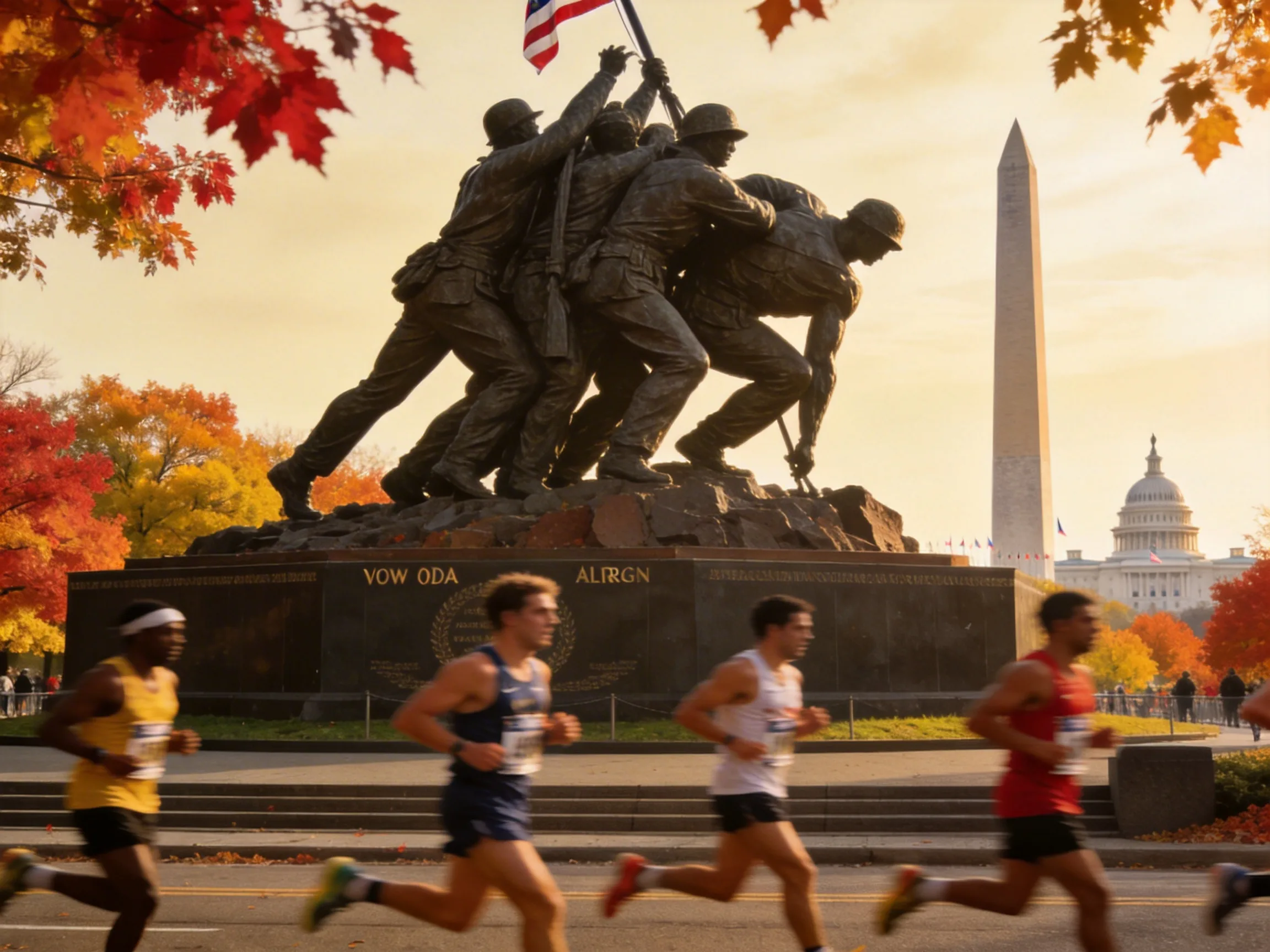
Washington DC · 2026-10-25

Zhengzhou · 2026-10-18

New York · 2026-11-01

Hangzhou · 2026-11-01