Melbourne Running Routes: 8 Loops — The Tan, Bay Trail
Melbourne running guide — The Tan Track, Albert Park Lake, Bay Trail, 40+ parkruns, and race calendar from the Great Ocean Road to the MCG. Australia'...
Read City Guide →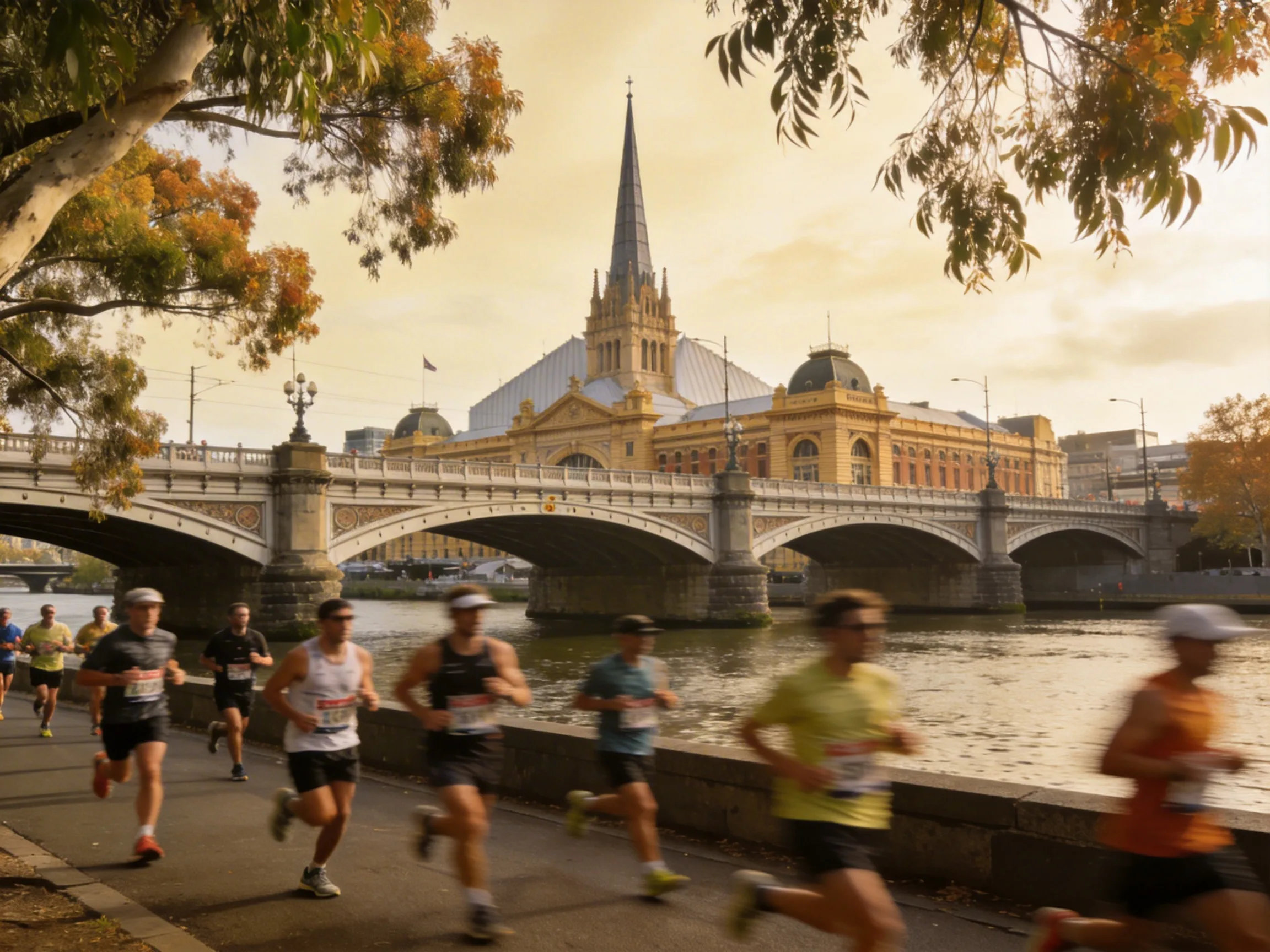
Want personality modes & weather integration? Try the full countdown experience
See entry dates for other marathons →
| Race | 2026 Nike Melbourne Marathon - Oct 11 |
|---|---|
| City | Melbourne |
| Date | 2026-10-11 at 06:15 |
| Field Size | ~13,000 runners |
| Time Limit | 7 hours 45 min |
| Cutoff pace | 11:01/km |
| Course speed |
Typical paceSpeed index 0.96 — median of the last 5 winners' times against the global same-year median. Winner times track elite fields and prize money, so this reads the course as a proxy, not a pure measurement. |
| Timezone | Australia/Melbourne |
| Official Site | Melbourne Marathon |
| Average Temperature | 13.5°C / 56°F |
|---|---|
| Humidity | 75% |
| Peak Wind | 23.1 km/h |
| Rain Chance | 43% |
| Typical Conditions | Cool spring weather with variable conditions |
What to Prepare: Melbourne is famous for "four seasons in one day" — prepare for anything from sunshine to rain showers. Beach Road sections are exposed to wind off the bay. Light layers that can be shed are essential. The early October spring weather is generally favorable for racing.
Based on historical averages for race week. Use our Weather Score Calculator and What to Wear Guide for personalized advice.
Winds peaking around 23.1 km/h — the typical daily maximum for this date — can affect your pace by 5-15 seconds per kilometer in exposed stretches. Headwinds slow you down exponentially: a 20 km/h wind costs more than twice a 10 km/h wind.
Calculate your wind-adjusted pace →Based on 20 years of race-week weather (2005-2024), MERRA-2 reanalysis
| Cooler | Typical | Warmer | |
|---|---|---|---|
| Temperature | 10.8°C | 12.9°C | 17.3°C |
| Dew point | 5.7°C | 8.3°C | 11.4°C |
Data: NASA POWER (MERRA-2 reanalysis), NASA Langley Research Center
| Course Type | Urban Coastal Out-and-Back |
|---|---|
| Elevation Gain | 185m |
| Terrain | Road |
| Profile | Starts on Batman Avenue near Rod Laver Arena, passes Flinders Street Station, the Royal Botanic Gardens, Albert Park Lake, and the St Kilda foreshore before finishing with a lap inside the MCG. The 2026 redesign reverses direction along Beach Road and removes the 36km Birdwood Avenue climb, reducing total elevation gain by up to 20% for a faster, more PR-friendly course. Australia's largest road race — 66,000 participants across two days (October 10-11), with 20,000 in the marathon alone. |
| Boston Qualifier | Yes — Check your BQ time |
| Year | Finishers | vs prev. |
|---|---|---|
| 2024 | 8,688 | — |
| 2025 | 12,144 | +39.8% |
Runners who crossed the line, not the registered field size.
The Nike Melbourne Marathon is Australia's largest road race, finishing with a lap inside the historic MCG (Melbourne Cricket Ground). The 2026 edition marks 20 years of the MCG finish and the festival's biggest redesign in two decades: a two-day weekend format (October 10-11), a course reversal, and a -20% elevation reduction.
Scale is the headline number — 66,000 total participants across the weekend, including 20,000 in the marathon (up 38% from 14,500 in 2025). Both the 42.2km marathon and 21.1km half marathon sold out before May 2026, well ahead of race day, leaving runners chasing waitlist spots, second-chance ballot entries, charity bibs, or travel-partner packages.
The marathon starts on Batman Avenue, 150m north of Rod Laver Arena and just outside the MCG. The opening kilometers track through the Melbourne CBD past Flinders Street Station and along the Yarra River, with the city skyline framing the field. Crowd support is strongest in the first 5km — concentrated within the CBD grid before the field thins out southward.
From around 8-10km, the course routes through the Royal Botanic Gardens and toward Albert Park Lake, both featured Melbourne landmarks. By the half-marathon split near 21km, runners hit the St Kilda foreshore and turn onto Beach Road. Pace discipline matters here — the flat CBD opening tempts faster splits than your goal pace.
The 2026 redesign's signature change happens on Beach Road. The marathon (and half marathon) now run in reverse direction, opening up wider running lanes and reducing congestion. The most welcome change: the 36km Birdwood Avenue to Domain Road climb — historically the course's hardest stretch — has been removed entirely, contributing to the 20% total elevation reduction.
The route turns inland from St Kilda, passes back through the Royal Botanic Gardens approach, and threads toward the MCG. The closing kilometers wind through familiar inner-city streets before the iconic lap inside the MCG turf to the finish line. The new profile is engineered for PRs — fewer direction changes, smoother flow, less elevation cost.
Pacing: With the 36km climb gone, the course favors an even-split or slight negative-split approach. Resist banking time in the flat CBD opening — the historic positive-split trap on this course came from runners burning matches before Birdwood Avenue. Race data from 2024 runners shows those who held pace through Beach Road and pushed from 35km onwards achieved negative splits on the old course; the 2026 profile rewards patient pacers even more. Plan splits with our Pace Calculator.
Fueling: Maurten is the official nutrition partner. Hydrogel Fuel Depots at approximately 6, 11, 17, 19, 24, 27, 30, 37, 40, and 41km provide Drink Mix 160 (20g carbs + 210mg sodium per cup) and Gel 100. Three personal drink stations at 11.5km, 24km, and 36.5km — label your bottles clearly. The 3.5-hour head start over the half marathon means no more merge-zone weaving through slower runners at km 30+, a major improvement over previous years.
Weather: The 6:15 AM start means cool early conditions — expect 8-14°C at gun time, warming to 16-20°C by finish. Melbourne's "four seasons in one day" reputation is real; the exposed Beach Road sections catch bay winds averaging 17-22 km/h. Pack a light disposable layer for the start. Check conditions with our Weather Score.
BQ pacing: The flatter 2026 course is one of the more BQ-friendly Major-tier races worldwide. Confirm your qualifying target with our Boston Qualifying Calculator.
Arriving early? Explore daily running routes and local tips.
Melbourne running guide — The Tan Track, Albert Park Lake, Bay Trail, 40+ parkruns, and race calendar from the Great Ocean Road to the MCG. Australia'...
Read City Guide →Use our free training tools to get race-ready:
Free running pace calculator for 5K, 10K, half marathon, and marathon. Get min/km or min/mile, your ...
Use Calculator →Free printable pace band for marathon, half marathon, or custom distance. Choose even, negative, or ...
Use Calculator →7 AM race, wake at 3:45 AM? Enter the gun time; we work backward through meal, gear, bathroom, warm-...
Use Calculator →How much does a headwind actually slow you down? This free calculator turns wind speed and direction...
Use Calculator →How much will hills slow you down? Enter elevation gain, loss, and distance to see adjusted pace, di...
Use Calculator →Convert uphill or downhill running pace to flat-equivalent GAP in one click. Free grade adjusted pac...
Use Calculator →The festival runs Saturday October 10 and Sunday October 11, 2026. The 42.2km marathon starts at 6:15 AM Sunday October 11, with the half marathon at 9:45 AM (3.5-hour gap gives marathon runners exclusive course access). Saturday hosts the 10K (7:00 AM), 5K (8:30 AM), 3K (9:15 AM), 2.5K walk, and 1K Mini Marathon. Expo at MCG Gates 2-3 from Thursday October 8. The 2026 edition is the first two-day format and marks 20 years of the MCG finish.
Both the marathon (20,000 runners, +38% YoY) and half marathon allocations were exhausted before May 2026. The 2026 ballot drew 52,000+ entries, with over 30,000 securing places. Marathon capacity jumped 38% (14,500 to 20,000). Australia's largest road race now totals 66,000 participants across the weekend.
All ballots (initial and second-chance) are now closed. Remaining entry routes: (1) official waitlist for release-back spots through race week; (2) qualifying entry with an AIMS-certified marathon or half marathon time (Jan 1, 2025 through Sept 1, 2026) meeting the published standard; (3) charity entry through official partners (minimum AUD $2,000 fundraising); (4) travel packages through Marathon Tours and other official partners (AUD $825-$1,339 for 3-night packages including entry).
Two big changes: the marathon and half marathon now run in reverse direction along Beach Road (wider running lanes, fewer direction changes), and the 36km Birdwood Avenue climb has been removed entirely. Total elevation gain is reduced by up to 20%, making this the flattest, fastest Melbourne course in its 48-year history. The MCG finish lap is preserved.
Yes — the course is AIMS-certified and accepted by the Boston Athletic Association for Boston Marathon qualifying times. The 2026 profile (flatter, fewer turns, no 36km climb) is one of the most BQ-friendly Major-tier courses available. Use our Boston Qualifying Calculator to check your target time.
Early October in Melbourne averages 14°C / 57°F at start time, with 60% humidity, 15 km/h winds, and a 20% precipitation chance. The city is famous for "four seasons in one day" — bring a disposable warm layer for the start and prepare for possible showers, particularly on the exposed Beach Road sections where bay winds amplify any weather change. Check race-week conditions with our Weather Score Calculator.
Sydney Marathon joined the Abbott World Marathon Majors in 2025 and is now the priority Australian race for Six Star Medal collectors. Melbourne remains Australia's largest race by participation (66,000 vs Sydney's ~40,000) with the iconic MCG finish, and its flatter 2026 course is friendlier for PR-chasers. Many Australian runners now plan an August Sydney → October Melbourne back-to-back season — see our Sydney vs Melbourne comparison for a side-by-side breakdown.
Chicago · 2026-10-11
Long Beach · 2026-10-11
Detroit · 2026-10-18

Columbus · 2026-10-18

Xi'an · 2026-10-18

Munich · 2026-10-11