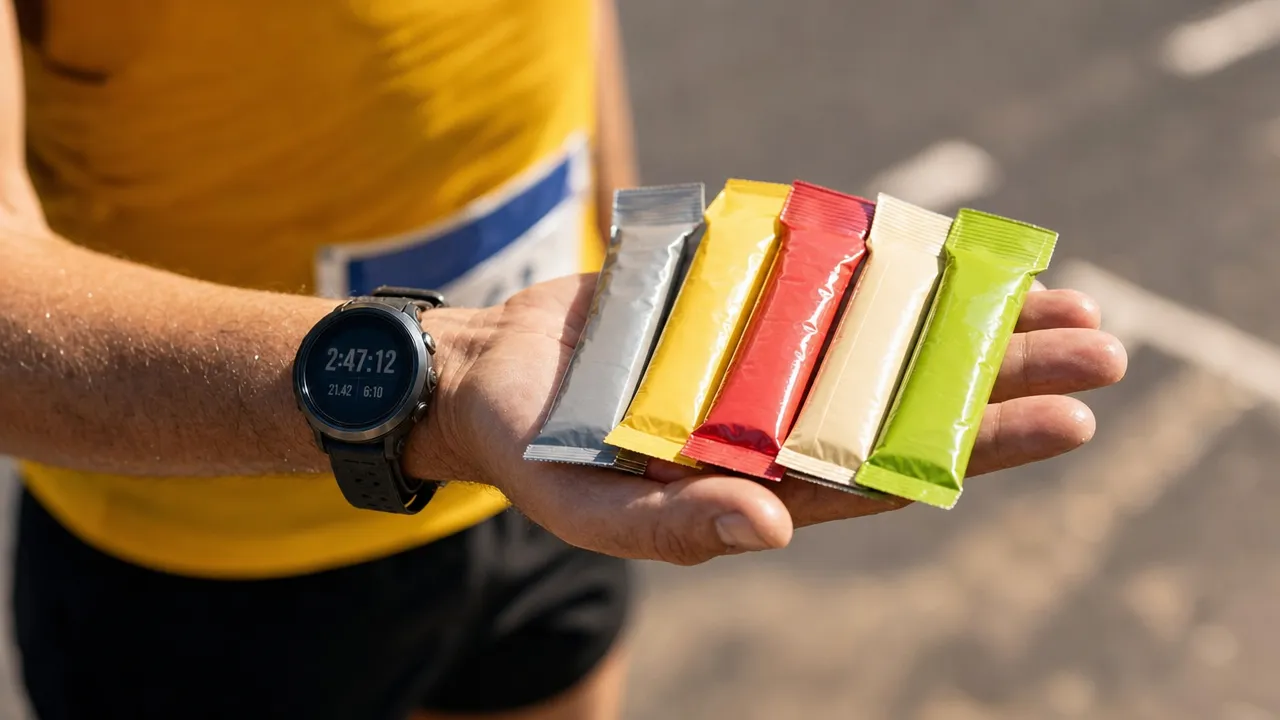
Marathon Fueling Strategy — Gel Timing by Pace and Distance
How many gels for a marathon? 5-8 gels at 30-min intervals, 30-60g carbs/hour. Gel timing blueprints for sub-3 to 5-hour goals, plus gut training protocol.
Key Takeaways
- Glycogen lasts 90-120 minutes at marathon pace — Without fueling, hitting the wall is near-certain for any marathon over 3 hours.
- Start fueling early (25-35 minutes in) — Waiting until tired means depletion is already underway and harder to reverse.
- Train your gut for 6 weeks before race day — Untrained stomachs reject gels; systematic gut training is the missing piece most skip.
- Never combine gels with sports drinks — The sugar overload creates a hypertonic solution causing cramping and nausea.
Here is the uncomfortable truth about race fueling: you cannot outrun bad nutrition. A runner with a 3:15 marathon engine and a broken fueling strategy will finish slower than a 3:30 runner who nails their gels. The longer the race, the more nutrition becomes the limiting factor — and the more a smart plan separates good races from great ones.
This guide goes beyond generic advice. We break down fueling by distance, give you concrete timing templates, and cover the gut-training protocol that makes race-day nutrition actually work. If you have ever bonked, had stomach cramps from a gel, or finished a race wondering if you ate too much or too little — this is for you.
Why Race Fueling Matters: The Energy Gap
Your body stores enough glycogen for roughly 90-120 minutes of running at marathon pace. For a 5K or 10K, that is plenty — you will finish before the tank is empty. But for a half marathon, the math gets tighter. And for a full marathon, running out of fuel is a near certainty without active fueling.
Our Wall Predictor models this precisely: given your pace, weight, training background, and nutrition plan, it estimates exactly when you will deplete glycogen. The goal of race fueling is simple — push that depletion point past the finish line.
Fueling Strategy by Distance
5K and 10K: No Fueling Needed
Races under 75 minutes do not require mid-race fueling. Your glycogen stores are more than sufficient. Focus instead on:
- Pre-race meal: 2-3 hours before, light and carb-rich (toast, banana, oatmeal)
- Hydration: Drink normally in the hours before; a few sips of water at the start line is enough
- Post-race: Refuel within 30-60 minutes with carbs and protein
The biggest nutrition mistake in short races is over-thinking it. Eat your normal breakfast, run hard, eat afterward. Use our Pre-Race Meal Planner to dial in the timing.
Half Marathon: The Transition Zone
A half marathon sits in a gray area. Faster runners (under 90 minutes) can finish on stored glycogen alone. Slower runners (2+ hours) will benefit from mid-race fueling. The safest approach: fuel regardless of your finish time.
- Pre-race: Full pre-race meal 3-4 hours before, 1-3g carbs per kg
- During race: 1-2 gels total — first at 30-40 minutes, second at 60-75 minutes if racing over 100 minutes
- Hydration: Water at every other aid station (every 4-5km)
Marathon: Where Fueling Defines the Race
The marathon is where nutrition strategy separates from optional to essential. Without fueling, you will hit the wall. Period. The question is not whether to fuel, but how much and how often.
- Pre-race: Full carb-loaded meal 3-4 hours before, 2-4g carbs per kg. You should have been carb loading for 48-72 hours already.
- During race: 30-60g carbohydrates per hour (detailed below)
- Hydration: 400-800ml per hour, with electrolytes after hour 2
Ultra Marathon (50K+): Continuous Fueling Machine
Ultras flip the script — you are essentially eating a meal while running for hours. Stomach tolerance becomes the primary constraint, not glycogen math.
- Target: 200-400 calories per hour from mixed sources
- Variety is critical: Gels, bars, sandwiches, bananas, potatoes, broth — flavor fatigue is real over 6+ hours
- Solid food becomes essential: Your gut can only handle pure sugar for so long; real food provides psychological and physiological relief
- Salt: Electrolyte capsules or salted foods every 30-60 minutes
The Gel Timing Blueprint
For most road racers (half marathon to marathon), gels are the primary fueling tool. Which gel to carry is a separate decision: our energy gel buying guide compares US and UK gels on carbs per packet, cost per 25 g of carbs and whether they need water. Here is how to time them for different marathon goals:
Sub-3:00 Marathon (4:16/km pace)
- Total gels: 5-6 gels (25g carbs each = 125-150g total)
- Schedule: First gel at 25 min, then every 25-30 minutes
- Carb rate: ~50g/hour
- Strategy: Higher intensity means faster gastric emptying — can handle more frequent gels
3:30 Marathon (4:58/km pace)
- Total gels: 5-7 gels
- Schedule: First gel at 30 min, then every 30 minutes
- Carb rate: ~45-50g/hour
- Strategy: Take gels with water at aid stations to maintain a predictable schedule
4:00 Marathon (5:41/km pace)
- Total gels: 6-8 gels
- Schedule: First gel at 30 min, then every 30-35 minutes
- Carb rate: ~40-45g/hour
- Strategy: Walk through aid stations for easier gel consumption; more time means more fueling opportunities
5:00 Marathon (7:07/km pace)
- Total gels: 7-10 gels (or mix of gels + solid food)
- Schedule: First at 30 min, then every 30-40 minutes
- Carb rate: ~35-40g/hour
- Strategy: Consider alternating gels with solid snacks (pretzels, banana pieces) to prevent flavor fatigue over 5 hours
Calculate your exact needs with the Gel Calculator and preview aid station locations with the Aid Station Planner.
Gut Training: The Missing Piece
Here is the number-one reason race-day fueling fails: untrained guts. If you have never eaten a gel while running 5:00/km, your stomach will revolt the first time you try it in a race. The GI system is trainable — like any other system in your body — but it requires practice.
The 6-Week Gut Training Protocol
- Weeks 1-2: During your long run, consume 20-30g carbohydrates per hour (1 gel or a few swigs of sports drink). Focus on tolerance, not performance.
- Weeks 3-4: Increase to 40-50g per hour. Practice taking gels at race pace, with water. Note which brands and flavors sit well.
- Weeks 5-6: Simulate race-day fueling exactly — same gels, same timing, same water intake. Your final long run before taper should be a full dress rehearsal.
The golden rule: Nothing new on race day. Every gel brand, every flavor, every timing interval should be tested in training first. Your stomach does not care about the free gels they hand out at kilometer 20 if you have never tried them before.
Aid Station Strategy
Knowing what to do at aid stations is an underrated race skill. Fumbling with cups and gels costs time and breaks rhythm.
- Plan which stations to use: You do not need to stop at every one. Use the Aid Station Planner to map your fuel points.
- Gel + water, not gel + sports drink: Taking a gel with a sports drink creates a hypertonic solution in your stomach (too much sugar at once), leading to cramping and nausea.
- Walk through aid stations: Seriously. The 10-15 seconds you lose walking is recovered in better fluid absorption and fewer GI issues. Many sub-3:00 marathoners walk aid stations.
- Pinch the cup: Squeeze the top of paper cups into a V-shape to drink without spilling while moving.
- Carry your own: If your preferred gel is not available on course, use a running belt or shorts pockets. Never gamble on unknown brands.
Troubleshooting: When Fueling Goes Wrong
Stomach Cramps or Nausea
Likely causes: too much fuel at once, gel + sports drink combo, dehydration, or trying an untested product. Fix: Slow your pace slightly, switch to water only for 10-15 minutes, then resume fueling at a lower dose.
Side Stitch
Often caused by eating too close to the start or high-fructose products. Fix: Exhale hard on the opposite foot strike; if persistent, slow to a walk for 30 seconds and press on the stitch.
Bonking Despite Fueling
If you fueled on schedule but still hit the wall, the issue is likely: insufficient carb loading beforehand, too-aggressive early pace (burning more glycogen than planned), or not enough carbs per hour. Our Wall Predictor can help diagnose which factor is the culprit.
Race Fueling Checklist
- 6 weeks before: Begin gut training during long runs
- 3 days before: Start carb loading (8-10g carbs per kg/day) — use the Carb Loading Calculator
- Night before: Familiar, carb-rich, low-fiber dinner
- Race morning: Pre-race meal 3-4 hours before (1-4g carbs per kg) — use the Pre-Race Meal Planner
- 30 minutes before start: Optional small carb boost (half a gel or sports drink)
- Race: Execute your practiced gel schedule, drink to thirst, walk aid stations
- Post-race: Carbs + protein within 30-60 minutes
Fueling Tools
- Gel Calculator — personalized gel count and timing schedule
- Aid Station Planner — map fueling points along your course
- Wall Predictor — glycogen depletion modeling
- Carb Loading Calculator — pre-race carbohydrate targets
- Calorie Calculator — total energy expenditure by distance
Race fueling starts weeks before the starting line. Our Marathon Nutrition Guide covers the full carb-loading protocol and pre-race meal planning, and none of it works without a solid base — the Runner's Diet Plan covers the daily macros and meals that training actually runs on. Fluid intake is equally critical — see our Hydration Guide for Runners for sweat rate testing and race-day hydration strategies.
Sources & References
- (2011). Nutrition for endurance sports: marathon, triathlon, and road cycling. Journal of Sports Sciences.
- (2014). A step towards personalized sports nutrition: carbohydrate intake during exercise. Sports Medicine.
- (2019). Contemporary nutrition strategies to optimize performance in distance runners. Nutrients.