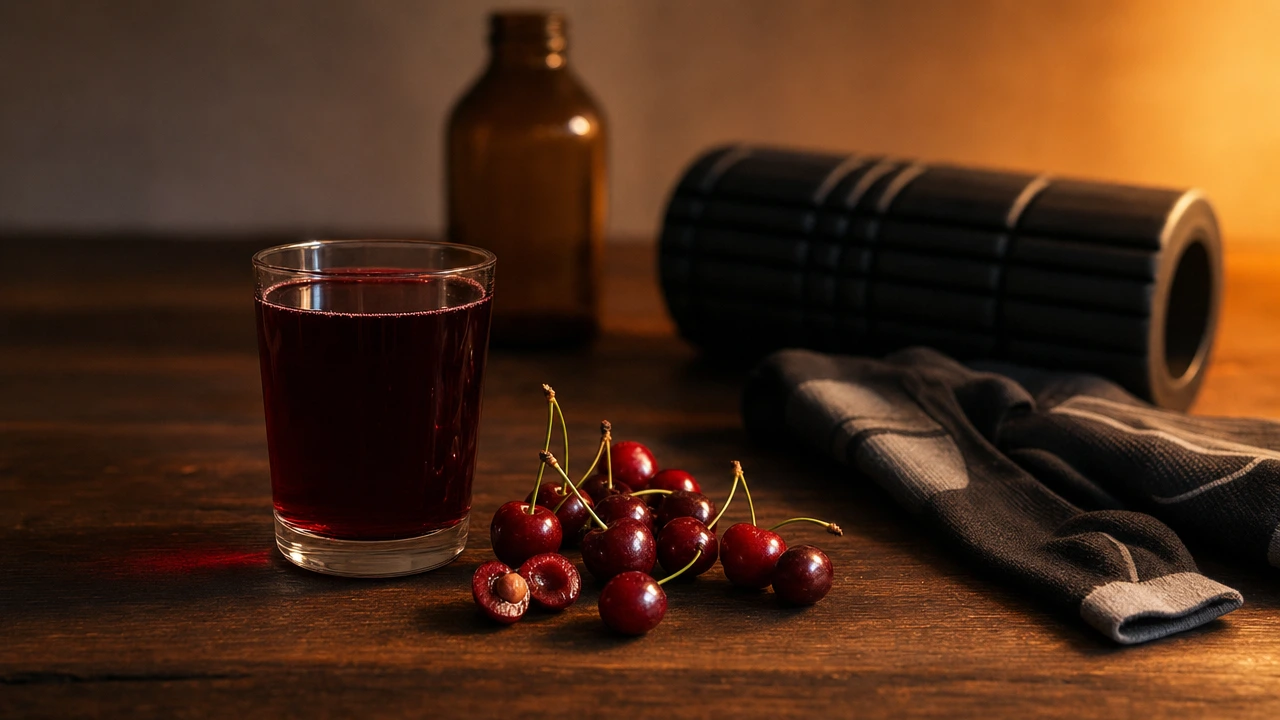
Tart Cherry Juice for Runners: Recovery and Race Day
Does tart cherry juice work? A 19-trial meta-analysis says it speeds strength recovery, not soreness - plus the 8-day protocol and the pre-race reversal.
Key Takeaways
- Take it for force, not for comfort: pooled across 19 trials it returns maximal voluntary contraction faster but does not touch soreness or creatine kinase.
- The recovery protocol is eight days — 5 before the race, race day, and the 48 hours after — at roughly 237 mL of ready-to-drink juice twice a day.
- The gout question has never been tested: the 35% figure is observational, and the randomised trial built to answer it stopped after 38 of a planned 120.
- No brand prints anthocyanin milligrams. Cherry counts are not a dose: two products with identical nutrition panels claimed 60 and 40 cherries.
- Eight days of it is about 50 g of sugar a day: useful work in a carb-loading week, a pointless daily addition in a base block.
Tart cherry juice is sold on a promise it does not keep. Pooled across 19 trials in trained athletes it does not make you less sore: "no significant pooled effects were found for muscle soreness, CK, IL-6, TNF-alpha, ROM, or most subgroup time points."
- Recovering from a marathon or hard endurance race: this is the job the evidence backs. Run the eight-day protocol below and judge it by what your legs can produce, not by how sore they feel.
- Well trained (65 mL/kg/min or above), after a pre-race edge: there is a small one, the opposite way round from beetroot — 2.83% in a 15 km cycling time trial with the dose 90 minutes out, significant in the trained half of the group only. Recreational: no pre-race improvement was measured, so save it for afterwards.
- A woman: the pooled performance data found no effect, and the recovery analysis reported no breakdown by sex, so on strength recovery it says nothing either way.
How to actually use it
- For recovery, run the eight-day protocol: 5 days before, race day, and the 48 hours after, at about 237 mL of ready-to-drink juice twice a day.
- For a pre-event dose, time it 90 minutes out — the best of the three timings tested.
- Check what you are buying. Ready-to-drink, dilute-first syrup and drink-neat "concentrate" are three different doses.
- Budget the sugar — roughly 50 g a day for eight days.
- Do not drink it year round — save it for race weeks.
- Clear it first if you take regular medication — the interaction literature is empty rather than reassuring.
On this page
- How to actually use it
- What it actually does
- The marathon study, and the protocol that came out of it
- The reversal: before a race, and only if you are well trained
- How to read a tart cherry label
- When it does not work
- Side effects, and the studies that do not exist
- Cherries and gout: what is actually known
- What about sleep
What it actually does
In that same 19-trial review, maximal voluntary contraction recovery improved at every time point measured, from immediately post-exercise out to 96 hours; countermovement jump improved at one point only, and C-reactive protein came down.
That is a real finding with a wide error bar around it, not a settled fact.
Evidence detail: the pooled effect sizes at each time point, and the authors' own caveats
The analysis is Daab et al., Sports Medicine Open, 2026. Maximal voluntary contraction recovery improved across all time points: effect sizes of 0.63 immediately post-exercise, 1.12 at 24 hours, 1.29 at 48 hours, 2.14 at 72 hours and 4.82 at 96 hours. Countermovement jump improved at one point only, 48 hours (ES 1.41). C-reactive protein was reduced post-exercise and up to 48 hours (ES -0.46, -0.73 and -0.68).
Now the caveats, which the authors state themselves. Heterogeneity was substantial (I-squared 69-93%). "Certainty of evidence ranged from very low to moderate." The conclusion sentence reads: "findings are heterogeneous and supported by low-to-moderate certainty of evidence, warranting cautious interpretation." A sensitivity analysis adds that "statistical significance at selected time points (MVC post and 72 h; CMJ 48 h; CRP 24-48 h) was influenced by individual studies" — remove one trial and some of those results move.
The marathon study, and the protocol that came out of it
The anchor trial recruited 20 recreational marathon runners, taking tart cherry juice or placebo "for 5 days before, the day of and for 48 h following a Marathon run" — eight days. Isometric strength recovered significantly faster. The next sentence of the abstract is the one nobody quotes: "No other damage indices were significantly different."
Be careful with what is actually documented. The eight-day timing is verbatim from the abstract; the per-day amount is not. It comes from secondary sources — about 8 fl oz (237 mL) of bottled ready-to-drink juice twice a day, roughly 120 cherries' worth. Not a concentrate to be diluted, which matters: drinking 237 mL of syrup-style concentrate is a completely different dose.
Evidence detail: which markers moved in that trial, and which one did not replicate
The trial is Howatson et al., 2010, and the isometric strength result it reports is P=0.024 (tart cherry versus placebo).
The paper counts muscle soreness among the damage markers it measured, so "No other damage indices were significantly different" covers soreness and creatine kinase — and the 19-trial pooled analysis later reached the same null independently.
Inflammation markers moved: C-reactive protein (P<0.01) and uric acid (P<0.05). Interleukin-6 was also significant in this single trial (P<0.001), but the later pooled analysis found no significant effect for IL-6, so treat that one as a single-study result that did not replicate. Total antioxidant status ran about 10% higher at every post-supplement measurement (P<0.05), and lipid peroxidation was lower at 48 hours.
The reversal: before a race, and only if you are well trained
Standard advice splits these neatly: beetroot before, cherry after. Two independent sources say that split is wrong.
A crossover trial timed Montmorency cherry concentrate 30, 90 or 150 minutes before a 15 km time trial. The 90-minute dose produced a 2.83% improvement — significant in the trained half of the group, not the recreationally active half. Phenolic metabolites peaked at 90 minutes while plasma nitrate did not move: the polyphenol pathway, a different lever from beetroot. Two limits before you act on it — that was a cycling time trial, not a run, and it is one trial with ten people per group.
| Who you are | Nitrate / beetroot | Polyphenols / tart cherry, taken pre-event |
|---|---|---|
| Recreational runner | Works, but the effect is small | No significant improvement measured |
| Well trained (VO2max 65+) | Not observed | Small but significant benefit |
| Women, either supplement | No effect found in the pooled female data ("no effect of nitrate or polyphenol consumption was found in females") | |
This is the opposite of how the two products are usually sold: the better trained you are, the less beetroot does and the more likely tart cherry is to do something. Both effects are small — the authors use the words "trivial" and "objectively small" themselves. The beetroot half is in the beetroot juice guide; the VO2max calculator tells you which row you are reading.
Evidence detail: the crossover trial's times, the 118-study analysis, and one scope note on the female row
The crossover result, verbatim: "MCC significantly improved TT performance, but not exercise economy. The greatest improvement in performance occurred following MCC90min compared to US (US 1603.1 ± 248 s vs. MCC90min 1554.8 ± 226.7 s, 2.83% performance improvement). Performance was significantly enhanced for trained (US 1496.6 ± 173.1 s vs. MCC90min 1466.8 ± 157.6 s) but not recreationally active participants." The authors add: "The ergogenic effect was greater for trained participants." The metabolites that peaked at 90 minutes were ferulic and vanillic acid.
A 118-study meta-analysis points the same way. "Trivial but significant benefits were demonstrated for consumption of nitrate and polyphenol-rich foods (SMD=0.15 and 0.17, respectively, p<0.001)", with Montmorency cherry named among the polyphenol foods showing benefit. The key line: "Well-trained males (VO2max 65 ml.kg.min-1 or above) exhibited small, significant benefits following polyphenol, but not nitrate consumption." Its conclusion: "Highly trained endurance athletes do not appear to benefit from consuming nitrate-rich foods but may benefit from polyphenol consumption."
The nitrate side of the female row is P = 0.347, and one scope note applies to that row: it comes from the performance analyses. The recovery meta-analysis reported on trained athletes without a sex breakdown, so it says nothing either way about women and post-race strength recovery.
How to read a tart cherry label
Try to compare two tart cherry products on dose and you hit the real problem: this category has no agreed unit of measure that lets a consumer compare products side by side — a statement about the category, not an accusation. Two causes stack up: anthocyanin concentration across batches of fresh cherries "varied almost 20-fold", and the measurement method is not standardised, so even two honestly measured products may not be on the same scale.
Across the brands checked in August 2026, none stated anthocyanin milligrams anywhere. What sits in that space is a substitute unit: cherry counts, weight of fruit, or equivalences such as "the antioxidant power of 1,000 tart cherries". All share one defect — there is no standardised anthocyanin content for "one cherry", so no count converts into a dose and no two counts compare.
Evidence detail: how far the raw material swings, what the researchers themselves asked for, and the label claims side by side
The 20-fold figure is sweet-cherry data, cited here as evidence that cherry raw material swings wildly from batch to batch rather than as a measurement of tart cherry products. Across cultivars, total phenolics span 74-754 mg per 100 g fresh weight and anthocyanins span 21-285 mg.
This is not an outsider's complaint. The authors of a 29-study review of cherry research wrote it into their own conclusion: "Developments of stable and standardized cherry products that retain nutrient composition of fresh cherries and of placebos devoid of polyphenols are desperately needed to precisely assess the health promoting effects of cherry consumption. It is important that all intervention studies report at least the daily total amounts of phenolics and anthocyanins served to study participants." Researchers are asking for the same numbers you are.
What brands print instead. Cherry counts: "60 TART CHERRIES / 8 OZ" and "50 TART CHERRIES / 8 OZ" on two products from one brand; "approximately 3,000 Montmorency cherries" per 946 mL from another; "Approximately 1,600 cherries per bottle" from a third. Weight of fruit: "made from 3 lbs. of organic cherries." Equivalences rather than contents: one bottle "delivers the antioxidant power of 1,000 tart cherries" and has "five times the antioxidants of sweet cherries"; on the beetroot side of the same shelf, "1 scoop = 40X the functional benefits of fresh beets."
Two pieces of evidence show the defect cleanly. Within one brand, a 59 mL recovery shot and a 74 mL concentrate pouch are identical on every nutrient both labels declare — 100 kcal, 23 g carbohydrate, 20 g sugar, 1 g protein, 45 mg sodium, 320 mg potassium — while claiming "60+" and "40" cherries respectively. Same measurable composition, a 50% gap in the claim. Both cannot be right.
Across brands it is worse, because the numbers are not even the same kind of claim. Two of them are ingredient statements; the third is an equivalence — a bottle that "delivers the antioxidant power of 1,000 tart cherries" is not telling you that 1,000 cherries went into it. Set 3,000, 1,600 and 1,000 side by side and you are holding two quantities up against an analogy. These figures do not qualify to sit in the same column.
The single most telling detail: on one brand's official article about how much tart cherry juice to drink per day, the only milligram figure on the entire page is "3mg of added melatonin". Anthocyanins get a qualitative sentence instead. The same company lists "320 mg of magnesium glycinate" on another product. Precise milligram labelling is clearly within reach when the ingredient is added rather than inherent; the molecule the recovery claim rests on is the one without a number. That is a verifiable contrast, stated as such — draw your own conclusion from it.
The category has a working counter-example, on the nitrate side: a 70 mL sports shot claiming 400 mg of nitrate was independently measured at 6.41 ± 0.60 mmol, which is about 397 mg. Claim and laboratory assay agree. That is what a checkable product looks like, and it exists; on the tart cherry side there is currently no equivalent, because there is no published number to check against.
Can you check a serving against the studied amount? The exercise studies in that 29-study review served the equivalent of 50 to 270 cherries per day, which the review's own authors describe as a high dose. On the cherry side you cannot hold a product up against that band, because some of the counts printed on labels are equivalence claims rather than statements of fruit content, and setting one of those against an amount of fruit people actually ate would repeat the exact error above. The beetroot side shows what the check looks like when the arithmetic is available: of the six beetroot powders in a 2019 independent testing round, not one stated a nitrate figure on its label and not one delivered 5 mmol in a single serving; measured contents ran from 0.43 to 2.56 mmol, so the weakest would take fourteen scoops or more to reach the research dose. Neither category is misstating a figure. Neither publishes one.
Two cautions on the 50-270 band before you use it as a target. Of the 29 human studies in that review, 20 used tart cherries, 7 used sweet cherries and 2 were unspecified, so it is a mixed pool. And the counts still cannot be converted to milligrams for the reasons above.
"Concentrate" means three different things
Syrup-style concentrate that must be diluted (a 30 mL or 40 mL dose), "concentrate" pouches drunk neat, and ready-to-drink juice — which is what the marathon trial used — all carry the same word. Confusing the first two ruins the dose in either direction: dilute the pouch and you drink a fraction of what you intended; drink 237 mL of the syrup and you are far past any studied protocol.
Evidence detail: how the three forms differ on the shelf
One brand instructs a 1-to-5 dilution for its syrup-style concentrate. A 2.5 fl oz (74 mL) pouch sold as "concentrate" is simply thicker than the same brand's ready-to-drink bottle, with no dilution step at all.
The sugar you are also buying
The eight-day protocol on one common ready-to-drink product means about 200 kcal and 50 g of sugar per day; the 270-cherry top of the studied band would mean roughly 4.5 bottles a day.
Whether that is a cost or a bonus depends on where it lands. In a carb-loading week it may be doing useful work — the carb loading calculator says how much you need — while in a base block it is a large daily sugar addition with no training purpose. Set it against your targets in the daily nutrition guide for runners.
Evidence detail: the other formulations, what the pooled trials found on glucose, and how price behaves
On the same brand's original formula the eight-day protocol runs 240 kcal and 58 g of sugar a day. Pushing to roughly 4.5 bottles a day means about 450 kcal and 112.5 g of sugar.
One thing that number does not automatically imply. A dose-response meta-analysis of 12 randomised trials, graded with GRADE, concluded that "tart cherry supplementation did not have significant effects on anthropometric and glycemic indices", while finding improvements in lipid profile. So the sugar is real arithmetic, but the knock-on to glucose measures you might expect has not appeared in the pooled trials. No trial has been run in people with diabetes at all, so if you manage blood sugar, the 50 g figure is information to take to your doctor rather than a decision this page can make.
On price, only structural conclusions age well. Within a single brand, covering one race week can differ by roughly three-fold depending only on which pack size you buy. And bulk is not automatically cheaper: the multi-serve bottle came out about 18% more expensive per serving than the single-serve pouches.
When it does not work
A trial with 36 participants took 2 x 250 mL daily for 9 days and performed heavy eccentric elbow flexor exercise. The damage was real, but there were no differences between groups: "neither TC nor POM enhance recovery from high-force eccentric exercise of the elbow flexors."
The honest boundary is narrower than the marketing: the supporting evidence sits in endurance-type, metabolically driven muscle damage — what a marathon produces — not high-force eccentric loading. What does help after a hard race is in the post-run recovery guide.
Evidence detail: how much damage that trial actually produced
Maximal voluntary contraction fell by up to 26.8% and creatine kinase rose as high as 1385 U/L — so the null is not explained by the protocol failing to cause damage.
The argument against drinking it every day
A review of nutritional interventions for muscle damage raises a question that applies directly here: the oxidative stress and inflammation these supplements target are "also crucial for the recovery and adaptation process", which "calls into question whether long term administration of supplements and functional foods used to target EIMD is indeed best practice." The authors flag "the potential hormetic effect of long term use."
Two things it does not say: it never names tart cherry, and it does not claim antioxidants ruin adaptation. The translation is uncontroversial anyway — use it in race weeks and dense competition blocks, not year round while you are building adaptation, the distinction supercompensation turns on. The training load calculator and recovery planner will place the week.
Side effects, and the studies that do not exist
No research has been designed to evaluate the adverse effects of tart cherry juice. That is not the same sentence as "the research found it safe": a search for adverse events or safety reporting turns up no study built to answer the question.
The one quotable safety line comes from a 282-person gout trial: "Adverse events were similar across all three groups." Read the design first — a cherry and citrate mixture, open label, two active comparators rather than a placebo.
On drug interactions the human literature returned no studies at all. Zero studies is not a clean bill of health — if you take regular medication, ask a pharmacist rather than infer from a running guide.
Evidence detail: one gap that is different in kind
Whether the melatonin in tart cherry interacts with sedative or sleep medication was not searched for this page at all. Its absence here carries no information either way.
Cherries and gout: what is actually known
The number everyone repeats comes from a case-crossover study of 633 people with gout: cherry intake "was associated with a 35% lower risk of gout attacks". Observational and self-reported — a correlation that cannot show cherries prevent anything.
Gout has diagnostic criteria, a first-line drug and a treatment target. Cherry juice is none of those; whether it earns a place alongside treatment is a question for the doctor managing it.
Evidence detail: the observational numbers, the two controlled trials, and the current treatment standard
In the case-crossover study the multivariate odds ratio was 0.65 [95% CI 0.50-0.85], and combining cherry intake with allopurinol was associated with a 75% lower risk (OR 0.25 [95% CI 0.15-0.42]).
The controlled evidence is thinner and points somewhere less convenient. A crossover trial in 26 overweight and obese adults, who did not have gout, found plasma urate fell from 378.3 to 320.8 micromolar (P < 0.05) on tart cherry juice, while the placebo arm moved from 382.1 to 390.2. And in the only reasonably sized trial in people who actually have gout, 282 men over 12 weeks, urine pH rose and serum urate fell in all three arms with no significant differences between them: the cherry-containing preparation performed like the standard alkalinising treatments it was compared against.
On the standard of care, the 2020 American College of Rheumatology guideline recommends allopurinol as the preferred first-line urate-lowering therapy, with treatment titrated to a serum urate below 6 mg/dL.
What about sleep
A systematic review of randomised placebo-controlled trials reports that "the consumption of milk and sour cherries, sources of melatonin, may improve sleep quality in humans." That is the whole claim, and it is weaker than it looks: the review covers milk and cherries together, in general rather than athletic populations. Since sleep is where most recovery happens, the higher-leverage work is upstream of any drink — see sleep and recovery for runners.
Evidence detail: what that review says about its own limits
It names its own limitation — "lack of homogeneity of treatment dosage and duration" — and closes with "Further studies are necessary."
Sources & References
- (2026). Effects of Tart Cherry Juice Supplementation on Recovery from Exercise-Induced Muscle Damage in Athletes: A Systematic Review and Meta-Analysis. Sports Medicine - Open.
- (2024). Montmorency cherry supplementation enhances 15 km cycling time trial performance: Optimal timing 90-min pre-exercise. European Journal of Sport Science.
- (2021). Effect of food sources of nitrate, polyphenols, L-arginine and L-citrulline on endurance exercise performance: a systematic review and meta-analysis of randomised controlled trials. Journal of the International Society of Sports Nutrition.
- (2010). Influence of tart cherry juice on indices of recovery following marathon running. Scandinavian Journal of Medicine & Science in Sports.
- (2018). A Review of the Health Benefits of Cherries. Nutrients.