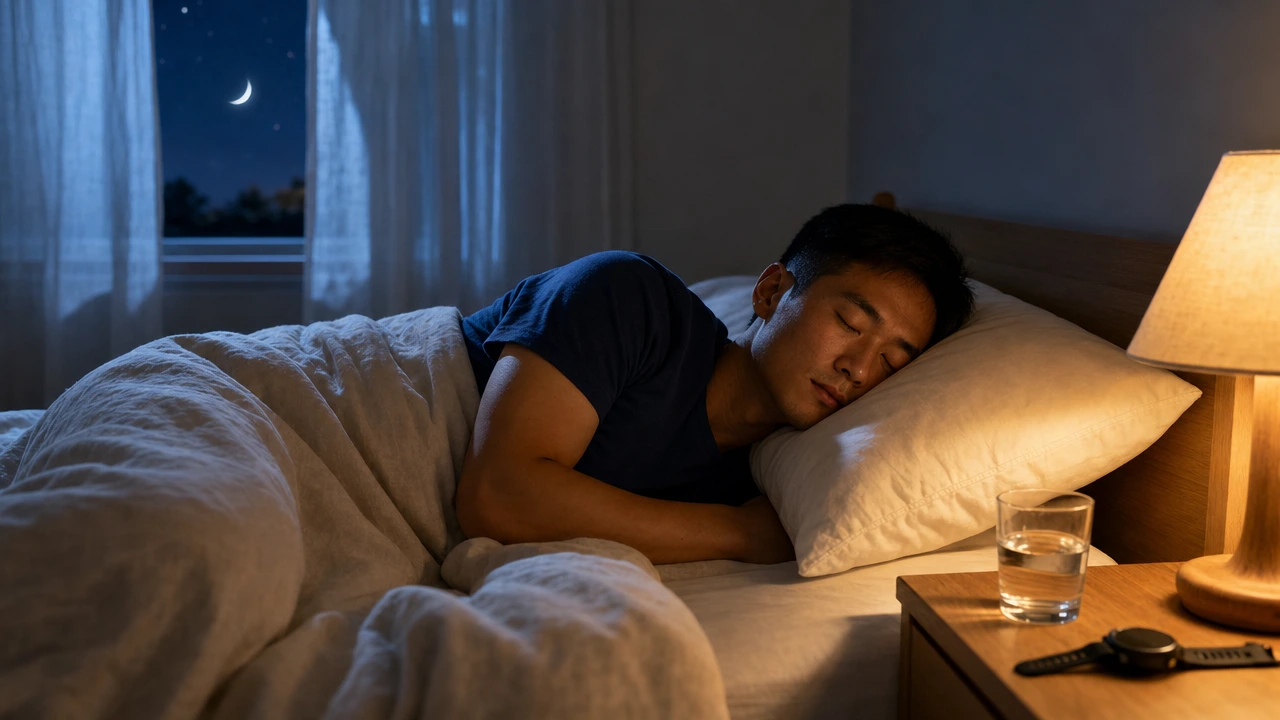
Sleep and Running: How Rest Drives Recovery and Performance
Sleeping under 7 hours raises injury risk by 70%. Sleep optimization strategies for runners: nap timing, training schedule tips, and pre-race insomnia facts.
Key Takeaways
- Sleep drives 75% of growth hormone release — Deep sleep (N3) is when your body performs the bulk of muscle repair, tendon healing, and bone remodeling; cutting sleep short directly impairs recovery.
- Less than 7 hours increases injury risk by 70% — Chronic sleep restriction impairs proprioception, reaction time, and tissue repair, making both acute and overuse injuries far more likely.
- Consistency beats duration — A regular sleep schedule (within 30 minutes daily) improves sleep efficiency more than occasional long sleeps; anchor your circadian rhythm for better recovery.
- Nap strategically — A 20-minute power nap or 90-minute full-cycle nap before 3pm partially compensates for nighttime deficits without disrupting evening sleep.
- Race-eve insomnia is harmless — One poor night minimally affects endurance performance; your sleep bank from the preceding 3-5 nights determines race-day readiness.
Sleep: The Most Powerful Recovery Tool You Are Not Using Enough
If you could take a legal performance-enhancing substance that improved reaction time by 12%, increased time to exhaustion by 30%, reduced injury risk by 68%, enhanced muscle protein synthesis, optimized hormone profiles, and cost nothing — you would take it without hesitation. That substance is sleep.
Despite decades of research confirming sleep as the single most important recovery modality, runners consistently undervalue it. A 2019 survey of recreational marathon runners found that 62% averaged fewer than 7 hours of sleep per night during training, well below the 7-9 hours recommended by the National Sleep Foundation and the 8-10 hours recommended for athletes by the American Academy of Sleep Medicine.
How Sleep Affects Running Performance
Endurance and Time to Exhaustion
Mah et al. (2011) conducted a landmark study on Stanford basketball players who extended their sleep to 10 hours per night for 5-7 weeks. Sprint times improved by 4.4%, free throw accuracy increased by 9%, and reaction time improved by 12%. While this study used basketball players, subsequent research confirmed similar benefits for endurance athletes.
A study in the European Journal of Applied Physiology found that runners who slept fewer than 6 hours the night before a time trial ran 3% slower than when they slept 8 hours. Over a marathon distance, that translates to approximately 6-8 minutes — the difference between a PR and a disappointing race. Use the Sleep Recovery Calculator to estimate how your sleep patterns affect your recovery timeline.
Injury Prevention
Milewski et al. (2014) found that adolescent athletes who slept fewer than 8 hours per night were 1.7 times more likely to be injured than those who slept 8+ hours. In runners specifically, sleep deprivation impairs proprioception (balance and body awareness), reduces reaction time, and compromises tissue repair — all factors that increase injury risk.
Chronic sleep restriction also reduces pain tolerance, meaning minor discomfort that you would normally run through becomes a distraction that alters your gait mechanics, potentially leading to compensatory injuries.
Hormonal Recovery
During deep sleep (slow-wave sleep), your body releases up to 75% of its daily growth hormone. Growth hormone is essential for muscle repair, tendon healing, and bone remodeling. Sleep deprivation dramatically reduces growth hormone output — research shows that sleep restriction to 4 hours significantly blunts the nocturnal GH surge, cutting sleep-related growth hormone release by roughly 30%.
Sleep also regulates cortisol, the primary stress hormone. Normally, cortisol drops to its lowest levels during early sleep and rises gradually toward morning. Sleep deprivation keeps cortisol elevated, maintaining a catabolic (tissue-breaking) state that directly opposes recovery.
Sleep Architecture for Runners
Understanding Sleep Stages
A complete sleep cycle lasts approximately 90 minutes and includes four stages:
- Stage 1 (N1): Light sleep lasting 5-10 minutes. Transition from wakefulness.
- Stage 2 (N2): Core sleep lasting 20-25 minutes. Body temperature drops, heart rate slows. Motor memory consolidation begins.
- Stage 3 (N3 — Slow-Wave Sleep): Deep sleep lasting 20-40 minutes. This is the physically restorative stage — growth hormone peaks, tissue repair accelerates, immune function strengthens. Most slow-wave sleep occurs in the first half of the night.
- REM Sleep: Dream stage lasting 10-60 minutes. Cognitive recovery, emotional processing, and motor skill consolidation. REM periods lengthen as the night progresses — most REM occurs in the second half of sleep.
For runners, both N3 and REM are critical. N3 handles physical recovery while REM processes the neuromuscular patterns you practiced during training. Cutting sleep short from either end impairs recovery.
Why 7-9 Hours Is the Minimum for Runners
A typical night includes 4-6 complete sleep cycles. Sleeping only 6 hours gives you roughly 4 cycles, losing an entire cycle of REM-dominant late sleep. Athletes in heavy training may need 9-10 hours because the increased tissue damage and metabolic demands require additional repair time.
Walsh et al. (2021) published consensus recommendations stating that athletes should aim for at least 8 hours of sleep opportunity (time in bed) with a target of 7+ hours of actual sleep, and that 9-10 hours is appropriate during intensified training blocks.
Sleep Optimization Strategies for Runners
Pre-Sleep Routine
- Consistent sleep schedule: Go to bed and wake up within 30 minutes of the same time every day — including weekends. This anchors your circadian rhythm and improves sleep efficiency.
- Cool bedroom: Optimal sleep temperature is 18-20°C (64-68°F). Your core body temperature needs to drop 1-2°F to initiate sleep. A warm bath 60-90 minutes before bed paradoxically helps by triggering peripheral vasodilation and subsequent core cooling.
- Darkness: Even dim light exposure suppresses melatonin. Use blackout curtains and eliminate all light sources. If that is not possible, wear a comfortable sleep mask.
- Screen curfew: Blue light from phones and laptops suppresses melatonin production for up to 90 minutes. Set a hard cutoff 60-90 minutes before bed, or use blue-light-blocking glasses.
- Caffeine cutoff: Caffeine has a half-life of 5-6 hours. A 2pm coffee still has roughly a third of its caffeine active at 10pm. Set your last caffeine intake at 10-12 hours before bedtime — earlier for slow metabolizers.
Training Timing and Sleep
Exercise timing affects sleep quality significantly. High-intensity training (tempo runs, intervals) in the evening can elevate core temperature, heart rate, and sympathetic nervous system activity for 2-3 hours post-workout, potentially delaying sleep onset.
- Morning runs: Ideal for sleep. Morning exercise reinforces circadian rhythm and has no negative effect on nighttime sleep.
- Afternoon runs (2-5pm): May actually improve sleep quality due to the subsequent body temperature drop coinciding with bedtime.
- Evening runs: Easy runs are generally fine. Avoid high-intensity sessions within 3 hours of bedtime. If evening is your only option for hard sessions, extend your pre-sleep cool-down routine.
Plan your training schedule with the Training Plan Calculator to align hard sessions with your optimal training windows.
Strategic Napping for Runners
Napping is a legitimate recovery strategy when used correctly. Research shows that a well-timed nap can partially compensate for nighttime sleep deficits and enhance afternoon performance.
The Power Nap (20 minutes)
A 20-minute nap between 1-3pm provides alertness restoration without entering deep sleep, meaning you wake up refreshed rather than groggy. This is ideal for runners who have an afternoon or evening session after a shortened night of sleep.
The Recovery Nap (90 minutes)
A 90-minute nap allows a complete sleep cycle including one period of slow-wave sleep and one period of REM. This provides meaningful physical recovery benefit and is especially valuable during heavy training blocks or stage races. Time it for early afternoon to minimize nighttime sleep disruption.
Napping Rules
- Nap before 3pm to avoid disrupting nighttime sleep
- Choose either 20 minutes or 90 minutes — avoid 30-60 minute naps that leave you in deep sleep upon waking
- Use napping to supplement nighttime sleep, not replace it
- If you cannot nap, even a 10-minute eyes-closed rest (non-sleep deep rest) provides partial recovery benefit
Sleep and Running-Specific Challenges
Pre-Race Insomnia
Difficulty sleeping before a race is extremely common and, thankfully, largely inconsequential. Research shows that one night of poor sleep has minimal impact on endurance performance. Your body draws on sleep reserves from the preceding week. Focus on sleeping well during the 3-5 nights before race night rather than obsessing over the night immediately before.
Post-Long-Run Sleep Disruption
Long runs and hard workouts can paradoxically disrupt sleep by elevating cortisol, core temperature, and sympathetic nervous system activity. Strategies to counter this:
- Complete long runs earlier in the day when possible
- Use a cool shower or cold water immersion post-run
- Consume a carbohydrate-rich meal within 2 hours of the run
- Avoid screens and stimulating activities before bed
- Consider magnesium supplementation (200-400mg magnesium glycinate), which has mild sleep-promoting effects
Early Morning Training
Runners who train at 5-6am often sacrifice sleep to fit in their sessions. If your alarm goes off at 4:45am and you went to bed at 11pm, you are getting fewer than 6 hours of sleep — chronically insufficient for recovery. Solutions: go to bed earlier (non-negotiable), or move some sessions to a lunch break or evening slot.
Sleep Tracking: What Matters and What Does Not
Consumer sleep trackers (wrist-worn devices) provide useful estimates of sleep duration and consistency but are poor at accurately staging sleep (differentiating N1, N2, N3, and REM). Use your tracker for:
- Total sleep time trends: Are you consistently getting 7+ hours?
- Consistency: Are your bedtime and wake time stable?
- Sleep efficiency: What percentage of your time in bed is spent actually sleeping?
Do not stress over specific deep sleep or REM percentages reported by consumer devices — the accuracy is insufficient for meaningful conclusions. If you are sleeping 8+ hours consistently and waking feeling rested, your sleep architecture is almost certainly adequate.
Track your sleep and recovery patterns using the Recovery Planner alongside your Training Load Calculator to understand how sleep quality correlates with your readiness to train.
Sleep is one component of a comprehensive recovery strategy. For the full picture of post-run recovery methods including nutrition, active recovery, and HRV monitoring, see our Post-Run Recovery Guide. If you suspect you may be under-recovering, our Overtraining Prevention Guide helps you recognize the warning signs before they become serious.
Sources & References
- (2015). Sleep and athletic performance: the effects of sleep loss on exercise performance, and physiological and cognitive responses to exercise. Sports Medicine.
- (2013). Sleep, Recovery, and Athletic Performance: A Brief Review and Recommendations. Strength and Conditioning Journal.
- (2011). The Effects of Sleep Extension on the Athletic Performance of Collegiate Basketball Players. Sleep.
- (2021). Sleep and the athlete: narrative review and 2021 expert consensus recommendations. British Journal of Sports Medicine.