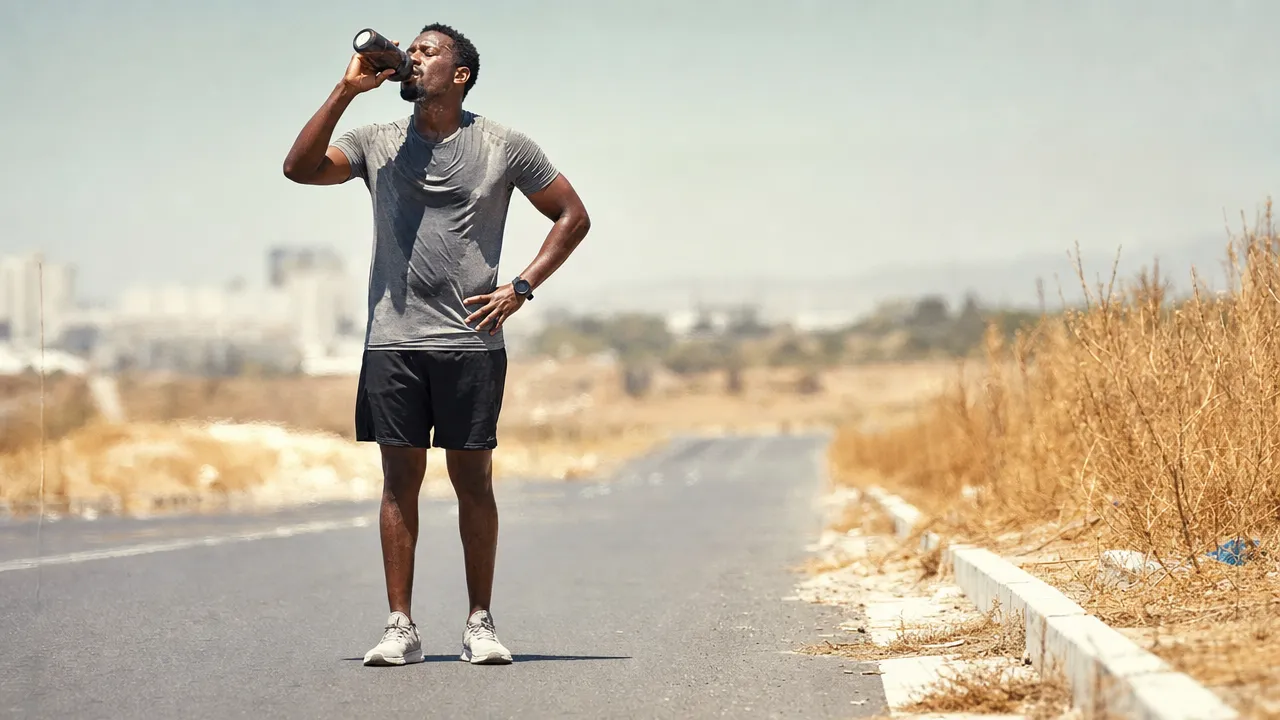
How Hot Is Too Hot to Run? Heat Safety & Pace Guide
How hot is too hot to run? A °C/°F threshold table, heat-illness warning signs, pace-slowdown percentages, and free calculators for safe summer running.
Key Takeaways
- Heat costs 0.3-0.5% pace per degree above 15°C (59°F) -- Accept slower paces in heat as a physiological reality, not a fitness failure. Run by heart rate, not pace, when temperatures rise.
- Acclimatize over 10-14 days -- Gradual heat exposure produces dramatic adaptations including plasma volume expansion, earlier sweating, and lower exercising heart rate. Start at 75% intensity.
- Dew point is your best decision metric -- Below 10°C (50°F) is comfortable; above 21°C (70°F) is dangerous. Check it before every hot-weather run using environment calculators.
- Train through summer for the fall payoff -- Runners who maintain HR-based training in heat consistently experience 6-8 weeks of dramatically improved performance when temperatures drop, thanks to lasting plasma volume adaptations.
Heat is the most dangerous environmental condition runners face. Every year, heat-related illness sidelines thousands of runners and, in the worst cases, proves fatal. Yet with proper preparation, acclimatization, and real-time decision-making, you can train and race safely in conditions that would otherwise be hazardous. This guide covers the physiology of heat stress, evidence-based acclimatization protocols, pace adjustment strategies, hydration planning, warning signs of heat illness, and race-day tactics for hot conditions.
Is It Too Hot to Run? Temperature Decision Guide
There is no single "too hot" cutoff, because humidity shifts every threshold — but air temperature gives you a fast first read. Match today's reading to the band below, then cross-check the dew point (high risk above 21°C / 70°F). When conditions sit between two bands, the hotter verdict wins.
| Air temperature | Verdict and action |
|---|---|
| Below 15°C (59°F) | Green light. No heat penalty — goal pace is realistic. |
| 15-25°C (59-77°F) | Caution. Low-to-moderate heat stress; slow slightly and start running by effort. |
| 25-32°C (77-90°F) | Hard. Moderate-to-high heat stress; switch to heart-rate pacing, hydrate aggressively, favor early-morning starts. |
| 32-40°C (90-104°F) | Too hot for hard efforts. Easy runs only, shade and water mandatory, watch for heat-illness signs. |
| Above 40°C (104°F) | Do not run outdoors. Move to a treadmill or postpone. |
Source: RunDida's heat-adjustment model — a pace penalty begins above 15°C (59°F), with risk tiers at 25°C (77°F), 32°C (90°F), and 40°C (104°F) — combined with the heat-illness warning signs detailed below. There is no single official cutoff because humidity moves every line; confirm current conditions with the Dew Point Calculator and Heat Pace Adjustment Calculator.
How Heat Affects Running Performance
When ambient temperature rises above 15°C (59°F), your body faces a fundamental resource conflict: it needs blood flow to deliver oxygen to working muscles and blood flow to the skin surface to dissipate heat through sweating and convection. As temperature climbs, the cardiovascular system is forced to split resources, and running performance pays the price.
The key physiological changes in heat include:
- Elevated core temperature: Your core temperature rises faster and higher during hot-weather running. When core temperature approaches 39-40°C (102-104°F), the brain reduces motor output to protect organs -- this is why you slow down involuntarily in heat.
- Cardiac drift: Heart rate climbs progressively at the same pace because more blood is diverted to the skin for cooling. A pace that feels easy at 15°C (59°F) may push your heart rate 10-20 beats per minute higher at 30°C (86°F).
- Increased sweat rate: Your body can produce 1-2.5 liters of sweat per hour in hot conditions, depleting fluid and electrolytes rapidly.
- Reduced plasma volume: Fluid loss through sweat reduces blood plasma volume, making your heart work harder to maintain the same cardiac output.
The combined effect is significant: pace drops 5-15% depending on temperature, humidity, and individual heat tolerance. This is not a failure of fitness or mental toughness -- it is basic physiology. Use the Weather Score Calculator to assess how current conditions will affect your expected performance.
Understanding Heat Metrics: What the Numbers Mean
Air temperature alone is a poor predictor of heat stress during exercise. Humidity, wind, and solar radiation all influence how effectively your body can cool itself. Several metrics exist to capture this complexity, and understanding which to use will help you make better training decisions.
- Heat Index: Combines air temperature and relative humidity to estimate how hot it feels to the human body. When humidity is high, sweat evaporates slowly, reducing your primary cooling mechanism. Use the Heat Pace Adjustment Calculator to check conditions before heading out. A heat index above 40°C (104°F) is dangerous for exercise.
- Feels-Like Temperature: A broader metric that factors in humidity, wind speed, and sun exposure to give a single perceived temperature value. The Dew Point Calculator provides this integrated assessment. In winter, wind chill makes it feel colder; in summer, humidity makes it feel hotter.
- Dew Point: The temperature at which air becomes saturated with moisture. For runners, dew point is arguably the most useful single metric because it measures absolute moisture in the air regardless of temperature. Calculate it with the Dew Point Calculator.
Dew point thresholds for runners (a quick-reference summary — for the full interactive chart and an instant reading for your exact conditions, use the Dew Point Calculator):
- Below 10°C (50°F): Dry, comfortable conditions. Minimal heat impact.
- 10-15°C (50-59°F): Comfortable for most runners. Slight performance impact.
- 16-18°C (61-64°F): Noticeable humidity. Moderate pace adjustment needed.
- 19-21°C (66-70°F): Uncomfortable. Significant pace reduction required.
- Above 21°C (70°F): Oppressive. High risk conditions. Slow substantially or move indoors.
WBGT (Wet Bulb Globe Temperature) is the gold standard used by sports medicine organizations. It integrates temperature, humidity, wind, and solar radiation into a single number. The American College of Sports Medicine (ACSM) recommends delaying or canceling endurance events when WBGT exceeds 28°C (82°F) (Armstrong 2007). Most runners cannot measure WBGT directly, but combining heat index, dew point, and wind data gives a reasonable approximation.
Heat Acclimatization: The 10-14 Day Protocol
Heat acclimatization is the process of gradually exposing your body to heat stress so it adapts to perform better in hot conditions. It is one of the most effective legal performance interventions available -- acclimatized runners can perform 5-10% better in heat compared to unacclimatized runners at the same fitness level.
The evidence-based protocol (Racinais 2015) involves:
- Duration: 10-14 consecutive days of heat exposure, with 90-minute sessions at conditions approximating 30°C (86°F) WBGT or above.
- Initial intensity: Start at approximately 75% of your normal training intensity. Unacclimatized runners who push too hard in the first few days risk heat illness before adaptations begin (Racinais 2015).
- Progressive overload: Gradually increase intensity and duration over the 10-14 day window as your body adapts. By days 10-14, you should be able to train at near-normal intensity in conditions that were debilitating on day one.
- Consistency: Missing more than 2 consecutive days significantly reduces adaptation. Heat acclimatization decays within 2-3 weeks of returning to cool conditions.
Physiological Adaptations
The adaptations your body makes during acclimatization are remarkable:
- Plasma volume expansion: Blood plasma volume increases by 10-15%, improving cardiac output and thermoregulation. This is the first adaptation, typically occurring within 3-5 days.
- Earlier and more profuse sweating: Sweat glands activate at a lower core temperature and produce more sweat, improving evaporative cooling.
- More dilute sweat: Sodium concentration in sweat decreases, conserving electrolytes.
- Lower resting and exercising core temperature: Baseline core temperature drops, giving you a larger buffer before reaching dangerous levels.
- Lower exercising heart rate: Cardiac drift is reduced because plasma volume is higher and thermoregulation is more efficient.
- Reduced perceived exertion: The same pace feels easier in the heat after acclimatization.
If you are training for a hot-weather race and live in a cool climate, simulate heat exposure by running in the warmest part of the day, wearing extra layers during easy runs, or using a sauna for 20-30 minutes after training. These are imperfect substitutes for true heat training but trigger partial adaptations.
Adjusting Your Pace for Hot Conditions
Attempting to maintain your cool-weather pace in the heat is the most common mistake runners make -- and one of the most dangerous. Your body simply cannot sustain the same output when it is diverting significant cardiovascular resources to thermoregulation.
General guidelines for pace adjustment based on temperature:
- 15-20°C (59-68°F): Slow by 0-15 seconds per kilometer
- 20-25°C (68-77°F): Slow by 15-30 seconds per kilometer
- 25-30°C (77-86°F): Slow by 30-60 seconds per kilometer
- Above 30°C (86°F): Slow by 60+ seconds per kilometer, or consider postponing
These are starting points -- individual heat tolerance varies significantly. Use the Dew Point Calculator for a more precise assessment that accounts for humidity and wind.
How Much Heat Slows You Down: Modeled Pace Penalty
The table below quantifies the slowdown using RunDida's heat-adjustment model — a Galloway-style layered curve that starts penalizing pace above 15°C (59°F) and steepens as heat climbs. Figures assume dry air (relative humidity at or below 40%); the penalty rises further as humidity increases.
| Air temperature | Pace penalty |
|---|---|
| 20°C (68°F) | ~1.0% slower |
| 25°C (77°F) | ~3.0% slower |
| 28°C (82°F) | ~4.8% slower |
| 30°C (86°F) | ~6.0% slower |
| 33°C (91°F) | ~8.4% slower |
Source: RunDida's heat-adjustment model (a Galloway-style layered curve of 0.2 to 1.1% per °C accumulating across bands above 15°C / 59°F). These are planning estimates from our own tool, not an official governing-body standard, and climb higher with humidity. Run your exact pace, distance, and humidity through the Heat Pace Adjustment Calculator for a personalized number.
The Dew Point Approach
Many experienced coaches prefer dew-point-based adjustments because dew point captures humidity more reliably than relative humidity alone. Calculate the current dew point with the Dew Point Calculator, then apply these adjustments:
- Dew point 10-15°C (50-59°F): Reduce pace by 1-2%
- Dew point 16-18°C (61-64°F): Reduce pace by 3-5%
- Dew point 19-21°C (66-70°F): Reduce pace by 5-8%
- Dew point above 21°C (70°F): Reduce pace by 8-12% or move indoors
For training runs, use heart rate rather than pace as your primary guide. If your easy run heart rate zone is 130-145 bpm, keep your heart rate in that range regardless of how slow the pace becomes. This ensures you are getting the intended training stimulus even when heat forces you to slow down.
Letting Go of Pace: Heart Rate as Your Summer Guide
The shift from pace-based to heart-rate-based training can feel psychologically difficult, especially for runners accustomed to hitting specific splits. A practical approach: "I just switch to monitoring my heart rate and run for some period of time, usually an hour. I don't care about pace or distance, just keeping that HR down". This reframes summer training from "slower than I should be" to "exactly the effort I intended."
Your aerobic system receives the same training stimulus at 6:30/km in 33°C (91°F) heat as it does at 5:45/km in 15°C (59°F) weather — the heart rate is what matters, not the number on your watch. For a detailed reference on heart rate zones and effort levels, see the Heart Rate Zone Calculator.
Hydration Strategy for Hot Weather Running
Fluid losses during hot-weather running can reach 1.5-2.5 liters per hour, far exceeding your stomach's ability to absorb fluid (typically 800 ml-1 liter per hour). The goal is not to replace 100% of fluid losses during the run, but to prevent dehydration from exceeding 2-3% of body weight, which is the threshold where performance degrades significantly.
Before Your Run
Pre-hydration in the 2-4 hours before a hot run is critical. Aim for 5-7 ml per kg of body weight (350-490 ml for a 70 kg runner). Your urine should be pale yellow -- not clear (which indicates over-hydration) and not dark amber (which indicates dehydration). Use the Hydration Calculator for personalized pre-run and during-run fluid targets.
Experienced runners emphasize that hydration is fundamentally a before activity. "I force myself to drink half a litre of water when I wake up," reports one runner who trains through tropical summers. The reasoning is straightforward: "If you're not well hydrated when you start there is no way to recover that on the run". Starting a hot-weather run even mildly dehydrated means fighting a deficit you cannot close, because your gut absorption rate is already slower than your sweat rate in the heat.
During Your Run
- General target: 400-800 ml per hour, adjusted upward in extreme heat
- Electrolytes: In runs over 60 minutes in heat, plain water is insufficient. You need sodium (300-700 mg per liter of fluid) to maintain blood sodium levels and drive fluid absorption in the gut.
- Frequency: Small, frequent sips (every 15-20 minutes) are better tolerated than large gulps. Set a watch timer if needed.
Sweat Rate Testing
Your individual sweat rate determines your exact needs. To measure it: weigh yourself before and after a 60-minute run in the heat, adding back any fluid consumed. Every kilogram of weight lost equals approximately 1 liter of sweat. Repeat this test at different temperatures to understand how your sweat rate varies with conditions. For a detailed protocol and hydration planning, see our Hydration Guide for Runners.
After Your Run
Rehydrate with 1.5 liters of fluid for every kilogram of body weight lost during the run. Include sodium-rich fluids or foods to restore electrolyte balance. Full rehydration can take 4-6 hours after a heavily sweating session.
What to Wear When Running in Heat
Clothing choices directly affect your thermoregulation efficiency. The right gear can reduce heat stress; the wrong gear amplifies it. Use the What to Wear Calculator for temperature-specific clothing recommendations.
Fabric and Fit
- Material: Lightweight, moisture-wicking synthetic fabrics (polyester, nylon blends) or merino wool. Cotton absorbs sweat and traps it against your skin, reducing evaporative cooling.
- Color: Light colors (white, pale yellow, light gray) reflect solar radiation. Dark colors absorb it. In direct sun, a white shirt can be 5-10°C (9-18°F) cooler on the surface than a black shirt.
- Fit: Loose-fitting clothing allows air circulation between fabric and skin, enhancing convective cooling. Compression gear in extreme heat can trap heat against the body.
- Minimal coverage: Singlet and shorts expose the most skin for evaporative cooling. However, in extreme sun exposure, a lightweight long-sleeve sun shirt can paradoxically keep you cooler by blocking direct radiation while still allowing sweat evaporation.
Sun Protection
- Hat or visor: A visor keeps sun off your face while allowing heat to escape from the top of your head. A full cap provides more sun protection but traps more heat. In very hot conditions, a visor is generally preferable.
- Sunglasses: Reduce squinting fatigue and protect eyes from UV radiation. Sport-specific frames with ventilation prevent fogging.
- Sunscreen: SPF 30+ on all exposed skin. Apply 20-30 minutes before running. Sweat-resistant formulas are essential. Note that thick sunscreen can impair sweat evaporation slightly, so use the minimum effective amount.
Cooling Strategies
- Ice bandana or neck gaiter: Wrapping ice around your neck targets the carotid arteries, cooling blood flowing to the brain.
- Sponges at aid stations: Squeezing cold water over your head, neck, and forearms provides immediate cooling.
- Cold water dousing: Pouring water on your hat and shirt creates ongoing evaporative cooling as you run.
In cold or windy conditions, the dynamics reverse. The Wind Effect Calculator helps you understand how wind and low temperatures combine to increase heat loss, which becomes the concern during winter running rather than overheating.
Recognizing and Preventing Heat Illness
Heat illness exists on a spectrum from mild (heat cramps) to life-threatening (heat stroke). Every runner who trains or races in warm weather must know the warning signs and when to stop. This knowledge can save your life or the life of a fellow runner.
Heat Cramps
Signs: Involuntary muscle spasms, usually in the calves, hamstrings, or abdomen. Caused by electrolyte depletion and dehydration.
Action: Stop running. Move to shade. Stretch the affected muscles gently. Drink fluids with electrolytes. Cramps typically resolve within 15-30 minutes. You can cautiously resume running once cramps fully subside, but consider ending the session if they return.
Heat Exhaustion
Signs: Heavy sweating, pale and clammy skin, nausea, dizziness, headache, weakness, rapid and weak pulse, muscle cramps, fatigue far beyond what your effort level should produce.
Action: Stop running immediately. Move to the coolest available location. Lie down and elevate legs. Remove excess clothing. Apply cold water or ice to neck, armpits, and groin. Sip cool fluids if conscious and not vomiting. Heat exhaustion is serious -- if symptoms do not improve within 15-20 minutes, seek medical attention. Do not attempt to continue running.
Heat Stroke
Signs: Core temperature above 40°C (104°F), confusion or disorientation, loss of coordination, slurred speech, hot and dry or hot and sweaty skin, seizures, loss of consciousness. Heat stroke can develop rapidly from heat exhaustion if warning signs are ignored.
Action: This is a medical emergency. Call emergency services immediately. Begin aggressive cooling: immerse in cold or ice water if possible, or apply ice packs to neck, armpits, and groin. Do not give fluids to an unconscious person. Keep cooling until emergency services arrive. Time is critical -- heat stroke mortality increases dramatically with each minute of elevated core temperature.
When to Stop Running
Do not negotiate with these warning signs. Stop immediately if you experience:
- Confusion or difficulty thinking clearly
- Nausea or vomiting
- Vision changes or seeing spots
- Goosebumps or chills despite hot conditions (your thermoregulation is failing)
- Cessation of sweating in hot conditions
- Heart rate that remains elevated despite slowing pace significantly
- Dizziness that does not resolve after walking for 2-3 minutes
Abandoning a training run is always the right decision when heat illness symptoms appear. No single workout or race is worth a trip to the emergency room -- or worse. For broader guidance on recognizing and managing running injuries and health emergencies, see our Running Injury Prevention guide.
Community Experience: Heat Illness Has Lasting Consequences
The clinical descriptions above may feel abstract until you hear from runners who have experienced them firsthand. One runner collapsed at mile 11 of the Bangkok Half Marathon — seizures, three days in a Thai ICU, and three years before being able to run a half marathon again. "I'm supposedly more vulnerable to heat strokes in the future," they reported, underscoring that a single episode of exertional heat stroke can permanently alter your thermoregulatory system.
Another runner described blacking out after walking directly from a 35°C (95°F) outdoor run into cold air conditioning — the rapid temperature differential caused a cardiovascular shock response. These are not worst-case outliers. They are reminders that heat illness operates on a different risk curve than most running injuries: the consequences are not measured in missed training days, but in years of recovery and permanently elevated vulnerability.
Racing in the Heat: Strategy and Preparation
Racing in hot conditions requires adjustments to every aspect of your race plan -- from goal time to pacing to fueling. The runners who perform best in the heat are those who accept the conditions and race the day, not their fitness.
Pre-Cooling
Pre-cooling before a hot race can lower starting core temperature and extend the time before heat limits performance. Evidence-based pre-cooling methods include:
- Cold towel on neck and forearms for 10-15 minutes before the start
- Ice slurry: Drinking a slushy mixture of crushed ice and sports drink in the 30 minutes before the gun. Research shows this can lower core temperature by 0.3-0.5°C (0.5-0.9°F) and improve subsequent performance by 3-6%.
- Cold water immersion: 10-15 minutes in cool (15-20°C / 59-68°F) water before warming up for the start. Practical only if facilities are available.
Race-Day Heat Management
- Adjust your goal time: Apply the temperature and dew-point adjustments described earlier in this guide. A 3:30 goal in 15°C (59°F) weather might become 3:45-3:55 in 30°C (86°F) weather. Use the Heat Pace Adjustment Calculator and Weather Score Calculator to quantify the expected impact.
- Start conservatively: In hot conditions, aggressive early pacing is even more costly than in cool weather because you generate more metabolic heat at higher intensities. Target 5-10 seconds per kilometer slower than adjusted pace for the first 5-10 km. This is detailed further in our Race Day Preparation guide.
- Use every aid station: Drink at every fluid station and pour water over your head, neck, and forearms. Lost seconds at aid stations are repaid many times over in the final kilometers.
- Electrolyte strategy: In races over 90 minutes in heat, sodium depletion becomes a real factor. Carry salt tablets or electrolyte capsules and consume 300-500 mg of sodium per hour in addition to sports drink.
- Listen to your body ruthlessly: The stakes of ignoring heat illness symptoms during a race are higher than during training because competitive drive can override danger signals. If you experience confusion, chills, or nausea, slow to a walk and assess. If symptoms persist, drop out. As our Race Day Checklist Guide emphasizes, having a clear decision framework before the race prevents regrettable choices during it.
Choosing When to Run
When training in hot climates, timing is your most powerful tool:
- Early morning: Lowest air temperature and typically lower humidity. The window from sunrise to 90 minutes after sunrise is usually optimal.
- Evening: Air temperature drops, but pavement and buildings continue radiating stored heat. Evening runs may feel hotter than the thermometer suggests due to radiant heat.
- Avoid midday: 11am-3pm combines peak temperature, peak UV radiation, and peak radiant heat from surfaces.
Check conditions before every hot-weather run using the Weather Score Calculator, Heat Pace Adjustment Calculator, and Dew Point Calculator. Making an informed go/no-go decision is not weakness -- it is the behavior of experienced, healthy runners who will still be running years from now.
The Fall Payoff: Why Summer Training Pays Off
If the preceding sections have painted a grim picture of summer running, here is the reward: runners who train consistently through summer heat almost universally report a dramatic performance surge when autumn temperatures arrive. This is not placebo — it is the direct physiological consequence of the acclimatization adaptations described earlier.
During heat acclimatization, your body expands plasma volume by 10-15%, improves cardiac output, and becomes more efficient at thermoregulation. When the thermal stress disappears in fall, those adaptations persist for approximately two weeks — giving you what is effectively a temporary, natural "blood doping" effect. More red blood cells per unit of blood, more oxygen delivery to muscles, lower heart rate at the same pace. The result is 6-8 weeks of noticeably easier running that experienced runners describe as the best stretch of the entire year.
"When the weather breaks in the fall you get like 6-8 weeks of feeling like a total rockstar on runs if you put in the work now," as one experienced runner summarized a widely shared sentiment.
The key is training through summer at appropriate intensity rather than avoiding heat entirely. That means heart-rate-based training (not pace-based), accepting significantly slower splits, and treating the hot months as a physiological investment. Runners who retreat to the treadmill for three months miss the acclimatization stimulus and do not experience the fall payoff.
Methodology note: training recommendations in this guide were cross-checked against real-world experience discussions in online running communities to ensure alignment between laboratory findings and practical outcomes.
Sources & References
- (2015). Consensus Recommendations on Training and Competing in the Heat. British Journal of Sports Medicine.
- (2007). Exertional Heat Illness During Training and Competition: ACSM Position Stand. Medicine & Science in Sports & Exercise.
- (2015). Adaptations and Mechanisms of Human Heat Acclimation: Applications for Competitive Athletes and Sports. Scandinavian Journal of Medicine & Science in Sports.