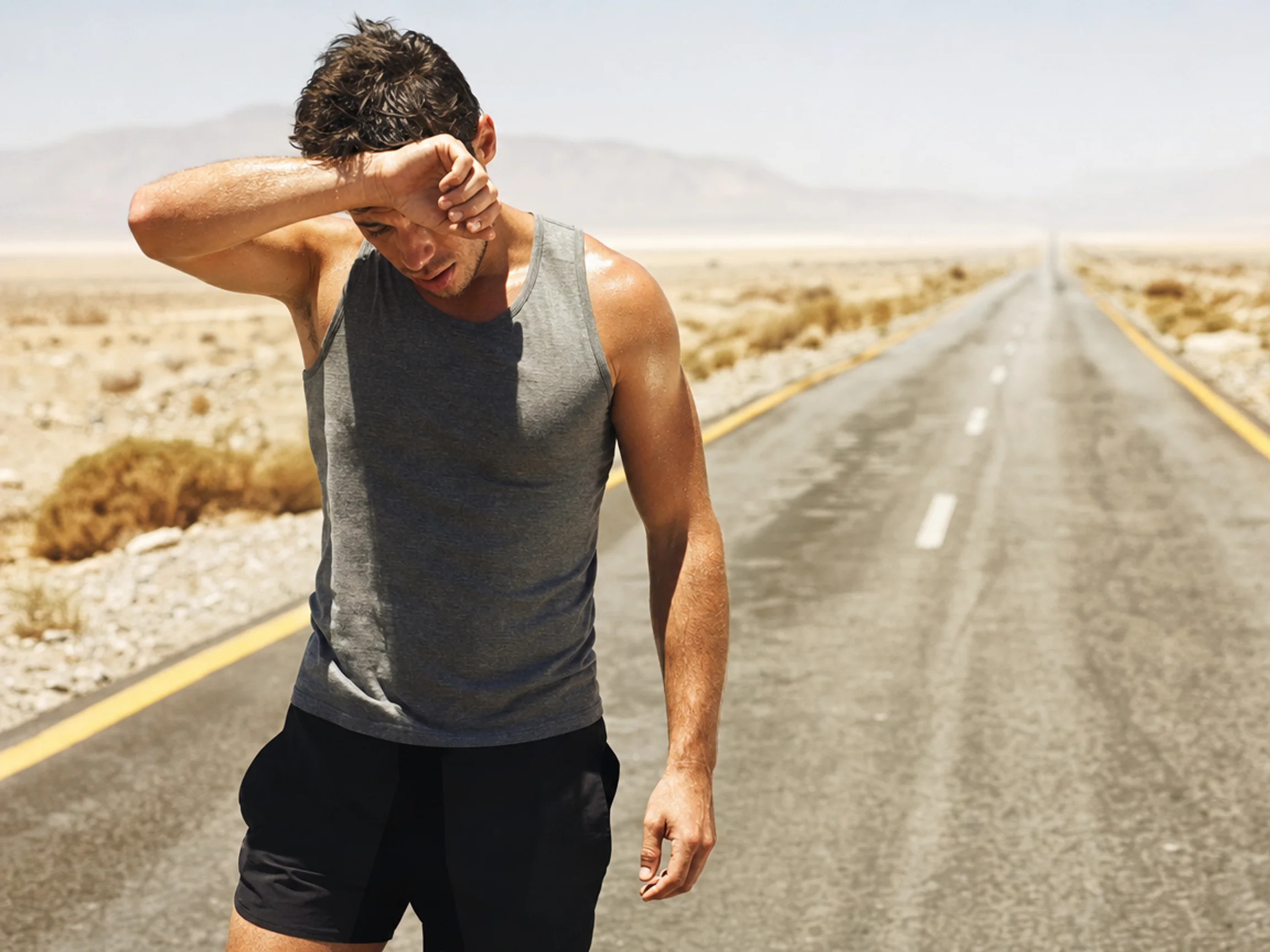
How the Heat Adjustment Calculator Works
The Heat Adjustment Pace Calculator uses the Galloway Temperature Adjustment Model — a well-established framework in running science that quantifies how rising temperatures degrade endurance performance. The model is built on the principle that 15°C (59°F) represents the thermally neutral zone for distance running: the temperature at which your body can most efficiently balance metabolic heat production with heat dissipation.
When you enter your target pace, ambient temperature, humidity, and race distance, the calculator applies a progressive percentage-based slowdown. The degradation is not linear — it accelerates as temperatures rise. Between 15-20°C, the impact is mild (~1% total). Between 25-30°C, the cumulative effect reaches 3-6%. Above 35°C, runners can expect a 10%+ performance decrease, which for a marathon runner targeting a 3:30 finish could mean arriving at the finish line 20-30 minutes later than planned.
Humidity is factored in as a multiplier. Above 40% relative humidity, the calculator increases the base temperature penalty because humid air reduces evaporative cooling efficiency. The combination of high heat and high humidity creates the most challenging conditions, which is why the calculator also provides a four-level heat risk assessment to help you make safe decisions about whether and how to race.
The Science Behind Temperature-Performance Degradation
The relationship between ambient temperature and endurance performance has been extensively studied. The foundational research by Galloway (2007) established practical pace adjustment guidelines that this calculator implements:
- 15-20°C: ~1% slowdown per 5°C — barely noticeable for most runners
- 20-25°C: ~2% slowdown per 5°C — equivalent to 5-8 sec/km for a 5:00/km runner
- 25-30°C: ~3% slowdown per 5°C — significant impact on marathon finish times
- 30-35°C: ~4% slowdown per 5°C — high risk zone requiring major pace adjustment
- 35°C+: ~5-6% slowdown per 5°C — extreme conditions where cancellation should be considered
The physiological mechanism is well understood. As core body temperature rises, the cardiovascular system diverts an increasing proportion of cardiac output to the skin for cooling (cutaneous vasodilation). This reduces blood flow available for working muscles and decreases stroke volume. Simultaneously, the rate of glycogen utilization increases in hot conditions, accelerating fuel depletion. Research by Ely et al. (2007), analyzing 36 years of marathon data, confirmed that performance degradation is exponential rather than linear above 15°C, matching the progressive model used in this calculator.
The humidity adjustment is based on the principle that evaporative cooling accounts for approximately 80% of heat dissipation during exercise. When the vapor pressure gradient between skin and air decreases (high humidity), sweat drips rather than evaporates, providing minimal cooling. Studies by Maughan et al. (2012) demonstrated that high humidity independently increases core temperature and heart rate at a given exercise intensity, compounding the direct temperature effect.
How to Race Successfully in the Heat
Racing in hot conditions requires strategic adjustments beyond simply slowing your pace. Here are evidence-based strategies used by elite athletes and recommended by sports scientists:
Pre-Race Preparation
Heat acclimatization is the single most effective strategy. Research shows that 10-14 days of training in heat produces significant physiological adaptations: earlier onset of sweating, increased plasma volume, lower core temperature at a given intensity, and reduced heart rate. If you can't train in heat, even passive heat exposure (sauna sessions of 20-30 minutes post-exercise) provides partial acclimatization benefits.
Pre-Cooling Strategies
Pre-cooling with ice vests, cold towels, or ice slurry drinks 30 minutes before your start has been shown to improve endurance performance in the heat by 3-6% in multiple studies. Ice slurry ingestion is particularly effective because it creates a "heat sink" in your core, giving you a larger thermal buffer before reaching critical temperatures.
During the Race
Run the first half 10-15 seconds per kilometer slower than your heat-adjusted pace. In the heat, going out conservatively is far more important than in cool conditions because thermal stress accumulates — the longer you run, the harder cooling becomes. Pour water over your head and wrists at every aid station to assist external cooling. Drink cold fluids when available, as they provide both hydration and internal cooling.
Warning Signs
Learn to recognize the early signs of heat exhaustion: dizziness, nausea, excessive sweating that suddenly stops, confusion, or goosebumps despite the heat. If you experience any of these, stop immediately, move to shade, and seek medical attention. No finish time is worth risking exertional heatstroke, which can be life-threatening.
Heat Acclimatization Protocol
Heat acclimatization is the single most powerful tool in a runner's arsenal for combating hot-weather performance loss. When you repeatedly expose your body to exercise in the heat over 10 to 14 consecutive days, a cascade of physiological adaptations occurs that dramatically improves your heat tolerance and running performance.
The key adaptations include: earlier and more profuse sweating (your body learns to start cooling sooner), plasma volume expansion of 10-15% (improving cardiac output and oxygen delivery), lower resting and exercising core temperature (giving you a larger thermal buffer), and reduced heart rate at a given intensity (less cardiovascular strain). Research by Periard et al. (2015) in the Scandinavian Journal of Medicine & Science in Sports confirmed that these adaptations collectively reduce perceived exertion and improve time-trial performance by 7-15% in hot conditions.
A practical protocol for runners: begin 14 days before your target race. For the first 3-4 days, run easy (60-70% effort) for 30-45 minutes in the heat of the day. Gradually increase duration to 60-75 minutes by days 5-7, then introduce moderate-intensity work (tempo segments, race-pace intervals) in the second week. If you live in a cool climate, post-run sauna sessions of 20-30 minutes can provide roughly 75% of the acclimatization benefit. Most adaptations plateau by day 10-12, with sweat rate improvements appearing first (days 3-5) and plasma volume expansion completing last (days 8-14).
Hydration Strategy by Temperature Tier
Your fluid needs during running scale dramatically with temperature, yet most runners apply a one-size-fits-all hydration strategy regardless of conditions. Understanding how to adjust your fluid intake by temperature tier can prevent both dehydration and the equally dangerous condition of hyponatremia (over-hydration).
15-20°C (Cool): Sweat rates are moderate at 400-800 mL/hour. Drink 150-200 mL every 20 minutes during runs over 60 minutes. Water alone is sufficient for efforts under 75 minutes; add electrolytes for longer sessions. 20-25°C (Warm): Sweat rates increase to 800-1200 mL/hour. Consume 200-250 mL every 15-20 minutes. Begin adding sodium-containing electrolytes (300-500 mg sodium per liter) for any run over 45 minutes, as salt losses increase significantly. 25-30°C (Hot): Expect sweat rates of 1000-1500 mL/hour. Drink 250-300 mL every 15 minutes with electrolytes. Pre-hydrate with 500 mL of sodium-rich fluid 2 hours before running. 30°C+ (Extreme): Sweat rates can exceed 1500-2000 mL/hour. Maximum absorption rate is approximately 800-1000 mL/hour, meaning you cannot fully replace losses in real time — accept a fluid deficit and focus on minimizing it.
Pre-hydration is critical in hot conditions. Drink 5-7 mL per kg of body weight 2-4 hours before your run, then another 200-300 mL 15 minutes before starting. Monitor urine color as a hydration gauge: pale straw yellow indicates adequate hydration, while dark amber signals significant dehydration. Key warning signs include thirst (you are already 1-2% dehydrated), headache, reduced sweat output, and muscle cramping — all signals to increase fluid intake immediately.
Distance-Specific Heat Racing Strategy
Heat does not affect all race distances equally. The longer you run, the more thermal stress accumulates, making distance-specific pacing adjustments essential for both performance and safety.
5K (12-25 minutes): The short duration limits total heat accumulation, but the high intensity means you generate metabolic heat rapidly. Expect a 1-3% performance loss at 25-30°C. Strategy: start at your heat-adjusted pace and hold steady — the race is short enough that you can tolerate mild thermal debt. Focus on pre-cooling rather than mid-race hydration, as there is limited time for fluid absorption. 10K (25-55 minutes): The sweet spot where heat begins to matter meaningfully. Expect 2-5% degradation at warm temperatures. Take water at every station if available, and consider running the first 3K conservatively before settling into your adjusted rhythm.
Half Marathon (75-150 minutes): Heat impact becomes substantial with 3-8% performance loss. The second half is where thermal stress peaks — your core temperature continues rising even if you slow down. Plan to negative split aggressively: run the first 10K 10-15 sec/km slower than adjusted pace. Consume 150-200 mL of fluid with electrolytes at every aid station. Marathon (2.5-5+ hours): Heat is the great equalizer at this distance, with potential performance loss of 5-15%. Above 25°C, seriously consider abandoning time goals entirely and running by perceived effort. Use every cooling opportunity: ice in your cap, sponges under your arms, water over your head. The risk of exertional heatstroke peaks between kilometers 30-38 when glycogen depletion compounds thermal stress. If you feel nauseous, confused, or notice your skin has stopped sweating, stop immediately — these are medical emergencies.