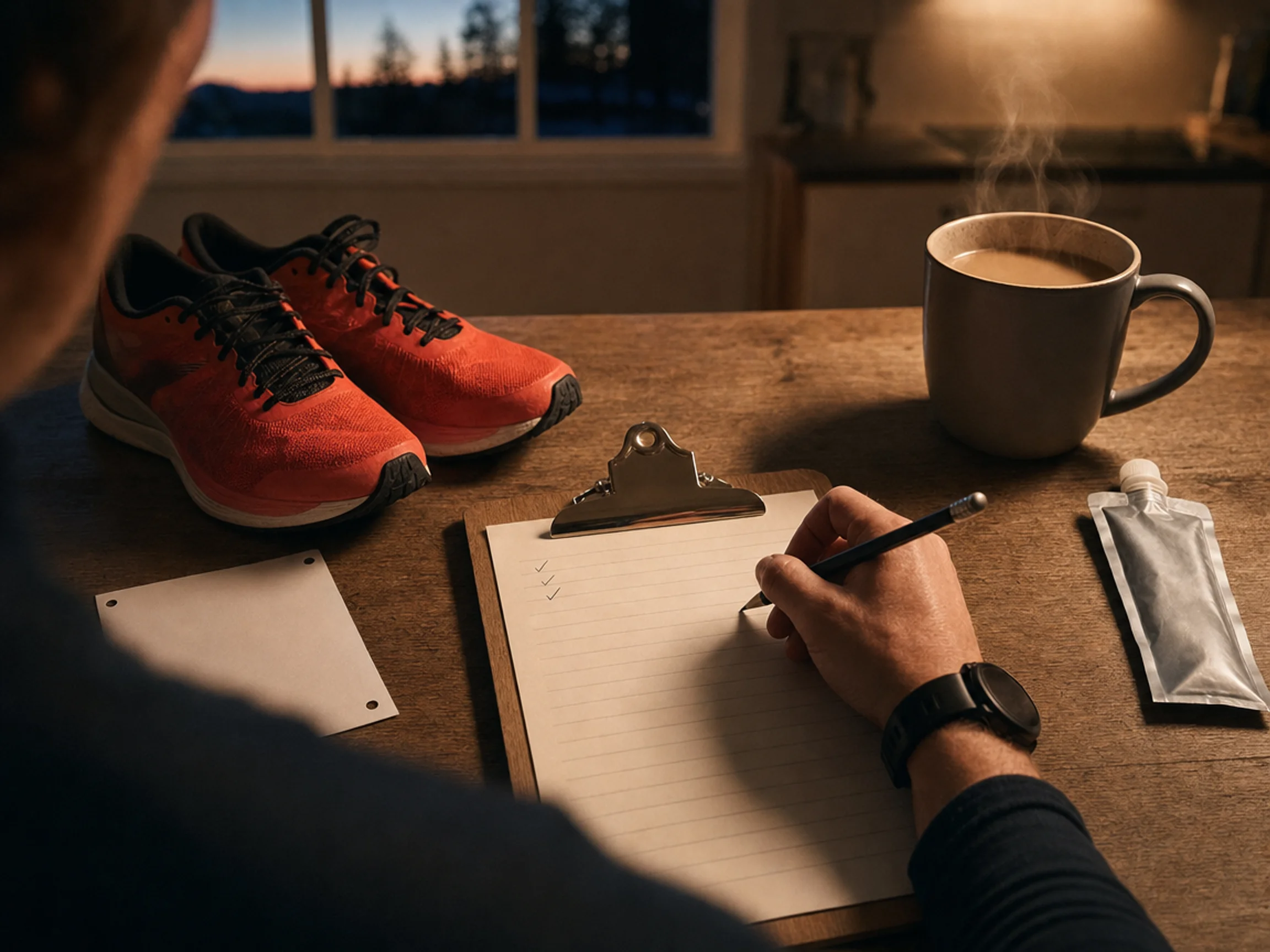
How the Race Day Checklist Generator Works
The Race Day Checklist Generator creates a personalized, interactive packing and preparation list based on five key variables: your race distance, expected weather conditions, experience level, race start time, and whether you're traveling to the event. Unlike generic checklists that try to cover everything, this tool builds a focused list of exactly what you need — and nothing you don't.
Select your race distance from 5K through Ultra Marathon. Each distance triggers different gear, nutrition, and preparation requirements. A 5K runner doesn't need gels or a hydration vest; an ultra runner needs headlamps and solid food. Choose your expected weather from mild, hot, cold, or rainy — this single selection adds or removes 8-12 weather-specific items across all categories, from throwaway start-line layers in cold weather to electrolyte tablets and sunscreen in heat.
Your experience level adjusts the checklist's detail and tone. First-time racers receive additional items like visualization reminders, pace band instructions, and the explicit reminder that race day is not the time to try new gear or food. Experienced runners get post-race logging and analysis prompts instead. The checklist is divided into five timed categories — Night Before, Morning Of, Gear Bag, Nutrition, and Post-Race — so you know not just what to prepare, but when to prepare it.
Every item includes a priority level: Essential items (marked in red) are non-negotiable — forgetting your race bib or timing chip means no official finish. Medium-priority items improve your experience but won't ruin your race if missed. Low-priority items are nice-to-haves that experienced runners appreciate. Pair this tool with the Race Morning Planner for precise timing, and the Pace Band Generator to have your splits ready the night before.
The Psychology of Checklists in Athletic Performance
Checklists are not just organizational conveniences — they are performance tools grounded in cognitive science. Dr. Atul Gawande's research, published in his landmark book The Checklist Manifesto, demonstrated that even highly trained professionals (surgeons, pilots) make fewer errors when following structured checklists. The mechanism is simple: under stress, working memory degrades. Race morning is one of the highest-stress environments a recreational athlete faces — early wake-ups, disrupted routines, performance anxiety, and logistical complexity all compete for limited cognitive bandwidth.
Sports psychologist Dr. Jim Taylor identifies preparation and routine as the two most effective anxiety reducers for athletes. A checklist serves both functions simultaneously: it structures preparation into discrete, manageable steps, and it creates a repeatable routine that becomes more comfortable with each race. Research by Baumeister and colleagues on ego depletion shows that decision-making consumes the same mental energy used for self-regulation — energy you need for pacing discipline during the race. By eliminating dozens of small decisions ("Did I pack sunscreen? Where are my gels? Should I eat more?"), a checklist preserves willpower for when it matters most: mile 20 of a marathon.
The interactive checkbox feature in this tool leverages the Zeigarnik effect — the psychological tendency to remember uncompleted tasks more vividly than completed ones. As you check off items, your brain releases them from active processing, freeing up mental space. The progress bar provides visual feedback that triggers small dopamine rewards, making the preparation process itself satisfying rather than anxiety-inducing. Research by Amabile and Kramer on the "progress principle" confirms that visible progress — even on mundane tasks — significantly boosts motivation and positive affect.
The localStorage persistence means your checked state survives page refreshes and browser restarts. Start checking items off days before the race and return to see your progress. This distributed preparation approach is more effective than a single frantic session, as spaced practice improves retention and reduces the chance of oversight. The print function creates a physical artifact you can carry to the race — useful when your phone is in your gear bag and you need a final confirmation that everything is packed.
Weather-Specific Race Day Preparation
Weather is the single most impactful variable on race day preparation. A 20-degree temperature swing between your last long run and race morning can change your clothing, nutrition, pacing, and gear requirements entirely. Here's how to prepare for each condition.
Hot Weather Racing (Above 75°F / 24°C)
Heat is the most dangerous race condition and requires the most preparation changes. Start hydrating with electrolytes 48 hours before the race, not just race morning. Apply sport-formula sunscreen (SPF 30+) 30 minutes before sun exposure — regular sunscreen washes off with sweat. Wear light-colored, moisture-wicking fabrics. A white visor protects your face while allowing heat to escape from the top of your head, unlike a full cap which traps heat.
Adjust your pace expectations: add 1-2 minutes per mile for every 10°F above 55°F. Carry extra sodium tablets — you lose 500-1500mg of sodium per hour of sweating, and plain water alone cannot replace it. Consider an ice slushie 30 minutes before the start, which research by Ross et al. (2011) in Medicine & Science in Sports & Exercise showed can lower core body temperature and improve endurance performance in heat by up to 10%.
Cold Weather Racing (Below 40°F / 5°C)
The key challenge in cold weather is the gap between start-line conditions and mid-race conditions. You may be standing still for 30-60 minutes in freezing temperatures before running at a pace that generates significant body heat. The solution: throwaway layers. Wear old clothes over your race kit that you can discard at the start line (most races collect discarded clothing for charity). Arm warmers and running gloves are essential because extremities lose heat fastest, and unlike a jacket, they can be removed and tucked into your waistband if you warm up.
Cold air can trigger exercise-induced bronchoconstriction (runner's asthma). A neck gaiter or buff pulled over your mouth pre-warms inhaled air. Warm up indoors if possible — start your dynamic stretches in the car or a nearby building. Nutrition needs are slightly lower in cold weather (reduced sweat loss), but don't eliminate hydration entirely — you still lose moisture through respiration.
Rainy Conditions
Rain creates unique challenges: chafing increases dramatically, visibility decreases, and footing becomes uncertain. Apply anti-chafe balm liberally — double your normal coverage area. Nipple guards or medical tape are essential for male runners, as wet fabric amplifies friction. Wear a brimmed cap to keep rain out of your eyes. Store your phone and valuables in ziplock bags inside your gear bag.
Keep your race shoes dry until the last possible moment — wear old shoes to the venue and switch just before entering the corral. Bring an extra pair of dry socks in a ziplock. A disposable poncho keeps you dry during the wait and can be discarded at the start. Despite the conditions, many runners actually perform well in light rain — the cool moisture acts as natural temperature regulation.
Checklist Differences by Race Distance
Your race distance fundamentally changes what belongs on your checklist. A 5K requires minimal gear but maximum warm-up; an ultra marathon requires extensive nutrition planning but a casual start. Here's how preparation scales with distance.
5K and 10K
Shorter races are deceptively simple — many runners under-prepare because they dismiss the distance. The critical difference is warm-up intensity. In a 5K, you're running near VO2max from the start, so a proper 15-20 minute warm-up with strides is essential for optimal performance. Skip the warm-up and your first kilometer will feel terrible as your body scrambles to deliver oxygen to muscles.
Nutrition needs are minimal: a light meal 2-2.5 hours before and water is sufficient. No mid-race fueling needed — your glycogen stores cover 60-90 minutes of intense exercise. Your gear bag is light: race shoes, bib, watch, and weather-appropriate clothing. Post-race recovery is straightforward — you'll be walking normally within hours.
Half Marathon
The half marathon occupies a middle ground where both speed and endurance matter. You need a moderate pre-race meal (400-600 calories, 2.5-3 hours before) and should carry 1-2 energy gels for the second half of the race. Research by Jeukendrup (2011) in the Journal of Sports Sciences suggests that carbohydrate intake during events lasting 60-150 minutes can improve performance by 2-3%, even though glycogen depletion isn't the primary limiter.
Warm-up is moderate: 5-10 minutes of easy jogging and dynamic stretches. You don't need the aggressive warm-up of a 5K, but some activation helps you settle into goal pace faster. Anti-chafe protection becomes important for many runners at this distance — 90+ minutes of repetitive motion is where friction injuries begin.
Full Marathon
The marathon is where preparation complexity peaks. You need 4-6 energy gels, a full pre-race meal 3-3.5 hours before start, anti-chafe protection on multiple areas, a nutrition belt or method for carrying gels, and a detailed pacing plan. The warm-up paradox applies: extensive warm-up wastes glycogen you'll desperately need at mile 22, so a simple 5-minute walk and gentle stretches suffice.
Post-race preparation matters more than in shorter races. You may struggle to walk for 24-48 hours, so arrange transportation home, pack compression socks, and have recovery nutrition ready immediately after finishing. Many marathoners pack a foam roller or massage ball for the car ride home.
Ultra Marathon
Ultra preparation enters a different category entirely. Your checklist may include a mandatory gear list from the race organizer — headlamp, emergency blanket, whistle, and minimum calorie count are common requirements. Nutrition shifts from gels alone to a diverse mix: real food (sandwiches, pretzels, PB wraps), salt tablets, and variety to combat flavor fatigue over 6-24+ hours. A hydration vest is standard, not optional. Know aid station locations and what each provides — your packing list should fill gaps in on-course support, not duplicate what's already available.