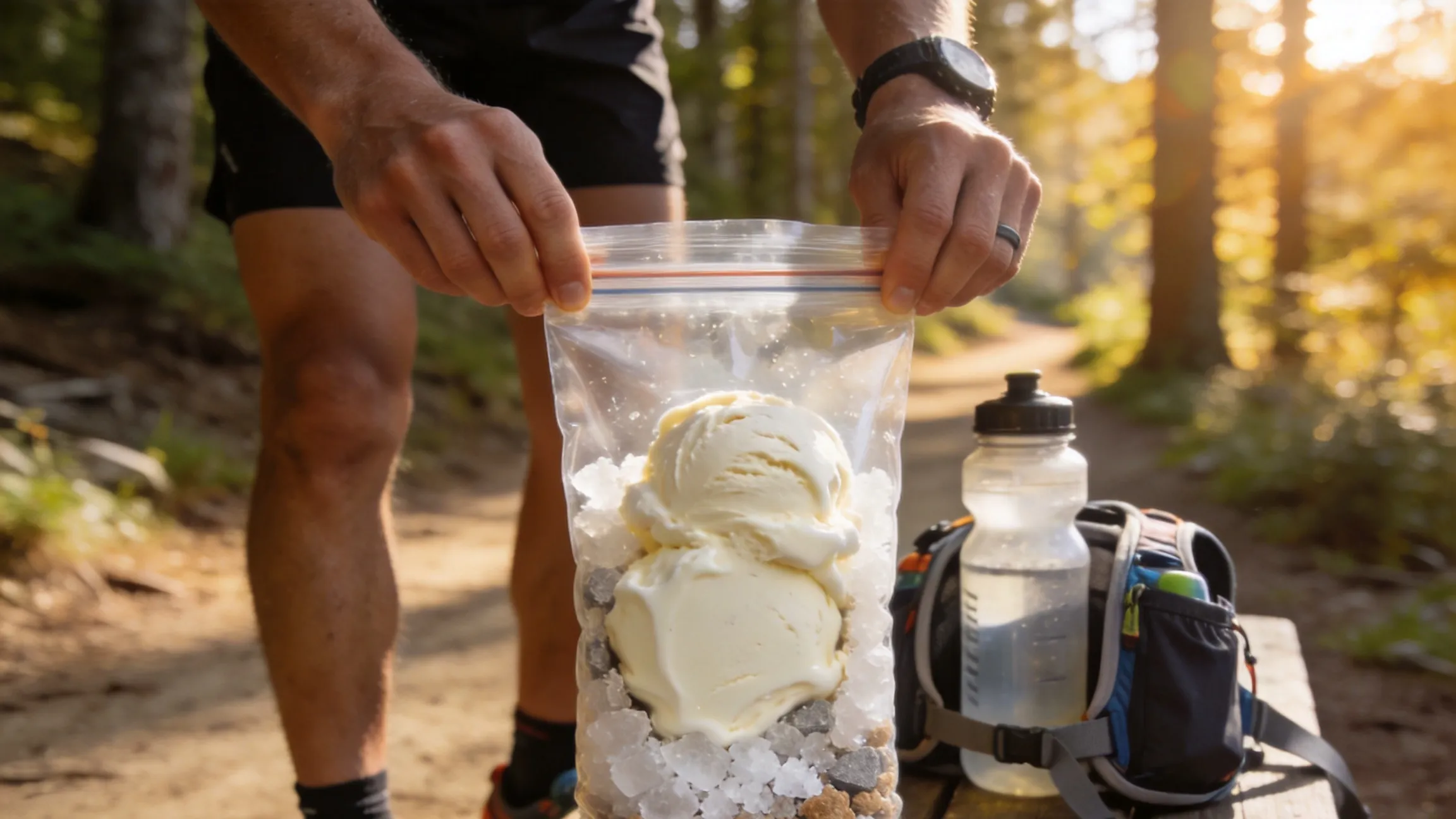
How to Make Ice Cream While Running: Churn & Chill
Strap ice, rock salt, and sweet cream to your vest and run ~25-40 min for real soft-serve. The science, the 5:1 salt ratio, and why it is a summer trick.
Key Takeaways
- Salt makes the cold; your stride makes it creamy. Dissolving rock salt in melting ice is endothermic and depresses the freezing point, so the brine drops to about −10 °C (hard floor −21 °C at ~23% salt) — cold enough to freeze the base while your bounce churns it smooth.
- It is not a butter run. Butter is a mechanical, temperature-agnostic emulsion break (fat coalescence and phase inversion); ice cream is a thermodynamic freeze via the salt-and-ice bath. Same churn, completely different state change — don't conflate them.
- Pack it right: base at 13–18% sugar (default ~14%), outer bag at 5:1–6:1 ice-to-rock-salt by weight, double-bagged so brine never leaks into the base. Cutting sugar to "be healthier" only makes it icier.
- Summer is the season. The bath self-cools, so heat does not stop it — it just melts your ice faster. On hot days use more ice, more salt, better insulation, and top up if it runs low. Butter run = cool season; ice cream run = hot season.
- Budget the time loosely: a vigorous hand-shake hits soft-serve in 5–10 min, but a gentler running vest is estimated at 25–40 min — that figure is an extrapolation, so check the texture, not the clock.
On this page
- What Is an Ice Cream Run?
- The Science: Salt, Ice & Freezing-Point Depression
- How to Make Ice Cream While Running (Step-by-Step)
- Dialing In the Conditions
- Why It's a Summer Trick (and the Butter Run Isn't)
- Fitting an Ice Cream Run into Your Training Week
- When It Goes Wrong: Troubleshooting
- Creative Variations
- Food Safety
- Try It Yourself
Here is a riddle every kid who has ever made ice cream in a bag has bumped into without quite noticing: the same salt that melts the ice on a winter road is the salt that freezes the cream in your bag. Strange, right? That little paradox is the entire engine of the ice cream run — the hot-weather cousin of 2026's butter-run craze, sometimes tagged "Churn & Chill" by the running internet.
Instead of shaking plain cream into spreadable butter, you nest a sealed bag of sweetened cream inside a bag of ice and rock salt, strap it to your back, and run for about half an hour. You finish with genuinely frozen soft-serve.
It is part tempo-free summer jog, part chemistry experiment, and entirely shareable. This guide explains exactly how it works, why it is a summer trick where the butter run is a cool-season one, and how to give yourself the best odds of pulling cold soft-serve out of your vest instead of a warm milkshake.
What Is an Ice Cream Run?
An ice cream run is the classic ice-cream-in-a-bag kitchen experiment — the no-machine method most of us first met in a school science class — except the shaking is replaced by the bounce of your stride. A small sealed inner bag holds the ice-cream base (cream, sugar, and flavor). That bag sits inside a larger outer bag packed with ice and rock salt. As you run, two things happen at once: the salt-and-ice bath gets cold enough to freeze the base, and your footstrike churns it so it sets into smooth soft-serve rather than one solid frozen brick.
The trend is a direct spin-off of the butter run. As the wider "make food while you run" wave rolled through trail- and road-running feeds in 2025, a trail-running creator reportedly posted a clip of making chocolate ice cream this way on a fall run, and the summer-friendly version took off from there. We credit that origin as reported rather than as settled fact — the exact who, when, and view-count drift between retellings. What is not in dispute is the method underneath, which is decades-old food science you can reason about from first principles.
The Science: Salt, Ice & Freezing-Point Depression
So, the riddle first, because it is the single most confusing thing about this whole activity: why does salt melt the ice on a winter road but freeze the ice cream in your bag? It is the same physics both times. Salt lowers the freezing point of water.
On the road, that means ice that would normally stay solid at −5 °C turns into cold liquid brine instead — the ice "melts." In your bag, that exact same sub-zero brine is now a liquid sitting well below 0 °C, which makes it cold enough to pull heat out of the cream right next to it and freeze it. Melting the road ice and freezing the bag cream are two faces of one coin: a salty solution that refuses to stay frozen until it gets very cold.
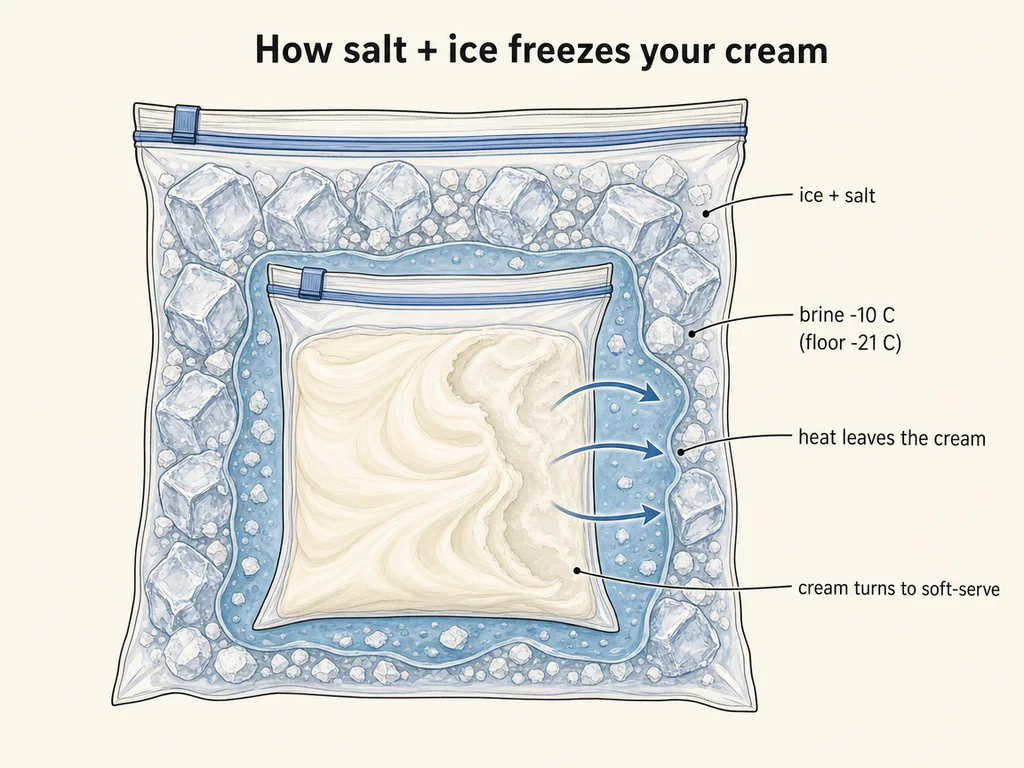
Here is what is happening in the bath in more detail. When you dissolve rock salt into melting ice, the process is endothermic — it absorbs heat — and it depresses the freezing point of the ice-water mixture2. Instead of holding at 0 °C, the brine drops to a practical working temperature of roughly −10 °C (about 15 °F), comfortably cold enough to freeze the base. There is a hard floor: the salt-water (NaCl) eutectic bottoms out at about −21 °C at roughly 23% salt by weight3. Past that concentration, more salt does nothing — you cannot get a plain salt-and-ice bath any colder than that.
So in an ice cream run the freezing is thermodynamic: heat flows out of the warm base, across the bag wall, into the sub-zero brine. The running supplies the churn — rhythmic agitation that keeps ice crystals small and beats in a little air, which is the whole difference between creamy soft-serve and a coarse, gritty puck. Remove the salt and the bath simply sits at 0 °C; the base never freezes, no matter how far you run.
How to Make Ice Cream While Running (Step-by-Step)
What You Need
- The base: heavy cream (or half-and-half) sweetened to roughly 13–18% sugar by weight1, plus a little flavor. A simple starter that lands in that window: about 120 ml (1/2 cup) cream, 1.5 tablespoons (~19 g) sugar, and 1/4 teaspoon vanilla.
- Ice and rock salt: roughly 500 g (about 6–8 cups) of ice with ~100 g of rock salt for one base bag — a 5:1 starting ratio2 (more on dialing this in below).
- Two sturdy zip-top bags in nesting sizes (a quart bag inside a gallon bag is the classic combination), ideally freezer-grade and leakproof.
- A running vest or hydration pack with a back pocket that holds the bag snugly against your spine, so your stride transfers into the bath.
1 Mix the base
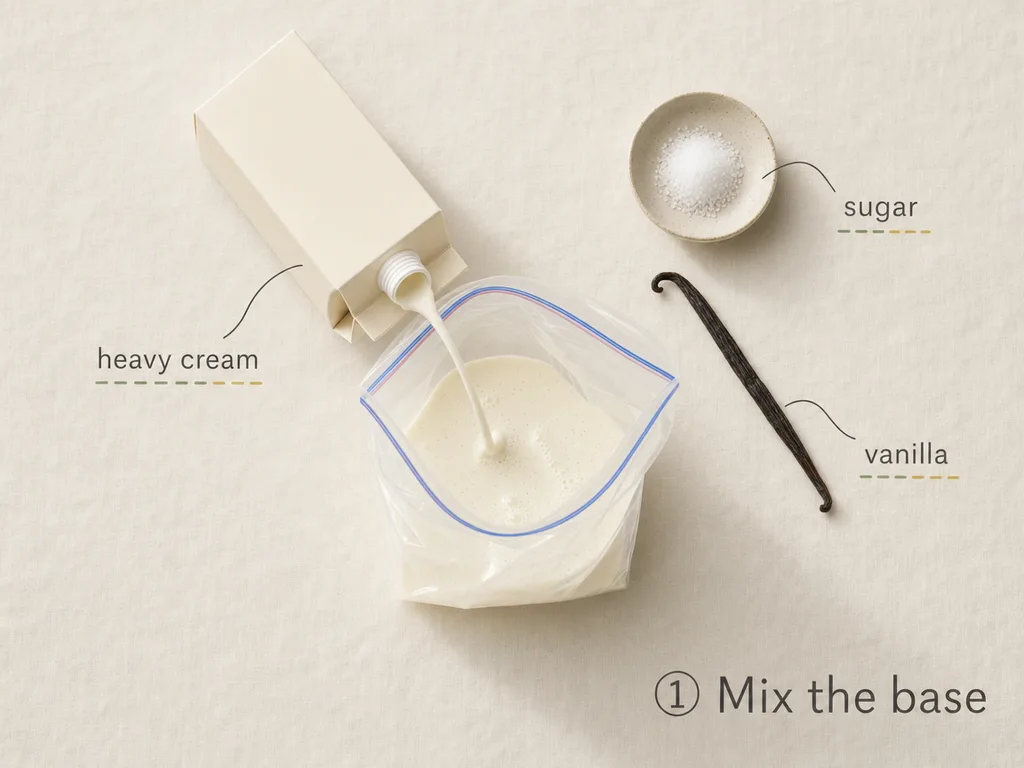
Combine the cream, sugar, and vanilla in the inner bag — aim for that 13–18% sugar window (about 14% is the sweet spot). Press out as much air as you can and seal it firmly. The flatter and more air-free the bag, the more surface contact it makes with the cold brine and the faster it freezes. Resist the urge to cut the sugar "to be healthy" — you will pay for it in texture later.
2 Pack the ice & rock-salt bath
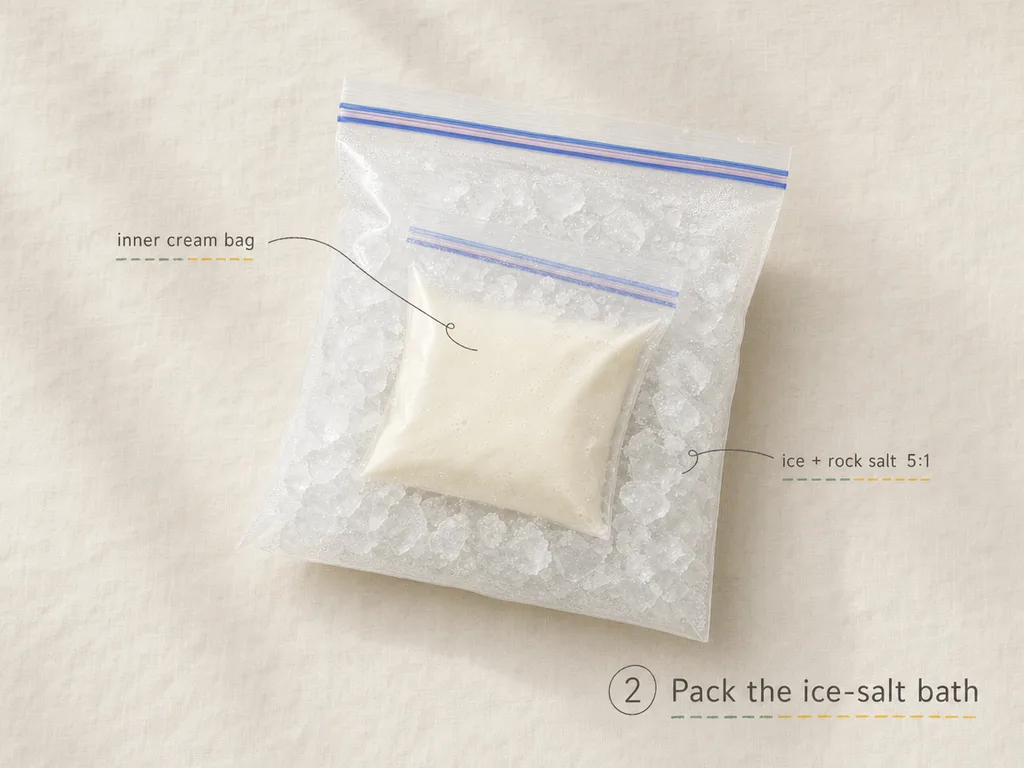
Set the sealed base bag inside the larger bag and surround it with ice, scattering rock salt as you go — about 5:1 ice-to-salt by weight to start. Use crushed or small cubes, not big blocks: smaller ice means more surface area touching the brine, which cools faster. Squeeze out excess air and seal the outer bag. If you can, slip the whole thing into a third bag or an insulated sleeve to keep hand and body heat from bleeding in.
3 Load it in your vest
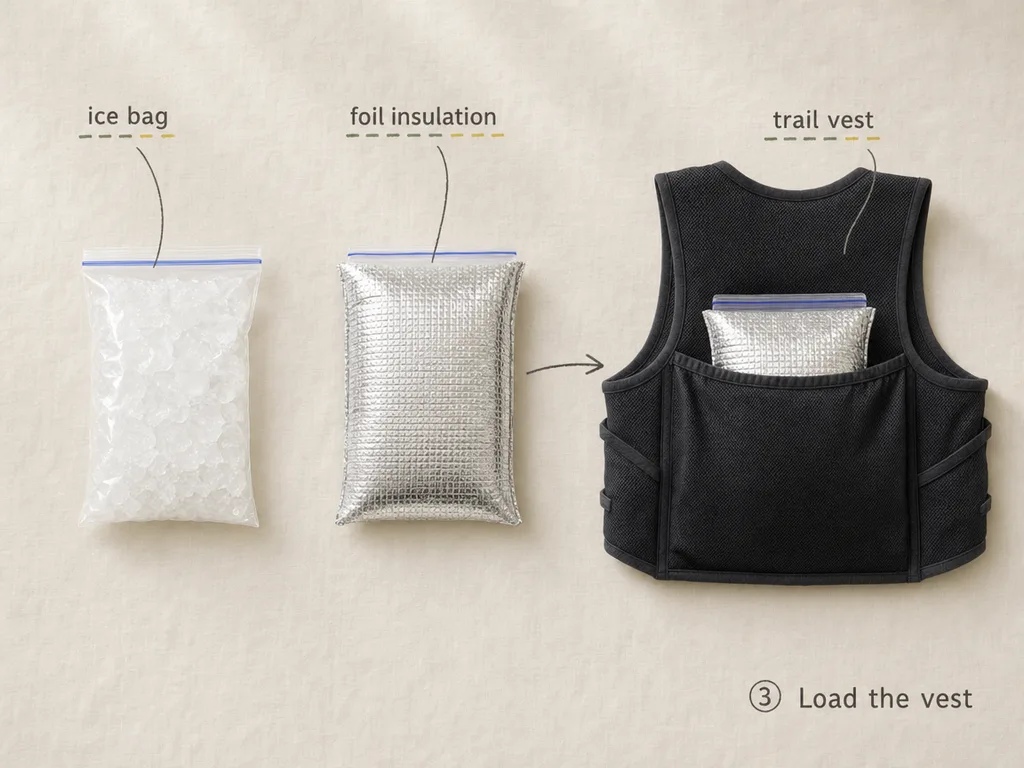
Slide the bag into a back pocket of your vest so it rides snugly against your spine, base bag fully buried in the ice and salt. A loose bag flopping around at the bottom of a pack will not churn well — you want your stride's bounce transmitting straight into the bath. A towel or spare layer between the cold bag and your back keeps you comfortable and adds a little insulation.
4 Run 25–40 minutes
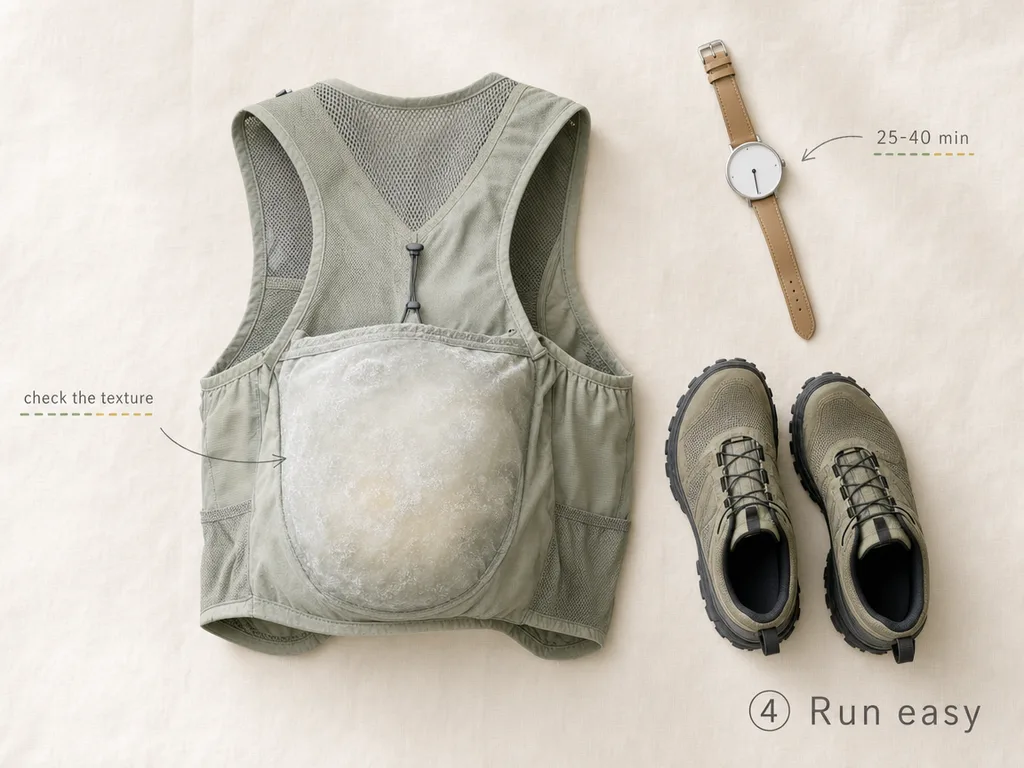
Run easy. The bounce is doing the churning. Plan for roughly 25–40 minutes — but treat that as an estimate, not a stopwatch target. A vigorous hand-shake of the same bag hits soft-serve in just 5–10 minutes; a running vest agitates far more gently and intermittently, so it needs longer. Because no one has rigorously timed the vest version, this figure is an extrapolation. Trail or uneven ground churns more than smooth road or a treadmill, so rougher terrain finishes sooner. Check texture, not the clock.
5 Drain, scoop & eat right away
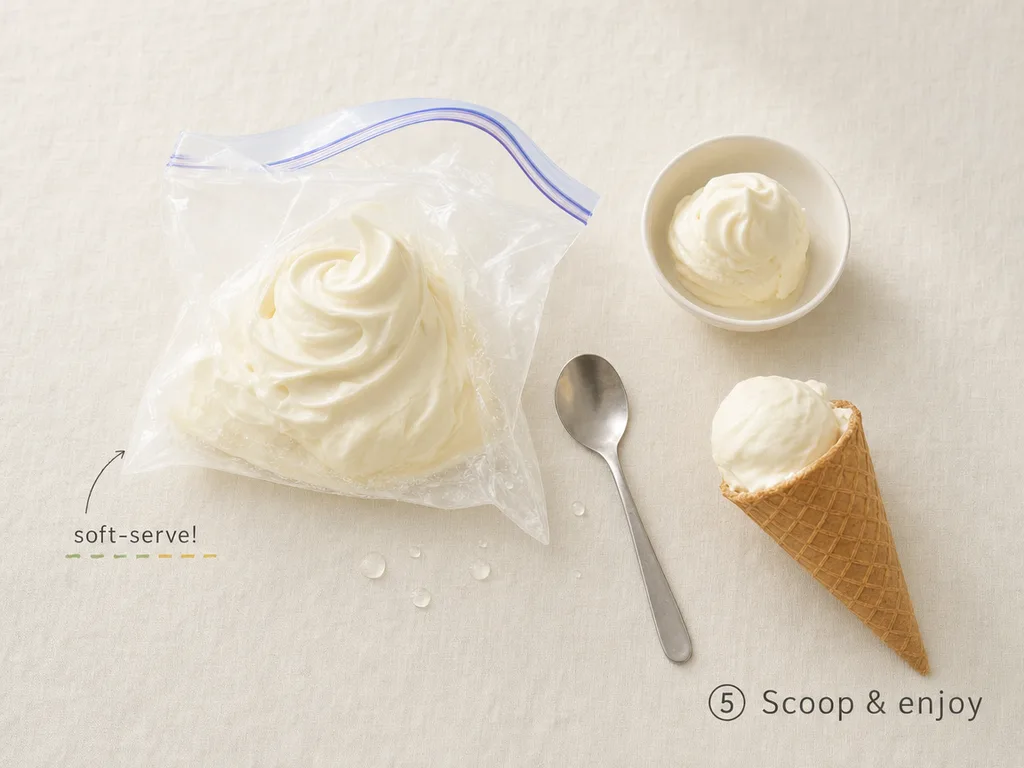
When the base has thickened into scoopable soft-serve, you are done. Pull the inner bag out, rinse the salty brine off the outside before you open it, then snip a corner or spoon it straight out. Eat it immediately — soft-serve made this way melts within minutes, and that is exactly the point.
Dialing In the Conditions
Six variables decide whether you get soft-serve or a sad milkshake. Here is what to aim for and why each one matters.
| Factor | Target | Why it matters |
|---|---|---|
| Ice : rock-salt ratio | 5:1 to 6:1 by weight (about 100 g salt per 500 g ice) | This is the sustained band: rock salt dissolves slowly and keeps the brine cold for the whole run. Too little salt and it never gets cold enough; too much and the ice melts too fast. |
| Base sugar | 13–18% by weight (default ~14%) | Sugar sets the base's own freezing point and texture1. Below ~12% it freezes hard and icy; above ~20% the freezing point drops so far it won't set and stays soupy. |
| Run time | 25–40 min (estimate — check texture) | The gentle vest motion is slower than a hand-shake's 5–10 min. This window is extrapolated, not measured, so judge by feel. |
| Base richness | Heavy cream > half-and-half > milk | Higher fat means smoother results. A thin, milk-only base trends icy and crunchy; a rich cream base sets up silky. |
| Terrain (agitation) | Trail > road > treadmill | More bounce keeps ice crystals small and beats in air. Rougher ground churns harder and finishes creamier and sooner. |
| Insulation | Triple-bag or insulated sleeve | Body and hand heat bleed into the bath and warm it. Insulating the outer layer makes the cold last, which matters most on hot days. |
Why It's a Summer Trick (and the Butter Run Isn't)
Here is the seasonal twist, and it is the reverse of what most people assume. Because the salt-and-ice bath makes its own cold — down to that −10 to −21 °C range — hot weather does not stop an ice cream run. The bath does not care what the air temperature is; it generates sub-zero conditions internally. What heat does do is melt your ice faster, bleeding the cold away sooner. So on a scorching day the answer is not "give up," it is simply: use more ice, salt toward the 5:1 end, better insulation, and top up with fresh ice and salt if the bath runs low mid-run.
That is exactly why the two challenges split along the calendar. The butter run is the cool-season challenge: its success hinges on cream staying firm enough to coalesce, which is hard to hold once it is warm out. The ice cream run is the hot-season challenge: it brings its own freezer along for the ride. If the forecast has turned cool and your cream just will not firm up, you are reading the wrong guide — head over to the butter run guide instead.
Fitting an Ice Cream Run into Your Training Week
Treat the ice cream run as what it physically is: an easy-effort summer run of 25–40 minutes. It slots naturally into a recovery day or a relaxed shakeout, never a quality session — you cannot do hill repeats with a sloshing bag of brine on your back, and you would not want to. The reward at the finish is a genuinely fun reason to get a gentle aerobic run done on a hot day when motivation is thin.
Because it is a hot-weather activity, plan it like one. Run in the cooler edges of the day — early morning or evening — favor shade, and keep the pace conversational. Check the conditions before you commit: a quick look at the weather score tells you whether the heat and humidity make for a sensible easy run, and how aggressively you will need to over-pack ice.
And do not let the novelty distract you from basic summer sense: the ice cream is dessert, not hydration. Carry water and drink to thirst; if you want a number to anchor your fluids around, the hydration calculator will estimate your sweat needs for the session. The frozen treat is the bonus at the end of a smart, easy summer run — not a substitute for fueling and cooling yourself properly along the way.
When It Goes Wrong: Troubleshooting
Almost every failure traces back to one of a handful of causes — too little salt, ice that is not crushed small enough, not enough agitation, running out of ice mid-run, or poor insulation. Here is how to read your result and fix it.
| What you got | Why | Fix |
|---|---|---|
| A milkshake (never froze) | Bath never got cold enough, or did not stay cold long enough — too little salt, ice too chunky, or it melted out. | Add salt toward 5:1, use crushed ice, run longer, and insulate the outer bag. Top up ice and salt if it ran low. |
| Icy and coarse | Too little sugar (below ~13%) so it froze hard and crystalline — or too little churn let big crystals form. | Nudge sugar up into the 13–18% window and keep the bag bouncing; rougher terrain helps. |
| Won't set at all | Too much sugar (over ~20%) dropped the base's own freezing point too far. | Pull the sugar back toward ~14%. The base needs to be able to freeze. |
| Tastes salty | Salty brine leaked from the outer bag into the base. | Re-seal carefully, double-bag the inner base, and rinse the bag before opening (see the warning below). |
| Ran out of cold halfway | Ice melted through before the base set — common on hot days or with too much salt. | Drain the meltwater, top up with fresh ice and rock salt, and keep going. |
Creative Variations
The vanilla cream base is the reliable workhorse, but the method is forgiving once you respect the sugar window. A few directions worth trying:
- Chocolate — the original viral flavor. Whisk a spoonful of cocoa powder (and a touch more sugar to keep texture, staying under ~18%) into the base before sealing.
- Fruit and mix-ins — fold crushed berries, cookie bits, or chocolate chips into the inner bag near the end of the run, once it has started to set, so they stay distinct instead of dissolving.
- Lighter texture — swapping some cream for half-and-half makes a leaner, icier result on purpose; just know it trends crunchier, since less fat means less creaminess.
- Dairy-free — full-fat coconut milk or other rich plant creams work, because fat content (not the specific dairy) drives smoothness. Thin, watery plant milks freeze icy.
Whatever you fold in, keep total sugar inside that 13–18% band — the physics of the set does not care whether your sweetness comes from sugar, honey, or syrup, only how much there is.
Food Safety
This is a perishable-dairy dessert made outdoors, so a few sensible rules apply.
- Use pasteurized cream, within its date. Raw-milk dairy carries pathogen risk and is not worth it here.
- Mind the danger zone — but it rarely binds. Perishable dairy should not linger in the temperature danger zone (about 4–60 °C / 40–140 °F) for more than ~2 hours, and above ~32 °C / 90 °F ambient, more like 1 hour4. In practice the soft-serve melts within minutes anyway, so "eat it right away" is the natural rule and this limit is almost never the binding constraint.
- Clean, food-grade everything. Use clean food-grade bags and food-grade coarse salt — never industrial de-icing salt on anything that touches food.
- If you ever use an egg (custard) base, cook it or use pasteurized egg to avoid raw-egg salmonella risk. The default cream-and-sugar base has no egg, so this is not a concern for the standard recipe.
Try It Yourself
Want to know your odds before you head out the door? Run your numbers through the ice cream run calculator — it predicts your chance of finishing with real soft-serve from your ice-to-salt ratio, base sugar, run time, and the day's heat, and flags the summer-inversion warning when the air is hot enough to threaten your bath. And when the weather turns cool and the cream just will not freeze, switch challenges: read the butter run guide and crunch the numbers in the butter run calculator, the cool-season counterpart where mechanical churn — not a salt bath — does all the work. Cool months churn butter; hot months churn ice cream. Pick your season and run.
Sources & References
- (2013). Ice Cream (7th ed.) — freezing-point depression of mixes and sweetener composition. Springer.
- (2014). Scrumptious Science: Making Ice Cream in a Bag. https://www.scientificamerican.com/article/scrumptious-science-making-ice-cream-in-a-bag/.
- (2025). Brine / Cooling bath — NaCl-water eutectic at -21.1 C (23.3 wt% NaCl). https://en.wikipedia.org/wiki/Brine.
- (2024). Food Safety — the 2-hour rule and the temperature danger zone (40-140 F / 4-60 C). https://www.foodsafety.gov/keep-food-safe/danger-zone-40f-140f.