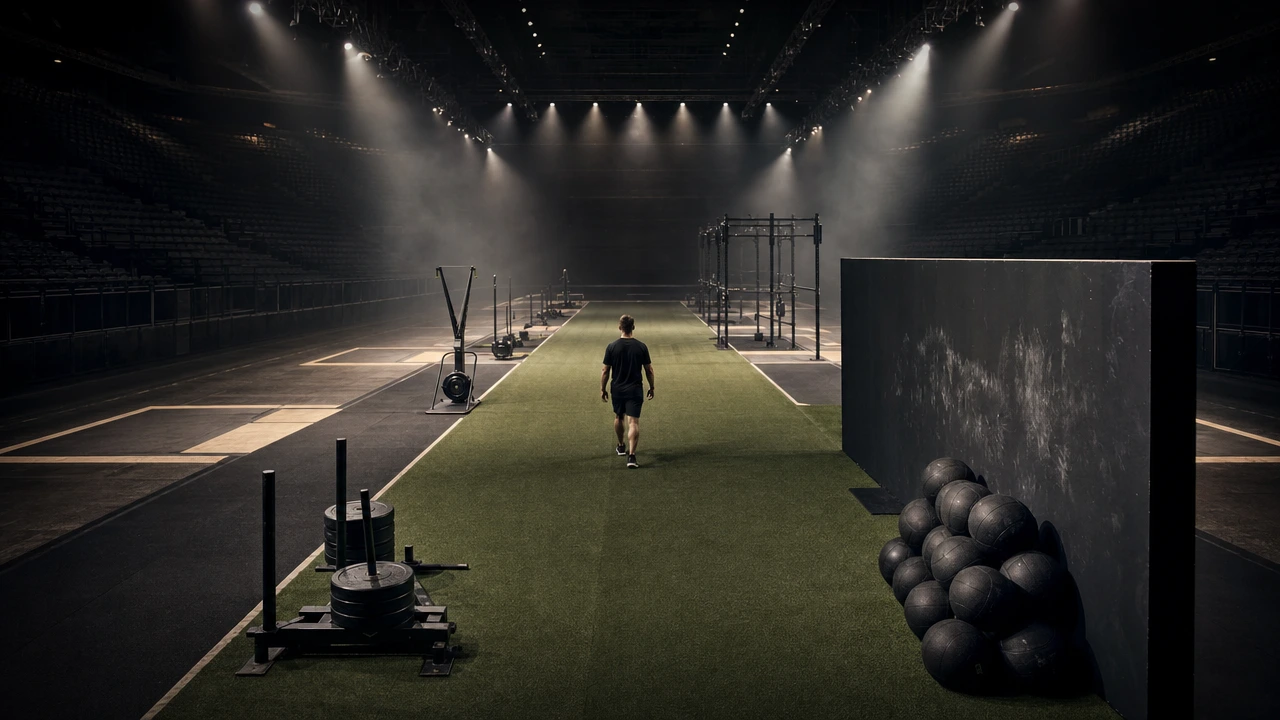
Hyrox Stations in Race Order: Splits, Fixes, No-Reps
Your engine won't save you at the wall balls. All 8 Hyrox stations in race order — official loads, expected splits, no-rep rules, and one fix per station.
Key Takeaways
- Walk the course in race order. SkiErg first, wall balls last, with a 1 km run before every station — and the three that ambush a runner hardest are the wall balls, sandbag lunges and sled pull.
- Your engine is no help here. In the one early study (n=11), aerobic fitness showed no meaningful link to station times — strength and skill set your splits.
- No-rep rules cost real time. Wall balls need hips below knees, no warnings — every throw is simply rep or no-rep, and leaving before 100 valid reps is a disqualification; skipping a station means no valid finish.
- Fix the legs, not the lungs. Lunges, sled pull and wall balls reward loaded single-leg strength and grip — train those gassed, not fresh, so they survive the runs.
If you are a runner walking into your first Hyrox, you have a story in your head: my engine will carry me. The bad news is that your engine is the one thing the eight stations do not test. In the only published study so far (Brandt et al. 2025, an early, small sample of 11 recreational athletes), aerobic fitness had no meaningful correlation with station performance (rho=-0.11, p=0.74). Your VO2max predicts your runs; it does not predict the floor work between them.
So this guide walks the eight stations in race order — SkiErg first, wall balls last, with a 1 km run before each one. For every station you get three things: why it ambushes a runner, the official standard plus the no-rep rule the 46-page rulebook buries, and one fix. If you only want to know what to train first, here is the ranking that matters: the three stations that ambush a runner hardest are the wall balls, the sandbag lunges and the sled pull — they reward loaded leg strength, grip and skill, none of which running builds.
The table below is the race-order map; the last column flags each station's real trap. Run the Hyrox time calculator for a finish estimate that flags your weakest station, and if you are brand new to the format start with the intro guide for runners.
| Order | Station | Spec | Median split | Runner note |
|---|---|---|---|---|
| 1 | SkiErg | 1000 m | ~4:34 | Don't go out too hot |
| 2 | Sled Push | 50 m | ~3:01 | Fresh-legs trap |
| 3 | Sled Pull | 50 m | ~5:10 | Grip & technique |
| 4 | Burpee Broad Jumps | 80 m | ~5:46 | Highest heart-rate spike |
| 5 | Row | 1000 m | ~4:55 | Feels like rest — over-pace trap |
| 6 | Farmers Carry | 200 m | ~2:14 | Grip fades |
| 7 | Sandbag Lunges | 100 m | ~5:27 | Wrecks the final runs |
| 8 | Wall Balls | 100 reps | ~7:10 | Only rep-gated station |
Every split above is a directional first-timer median from a third-party aggregate — early data, no disclosed sample size — not an official percentile; use it to know roughly where you bleed time, not as a target. A few course-wide facts to bank:
- The eight 1 km runs and eight stations alternate in this fixed order; average amateur finish is around 1.5 hours.
- The Roxzone transitions between every run and station are live clock time, not rest.
- The SkiErg and rower are preset identically for everyone (damper 6, rower footplate 4) — the Pro machines are not "harder".
- Women's Pro loads equal men's Open on every loaded station — the only Pro-vs-Open difference for women is the wall-ball target height (2.70 m).
Official Station Standards (26/27 Season)
Here are all eight HYROX exercises in order, with the official load for every division. This is the full standards map: the HYROX exercise order never changes, and the weights are fixed for the whole season, so you can train against exact numbers. Doubles and mixed teams use these same figures — see the notes under the table.
| Order | Station | Distance / reps | Open W | Open M | Pro W | Pro M |
|---|---|---|---|---|---|---|
| 1 | SkiErg | 1000 m | No added load — machine preset Resistance 6 (all divisions) | |||
| 2 | Sled Push | 50 m (4 × 12.5 m) | 102 kg | 152 kg | 152 kg | 202 kg |
| 3 | Sled Pull | 50 m (4 × 12.5 m) | 78 kg | 103 kg | 103 kg | 153 kg |
| 4 | Burpee Broad Jumps | 80 m | Bodyweight — all divisions | |||
| 5 | Row | 1000 m | No added load — Resistance 6, footplate Position 4 (all divisions) | |||
| 6 | Farmers Carry | 200 m | 2 × 16 kg | 2 × 24 kg | 2 × 24 kg | 2 × 32 kg |
| 7 | Sandbag Lunges | 100 m | 10 kg | 20 kg | 20 kg | 30 kg |
| 8 | Wall Balls | 100 reps | 4 kg / 2.70 m | 6 kg / 3.00 m | 6 kg / 2.70 m | 9 kg / 3.00 m |
Table notes. Loads and distances come from the HYROX Singles Rulebook 26/27 (loads in §4.1; each station in §8.1–8.8). Sled figures include the sled itself — that is whole-system weight, not the plates. Farmers-carry weights are per hand (two bells). Doubles and mixed teams lift the same weights — nothing is halved; partners split the reps and distance instead, and a mixed team uses the men's Open loads. Equipment is colour-coded by weight: 16 kg / 4 kg = white, 24 kg / 6 kg = grey, 32 kg / 9 kg = black (kettlebell / wall ball). The wall-ball cells show ball weight and target height together, because women's Pro throws the men's Open 6 kg ball but still to the lower 2.70 m line.
What changed in the 26/27 rulebook
Two things moved for the 26/27 season, and most station guides still quote the old rules. First, the wall-ball penalty: the old "15 seconds per missing rep" rule is gone. It is now purely rep or no-rep — an invalid throw simply does not count toward your 100, and leaving the station before you complete 100 valid reps is a disqualification. (Powdered chalk at the wall-ball station also carries a two-minute penalty.) Second, the Pro age policy opened up: Pro divisions now run through the 80+ age groups at regular races, with normal age-group rankings and podiums. Only at the HYROX World Championships do athletes aged 60 and over qualify and compete via Open — using Open weights, reps and distances.
1. SkiErg — fresh legs, but the wrong muscles and the wrong pace
Spec: 1000 m · Resistance 6 · all divisions · median split ~4:34.
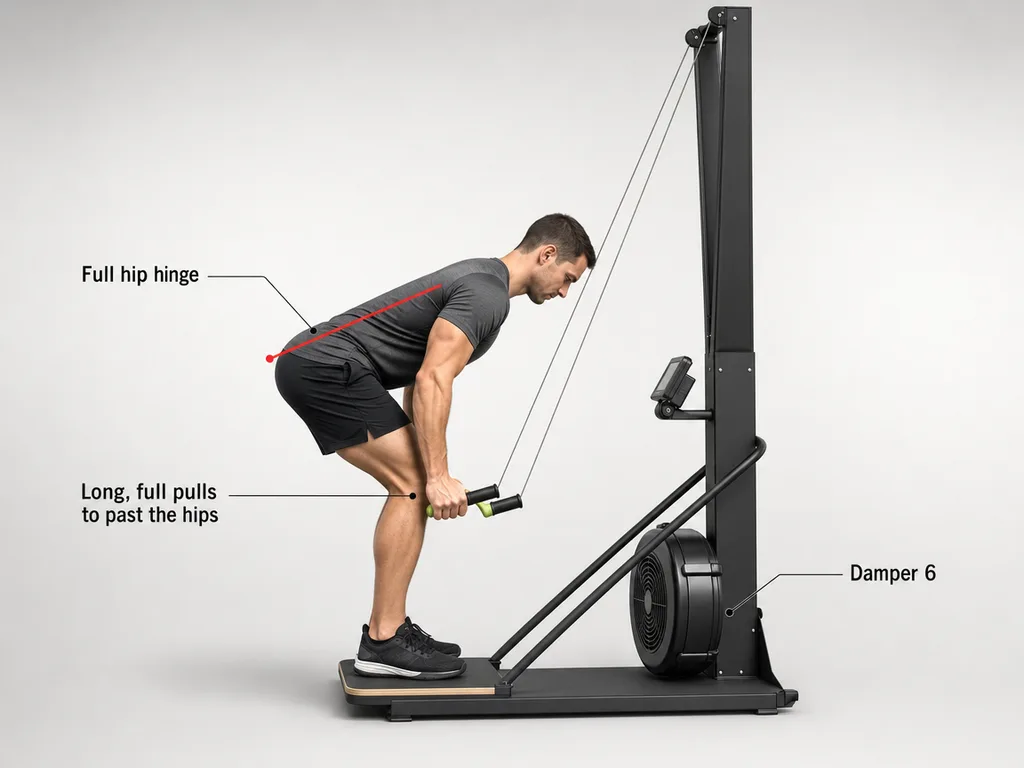
The SkiErg is station 1, so your legs are fresh — but it is upper-body and lat dominant, a non-running movement that fatigues a runner's untrained pulling muscles faster than expected. Fresh legs help nothing here, and if you attack it you set a deceptively hard tone for the whole race.
The far bigger first-timer error is pacing the opening: SkiErg plus run 1 is where almost everyone goes out too hot, running the first kilometre far too fast on adrenaline and paying for it all day.
Official standard: 1000 m, damper Resistance 6, all divisions — directional median ~4:34. Rule: complete the full distance before leaving the machine.
- Drive with a hip hinge and the lats, not your arms.
- Consciously settle — do not redline station 1; ten seconds banked here costs two minutes on the back half.
- Median ~4:34.
2. Sled Push — short, brutal, and where you quietly lose your legs
Spec: 50 m sled push (4 × 12.5 m) · Open 102/152 kg · Pro 152/202 kg (incl. sled) · median ~3:01.
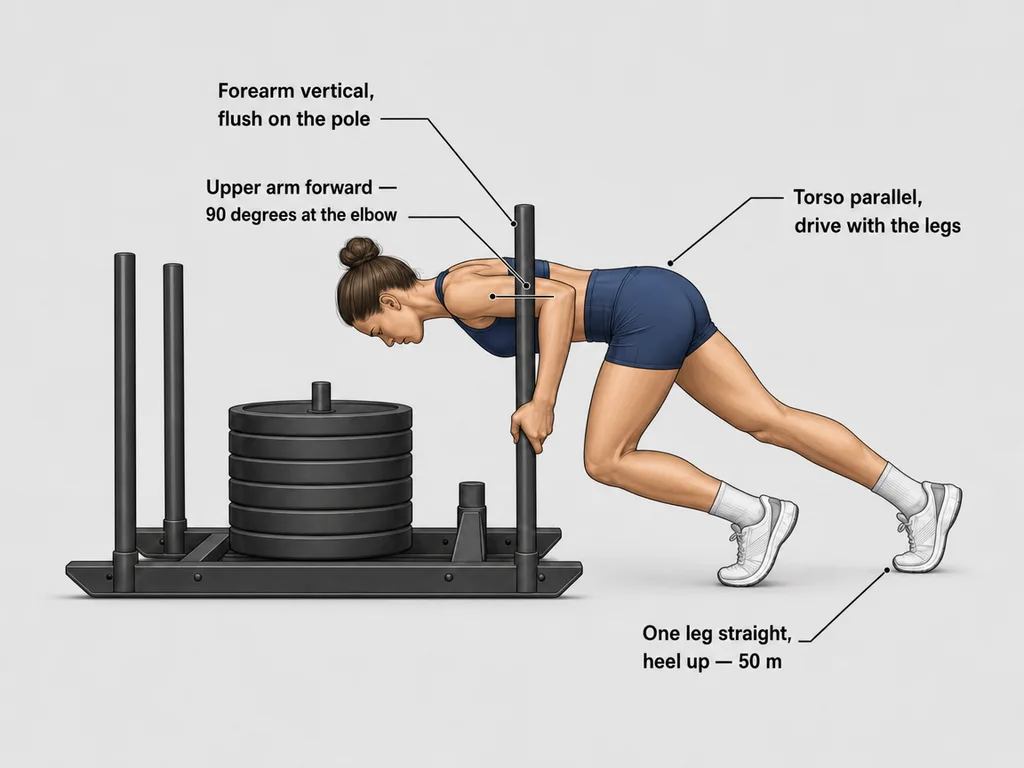
Heaviest load on the course, landing at station 2 on your freshest legs — which is why it gets attacked. The bill never shows on the sled clock; it shows in runs 3 through 8. Stay low, arms locked, short steps, and never let it stop. Loads by division are in the HYROX weights table, and traction is your shoe’s job too — a firm, low outsole holds where a soft, tall racing shoe skates; the HYROX shoe guide maps which shoes hold on turf. The sled push deep dive covers the four-length line rule and the turnarounds.
3. Sled Pull — the heaviest-feeling station for a pure runner
Spec: 50 m sled pull (4 × 12.5 m) · Open 78/103 kg · Pro 103/153 kg (incl. sled) · median ~5:10.
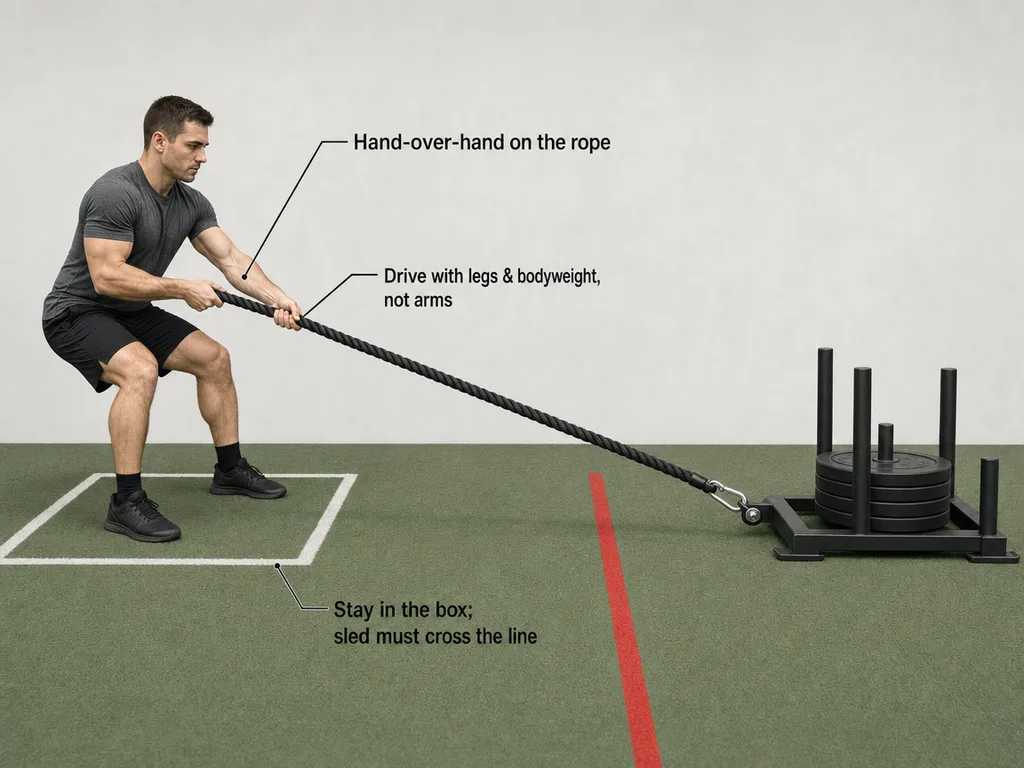
This is where runners get genuinely stunned. The sled pull is 50 m (four lengths of 12.5 m), and it is won on technique, not leg strength — the forearms, grip and posterior chain it demands are exactly what a road runner has never trained, so the hands fail shockingly fast.
Official load (whole-system, including the sled): 103 kg for open men, 78 kg for open women, 153 kg for men pro. This is why runners keep asking how much the sled itself weighs — miss this and your weight expectation is simply wrong. Rule: neither the sled nor you may cross the designated lines, and your feet may not cross the foul line to drive.
- Stay low, walk backwards and let your legs and bodyweight pull, not your arms.
- Keep the hand-over-hand action low and rhythmic.
- Build grip with dead hangs and heavy farmer holds — the carry and pull share that limiter.
- Median ~5:10.
4. Burpee Broad Jumps — the deceptive one that cashes your engine in early
Spec: 80 m · bodyweight · all divisions · median ~5:46.
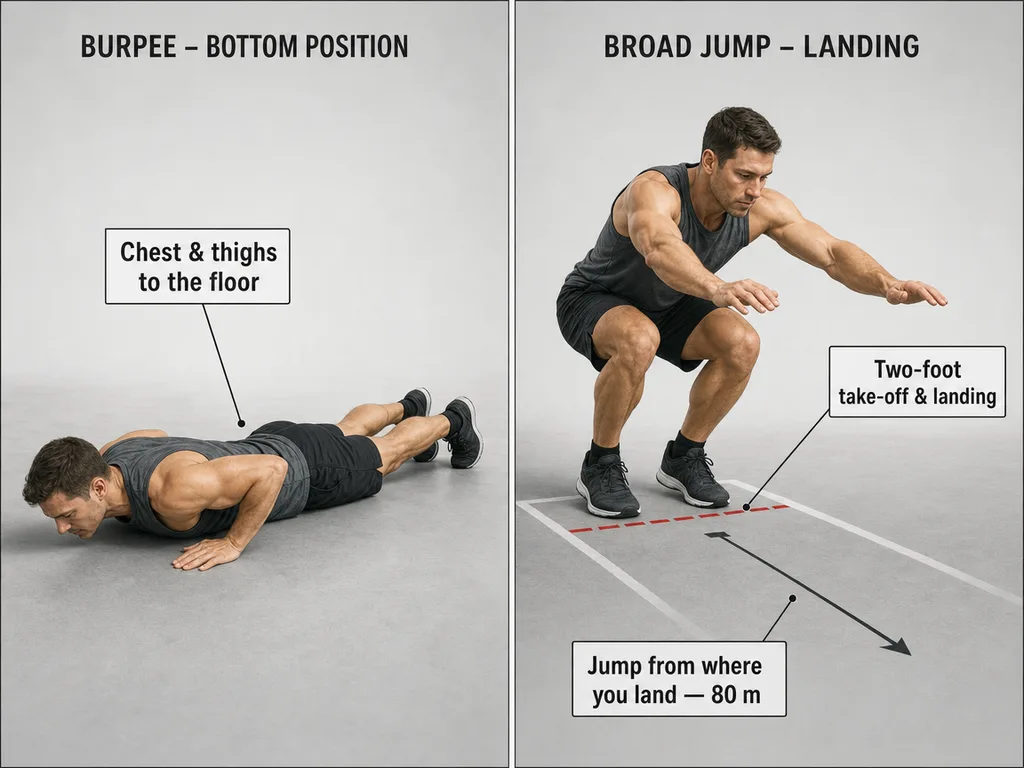
Eighty metres of burpee-into-broad-jump, the second-longest station, survivable rep by rep — that is the trap. It spikes your heart rate higher than running does, and the landings load the quads eccentrically — whatever your engine banked evaporates over the back half. The fix is counter-intuitive: the station is scored in metres, not reps, so stop trying to cover it in fewer jumps. Small, repeatable jumps and step-back burpees get you through faster with more leg left. The burpee broad jumps deep dive covers the three no-rep criteria and how to pace the 80 m.
5. Row — the "rest" that punishes runners who over-pace
Spec: 1000 m · Resistance 6, footplate Position 4 · all divisions · median ~4:55.
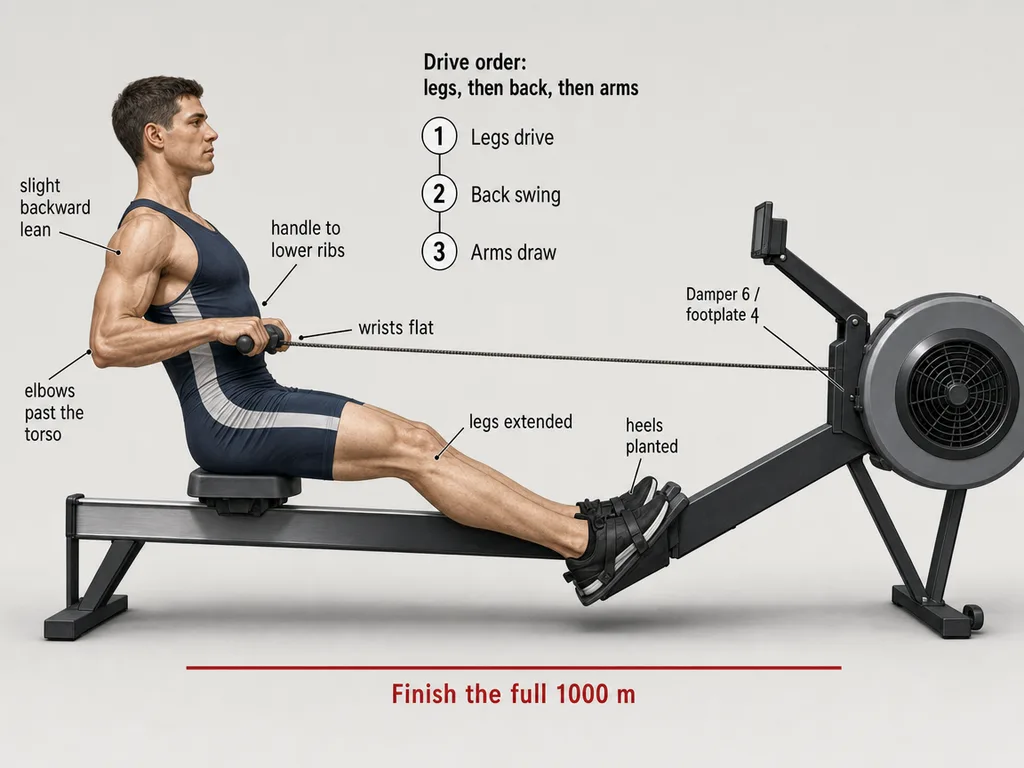
Here the pain drops sharply, because the rower is one of the two stations where your engine actually transfers. The row is 1000 m on a machine preset identically for everyone. The ambush is subtle: it feels aerobic, so runners settle in, over-pace early, blow up, and limp the back half — and it lands mid-race, exactly when fatigue is climbing.
The stroke is a sequence — legs, then back, then arms, and the reverse on the recovery — and stroke rate is a skill, not just effort.
Official standard: 1000 m, damper Resistance 6, footplate Position 4, all divisions. Rule: complete the full 1000 m — a short or missed row means no valid finish.
- Treat it as controlled aerobic work, not a time trial.
- Lead with the legs; use it to bring your heart rate back down — your heart-rate zones show where "controlled" is.
- Median ~4:55.
6. Farmers Carry — the most run-like station, where you should recover
Spec: 200 m · Open 2 × 16 / 2 × 24 kg · Pro 2 × 24 / 2 × 32 kg per hand · median ~2:14.
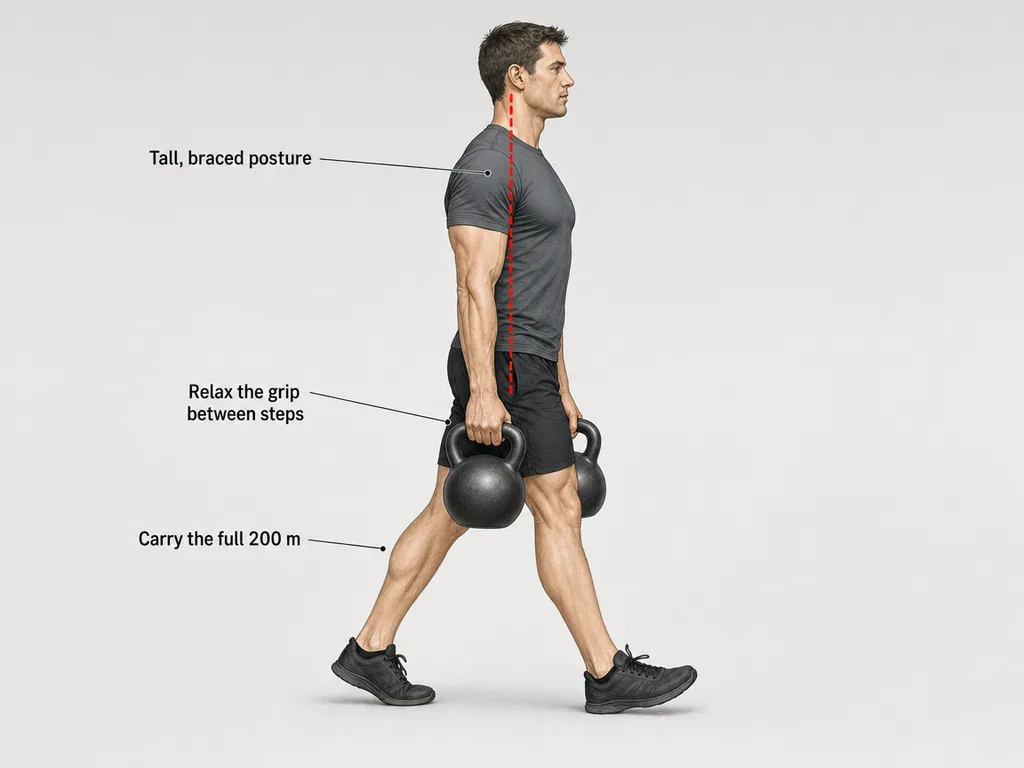
The most run-like station on the course, and the shortest. The farmers carry is 200 m carrying two bells, and the pattern — a steady, upright march over distance — is the closest thing to running you will do all race. The only real limiter is grip, already part-cooked from the sled pull.
Official load (per hand): 24 kg for open men, 16 kg for open women, 32 kg for men pro. Rule: carry the bells the full 200 m; you may set them down and pick them up (no no-rep, but it costs time), and dropping them outside the permitted zone can cost you.
- A recover-don't-push station — a smart runner recovers here, between the row and the lunges.
- Build grip with dead hangs and heavy carries, but do not death-grip — relax your hands, keep a metronomic march.
- Median ~2:14.
7. Sandbag Lunges — where a runner's legs actually tear
Spec: 100 m · Open 10/20 kg · Pro 20/30 kg sandbag · median ~5:27.
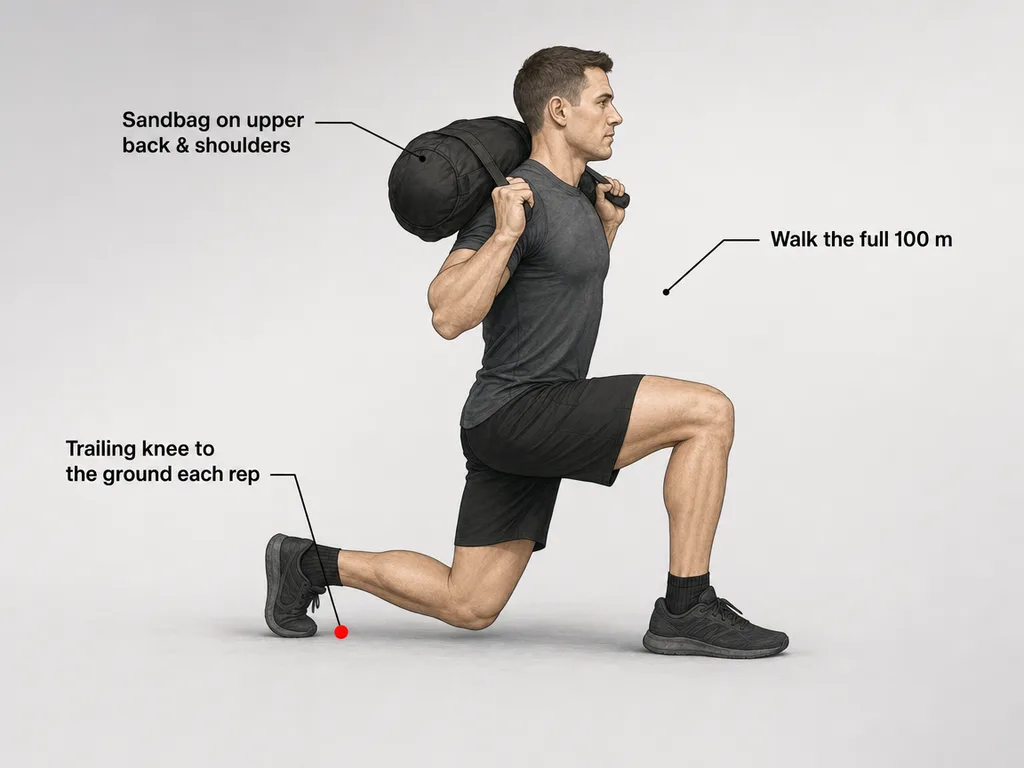
This is where a runner's legs actually tear, and it lands second-to-last — so when it is done you face only the wall balls, with nothing left. The lunges are 100 m of weighted walking lunges, but the real damage is downstream: this station torches the exact quad and glute chain you need for the final run and the wall balls that follow.
A road runner has the cardio but has almost never trained loaded single-leg eccentric work, so the legs — already pre-fried — give out fast: balance goes, the trailing knee won't reach the floor cleanly, and a few reps in you are spent.
Official load: 100 m, sandbag 20 kg for open men, 10 kg for open women, 30 kg for men pro. No-rep rule: the trailing knee must touch the ground on each rep, and the bag must stay on your shoulders or upper back — drop it and you restart.
- Train loaded walking lunges with the bag on your back; add balance and ankle work.
- Run brick sessions — lunge, then immediately run — so the final-1000m collapse is rehearsed.
- Model that compromised split on the pace calculator, not your fresh road pace.
- Median ~5:27.
8. Wall Balls — the skill station that lands when you are most broken
Spec: 100 reps · ball Open 4/6 kg · Pro 6/9 kg · target 2.70 m (women) / 3.00 m (men) · median ~7:10.
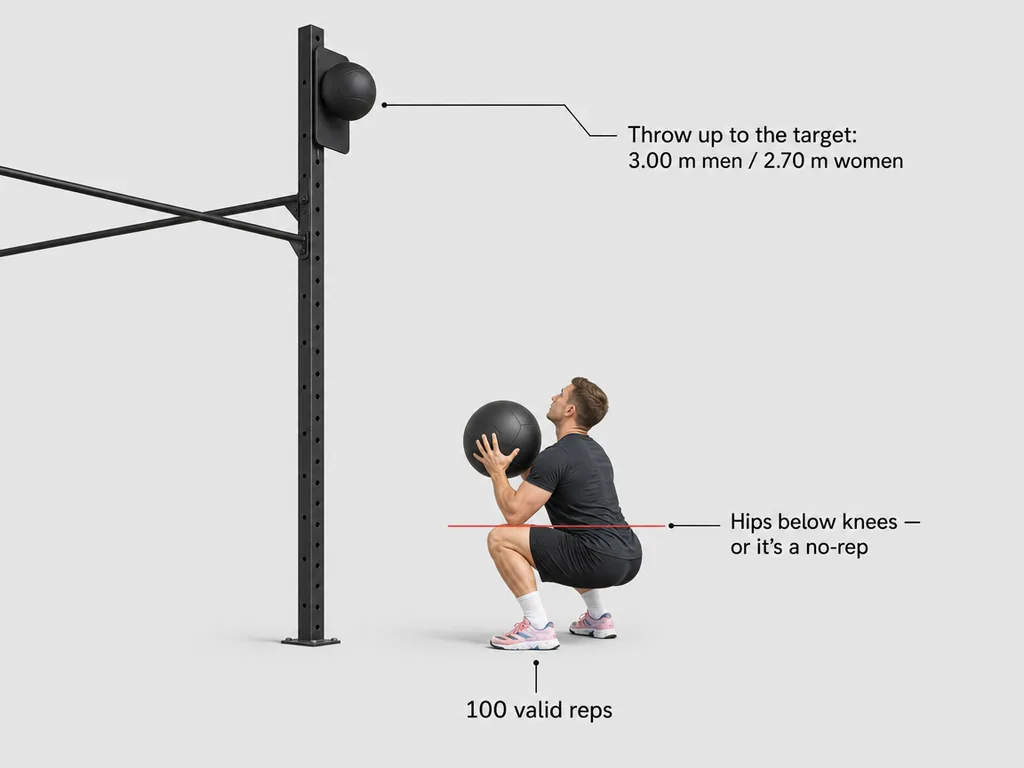
Wall balls are the final station, and the single hardest for a runner — it is not close. They are the longest single station (~7:10 median), they come after eight runs and seven stations, and they are a skill, depth and accuracy station rather than a fitness one. Your engine buys you nothing here.
The movement: hold the ball at your chest, squat until your hips drop below your knees, then drive up and throw so the ball hits the target line. You need 100 valid reps in every Singles division — not 75, which is an outdated rumour for this format; only fully valid reps count.
Official standard: ball 6 kg for open men, 4 kg for open women, 9 kg for men pro; target height 3.00 m for men and men pro, 2.70 m for women. No-rep rule, verbatim: there are no warnings — "it is either a rep or a no-rep" — valid depth is hips below knees, the ball must hit the target, and judging is rep or no-rep — a short throw simply doesn't count, and leaving the station before 100 valid reps is a disqualification (26/27 rulebook; the old 15-second-per-rep penalty is gone). No-reps stack fast on cooked legs, which is exactly when your depth collapses.
- Train wall balls already gassed — do them after a hard run so you rehearse depth tired.
- Build ass-to-grass squat strength in sets of 15-20; widen your stance, toes out; work ankle mobility.
- Pace it like its own endurance event — median ~7:10.
- Film a set from the side and run it through the wall ball depth checker to catch the reps a judge would no-rep for depth.
Train the gaps, not the engine you already have
The pattern across all eight is the same: the stations that ambush a runner hardest — wall balls, lunges, sled pull — reward loaded leg strength, single-leg eccentric capacity and grip, none of which running builds. The stations where your engine helps — the row, the SkiErg, and to a degree the sled push — are where you should pace conservatively, not attack.
Build the missing strength qualities with dedicated work like strength training for runners, and keep developing the engine that wins the runs with VO2max training — just know it helps the running, not the floor. And remember the Roxzone transitions between every run and station are live clock time, not rest; first-timers routinely lose minutes there they never trained for.
Whichever gaps you pick, the training only firms up once it has a deadline attached. Put one on the calendar — HYROX Boston or HYROX Dallas if you want a big US field, or something closer on the full race calendar — and count your strength weeks backwards from it.
Sources & References
- (2026). HYROX Singles Rulebook 26/27. hyrox.com.
- (2025). Acute physiological responses and performance determinants in Hyrox. Frontiers in Physiology.
- (2013). The Effects of Combined Strength and Endurance Training on Running Performance the Following Day. International Journal of Sport and Health Science.
- (2014). Strength training prior to endurance exercise: impact on the neuromuscular system, endurance performance and cardiorespiratory responses. Journal of Human Kinetics.