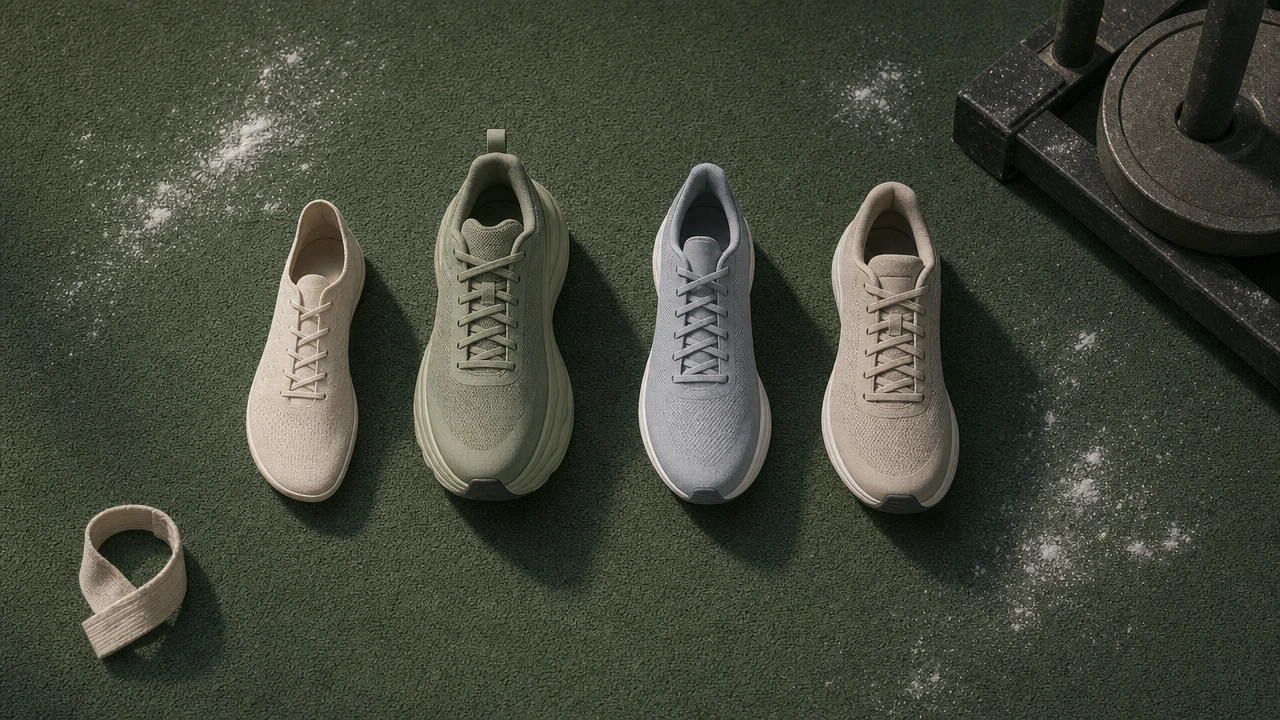
Best Shoes for HYROX: What to Actually Buy
The best HYROX shoe for most people is a stable, low-stack running shoe — not carbon. Compare rated shoes station by station, with no affiliate links.
Key Takeaways
- For most people the best HYROX shoe is a stable, low-stack running shoe with good grip — not a carbon plate and not a HYROX-branded model.
- A carbon plate is fully legal (the rulebook restricts nothing about plates, stack or drop) but mainly pays off if you run your laps around 4:00/km or faster — a race-day shoe; training in it daily stresses your lower legs.
- Already own a firm, grippy trainer? Wear it for your first race — you don’t need to buy anything.
- “HYROX version” shoes vary — the Deviate Elite 4 HYROX is a genuinely re-engineered grip outsole; the Velocity HYROX is just a colorway.
For most people, the best HYROX shoe is a stable, low-stack road running shoe with good grip — not a carbon plate, and not a HYROX-branded model. Roughly half of your finish time is spent running the eight 1 km laps2, so the shoe still has to run well; the other half is sleds, carries, lunges and wall balls, where a tall, soft, bouncy shoe quietly works against you.
Full ratings are in the spec table below, grouped by fit. Want a shortlist for your level? Try the shoe finder; run your splits through the HYROX time calculator to see where you lose time before spending a cent. New to the format? Start with HYROX for runners.
The compromise every HYROX shoe makes
A HYROX shoe is judged on three things, and no single shoe maxes all three:
- Turf grip — traction to push and pull the sled across the event turf.
- Lateral stability — a low, firm, planted platform for lunges, wall balls, burpees and carries.
- Run comfort — cushion and return over the eight 1 km laps.
The catch: grip and stability come from a low, firm, grippy shoe, run comfort from a tall, soft, cushioned one — they pull in opposite directions. Every shoe is a point on that triangle; the right one depends on whether you lose more time on the stations or the runs.
r/hyrox lands on exactly this, verbatim: “any shoe with a solid and less bouncy foam and low stack will do well… the most stable type of running shoe you can get it your best bet” (r/hyrox thread 1uoqkgn). Find your bottleneck first — run your splits through the HYROX time calculator: if the stations bleed your time, bias toward grip and stability; if the runs do, bias toward cushion.
What each station actually asks of your shoe
The surprising part: your shoe barely matters at half the stations and is decisive at the other half — a map no shoe review draws.
| Station | What the shoe needs |
|---|---|
| Sled Push, Sled Pull | Turf grip. The two heaviest external loads in the race, dragged across the event turf — this is where outsole rubber wins or loses you minutes. |
| Sandbag Lunges, Wall Balls, Burpee Broad Jumps, Farmers Carry | Lateral stability + low stack. Loaded and dynamic; a tall, soft shoe rolls under you and wastes energy on every rep. |
| SkiErg, Rowing | Almost nothing. Standing and seated pulls — any shoe is fine here. |
| The eight 1 km runs (about half the race) | Cushion + return. The one place a plush, springy shoe genuinely pays off. |
HYROX barely constrains what you wear: there is exactly one footwear rule, verbatim from the 26/27 Singles Rulebook: “All racers are required to wear closed-toe shoes at all times during the race, except at the Wall Ball workout station where racers may remove their shoes to complete the Wall Balls”1. Nothing about drop, stack height, plate or spikes. For per-division loads, see the station-by-station guide or the HYROX weights table.
HYROX shoe spec table — grouped by fit, not ranked
Every shoe in our database with a HYROX fit rating, sorted into four fit groups and listed alphabetically inside each. There is no ranking at all — the right shoe depends on where you lose time, not on a leaderboard position.
| Shoe | Drop | Stack (heel/fore) | Weight | Plate | Price (USD) |
|---|---|---|---|---|---|
| Top picks Low, firm and grippy — stable through every station and still cushioned enough for the eight 1 km runs. | |||||
| Adidas Adizero Takumi Sen 10 | 6 mm | 33/27 mm | 198 g | Glass rods | $180 |
| Brooks Hyperion 2 | 8 mm | 34/26 mm | 201 g | None | $140 |
| Suitable A dependable all-rounder: a clear strength somewhere, or the official purpose-built HYROX build. | |||||
| Adidas Adizero Boston 13 | 6 mm | 36/30 mm | 254 g | Glass rods | $160 |
| Adidas Adizero Dropset Elite | 12 mm | 44/32 mm | 210 g | None | $275 |
| ASICS Noosa Tri 16 | 5 mm | 34.5/29.5 mm | 215 g | None | $135 |
| HOKA Mach 6 | 5 mm | 37/32 mm | 232 g | None | $140 |
| HOKA Mach 7 | 5 mm | 37/32 mm | 241 g | None | $145 |
| New Balance FuelCell Rebel v5 | 6 mm | 35/29 mm | 215 g | None | $140 |
| Nike Structure 26 | 10 mm | 38/28 mm | 320 g | None | $145 |
| On Cloudflow 5 | 6 mm | 37/31 mm | 271 g | Nylon | $180 |
| PUMA Deviate NITRO Elite 4 HYROX | 8 mm | 40/32 mm | 194 g | Carbon | $260 |
| PUMA Velocity NITRO 4 HYROX | 10 mm | 34/24 mm | 224 g | None | $150 |
| PUMA Velocity NITRO 5 | 8 mm | 34/26 mm | 247 g | None | $140 |
| Saucony Endorphin Speed 5 | 8 mm | 38/30 mm | 238 g | Nylon | $175 |
| Usable — check one thing It works, but most are run-first race shoes you should test on the sled before race day. | |||||
| Adidas Adizero Adios Pro 4 | 6 mm | 39/33 mm | 200 g | Carbon | $250 |
| Adidas Adizero Evo SL | 6 mm | 39/33 mm | 224 g | None | $150 |
| ASICS Magic Speed 4 | 8 mm | 43.5/35.5 mm | 237 g | Carbon | $170 |
| ASICS Novablast 6 | 8 mm | 41.5/33.5 mm | 249 g | None | $150 |
| ASICS Superblast 2 | 8 mm | 45/37 mm | 249 g | None | $200 |
| Brooks Hyperion Elite 4 PB | 8 mm | 40/32 mm | 205 g | Carbon | $250 |
| Brooks Hyperion Max 3 | 6 mm | 46/40 mm | 283 g | Nylon | $200 |
| HOKA Clifton 10 | 8 mm | 42/34 mm | 278 g | None | $150 |
| Mizuno Wave Rebellion Pro 3 | 4 mm | 40/36 mm | 218 g | Carbon | $250 |
| New Balance Fresh Foam X 1080v15 | 6 mm | 40/34 mm | 261 g | None | $170 |
| Nike Pegasus 42 | 10 mm | 37/27 mm | 300 g | None | $145 |
| Nike Vaporfly 4 | 6 mm | 36/30 mm | 167 g | Carbon | $270 |
| Nike Zoom Fly 6 | 8 mm | 40/32 mm | 244 g | Carbon | $170 |
| On Cloudboom Echo 3 | 9.5 mm | 37/27.5 mm | 215 g | Carbon | $290 |
| PUMA Deviate NITRO 4 | 8 mm | 33.6/26.6 mm | 247 g | Carbon | $170 |
| Saucony Endorphin Pro 5 | 8 mm | 39.5/31.5 mm | 206 g | Carbon | $225 |
| Best avoided Tall, soft, max-cushion trainers — comfortable to run, but unstable on sleds, carries and lunges. | |||||
| Brooks Glycerin Max | 6 mm | 47/41 mm | 300 g | None | $200 |
| HOKA Bondi 9 | 5 mm | 43/38 mm | 297 g | None | $170 |
| Nike Alphafly 3 | 8 mm | 40/32 mm | 218 g | Carbon | $285 |
| Nike Vomero Premium | 10 mm | 55/45 mm | 329 g | None | $230 |
Drop, stack and weight come from our shoe database — manufacturer-official where the brand publishes a figure, independent lab measurement (e.g. RunRepeat) otherwise. Price is MSRP in USD. 34 shoes rated · updated 2026-07.
How these ratings are made (and why there's no #1)
Each shoe is scored on three axes that decide HYROX fit, then sorted into a group. Scores are spec-derived and cross-checked against r/hyrox race reports — not a subjective star rating — and no shoe wins outright, because the axes pull against each other.
- Turf grip (1–5, higher is better): outsole traction for the sled push and pull on HYROX turf.
- Lateral stability (1–5, higher is better): how planted the platform feels on lunges, wall balls, burpees and carries.
- Run trade-off (1–5): how much run cushioning is given up for a station-stable base. This axis runs the opposite way — 1 is a plush, forgiving ride over the 8 × 1 km, 5 is a firm, low ride that runs harsher, because a shoe that is rock-solid on the stations pays for it on the runs.
Every rating carries its evidence in the database — the spec logic, the r/hyrox thread IDs behind it, and the date it was rated.
RunDida earns no commission on any shoe. Nothing here is a paid placement and there are no buy links — the order is alphabetical and the grouping is about fit.
Do you need a carbon plate? Probably not
For most HYROX athletes, no. People get this backwards: a carbon plate is fully legal — the 26/27 rulebook sets no restriction on plates, stack or drop1. So it is a performance question, not a rules one.
The performance case is weaker than it looks. A carbon plate’s biggest gains come at fast running paces — but in HYROX you typically lose more time on the stations than the runs, and a stiff, tall carbon racer is exactly what wobbles on wall balls and lunges. r/hyrox is consistent: brilliant on the runs, punishing on certain stations. Rough community rule of thumb: a plate only clearly earns its place if you run your 1 km laps around 4:00/km or faster — and even then, treat it as a race-day shoe, not a daily trainer.
Durability seals it: carbon racers wear out faster, and the plate stiffness stresses your lower legs if you train in them daily. The community advice is blunt, verbatim: “Issue with the carbon plate shoes is they don’t last as long. That’s the main reason to only wear them on race day” — with some reporting a shoe can “lose their value after just 100 miles” (r/hyrox thread 1fodsxo). Break them in over a few sessions, then save them for race day. Whether a plate helps you at all: carbon plate truth.
“HYROX version” shoes: real upgrade, or just a colorway?
It depends entirely on the model. PUMA is HYROX’s official footwear partner: since the first race in Hamburg in 2017, a global partner from 2023, and from October 2025 the exclusive title partner of the HYROX World Championships through 20303. That badge now appears on several shoes — and they are not the same story.
The Velocity NITRO 4 HYROX is, by the community’s own account, cosmetic. Verbatim from r/hyrox: “The Hyrox version of the Velocity isn’t different in any way — it’s just a Hyrox colorway, no other differences” (r/hyrox thread 1un3lnv). Same shoe, HYROX paint.
The Deviate NITRO Elite 4 HYROX is the opposite — genuinely re-engineered. PUMA bills it as the first shoe built for the sport, and reviews confirm it: where the road Deviate Elite 4 exposes bare foam with sparse rubber, the HYROX version covers the entire outsole in grippy lugs that wrap up and around the toe box (traction however you brace against the sled) and thickens the medial midfoot for more ground contact — at about 24 g of extra weight. In our table it lands at suitable rather than a top pick only because a carbon racer is still a run-first shoe.
Fixing sled slip and heel lift
“Slipping on the sled” has two completely different causes, and the fix depends on which one — often the fastest free time in your race.
1. Your foot slides forward inside the shoe (your heel lifts out the back) on the sled pull. That is a lacing and fit problem, not the outsole. The fix is heel-lock lacing: thread each lace up through the extra top eyelet on its own side to make a small loop, then cross each lace through the opposite loop and cinch before tying. It is the single most-recommended fix on r/hyrox.
2. The whole shoe slides on the floor. That is a grip and outsole problem — and it is surface-dependent: grip that works at one venue can fail at another. One racer, verbatim: “Adios pro 3 was my favorite hyrox shoe until Chicago Worlds. There it did not work for the sleds any more on the new turf… I was slipping and it took me 8:30 minutes instead of the usual 4:30” (r/hyrox thread 1ls4g89). The lesson isn’t “avoid that shoe” — the floor changes, so test your grip and don’t assume last race’s traction carries over.
On sizing: true-to-size for most feet. Half a size up buys room for feet that swell late in a race, but it is a trade-off — that same room lets your heel slip on the rower and sled pull. Wide feet or bunions? Prioritise a wider toe box and lock the midfoot and heel down rather than sizing up. General fit: choosing running shoes.
What the fast people actually wear
Even the elite field doesn’t converge on one shoe. When r/hyrox tallied the elite start line at a recent World Championships, the most common were the Saucony Endorphin Pro 3 and Pro 4, alongside the On Cloudboom Echo 3 and Mizuno Wave Rebellion Pro 2 — a spread of low-stack carbon racers, not a single “HYROX shoe” (r/hyrox thread 1f9o45c). Two caveats: HYROX doesn’t publish what its champions race in, so treat this as observed, not confirmed; and elites run their laps far faster than the rest of us — precisely why carbon racers make sense for them and, for most people, not for you.
Sources & References
- (2026). HYROX Singles Rulebook 26/27. hyrox.com.
- (2025). Acute physiological responses and performance determinants in Hyrox. Frontiers in Physiology.
- (2025). PUMA announces early renewal of its long-term partnership with HYROX. about.puma.com.