
Couch to 5K: The Complete 8-Week Beginner Plan
Never run before? This free 8-week walk-run plan takes you from zero to 5K with pacing guides, injury prevention, and a clear path to your first race.
Key Takeaways
- Start slower than you think — Conversational pace during running intervals is the single most important rule for completing C25K without injury
- Trust the walk breaks — Walk intervals reduce impact forces by roughly half while maintaining cardiovascular stimulus, making them an active training tool rather than a rest period
- Consistency beats speed — Three sessions per week for 8 weeks matters more than pace; research shows most dropouts happen because people skip ahead, not because they go too slowly
- Invest in shoes, not gadgets — Proper running shoes are the only essential purchase; everything else can wait until after you complete the program
What Is Couch to 5K?
Couch to 5K (C25K) is a structured training program designed to take complete beginners from zero running experience to completing a 5-kilometer run in approximately 8 weeks. Originally created in 1996 by Josh Clark, the program uses progressive walk-run intervals to build cardiovascular fitness and musculoskeletal resilience gradually.
One common misconception deserves clearing up immediately: C25K trains you to run for 30 minutes continuously — not necessarily to cover 5 kilometers. Many program completers run only 3-4 km in their final 30-minute session, and that is entirely normal. Distance comes later; the 8-week goal is sustained running, not a specific distance.
The approach is simple: you start by mostly walking with short running bursts, then gradually shift the ratio until you can run 5K continuously. Each session takes just 20-30 minutes, three times per week — making it one of the most accessible entry points into running. If you already have some fitness base and want a broader overview of building a running habit, our Beginner Running Guide covers the full landscape from motivation to long-term consistency.
How the Walk-Run Method Works
The walk-run method is the foundation of every C25K program. Rather than attempting to run continuously from day one — which commonly leads to injury and burnout — you alternate between walking and running intervals. This approach works because it:
- Reduces cumulative impact — walking intervals let your joints, tendons, and muscles recover between running bursts, lowering the repetitive stress that causes overuse injuries
- Builds aerobic capacity gradually — short running intervals push your cardiovascular system just enough to trigger adaptation without overwhelming it
- Maintains motivation — knowing a walk break is coming makes each running interval psychologically manageable
Research supports this approach: a 2023 study of 110 C25K participants in the UK found that only 27% completed the program, with the main dropout reasons being musculoskeletal injury and the plan progressing too quickly. The takeaway is clear — respect the walk-run progression and resist the urge to skip ahead.
The Complete 8-Week Plan
This plan follows three sessions per week with at least one rest day between sessions. Every session begins with a 5-minute brisk walk warm-up and ends with a 5-minute walk cool-down. Use the Training Pace Calculator to find an appropriate easy pace — for C25K, your running intervals should feel conversational, never breathless.
Weeks 1-2: Building the Foundation
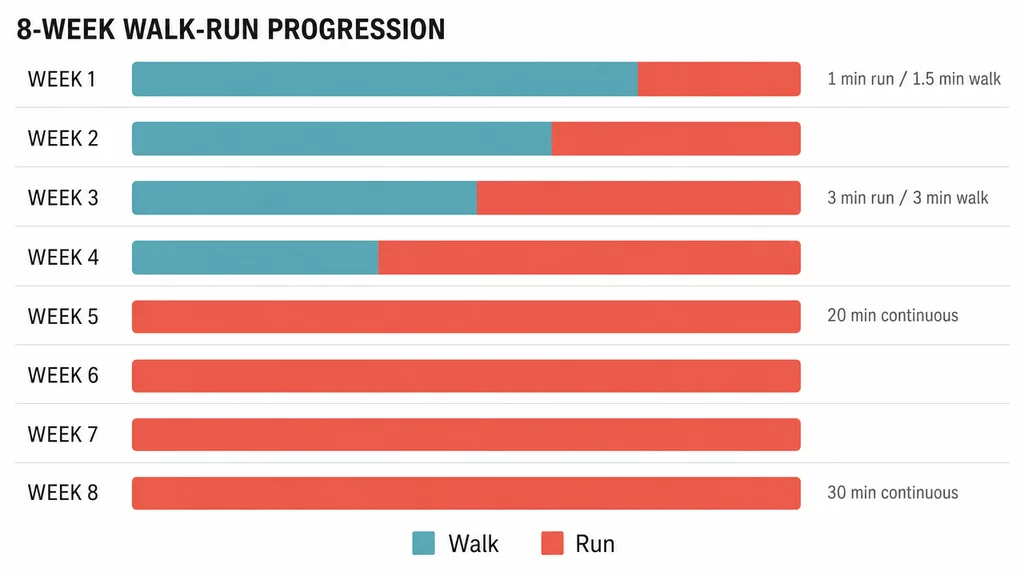
- Week 1: Alternate 60 seconds running / 90 seconds walking for 20 minutes
- Week 2: Alternate 90 seconds running / 2 minutes walking for 20 minutes
Weeks 3-4: Extending Run Intervals
- Week 3: Two cycles of [90 seconds running, 90 seconds walking, 3 minutes running, 3 minutes walking]
- Week 4: 3 min running, 90 sec walking, 5 min running, 2.5 min walking, 3 min running, 90 sec walking, 5 min running
Weeks 5-6: The Breakthrough
- Week 5: Progress from 5-minute runs to your first 20-minute continuous run by end of week
- Week 6: Build from 5/8-minute intervals up to a 25-minute continuous run
Weeks 7-8: Running Continuously
- Week 7: Three sessions of 25 minutes continuous running
- Week 8: Three sessions of 28-30 minutes continuous running — approximately 5K at a beginner pace
Track your distance with the Steps to Distance Calculator if you don't have a GPS watch — knowing your approximate distance builds confidence as the numbers grow each week.
Getting Started: Essential Gear
One of the best aspects of C25K is how little you need. But a few essentials make a real difference:
Running shoes are your only non-negotiable investment. Visit a specialty running store for a basic gait analysis, or read our Running Shoe Guide to understand what matters: fit, cushioning, and matching your foot type. You do not need the most expensive model — you need one that fits well. Plan to replace shoes every 500-800 km.
Clothing should be moisture-wicking synthetic or merino wool — cotton holds sweat and causes chafing. Use the What to Wear Calculator before each session to get weather-appropriate recommendations. Light colors and breathable fabrics in heat; layers with a windproof outer in cold.
A timing method is helpful for interval prompts. Your phone timer works, but a free C25K app (such as the NHS Couch to 5K or similar) automates interval cues so you can focus on running rather than watching the clock.
Pacing and Heart Rate for Beginners
The most important pacing rule for C25K: slow down. Almost every beginner runs too fast. Your running intervals should be at a pace where you can hold a full conversation — if you are gasping, you are going too hard.
For a more precise approach, use the Heart Rate Zone Calculator to find your Zone 2 range (typically 60-70% of maximum heart rate). Aim to keep your running intervals in Zone 2 for the first six weeks. This intensity feels deceptively easy — and that is exactly the point. Building aerobic base at low intensity creates the cardiovascular foundation for all future running.
Use the Pace Calculator to understand what different paces feel like. A typical C25K beginner runs at 7:00-8:30 min/km (11:00-14:00 min/mile). There is no such thing as too slow in C25K — there is only too fast.
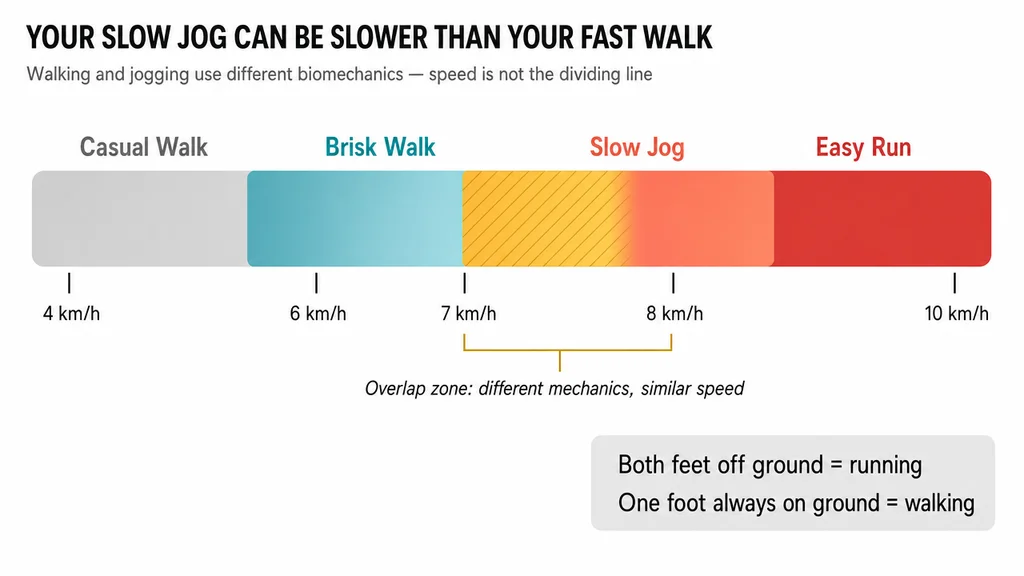
One breakthrough that transforms the C25K experience: your slow jog can absolutely be slower than your fast walk, and that is fine. Running and walking are biomechanically different movements. A slow jog involves a flight phase — both feet briefly leave the ground — and engages stabilizing muscles that walking does not.
Many beginners quit because they feel embarrassed that people are walking past them while they jog. This comparison is meaningless. As one community member put it: "My biggest breakthrough came when I realized there was no rule saying my slowest run needs to be faster than my fastest walk. They are absolutely different mechanics" (r/C25K community).
Speed will come with months of consistent running. For now, if you are moving in a running gait, you are training the right systems.
Common Mistakes That Derail Beginners
Skipping ahead in the program. If Week 3 feels easy, resist jumping to Week 5. Your musculoskeletal system adapts more slowly than your cardiovascular system — your heart and lungs may feel ready weeks before your tendons, ligaments, and bones are. The 2023 UK C25K study found that non-completion was significantly linked to the program progressing too fast for individuals.
Running every day. Rest days are when adaptation actually occurs. Stick to three sessions per week with at least one full rest day between runs. Your body rebuilds stronger during recovery, not during the workout itself.
Ignoring running form. Even at slow paces, poor form accumulates unnecessary impact over hundreds of steps. Focus on three fundamentals: land with your foot under your body rather than ahead of it, maintain a slight forward lean from the ankles, and aim for a cadence of 160-170 steps per minute. Our Running Form and Technique Guide covers these mechanics in full detail.
Comparing yourself to others. Social media overflows with sub-25-minute 5K runners, which can make your pace feel inadequate. But consider this: when runners post their first nonstop 5K times of 45-60 minutes, the community routinely responds with hundreds of supportive comments — because finishing is the achievement, not the clock. Your first 5K might take 35 minutes or 55 minutes, and both are legitimate milestones worth celebrating. The goal of C25K is completion, not speed.
Being a serial restarter — and blaming yourself for it. A significant number of people have started C25K three, five, even ten or more times without finishing. If this is you, the problem is almost certainly not willpower.
The two most common causes are running too fast (which makes every session feel like suffering) and unrealistic expectations about what the early weeks should feel like. One runner who had started the program over ten times finally completed it after modifying the plan with a physical therapist — slowing down dramatically and extending the early weeks.
If you have restarted multiple times, try these adjustments before your next attempt: cut your running pace until you can genuinely hold a conversation, repeat the first three weeks twice, and drop any expectation about distance covered. The program works — it just may need to run on your body's timeline rather than the calendar's.
Staying Injury-Free
Research shows that roughly 19% of C25K participants experience a musculoskeletal injury during the program, with previous injury being the strongest risk factor — increasing the likelihood by 7.5 times. The positive side: most C25K injuries are preventable.
Follow the built-in progression. The 8-week plan is designed so that weekly running volume increases gradually. The main risk comes from adding extra sessions, running on non-rest days, or jumping weeks. When in doubt, repeat a week rather than advancing.
Listen to pain signals. Sharp pain, pain that worsens during a run, or pain that persists more than 48 hours after a session means you should take additional rest days. Dull muscle soreness that fades as you warm up is normal; joint pain is not. For a detailed breakdown of common issues and when to seek professional help, read our Injury Prevention Guide. Knee pain is the most common running complaint among beginners — if you experience persistent knee discomfort, our dedicated Knee Pain Guide covers diagnosis, treatment, and return-to-running protocols in depth.
Add basic strength work. Spend 10-15 minutes twice per week on bodyweight exercises: calf raises, single-leg squats, glute bridges, and planks. A 2025 scoping review of running injury prevention practices found that strength training is one of the most consistently recommended interventions for reducing injury risk across all running populations.
Monitor energy balance. Use the Running Calorie Calculator to understand your energy expenditure — underfueling is a hidden cause of fatigue and injury in new runners who combine C25K with aggressive calorie restriction.
After Couch to 5K: What Comes Next
Completing C25K is a genuine milestone — you have built the habit, the aerobic base, and the confidence to call yourself a runner. Here are three natural next steps:
Run a 5K event — especially Parkrun. Nothing solidifies a running identity like crossing a finish line among other runners. Parkrun is the ideal first event for C25K graduates: it is free, held every Saturday morning in over 20 countries, exactly 5K, untimed-friendly (you can walk portions), and welcomes all speeds — from 16-minute racers to 60-minute joggers on the same course. There is no entry fee, no pressure, and no minimum pace requirement. Register online, print your barcode, and show up. Many C25K graduates describe their first Parkrun as the moment they started thinking of themselves as runners. Community 5K races are also excellent options if Parkrun is not available in your area.
Build consistency before chasing speed. Spend 4-6 weeks running three times per week at your comfortable pace before attempting to get faster. Gradually add 5 minutes to one weekly run to develop your long run — this is how endurance capacity expands.
Set your next goal. Once you can comfortably run 5K three times a week, you have the foundation for almost any running ambition: lowering your 5K personal best, training for a 10K, or even beginning the long road toward a half marathon. Many beginners tackle that first longer race with the Galloway run/walk method — planned walk breaks make the distance far more manageable. Each step builds on the aerobic base and structural resilience these 8 weeks have given you.
Sources & References
- (2023). Couch-to-5k or Couch to Ouch to Couch!? Who Takes Part in Beginner Runner Programmes in the UK and Is Non-Completion Linked to Musculoskeletal Injury?. International Journal of Environmental Research and Public Health.
- (2025). Running-Centred Injury Prevention Support: A Scoping Review on Current Injury Risk Reduction Practices for Runners. Translational Sports Medicine.
- (2008). No Effect of a Graded Training Program on the Number of Running-Related Injuries in Novice Runners: A Randomized Controlled Trial. American Journal of Sports Medicine.
- (2016). The NLstart2run Study: Training-Related Factors Associated with Running-Related Injuries in Novice Runners. Journal of Science and Medicine in Sport.