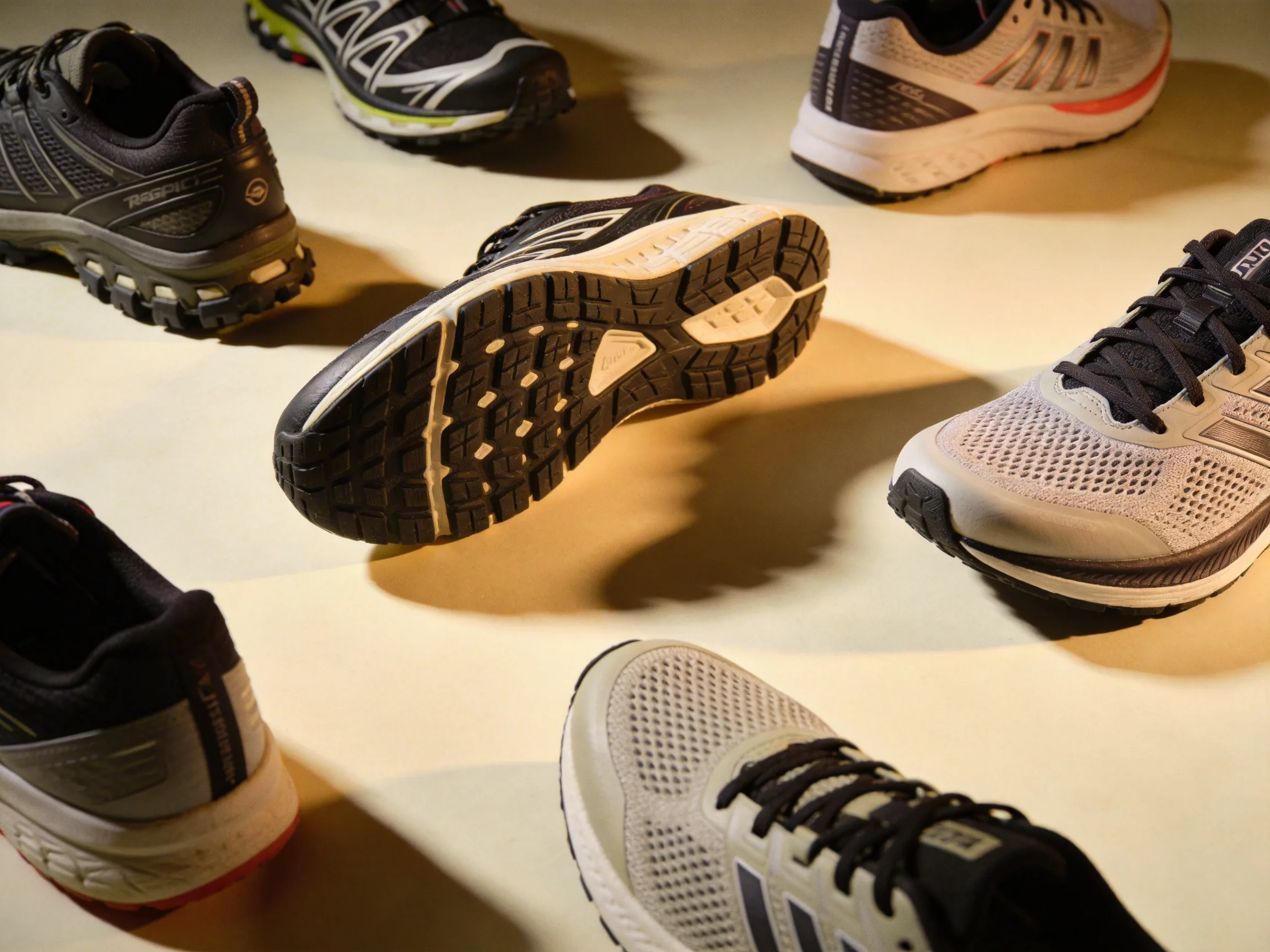
How to Choose Marathon Running Shoes: A Complete Guide
Which running shoes match your pace and gait? Carbon plates vs. cushioned trainers, the 39% injury-reduction rotation strategy, and cost-per-km analysis.
Key Takeaways
- Rotate 2-4 pairs to cut injury risk 39% — Alternating shoes distributes biomechanical stress across different tissues.
- Carbon-plated shoes are not for everyone — Greatest advantage at paces of 5:00/km or faster; slower runners benefit more from comfort.
- Never race in brand new shoes — Break in race-day shoes with 30-50 km, including at least two runs of 15+ km at marathon pace.
- Cost per kilometer beats sticker price — A $250 carbon racer at $0.83/km costs six times more than a $100 daily trainer at $0.14/km.
Your choice of marathon shoes is one of the most consequential gear decisions you will make as a runner. Research shows that footwear alone can influence running economy by 2-4% — enough to shave 3-8 minutes off a marathon finish time. Beyond performance, the wrong shoes contribute to overuse injuries that sideline thousands of runners every year. This guide provides a methodology-focused, evidence-based framework for selecting the right shoes for your marathon goals, body type, and running style.
Shoe Categories for Marathon Runners
Modern running shoes fall into four broad categories, each designed for a specific purpose in your training and racing. Understanding these categories is the first step toward building a smart shoe strategy.
Carbon-Plated Racing Shoes
The so-called "super shoes" have transformed marathon racing since 2017. They feature a rigid carbon-fiber plate embedded in highly resilient PEBA (Pebax) foam, creating a lever-like effect that returns energy with each stride. Research by Hoogkamer et al. (2018) demonstrated a 4% improvement in running economy compared to traditional racing flats — but individual responses span 1.59% to 6.26%, and gains shrink at slower paces. For the full evidence review and a decision framework for non-elite runners, see our Carbon Plate Truth guide, and run the per-minute cost numbers for your own goal with the Carbon ROI Calculator.
- Weight: 160-230g
- Stack height: 35-40mm
- Lifespan: 200-400 km (the foam and plate degrade faster than traditional shoes)
- Best for: Race day and key race-simulation workouts
- Limitation: Expensive, short lifespan, not ideal for daily training due to reduced ground feel and proprioception
Carbon-plated shoes deliver the greatest advantage to runners who maintain a pace of approximately 5:00 min/km or faster. Slower runners still benefit, but the effect diminishes as ground contact time increases.
Cushioned Daily Trainers
This is the workhorse category — the shoe you lace up for 80% of your weekly mileage. Daily trainers prioritize durability, comfort, and moderate energy return over raw speed. They use EVA or TPU-based foams that are heavier but far more durable than the PEBA foams found in racing shoes.
- Weight: 250-320g
- Stack height: 28-38mm
- Lifespan: 600-800 km
- Best for: Easy runs, recovery runs, long runs at conversational pace
A good daily trainer should feel comfortable from the first step without a long break-in period. It should provide enough cushioning to absorb the repetitive impact of high-mileage weeks without feeling mushy or unstable.
Stability Shoes
Stability shoes are engineered for runners who overpronate — meaning the foot rolls excessively inward during the stance phase. They incorporate medial posts, guide rails, or firmer-density foam on the inner side of the midsole to control the degree of pronation.
- Who needs them: Runners with moderate to severe overpronation, flat feet, or a history of medial-side injuries (shin splints, plantar fasciitis, knee pain)
- How to determine gait: A professional gait analysis at a running specialty store, or observation of wear patterns on your current shoes (excessive wear on the inner heel and forefoot indicates overpronation)
- Lifespan: 500-700 km
Not every runner needs stability features. If you have a neutral gait and no injury history related to pronation, a neutral shoe is the better choice. Before accepting a "you overpronate, you need stability" recommendation from a specialty store, review the 30-year research base in our Pronation Myth guide — military RCTs and the 2022 Agresta review show static arch-based prescription is not evidence-based for most runners.
Lightweight Trainers
Lightweight trainers occupy the middle ground between cushy daily trainers and aggressive racing shoes. They are firmer, more responsive, and 30-60g lighter than daily trainers, making them ideal for faster-paced sessions.
- Weight: 200-260g
- Lifespan: 400-600 km
- Best for: Tempo runs, interval sessions, marathon-pace long runs, shorter races (5K-half marathon)
Think of lightweight trainers as your speed-development tool. They encourage a quicker cadence and more efficient foot strike without the fragility of a full carbon racer.
Matching Shoes to Your Profile
The right shoe depends on who you are as a runner. Use the Pace Calculator to establish your current fitness level, then match your profile to the recommendations below. For an algorithmic shortcut, try our Shoe Match tool — it filters 155 SKUs across 15 brands by your pace, weight, budget, injury profile, and preferences (no affiliate weighting; always links to official brand product pages).
By Goal Marathon Pace
Your target finish time is the strongest predictor of which shoe category will benefit you most on race day.
- Sub-3:00 (under 4:16/km): Carbon-plated racers are essential. At this pace, the 4% economy gain translates to 5-7 minutes — the difference between a podium and mid-pack. Pair with lightweight trainers for workouts.
- 3:00-3:30 (4:16-4:59/km): Carbon-plated shoes offer a significant and measurable advantage. The investment is worthwhile if marathon performance is a priority.
- 3:30-4:00 (4:59-5:41/km): Carbon plates are beneficial but optional. A high-quality lightweight trainer can deliver 60-70% of the benefit at a lower cost and with greater durability.
- 4:00+ (5:41/km and slower): Prioritize comfort and cushioning over speed technology. At higher ground contact times, the carbon plate's lever effect is less pronounced. A well-cushioned daily trainer or lightweight trainer is often the better race-day choice for finish times over 4 hours.
By Body Weight
Body weight affects how much cushioning and support your shoes need to provide over 42.195 km.
- Under 65 kg: Light cushioning is typically sufficient. You can get away with lower-stack, lighter shoes without excessive impact fatigue.
- 65-85 kg: Standard cushioning from mid-stack daily trainers and carbon racers. This is the weight range most shoes are designed for.
- Over 85 kg: Maximum cushioning is recommended, especially for training shoes. Higher-stack midsoles distribute impact force across a larger volume of foam, reducing stress on joints. For race day, a carbon racer still works, but choose models with more midsole material rather than the lightest possible option.
By Course Type
Not all marathon courses are created equal, and your shoe choice should reflect the terrain you will face.
- Flat courses (Berlin, Tokyo): Carbon-plated shoes deliver maximum advantage on smooth, flat roads. The plate's propulsive effect works best on consistent surfaces.
- Hilly courses (Boston): Choose shoes with responsive foam and moderate stack height. Extremely high-stack carbon shoes can feel unstable on descents. Look for shoes with good rubber outsole coverage for grip on downhill turns.
- Mixed terrain / trail-adjacent: If the course includes unpaved sections, consider a shoe with a more aggressive outsole pattern. Trail-specific shoes are unnecessary for road marathons but offer better grip if conditions are wet.
By Running Gait
Your foot mechanics determine whether you need neutral or stability features.
- Neutral gait: The foot rolls slightly inward (normal pronation) during landing. The majority of runners are neutral. Choose from any neutral shoe category.
- Overpronation: The foot rolls excessively inward. Look for stability shoes with medial posting or guide rail technology. Signs include: wear concentrated on the inner edge of your shoe soles, recurring medial knee pain, or shin splints.
- Supination (underpronation): The foot rolls outward. This is less common (approximately 5-10% of runners). Choose highly cushioned neutral shoes to compensate for the reduced natural shock absorption. Avoid stability shoes, which would worsen the outward roll.
If you are unsure of your gait, visit a specialty running store for a free gait analysis, or check the wear pattern on a pair of shoes you have run at least 100 km in.
The Rotation Strategy
Running in multiple pairs of shoes — rather than using a single pair for every run — is one of the simplest evidence-based strategies for reducing injury risk. A landmark study by Malisoux et al. (2015) found that runners who rotated between at least two pairs of shoes had a 39% lower risk of running-related injury compared to single-shoe runners.
The mechanism is straightforward: different shoes alter your biomechanics slightly, distributing stress across different tissues rather than loading the same structures identically on every run. Additionally, rotating shoes allows midsole foam to recover its shape between runs, extending the functional lifespan of each pair.
Minimum Rotation: 2 Shoes
- 1 cushioned daily trainer (easy runs, long runs)
- 1 lightweight trainer or carbon racer (workouts, race day)
Optimal Rotation: 3-4 Shoes
- 1 cushioned daily trainer (easy/recovery runs)
- 1 lightweight trainer (tempo, intervals)
- 1 carbon-plated racer (race day, race simulations)
- 1 optional: trail shoe or stability shoe depending on your needs
Use the Shoe Rotation Planner to build a personalized rotation plan based on your weekly mileage, training types, and budget. The tool calculates how many pairs you need and when to retire each shoe.
Shoe Lifespan and When to Replace
Every running shoe has a finite lifespan. The midsole foam gradually loses its cushioning and energy-return properties through cumulative compression. Running in worn-out shoes increases injury risk because your body must absorb impact forces that the shoe no longer attenuates.
Typical Lifespan by Category
- Carbon-plated racers: 200-400 km. The PEBA foam and carbon plate degrade relatively quickly. Most runners notice a measurable drop in performance after 250-300 km.
- Lightweight trainers: 400-600 km.
- Daily trainers: 600-800 km. The most durable category, designed for high cumulative mileage.
- Stability shoes: 500-700 km. The medial post loses effectiveness as the foam softens.
Signs Your Shoes Need Replacing
- Visible midsole creasing: Deep wrinkles in the foam indicate permanent compression.
- Uneven outsole wear: If you can see the midsole foam through the rubber outsole, the shoe is past its prime.
- New aches and pains: Unexplained knee, shin, or hip discomfort that appears when nothing else in your training has changed.
- The shoe feels flat: If the cushioning that once felt bouncy now feels dead and unresponsive, the foam has lost its resilience.
- Asymmetric heel counter: If the back of the shoe leans to one side when placed on a flat surface, the midsole has collapsed unevenly.
Track your mileage per pair using the Shoe Mileage Tracker. The tool logs kilometers on each shoe and alerts you when replacement is due, so you never unknowingly train in dead shoes.
Cost Optimization
Marathon training is expensive, and shoes represent the single largest recurring cost. A serious runner buying 3-4 pairs per year at full retail can easily spend $600-$1,000+ annually. Smart purchasing strategies significantly reduce this burden.
Cost Per Kilometer Analysis
The sticker price of a shoe is misleading — what matters is cost per kilometer. A $100 daily trainer that lasts 700 km costs $0.14/km. A $250 carbon racer that lasts 300 km costs $0.83/km — six times more per kilometer. Use the Shoe Cost Per Mile Calculator to compare the true cost of different shoes in your rotation.
Saving Strategies
- Buy previous-season models: When manufacturers release updated versions, the outgoing model is typically discounted 30-50%. The differences between generations are usually cosmetic or incremental.
- Rotation extends lifespan: By alternating between 2-3 pairs, each shoe gets 24-48 hours of rest between runs for foam recovery. Research suggests this can extend effective lifespan by 15-20%.
- Reserve carbon racers for race day: Limit carbon-plated shoes to races and 2-3 key race-simulation workouts per training cycle. This preserves the foam for the days that matter.
- Stock up during sales: If you find a shoe that works for you, buy 2-3 pairs when discounted. Running shoe foam does not degrade in storage.
Race Day Shoe Tips
Your race-day shoes should be fully broken in but not worn out. Here is how to get it right.
Break-In Protocol
Run 30-50 km in your race-day shoes before the marathon. This is enough to confirm fit, identify any hot spots or blister-prone areas, and let the upper materials conform to your foot — but not so much that you eat into the shoe's limited race-day lifespan (especially important for carbon racers).
Never Race in Brand New Shoes
This is the single most important rule of race-day gear. A shoe that feels perfect in the store can cause blisters, black toenails, or arch pain over 42.195 km. Minor fit issues that are invisible on a 5 km test run become debilitating at marathon distance. Always test race-day shoes on at least two runs of 15+ km, including one at marathon pace.
Lacing and Fit
- Leave a thumb's width of space between your longest toe and the end of the shoe. Feet swell during a marathon, and toenails pay the price if shoes are too short.
- Use a runner's loop (heel lock) lacing technique to prevent heel slippage without over-tightening the midfoot.
- Wear the same socks you plan to race in during your break-in runs.
Weather Considerations
Check the forecast and plan accordingly. Use the What to Wear Calculator to get a complete race-day outfit recommendation based on temperature, humidity, and wind conditions. For wet conditions, some runners apply anti-blister balm to high-friction areas as an extra precaution.
Putting It All Together
Choosing the right marathon shoes does not need to be overwhelming. Follow this decision framework:
- Determine your gait type (neutral vs. stability need)
- Know your goal pace — use the Pace Calculator to establish this
- Build a rotation of 2-4 shoes matched to your training types — use the Shoe Rotation Planner
- Track mileage on each pair with the Shoe Mileage Tracker
- Analyze cost with the Shoe Cost Per Mile Calculator
- Break in race-day shoes with 30-50 km before the marathon
The perfect shoe is not the most expensive or the lightest — it is the one that matches your pace, gait, body, and course. Use RunDida's shoe tools to take the guesswork out of every step.
Proper footwear is just one part of staying healthy on the run. For strategies to avoid common overuse injuries, read our Running Injury Prevention Guide. If you are considering trail shoes, our Trail Running for Beginners Guide covers terrain-specific footwear selection.
Sources & References
- (2018). A Comparison of the Energetic Cost of Running in Marathon Racing Shoes. Sports Medicine.
- (2015). Can parallel use of different running shoes decrease running-related injury risk?. Scandinavian Journal of Medicine & Science in Sports.
- (2020). Systematic review of the role of footwear constructions in running biomechanics. Journal of Sports Science & Medicine.