How the Shoe Mileage Tracker Works
The Running Shoe Mileage Tracker estimates your shoe's remaining useful life by combining six key factors: shoe type, current accumulated mileage, weekly running volume, body weight, running surface, and visible shoe condition. Each factor adjusts the baseline lifespan range to produce a personalized estimate specific to your usage pattern.
Every shoe type has a manufacturer-informed lifespan range measured in kilometers. Racing flats, built with minimal foam and lightweight materials for maximum speed, have the shortest lifespan at 250-400 km. Daily trainers, constructed with denser, more durable foam compounds, can handle 500-800 km before the midsole loses meaningful cushioning. The tracker uses these ranges as the starting point.
Body weight applies a multiplier to the base range. Heavier runners generate higher ground reaction forces — approximately 2.5 times body weight per footstrike — which compresses midsole foam more aggressively. A runner over 90 kg can expect up to 20% shorter shoe life compared to the baseline. Conversely, runners under 60 kg benefit from approximately 10% longer shoe life.
Running surface further adjusts the estimate. Abrasive road surfaces wear outsole rubber faster than softer trail terrain for road shoes, while using road shoes on trails introduces additional stress from rocks and uneven ground. The condition selector accounts for discrepancies between logged mileage and actual wear — shoes that show more damage than expected receive a wear adjustment that effectively increases their "effective mileage" in the calculation.
The output includes estimated remaining distance, weeks of life at your current training volume, a projected replacement date, a visual wear percentage bar, and — if you enter the shoe price — a cost-per-kilometer analysis that helps you evaluate the value proposition of different shoe models. For help choosing replacement shoes, read our Complete Guide to Choosing Marathon Running Shoes.
The Science of Running Shoe Degradation
Running shoe midsoles are engineered to absorb and return energy, but this capacity degrades with use. The primary culprit is foam compression set — the permanent deformation of midsole material after repeated loading cycles. Research by Cook, Kester, and Brunet published in the American Journal of Sports Medicine found that running shoes lose approximately 30% of their shock absorption capacity after 500 miles (800 km) of real-world use (laboratory machine testing showed more than 40%).
Modern running shoes use several foam technologies beyond traditional EVA (ethylene-vinyl acetate). EVA foams are lighter and softer but compress permanently faster. Newer materials offer better long-term resilience: Nike ZoomX uses PEBA (polyether block amide), Adidas Boost uses expanded TPU (eTPU), and ASICS FlyteFoam uses modified EVA with organic fibers. All still degrade over time. Studies by Sun et al. (2020) in the Journal of Sports Science and Medicine confirmed that midsole composition significantly affects both impact forces and energy return as shoes age.
The relationship between shoe degradation and injury is well-documented. A landmark 2015 study by Malisoux et al. in Scandinavian Journal of Medicine & Science in Sports found that runners who rotated between multiple pairs of shoes had a 39% lower injury rate compared to single-shoe runners. The explanation lies in foam recovery: midsole foam requires 24-48 hours to fully decompress after a run. Rotating shoes gives the foam time to recover its cushioning properties.
Body weight amplifies the degradation rate. Ground reaction forces during running average 2.0-2.5 times body weight, meaning a 90 kg runner generates peak forces of 180-225 kg with each footstrike. Over a 10 km run with approximately 7,500 strides per foot, the cumulative loading on the midsole is enormous. This is why heavier runners consistently report that shoes feel "dead" sooner — the foam reaches its compression set threshold faster under higher repeated loads.
Outsole wear follows a different but parallel degradation path. Carbon rubber outsoles (harder, denser) outlast blown rubber outsoles (softer, lighter) but add weight. Trail shoes use specialized rubber compounds with deeper lugs that wear differently — the tread pattern matters more for grip performance than the foam does for cushioning, which is why trail shoe replacement is often driven by lug depth rather than midsole compression alone.
Signs Your Running Shoes Need Replacing
Knowing when to replace your running shoes is just as important as tracking mileage. While the mileage tracker provides an objective estimate, your shoes will also give you visible and tactile signals that their performance has degraded.
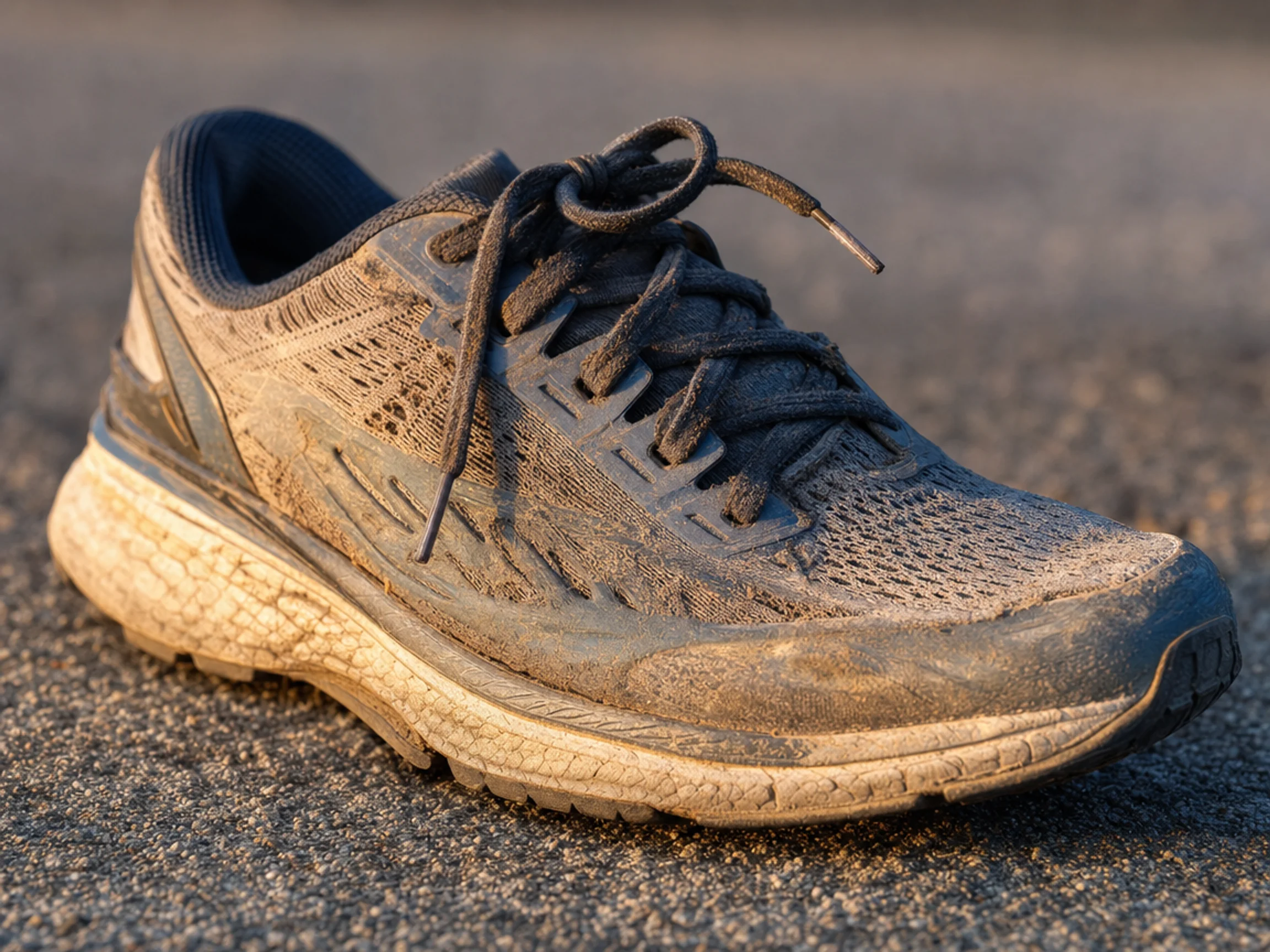
Visible wear indicators are the most straightforward to assess. Check the midsole for deep horizontal creases — these indicate permanent foam compression that will not recover even with rest. Examine the outsole tread pattern: if the rubber is worn smooth in the heel strike zone or forefoot push-off area, grip and shock absorption are compromised. Inspect the upper for mesh tears, stretched heel counters, or separated seams, all of which indicate structural breakdown.
Feel indicators are equally important. If you notice new aches in your knees, shins, hips, or feet that were not present when the shoes were newer, the cushioning may have degraded below effective levels. A loss of bounce or springiness during push-off suggests the midsole foam has reached its compression set limit. Some runners describe worn shoes as feeling "flat" or "dead" underfoot.
The thumb test is a quick field assessment: press your thumb firmly into the midsole foam at the heel and forefoot. Fresh foam should compress and spring back immediately with noticeable resistance. If the foam stays compressed, feels hard and unresponsive, or shows a visible dent that recovers slowly, the shoe has lost significant cushioning capacity. Compare the feel to a newer shoe of the same model if possible — the difference in foam response is often dramatic and immediately obvious.
When the data tells you a pair is done, the next decision is what to replace them with. Use Shoe Match to filter 155 SKUs from 15 brands by your weight, pace, surface, and budget — same official-spec algorithm, no reviews, no affiliate ranking.
Shoe Lifespan by Type
Different running shoe categories are engineered for different purposes, and their construction directly determines how long they last. Understanding these ranges helps you budget for replacements and plan your shoe rotation.
Daily trainers (400-800 km) are built for durability. They use denser foam compounds, thicker outsole rubber, and reinforced uppers designed to withstand daily use. Premium daily trainers from major brands can push past 800 km for lighter runners on softer surfaces.
Racing flats and carbon-plated shoes (150-400 km) sacrifice durability for performance. Carbon-plated super shoes like the Nike Vaporfly or Adidas Adios Pro use lightweight Pebax-based foams that deliver exceptional energy return but compress permanently faster. Reserve these for races and key workouts to maximize their performance window.
Trail shoes (500-1000 km) vary widely based on terrain. Shoes designed for groomed trails with moderate lugs can last 800-1000 km. Technical trail shoes with aggressive lugs used on rocky terrain may only last 500-600 km before the lugs wear down and lose grip. The outsole lug depth is often the limiting factor rather than midsole cushioning.
Minimalist shoes (300-500 km) have less material to absorb wear, resulting in shorter lifespans. Their thinner midsoles and outsoles reach degradation thresholds sooner than traditional trainers.
Several factors affect where your shoes fall within these ranges: runner weight (heavier runners compress foam faster), running surface (abrasive concrete vs. soft trails), running form (heel strikers concentrate wear differently than forefoot strikers), and climate (UV exposure and heat accelerate foam degradation). Tracking your mileage per shoe is the single most reliable way to know when replacement is approaching.
How to Extend Running Shoe Life
While every running shoe has a finite lifespan, several evidence-based strategies can help you extract maximum performance and value from each pair.
Shoe rotation is the single most effective strategy. Alternating between two or more pairs gives midsole foam 24-48 hours to fully decompress and recover its cushioning properties between runs. Alternating pairs is generally estimated to extend each pair's life by 10-15%; separately, Malisoux et al. found that runners who rotated shoes had a 39% lower injury risk. A practical rotation might include a cushioned daily trainer for easy runs, a lighter shoe for speed work, and a long-run shoe with maximum support.
Proper drying is critical after wet runs. Remove the insoles and stuff shoes loosely with newspaper or a microfiber towel to absorb moisture from the inside. Allow them to air dry at room temperature in a well-ventilated area. Never use direct heat sources — clothes dryers, radiators, hairdryers, or placing shoes in direct sunlight. Heat above 40°C degrades EVA and TPU foam compounds, accelerating compression set and reducing the foam's ability to recover between runs.
Store shoes away from UV light when not in use. Prolonged exposure to ultraviolet radiation breaks down the molecular bonds in foam materials and degrades rubber compounds. A cool, dry closet is ideal. Avoid leaving shoes in hot car trunks, where temperatures can exceed 60°C and cause accelerated foam degradation.
Use running shoes only for running. Wearing them as casual shoes throughout the day adds hundreds of low-level compression cycles to the midsole that contribute to wear without providing training benefit. Walking in running shoes also wears the outsole differently, altering the tread pattern in ways that can affect grip during actual runs.
Finally, alternate running surfaces when possible. Mixing in softer surfaces like grass, dirt paths, or a treadmill reduces cumulative outsole abrasion. Even one or two treadmill sessions per week can meaningfully extend outsole life compared to running exclusively on concrete.
Typical Lifespan by Shoe Model
Manufacturers rarely publish an official lifespan number. The ranges below come from aggregated runner reports and reviews (Solereview, Believe in the Run, Runner's World surveys), not marketing claims. Treat these as starting estimates — your actual per-shoe life depends on your weight, surface mix, and gait.
Neutral Daily Trainers
- Nike Pegasus 41: 500-700 km — durable ReactX foam, most popular trainer worldwide.
- ASICS Gel-Nimbus 26 / Gel-Cumulus 26: 600-800 km — FF Blast+ Eco foam, one of the most durable categories.
- Brooks Ghost 16: 500-700 km — DNA Loft v3, consistent generation-over-generation.
- Saucony Ride 17 / Triumph 22: 500-700 km — PWRRUN PB on higher tier delivers longer foam life.
- New Balance Fresh Foam 1080 v13: 500-700 km — the Fresh Foam X compound compresses less than most EVA.
- Mizuno Wave Rider 27 / Wave Inspire 20: 500-700 km — rhomboid wave plate adds stability as foam softens.
Max-Cushion / Long-Run Shoes
- HOKA Clifton 9 / Bondi 8: 400-600 km — softer compounds wear faster despite the thick stack.
- ASICS Novablast 4: 400-550 km — lightweight FF Blast+ prioritizes bounce over longevity.
Carbon-Plate Racers
- Nike Vaporfly 3 / Alphafly 3: 200-400 km — ZoomX foam peaks early, then drops sharply.
- Adidas Adios Pro 3 / 4: 250-400 km — Lightstrike Pro + EnergyRods.
- ASICS MetaSpeed Sky / Edge Paris: 300-400 km — FF Turbo+ offers slightly better durability than Vaporfly.
- Saucony Endorphin Pro 4: 250-400 km.
Factors That Shift These Ranges
Heavier runners (90+ kg) typically see 15-20% shorter lives. Forefoot strikers wear forefoot rubber faster than heel strikers; heel strikers wear the outer heel faster. Running predominantly on concrete shortens outsole life by 20-30% compared to asphalt or track surfaces. Hot-weather storage (car trunks, garages above 40°C) accelerates foam degradation even when the shoes aren't being used. Track per-pair mileage with the calculator above rather than guessing — the foam inside degrades invisibly, and runners consistently overestimate how many kilometers are left in a pair.