How the Race Medal Collection Tracker Works
The Race Medal Collection Tracker transforms your scattered medal memories into a comprehensive statistical profile of your racing career. You enter the number of finisher medals you have earned across five standard distance categories — 5K, 10K, half marathon, marathon, and ultra marathon — along with the year of your oldest and newest medals and optionally the name of the race that produced your most treasured medal.
From these inputs, the calculator computes a rich set of metrics. Total race distance is calculated by multiplying each medal count by its standard race distance (5 km, 10 km, 21.0975 km, 42.195 km, and 50 km for ultras) and summing across all categories. The result is displayed in both kilometers and miles. Medals per year divides your total count by the span of years between your oldest and newest medals, giving you a sense of your racing frequency over time.
The distance category breakdown shows each category's medal count, total distance contribution, and percentage share in a visual bar chart format. This reveals whether you are a specialist who gravitates toward one distance or a versatile racer who competes across the full spectrum. The tool also calculates your average distance per race and identifies your dominant category — the distance where you have collected the most medals.
Beyond the core statistics, the tracker generates fun real-world comparisons that put your cumulative race distance in perspective. Have you raced the equivalent of circling the Earth? How far along the Great Wall of China would your medals take you? These comparisons make your collection tangible and shareable. Finally, the tool evaluates your collection against a library of achievement badges that reward both volume (total medals) and diversity (number of distance categories), assigning you an overall collector tier from Bronze to Legendary.
Why Runners Collect Race Medals and What They Mean
Race medals are far more than stamped metal on a ribbon — they are physical embodiments of personal achievement that carry deep psychological significance for runners. Research in sport psychology by Masters, Ogles, and Jolton (1993) identified that marathon runners are motivated by a complex blend of intrinsic factors (personal accomplishment, self-esteem, psychological coping) and extrinsic factors (social recognition, competition, tangible rewards). The finisher medal sits at the intersection of these motivational streams: it is a personal reminder of internal effort and an external symbol recognized by the broader running community.
The tradition of awarding finisher medals at road races became widespread in the 1970s and 1980s as the recreational running boom transformed marathons from elite-only competitions into mass participation events. Today, according to Running USA's annual participation survey, over 18 million runners complete organized road races in the United States alone each year, and virtually every event from 5K charity runs to 100-mile ultramarathons awards some form of finisher medal. The design and quality of race medals have become a significant factor in event marketing, with major marathons like the Boston Marathon, Tokyo Marathon, and Berlin Marathon investing heavily in unique, collectible medal designs.
From a behavioral science perspective, medal collections function as tangible progress markers that reinforce the habit loop of training and racing. Each medal represents weeks or months of preparation distilled into a single physical object. Research by Cavallo et al. (2012) in the Journal of Physical Activity and Health demonstrated that social sharing of exercise achievements — including race results and medals — significantly increases exercise adherence and motivation. Displaying medals on a rack at home or sharing a collection summary on social media creates a positive feedback loop: the visible evidence of past accomplishment fuels commitment to future goals.
For many runners, the medal collection also serves as a biographical timeline. Each medal triggers memories of a specific race day — the weather, the crowd, the struggle at mile 20, the emotion of crossing the finish line. This autobiographical memory function makes medal collections deeply personal possessions that runners rarely discard, even after decades. Whether you have 3 medals or 300, each one tells a story that only you fully understand.
How to Display, Organize, and Preserve Your Medal Collection
As your medal collection grows, finding an effective display and storage solution becomes important both for preservation and for the motivational benefit of seeing your achievements daily. Here are proven approaches used by experienced medal collectors in the running community.
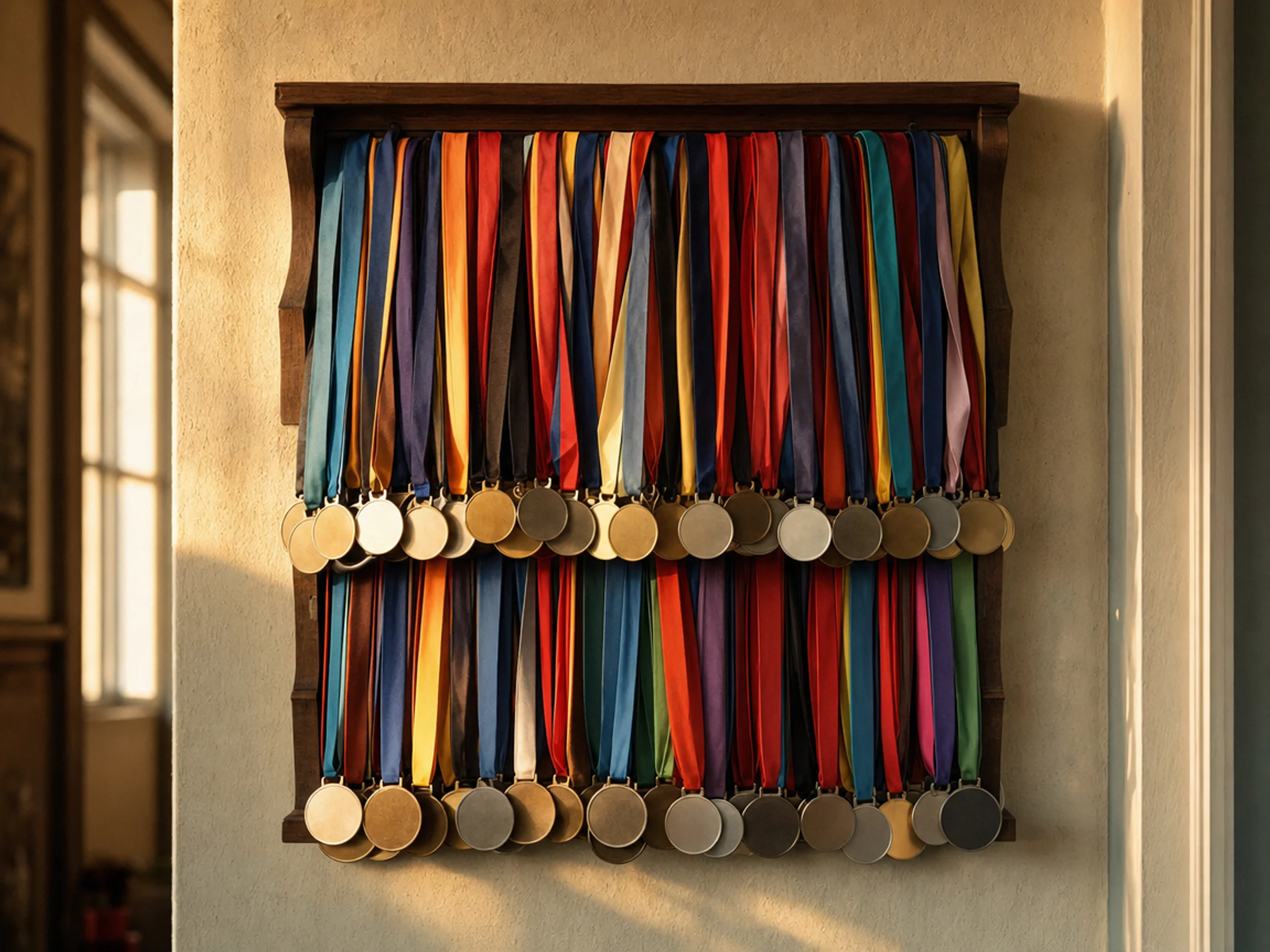
Medal display racks and hangers are the most popular option, ranging from simple wooden dowel bars mounted on a wall to custom laser-cut metal displays featuring running-themed designs. Wall-mounted racks work well for collections up to 30-40 medals. Position them in a visible location — near your front door, in your home gym, or in your office — where they serve as a daily reminder of what you have accomplished and what you are training toward.
For larger collections exceeding 50 medals, consider a rotating display system where you showcase your most recent or most meaningful medals on a primary rack and store the rest in organized containers. Shadow boxes or deep picture frames allow you to create themed displays — all your marathon medals together, medals from a specific year, or medals from races in a particular city or country.
To preserve your medals long-term, keep them away from direct sunlight (which fades ribbons) and high humidity (which tarnishes metal finishes). For valuable or sentimental medals, store them individually in soft cloth bags or acid-free tissue paper. Clean metal medals gently with a soft dry cloth — avoid harsh chemicals that can strip protective coatings. The ribbons are often the most fragile component; if a ribbon becomes frayed, many running stores and online services offer replacement ribbons in standard widths.
Digital tracking complements physical display perfectly. Using a tool like this Race Medal Collection Tracker alongside your running log creates a complete record of your racing career that you can share, print, or reference when planning future goals. Some runners photograph each medal and create a digital album organized by year or distance, which is especially useful for insurance purposes if your collection has significant monetary or sentimental value.