
Aerobic Base Building: Slow Running for Fast Results
Slow running really builds speed — but '80/20' is folklore and MAF 180-age isn't peer-validated. 2025 evidence on what actually works for recreational runners.
Key Takeaways
- '80/20' is a popularization label, not a validated ratio — Elite training distributions cluster between ~68/6/26 (Stoggl 2014) and ~90/10 by time (Tonnessen 2014). Marathoners specifically trend pyramidal (Casado 2022). The principle is large-easy-plus-some-hard; the round number is folklore.
- MAF 180-age is a practitioner heuristic, not a peer-validated threshold — Maffetone & Laursen 2020 explicitly state the formula 'must be verified scientifically.' Faude 2009 catalogues 25 different lactate-threshold concepts. Treat MAF as a conservative ceiling, not a calibrated physiological number.
- Volume drives mitochondrial content; intensity drives mitochondrial function — Bishop, Granata & Eynon 2014 show these are different axes. Easy mileage is the substrate; faster work sharpens it. 'Junk miles' is mostly bro-science for non-elite training.
- Heat is a real metabolic load, not just discomfort — Wingo 2012 shows cardiovascular drift in heat reflects a genuinely higher relative intensity. Watching drift within a run beats watching absolute HR in summer. Treadmill base is not a compromise.
- Pyramidal may serve recreational runners better than polarized — The 2025 Rosenblat network meta-analysis (n=348) found no overall difference but subgroup evidence that recreational runners may improve more on pyramidal. Pick the distribution you can execute consistently.
Why Slow Running Is the Foundation, Not the Floor
The fastest endurance athletes on the planet spend the overwhelming majority of their training at a pace most recreational runners would call jogging. Eliud Kipchoge logs the bulk of his weekly volume around 4:30-5:00/km. Jakob Ingebrigtsen, the Olympic 1500 m champion, performs enormous slow volumes before sharpening with his now-famous double-threshold sessions. The pattern is not new — it has been observed in Olympic and World Champion endurance athletes since the 1990s, and it is the single most reliable signature of elite endurance preparation.
But the popular shorthand for this pattern — "80/20" — is a popularization label, not a research-validated prescription. The original randomized controlled trial that catapulted the idea into the running press, Stoggl & Sperlich's 2014 study in Frontiers in Physiology, randomly assigned 48 well-trained endurance athletes across four training models and tracked them for nine weeks.
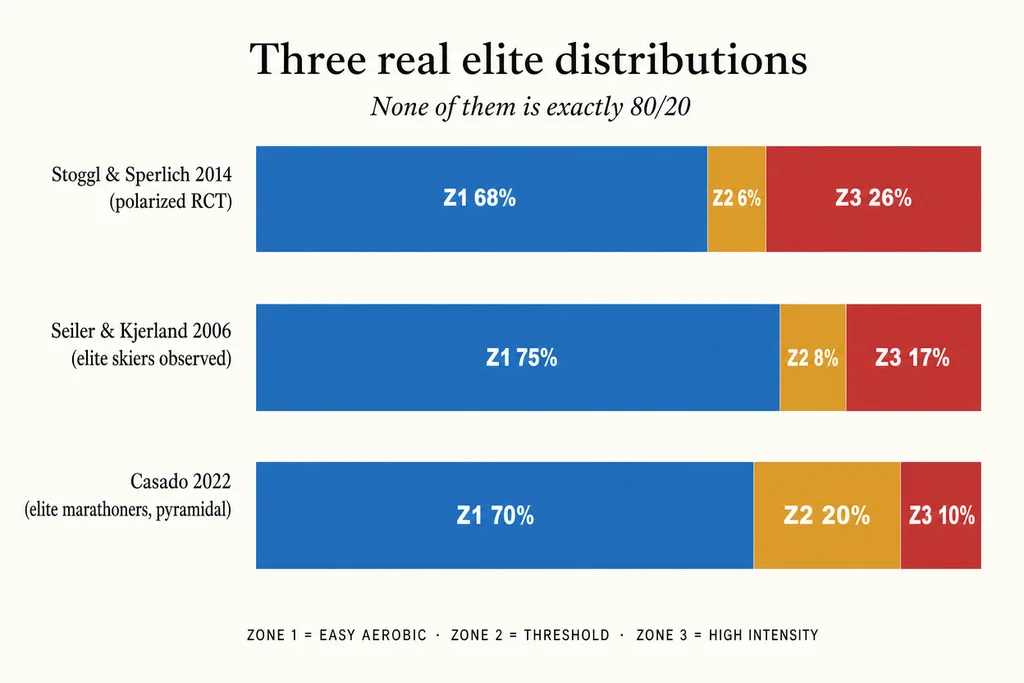
The polarized group produced the largest VO2peak gain at +11.7% and the largest time-to-exhaustion gain at +17.4%. The actual zone distribution that group ran was not 80/20 — it was approximately 68% / 6% / 26% across zones 1 / 2 / 3. The headline result is real; the round-number ratio attached to it later is not what the study tested.
What Easy Running Actually Builds in Your Body
Slow, conversational running is not a watered-down version of fast running. It triggers a distinct set of cellular and cardiovascular adaptations that hard running alone cannot reproduce.
Mitochondrial biogenesis
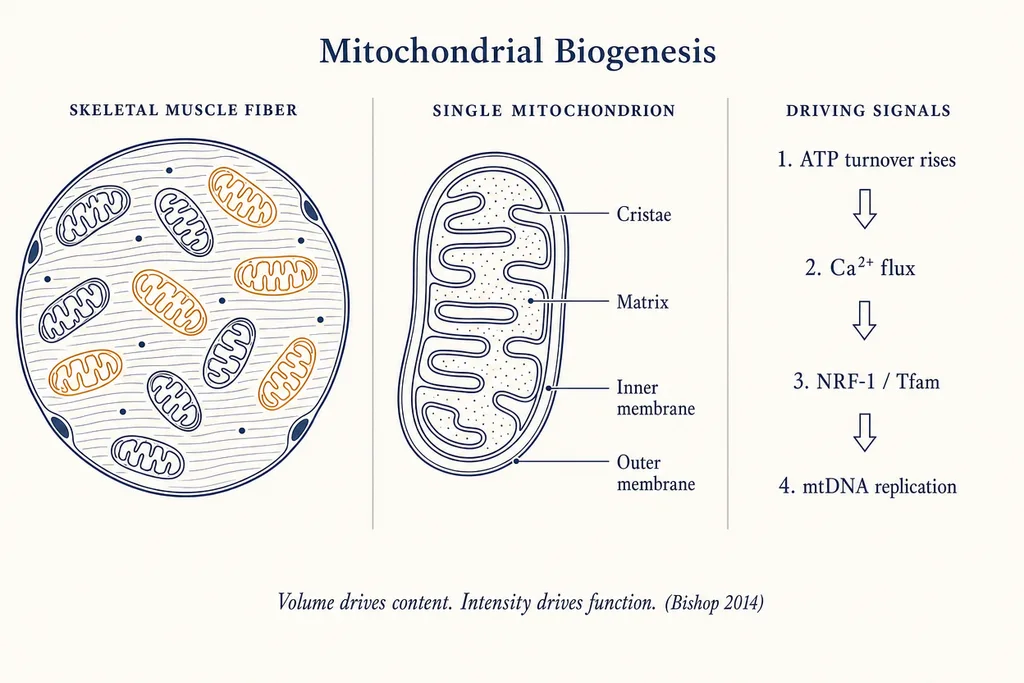
Chronic contractile activity — the technical term for repeated muscle contraction during endurance exercise — expands the muscle's mitochondrial reticulum, the cellular machinery that converts fat and glycogen into usable energy. Hood's 2001 mechanistic review in the Journal of Applied Physiology describes how this happens: ATP turnover during exercise, intracellular calcium fluxes, and downstream activation of transcription factors such as NRF-1 and mitochondrial transcription factor A (Tfam) drive the import of nuclear-encoded proteins into mitochondria and the replication of mitochondrial DNA.
Crucially, the volume-versus-intensity question turns out to be more nuanced than popular Z2 evangelism suggests. Bishop, Granata & Eynon's 2014 review synthesized cross-sectional and intervention data in rats and humans and concluded that training volume appears to be the primary driver of mitochondrial content (measured by citrate synthase activity), while training intensity appears to drive mitochondrial function (measured by respiration). Volume and intensity contribute to different aspects of mitochondrial adaptation. The framing that "only Z2 builds mitochondria" is a simplification the literature does not support.
Capillarization, stroke volume, and fat oxidation
Around those expanding mitochondria, easy running stimulates the growth of new capillaries, improving the delivery of oxygen and the clearance of metabolic byproducts at the cellular level. At the central side of the cardiovascular system, sustained aerobic training enlarges the left ventricle and increases stroke volume — the amount of blood ejected per beat — which lowers your heart rate at every submaximal pace. And as the aerobic enzymes that oxidize fat upregulate, your body learns to lean more heavily on its essentially limitless fat stores, sparing the much smaller glycogen reserves that determine whether you fade at km 30.
Most of these adaptations reverse quickly when training is reduced, which is why two unstructured months can erase a year of careful base work. The mitochondrial machinery is remarkably plastic — built up over months, lost over weeks.
How Elite Athletes Actually Distribute Their Training
If you have read a running magazine in the last five years you have probably seen "80/20" presented as the universal elite ratio. The actual numbers reported in the underlying studies tell a more textured story, and the differences matter when you are deciding how to structure your own week.
Seiler & Kjerland 2006 monitored 11 nationally competitive junior cross-country skiers across 384 training sessions over 32 days and reported a distribution of approximately 75% / 8% / 17% across zones 1 / 2 / 3 by heart rate, with similar values from session-RPE and blood lactate. Their headline finding was that "elite endurance athletes train surprisingly little at the lactate threshold intensity."
Tonnessen, Sylta & Seiler 2014, the "Road to Gold" study published in PLoS ONE, followed 11 Olympic and World Champion XC skiers and biathletes for a full year leading into their best-ever race. About 94% of training was aerobic endurance work, with roughly 90% of time below the first lactate threshold and 10% above it — but counted by session, 23% of sessions involved high-intensity work. Whether you describe this group as "90/10" or "77/23" depends on whether you count minutes or sessions; both are accurate, neither is "80/20."
Casado, Gonzalez-Mohino, Gonzalez-Rave & Foster 2022 reviewed ten studies of highly trained and elite middle- and long-distance runners and reached a conclusion that surprises runners coached on polarized orthodoxy: elite distance runners typically follow a pyramidal training intensity distribution — most time in zone 1, less in zone 2, least in zone 3 — and shift toward a more polarized pattern only in the competition phase. The review specifically noted that marathoners tend to be more pyramidal-oriented; the 1500 m runners trend more polarized.
And the most rigorous synthesis of the experimental evidence to date — Rosenblat and colleagues' 2025 network meta-analysis of 13 randomized trials with individual participant data (n=348 across 296 male and 52 female athletes) — found no statistically significant difference in VO2max or time-trial performance between polarized and pyramidal training overall. The subgroup result is interesting: competitive athletes appeared to benefit more from polarized, while recreational athletes appeared to benefit more from pyramidal (SMD difference -0.63, p<0.05). For most people reading this guide, that is the live result — pyramidal may suit you better than polarized, and "polarized always wins" is not what the strongest 2025 evidence says.
What Threshold Are We Even Talking About?
"Run below your aerobic threshold" sounds like clear advice until you try to find your aerobic threshold. Faude, Kindermann & Meyer's 2009 review in Sports Medicine catalogued 25 distinct lactate threshold concepts from the literature, falling into three broad categories: fixed blood-lactate thresholds, points where lactate first rises above baseline, and points where lactate production and clearance equilibrate (the maximal lactate steady state, ~LT2). "Aerobic threshold" is not a single number; it is a family of definitions that produce different heart rates and paces depending on which one your coach or watch happens to use.
The status of the MAF 180-age formula
The Maffetone Method, popularized in The Big Book of Endurance Training, uses a personalized heart-rate ceiling — generally 180 minus your age, adjusted for fitness and health history — as a stand-in for your aerobic threshold. The method has a clinical history spanning four decades and produces real results for many runners who follow it consistently. But its scientific status is more honest than the running internet usually admits.
In Maffetone & Laursen 2020, the method's own co-developers, writing in Frontiers in Physiology, included this remarkably direct sentence in their abstract: "The relationship between exercise training at this heart rate and associated laboratory measures of maximal fat oxidation, health outcomes and athletic performance must be verified scientifically." That is not a marketing line.
It is the authors themselves declaring that the formula is not yet peer-validated against laboratory measures. No randomized controlled trial has established that 180-age corresponds to the ventilatory or lactate threshold for any given runner — and given the ±15 bpm individual variability Faude 2009 documented across threshold methods, it would be surprising if it did consistently.
None of this means MAF cannot work for you. It means MAF is best understood as a practitioner heuristic — a conservative ceiling that helps runners who tend to drift too fast on easy days actually run easy. If you treat it as a starting estimate rather than a precision instrument, it is useful. If you treat it as your physiologically validated aerobic threshold, the formula's own authors will disagree with you in writing.
The Norwegian-Method Wrinkle You Will Hear About Soon
If you spend any time on r/AdvancedRunning in 2026 you will encounter "the Norwegian method," "double threshold," and the work of Marius Bakken — the former Norwegian 5000 m record-holder (13:06) and physician who codified the system Jakob and Henrik Ingebrigtsen now train under. Bakken's April 2026 AMA on r/AdvancedRunning, conducted with mod approval and based on a 2026 book drawing on roughly 5,500 lactate measurements, has reopened the polarized-versus-threshold debate for serious recreational runners. The shorthand is that the Norwegian model deliberately includes large weekly volumes of carefully controlled threshold work (often two threshold sessions in a single day), bookended by very easy aerobic running — closer to a pyramidal pattern than a purely polarized one.
For most runners building a base, the Norwegian-method controversy is not a reason to change what you are doing. It is a reason to be skeptical when anyone — coach, podcast, or guide — claims a single intensity distribution is universally correct. The strongest 2025 meta-analysis says they are roughly equivalent on average and that recreational runners may do slightly better with pyramidal. Train consistently, manage your easy days honestly, and the difference between 75/8/17 and 80/0/20 will not be the variable that decides your finish line.
The Heat Reality: When MAF Becomes Impossible
For a large fraction of runners — anyone training a summer marathon, anyone living in the US South, the Gulf Coast, southern Europe, or much of subtropical Asia — heat is the single most disruptive force in a base-building cycle. The physiology is not mysterious. Coyle's 1998 review in the International Journal of Sports Medicine described how prolonged exercise produces "cardiovascular drift": stroke volume falls progressively while heart rate climbs to maintain cardiac output. About half of the stroke-volume reduction in dehydration-induced drift comes from reduced blood volume; the rest relates to hyperthermia and reduced ventricular filling.
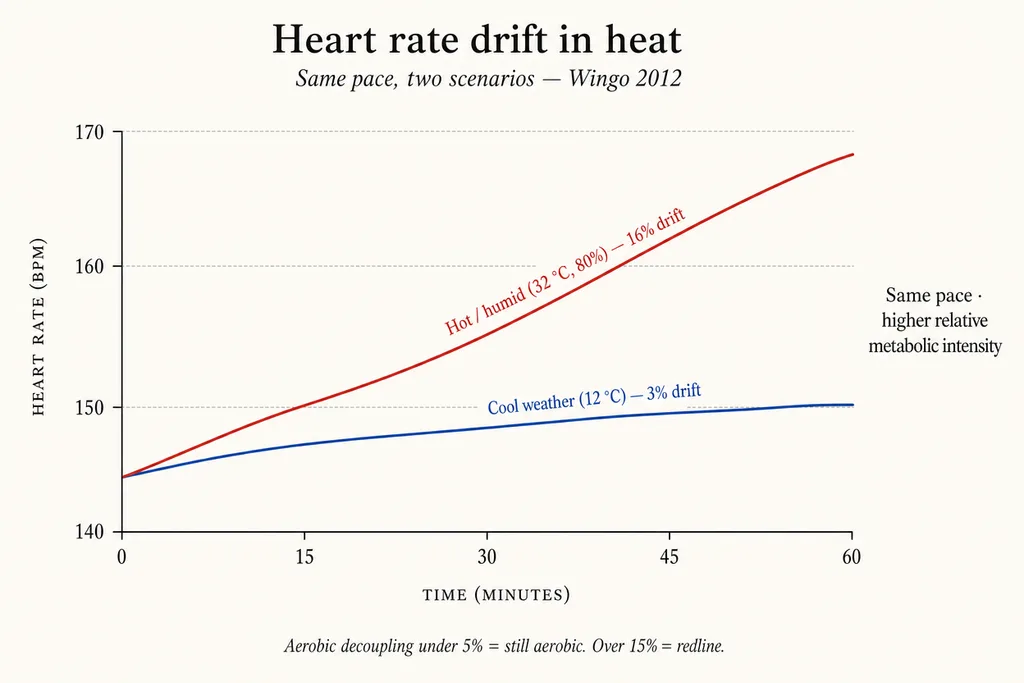
Wingo, Ganio & Cureton 2012 extended this picture specifically to heat stress: cardiovascular drift typically begins about 10 minutes into prolonged moderate-intensity exercise, and the rising heart rate reflects a genuinely increased relative metabolic intensity. The same absolute pace in 32 °C and 80% humidity is physiologically harder than in 12 °C and 50% humidity, and your watch's HR-only zone prescription will tell you to slow to a crawl that may not actually correspond to a higher metabolic load. This is why a strictly HR-capped MAF run in a July afternoon in Houston or Shanghai can devolve into walking.
The honest 2025-2026 recreational running consensus, visible across r/Marathon_Training and r/AdvancedRunning summer threads, is that heat-season base training is a different beast and the rules bend. Treadmill base work is no longer treated as a compromise. Pre-dawn starts are normal. Switching to a slightly higher HR ceiling — say 5-10 bpm above your cool-weather MAF — is acceptable as long as you are tracking the delta between your starting HR and end-of-run HR, not the absolute number. If the drift inside one run is small relative to its starting point, you are still aerobic; if it is large, slow down or shorten the session.
Building Your Base: A Practical 8-12 Week Structure
The Casado 2022 and Campos 2022 reviews converge on a practical heuristic: at least 70% of weekly volume at low intensity, with the remaining 30% distributed between threshold and high-intensity work depending on phase and event. The specific weeks below sketch a beginner-to-intermediate base block at roughly 40 km / week of running.
Weeks 1-2 — Foundation. All running easy, conversational pace, 4 sessions/week, longest 10 km. Goal: build the habit and let the joints, tendons, and connective tissue catch up to your aerobic ambitions. If you cannot speak a full sentence aloud, slow down.
Weeks 3-4 — Volume. Add a fifth easy session. Longest 12-14 km. Still 100% easy. Most "I lost speed in base building" complaints come from runners who skipped this phase and added intervals in week three.
Weeks 5-6 — Texture. Add 8-12 × 30-second strides at the end of one easy run per week — controlled accelerations to ~5 km race effort, full recovery between. Strides preserve neuromuscular signaling without accumulating fatigue and do not break the easy-volume principle.
Weeks 7-8 — Aerobic threshold introduction. Add one short tempo per fortnight: 15-20 minutes at "comfortably hard," roughly half-marathon to marathon effort. This is not your tempo block — it is one threshold finger placed lightly on the scale while the easy volume keeps building. Total volume now 45-50 km/week.
Weeks 9-12 (optional extension). Hold easy volume. Extend the tempo to 25-30 minutes. Begin one set of longer intervals (e.g., 6 × 1 km at 5 km effort) once every two weeks. You are now transitioning out of base into pre-competition.
The Most Common Base-Building Mistakes
The single most common mistake is letting easy days quietly drift hard. The Strava-and-watch ecosystem makes this almost automatic: a small pace gain on Sunday becomes the new "easy" pace on Tuesday, and within a month every run is in the moderate gray zone — the zone Stoggl 2014 and the elite observational studies show produces the least useful adaptation. The fix is mechanical: cap your easy days by heart rate, RPE, or pace and respect the cap.
The second most common mistake is stripping out all higher-intensity work for so long that neuromuscular sharpness fades. This is the basis of the legitimate skepticism toward "base building forever" you will see on Reddit — runners who follow strict pure-aerobic protocols for six months and emerge slower at all paces. Strides from week three, a single short tempo from week seven, and one weekly fast-finish long run prevent this without polluting the aerobic adaptation curve.
The third — and the one most relevant to the way running internet argues — is the "junk miles" conversation. Inside r/Marathon_Training the most up-voted view of recent years is that calling any easy mile "junk" is bro-science, on a par with old myths about a beer canceling out a lift. The exercise physiology supports that framing far more than it supports the alternative: low-intensity volume drives mitochondrial content (Bishop 2014) and is the substrate every faster training block is built on. Unless you are a professional optimizing the final percent at 130-mile weeks, your easy miles are not junk. They are the work.
When You Are Ready to Transition Out of Base
You are ready to add structured workouts when your easy-pace heart rate has dropped (typically 5-10 bpm at the same pace versus week one), when you can complete the planned long run conversationally with limited drift, when your weekly volume has been stable for at least three weeks without elevated resting HR or HRV decline, and when you are sleeping well and recovering between sessions. Aerobic adaptation is dose-dependent; it cannot be rushed and it does not respect impatience. The runners who hold the line in weeks four through eight are usually the ones who set personal bests in weeks eighteen through twenty-two.
Sources & References
- (2014). Training Intensity Distribution in Elite Endurance Athletes: Polarized or Threshold?. Frontiers in Physiology.
- (2010). The Big Book of Endurance Training and Racing: The MAF Method. Skyhorse Publishing.
- (2014). 80/20 Running: Run Stronger and Race Faster by Training Slower. Penguin Books.
- (2001). Training Characteristics and Performance in Recreational Marathon Runners. International Journal of Sports Medicine.
- (2009). Mitochondrial Biogenesis during Cellular Differentiation and Endurance Exercise. Journal of Applied Physiology.