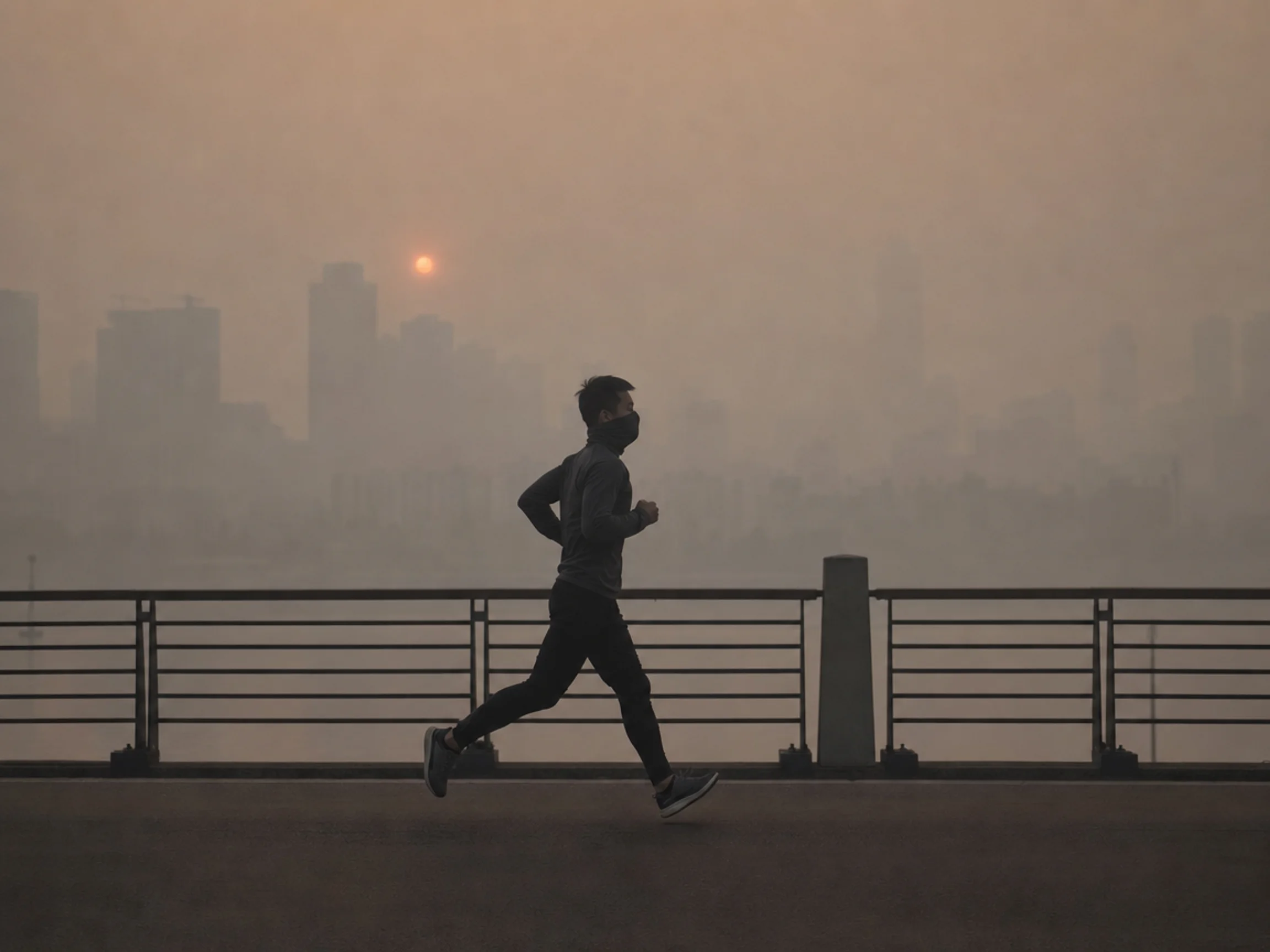
How the AQI Running Advisor Works
The AQI Running Advisor evaluates outdoor air quality conditions against your planned running workout to determine whether it is safe, requires modification, or should be moved indoors. The tool combines three key variables: the Air Quality Index (AQI) value, your exercise intensity, and your health status to produce a personalized safety recommendation.
AQI is a standardized scale from 0 to 500 used by the US EPA and adopted (with variations) by environmental agencies worldwide, including China's MEP. The scale translates complex pollutant concentration data into six intuitive categories: Good (0-50), Moderate (51-100), Unhealthy for Sensitive Groups (101-150), Unhealthy (151-200), Very Unhealthy (201-300), and Hazardous (301-500).
The critical insight for runners is that AQI guidelines are designed for the general population at rest. During exercise, your minute ventilation (volume of air breathed per minute) increases dramatically — from about 6 L/min at rest to 30-40 L/min during easy running and 100-150 L/min during hard intervals or racing. This means a runner's actual pollutant intake can be 5-25 times higher than a sedentary person breathing the same air. The calculator applies ventilation rate multipliers for each intensity level to compute your effective exposure and adjusts the recommended maximum outdoor exercise duration accordingly.
For runners with asthma, respiratory conditions, or cardiac conditions, the tool shifts the safety threshold one category stricter, following EPA guidance that sensitive populations should treat conditions as one level worse than the general AQI reading suggests.
AQI to Running Decision: What Each Level Actually Means
US federal guidance places no activity restriction on healthy adults until AQI 151. That surprises most runners, and it comes with a catch you need to understand before you use it. The EPA table below is written for people going about an ordinary day — walking to the car, standing at a bus stop. It is not written for people moving ten times more air through their lungs than usual.
The EPA states that multiplier plainly in its wildfire smoke guidance: "when exercising, people can increase their air intake 10 to 20 times over their resting level." Put those two facts together and the practical meaning is stark. A 40-minute run pulls as much air through your lungs as roughly 7 to 13 hours of sitting still in the same air. The AQI number describes the air. Your intensity and your minutes decide the dose.
| AQI | EPA guidance — sensitive groups | EPA guidance — everyone else | What it means for your session |
|---|---|---|---|
| 0-50 Good | No cautionary statement | No cautionary statement | Train as planned. Any distance, any intensity. |
| 51-100 Moderate | Unusually sensitive people: make outdoor activity shorter and less intense | No cautionary statement | Normal training. If you are unusually sensitive, drop the hard reps and keep the easy volume. |
| 101-150 USG | Shorter and less intense; "it is OK to be active outdoors but take more breaks" | No cautionary statement | Keep the easy run outdoors. Move the tempo or intervals to a treadmill — this is where intensity, not distance, is the thing to cut. |
| 151-200 Unhealthy | Consider rescheduling or moving all physical activity inside to cleaner air | Keep outdoor activity shorter and less intense | Hard sessions come indoors for everyone. Easy running outdoors only if short, and stop on any symptoms. |
| 201-300 Very Unhealthy | Avoid all physical activity outdoors | Limit outdoor physical activity | Indoors, or a rest day. No outdoor running. |
| 301+ Hazardous | Stay indoors in cleaner air and keep activity levels light | Avoid all physical activity outdoors | Rest, or light indoor work in filtered air. |
Why this calculator is stricter than the EPA table at 101-150
You will notice the table gives healthy adults nothing to do at AQI 101-150, while the calculator above starts trimming your outdoor time there. That is deliberate, and it is not us second-guessing the EPA — it is us applying the EPA's own exercise multiplier to a table the EPA wrote for the general public. A person running a tempo session at AQI 125 is not experiencing AQI 125 the way the table's reader is. Cutting intensity rather than distance is the highest-leverage change available, because ventilation rises far faster with effort than with time on feet. One reading note for the 201-300 band: the table says no outdoor running, yet the calculator still returns a minutes figure there — that number is an exposure cap for time outside you cannot avoid, not a suggested workout length.
Who counts as a sensitive group
The EPA's definition is broader than most runners assume: "people with heart or lung disease; older adults; children, including teenagers; and pregnant women." If you fall in one of those groups, read one band stricter than the number in front of you — AQI 130 becomes an AQI 160 decision. That is exactly the shift the health-status selector applies above, so you do not have to do the arithmetic yourself.
Wildfire Smoke vs Everyday Pollution: What Changes for Runners
The difference that should change your training is not toxicity — it is the shape of the exposure. Urban pollution oscillates around a low baseline you can plan around. Wildfire smoke can take a city from AQI 30 to AQI 200 in an afternoon and hold it there for a week. That is a different problem, and it calls for a different response.
The toxicity question is unsettled, and it does not change what you do
You have probably read that wildfire particles are roughly ten times more harmful than ordinary urban particles. The source is real but narrower than the headline: a 2021 study in Pediatrics of emergency and urgent care visits in San Diego County found that a 10-unit rise in PM2.5 from non-smoke sources raised respiratory visits by 3.7%, while the same rise in wildfire-specific PM2.5 raised them by 30.0% — the authors concluded wildfire PM2.5 was about ten times more harmful to children's respiratory health, most of all for ages 0 to 5.
The EPA's current assessment is more cautious. Its 2026 wildfire smoke guide notes that such differences "do not necessarily indicate a difference in toxicity" and can stem from how exposure is measured and modelled, and it cites the 2019 Integrated Science Assessment conclusion that the evidence "does not indicate that any one source or component is consistently more strongly related with health effects than PM2.5." The EPA's own bottom line settles it for practical purposes: regardless of the origin of the smoke, the guidance is to reduce PM2.5 exposure. So the toxicity debate is worth knowing about and worth nothing to your Tuesday workout decision.
What does change: one pollutant, one very long event
Fine particles are, in the EPA's words, "the principal air pollutant of concern for public health" in wildland fire smoke. On a smoke day, set the pollutant selector above to PM2.5 rather than leaving it on overall AQI — you will get particle-specific guidance instead of a generic reading. Ozone is a partial exception worth knowing: wildfires do not emit it directly, but they emit the precursors that form ozone downwind in sunlight, and the EPA notes this enhancement is inconsistent and "highly variable spatially and temporally." An N95 filters particles; it does nothing for ozone.
The bigger shift is duration. The EPA advises that when air is forecast to sit in the Unhealthy for Sensitive Groups range or worse "for multiple days to weeks," people should take "additional precautions beyond those indicated by the 24-hour AQI or NowCast AQI." In plain terms: on day four of a smoke event, the same number means more than it did on day one. A workable rule is to read one band stricter from the third consecutive day — or set the health-status selector one step stricter above, which produces the same effect.
Smoke plus heat
Smoke season and heat season overlap, and the EPA reports evidence that the combined effect of the two "may be greater than each individually" for cardiorespiratory emergency visits and hospital admissions — while also noting that days with both are relatively rare. On the days you do get both, treat them as compounding rather than additive: check the air first, then run your pace through the heat adjustment calculator and accept both penalties.
Smoke Season Playbook: Timing, Masks, and Whether Indoors Is Actually Clean
Four decisions come up on repeat during a smoke season, and the official answers to all four are more specific — and more surprising — than the running-blog consensus.
1. The number on your app is a 12-hour lookback, not a live reading
This is the single most useful thing to know about the AQI you are staring at. The true PM2.5 AQI is a 24-hour average, so it cannot exist until the day is over. To publish something in real time, AirNow uses the NowCast, which "calculates a weighted average of the past 12 hours." When levels are swinging, recent hours get weighted more heavily; when levels are steady, all twelve hours count almost equally.
The consequence for timing your run: when smoke is clearing, the displayed number sits above the air you would actually breathe, and waiting for it to drop costs you a usable window. When smoke is rolling in, it sits below what you will breathe thirty minutes from now. Either way, look at the hourly trend, not just the headline number, and re-check immediately before you step out rather than when you start lacing up.
2. No monitor nearby? Estimate by how far you can see
Monitors are sparse outside cities, and smoke concentrations can vary within a couple of miles. The EPA publishes a field method for exactly this: pick the darkest distant object you know the distance to, and judge where it disappears.
| How far you can see | Healthy adults and teenagers | Sensitive groups |
|---|---|---|
| More than 10 miles (16 km) | Watch for changing conditions; make outdoor activities shorter and less intense based on personal sensitivity | Same — the EPA gives one combined row at this range |
| 5-10 miles (8-16 km) | Minimize outdoor activity by making it shorter and less intense | Minimize or avoid outdoor activity; consider going indoors to cleaner air, especially with symptoms |
| Under 5 miles (8 km) | Minimize or avoid outdoor activity | Stay inside or somewhere with good air quality |
Three conditions make or break this method, and skipping them will mislead you: use it in daylight only, avoiding sunrise and sunset; only when relative humidity is below 65%, because water in the air reduces visibility independently of smoke; and sight on the darkest available target, not a green hillside. It was developed for the dry interior west and does not transfer to humid regions. Once you have a band, enter its representative AQI above to get duration and intensity guidance.
3. What an N95 can and cannot do for a runner
The honest position: the EPA does not endorse running in a respirator. Its own hierarchy puts masks last — limit time outdoors first, reduce activity second, filter indoor air third, and only then, for people who "must go outside during a smoke episode," a NIOSH-approved respirator. Its stated use case is needing to be outdoors for extended periods, not choosing to train.
Where masks do work, they work conditionally. Properly fitted N95s "will significantly reduce the wearer's exposure to smoke particles." But ear-loop surgical and procedure masks are not respirators: the EPA says they "are not designed to seal tightly to the face," and ranks them only as a fallback that "may provide some protection from wildfire smoke or ash if respirators are not available." A good seal is likewise "not possible if the user has a beard or other excess facial hair where the respirator seals to the face." Any gap at the edge lets unfiltered air straight in, which is the failure mode most runners never check for. The EPA also warns that wearing a respirator "can make it harder to breathe" and that doing so while hot or physically active "can increase the risk of heat-related illness." Treat an N95 as insurance for outdoor time you cannot avoid, not as a permission slip for a workout.
4. Indoors is not automatically clean air
"Move it to the treadmill" is the standard advice and it is right, but it is incomplete in a way that matters. During smoke episodes, indoor PM2.5 in public and commercial buildings ranges from 30% to 80% of outdoor concentrations. And in any building with the doors and windows open, indoor and outdoor PM2.5 end up essentially the same — a garage treadmill with the door up is an outdoor run with a roof.
So make the indoor option a real one: run somewhere sealed with filtration running, ask whether the gym's HVAC is recirculating rather than pulling outside air, and keep a portable air cleaner going in a home setup. Then use the treadmill pace calculator to convert your outdoor session to belt speed and incline so the week's training still counts.
When to go back outside
There is no official waiting period after smoke clears, and any specific number of hours you read online is invented. The EPA's actual instruction is a condition, not a clock: "Smoke levels can change a lot during the day, so wait until air quality is better before you are active outdoors." Judge it on the current category, the direction of the hourly trend, and your own symptoms — a cough or chest tightness that lingers means give it another day regardless of what the map says.
The Science of Air Pollution and Exercise Performance
The interaction between air pollution and exercise has been extensively studied since the 1970s, with particular attention to how elevated breathing rates during physical activity amplify pollutant exposure. Understanding this science helps runners make informed decisions about when, where, and how hard to train outdoors.
Particulate Matter and the Respiratory System
PM2.5 (particles smaller than 2.5 micrometers) is the most dangerous pollutant for runners. These ultra-fine particles are small enough to penetrate deep into the alveoli of the lungs and cross into the bloodstream. Research by Giles and Koehle (2014) in the British Journal of Sports Medicine demonstrated that exercising in PM2.5-polluted air causes acute reductions in lung function (FEV1), increased airway inflammation, and elevated markers of oxidative stress. Critically, these effects are dose-dependent — and dose is the product of concentration and ventilation rate.
During running, two factors compound exposure: first, the massive increase in ventilation rate means more polluted air passes through the lungs per minute. Second, runners tend to switch from nasal to oral breathing at moderate-to-hard intensities. The nasal passages filter approximately 60-70% of particles larger than 10 micrometers, but this natural filtration is bypassed during mouth breathing.
Ozone and Exercise
Ground-level ozone (O3) is a potent respiratory irritant that peaks during warm afternoons. Unlike particulate matter, ozone is a gas and cannot be filtered by masks. Studies show that ozone exposure during exercise causes dose-dependent decreases in lung function, increased airway reactivity, and inflammation that can persist for 18-24 hours post-exposure. For runners, this means that a hard afternoon session in high-ozone conditions can impair lung function for the following day's training as well.
Chronic vs. Acute Effects
While a single run in moderately polluted air is unlikely to cause lasting harm in healthy individuals, chronic exposure is more concerning. Research on athletes training in polluted cities shows accelerated decline in lung function, increased prevalence of exercise-induced bronchoconstriction, and elevated cardiovascular risk markers. Studies of runners in cities like Beijing, Delhi, and Los Angeles — where AQI frequently exceeds 100 — highlight the importance of monitoring air quality as part of regular training plan management, not just on race day.
The 2021 WHO Guidelines
The World Health Organization's 2021 Global Air Quality Guidelines significantly tightened recommended exposure limits, reducing the annual PM2.5 guideline from 10 to 5 ug/m3. This revision, based on accumulated evidence of health effects at lower concentrations than previously recognized, underscores that there is no truly "safe" level of air pollution — only levels where the risk is acceptably small. For runners who train outdoors daily, these updated guidelines make AQI monitoring an essential component of training, on par with tracking heart rate zones or hydration needs.