Running Cadence & Stride: The 180 SPM Myth Debunked
What is a good running cadence for your height? The 180 spm rule is a myth. A 5-10% increase cuts braking forces by 10-20% without forcing unnatural strides.
Key Takeaways
- 180 spm is a myth, not a target — The "magic" cadence number was a misinterpretation of elite racing observations; optimal cadence varies by individual, pace, and terrain.
- Increase cadence by 5-10% from your natural rate — Heiderscheit et al. (2011) showed this relative increase reduces impact loading by 10-20% without the metabolic penalty of larger changes.
- Overstriding is the real problem, not low cadence — Landing with your foot beneath your center of mass reduces braking forces and injury risk regardless of your specific step rate.
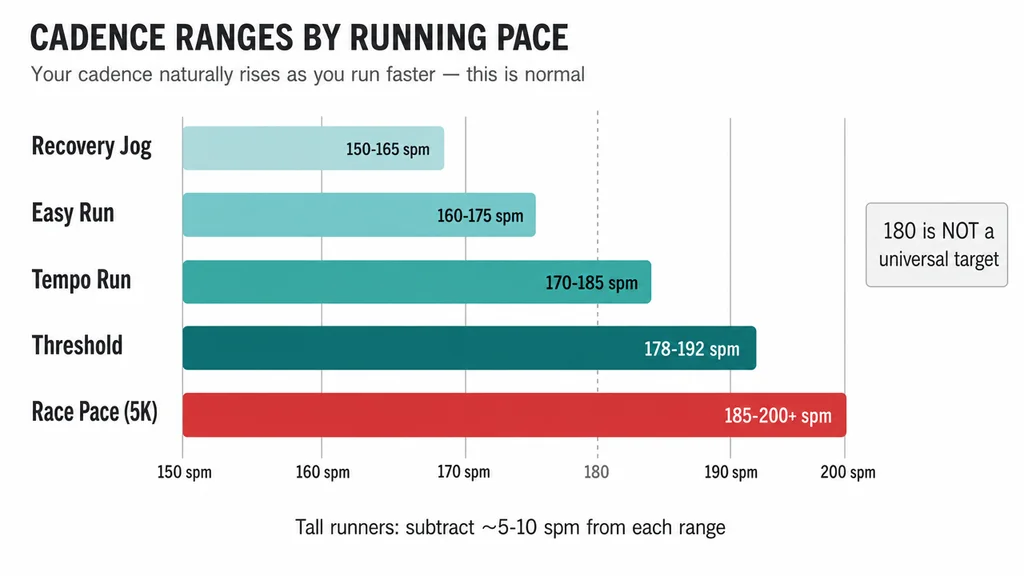
- Cadence should increase with pace — Expect 160-175 spm for easy runs, 170-185 for tempo, and 185+ for intervals; a single target for all speeds is biomechanically wrong.
- Stride length drives elite performance — Fast runners gain speed primarily through longer strides, not faster turnover; strength training and plyometrics develop the force production that extends stride.
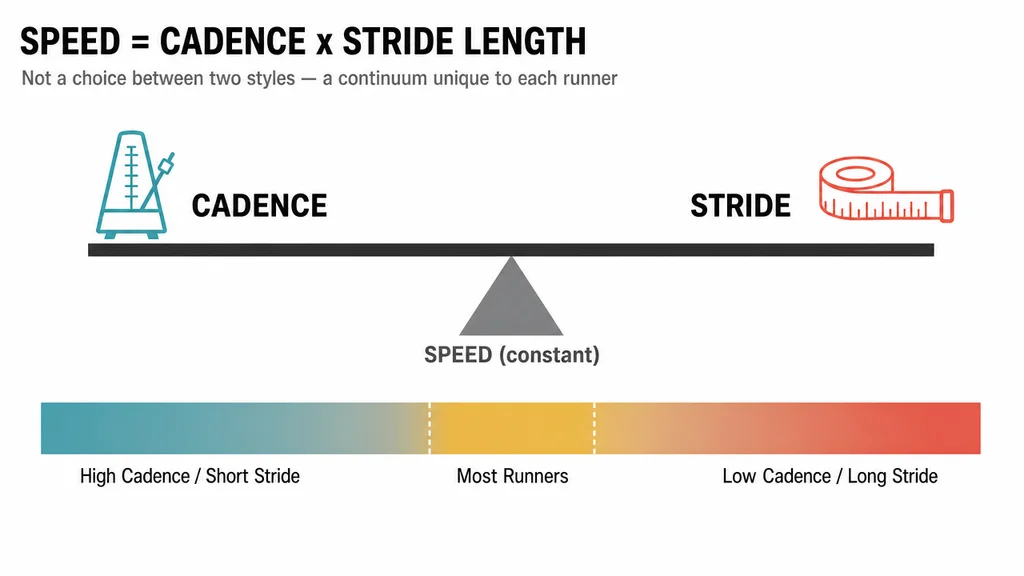
Running speed is determined by exactly two variables: cadence (steps per minute) and stride length (distance covered per step). Every pace improvement in running history has come from increasing one or both of these factors. Yet the relationship between them — and how to optimize each — is widely misunderstood, largely due to the persistent "180 steps per minute" myth.
Understanding Cadence and Stride Length
Speed = Cadence x Stride Length. This equation is absolute. A runner taking 170 steps per minute with a 1.2-meter stride length covers 204 meters per minute (approximately 4:54/km pace). The same runner could achieve the same pace with 180 spm and a 1.13m stride, or 160 spm and a 1.275m stride.
Use our Cadence Calculator to analyze your current cadence and stride length at different paces, and see how adjustments would affect your running speed.
The 180 SPM Myth: Where It Came From
The "180 steps per minute" target traces back to coach Jack Daniels' observation at the 1984 Olympics. What Daniels actually did was count the cadence of elite finalists — specifically in the 5K and longer distances — and noted that nearly all of them ran at 180 spm or higher during their race. These were among the fastest distance runners on the planet, running at full race effort, not jogging their recovery days. The context has been catastrophically stripped away over four decades of retelling.
The critical nuances that got lost:
- Daniels observed racing cadence of elite 5K finalists, not training cadence — elite runners routinely drop to 160-170 spm during easy runs
- The observation was of Olympic-level runners — recreational runners have different body proportions, fitness levels, and biomechanics
- 180 was a floor, not a target — it was the minimum he observed among elites, with many running at 190-200+ spm
- Cadence naturally increases with speed — prescribing a racing cadence for all paces ignores basic biomechanics
The deeper problem is treating cadence as a variable to optimize directly. Research and coaching experience increasingly point to cadence as an outcome of good running form, not a cause of it. When a runner improves posture, eliminates overstriding, and develops hip extension, cadence naturally rises to an individually appropriate level. Chasing a number on a watch without addressing form is working backward.
Burns et al. (2019) studied elite ultramarathon runners during a 100-km road race and found that step frequency varied primarily with running speed, not fatigue — further evidence that cadence is speed-dependent, not a fixed number.
What Research Actually Shows About Cadence
The landmark study by Heiderscheit et al. (2011) at the University of Wisconsin found that increasing cadence by 5-10% from a runner's preferred rate reduced impact loading at the knee and hip. Crucially, they did not prescribe a specific cadence number — the intervention was relative to each individual's natural rate.
Key findings from the research:
- A 5-10% cadence increase reduces braking forces at initial contact by 10-20%
- Higher cadence naturally shortens stride length, reducing overstriding (landing with the foot far ahead of the center of mass)
- Impact peak loading rate decreases with modest cadence increases
- These benefits plateau — increases beyond 10% from preferred cadence offer diminishing returns and may increase metabolic cost
The practical takeaway: if you currently run at 160 spm, aim for 168-176 spm — not 180. The improvement comes from the relative change, not from reaching a magic number.
Overstriding: The Real Enemy
Most cadence advice is really about preventing overstriding — landing with your foot far in front of your center of mass. Overstriding acts as a braking force with each step, increases impact loading on the knees, and wastes energy.
Signs of overstriding include:
- Heel striking well ahead of your hips
- A visible "reaching" motion with each step
- Shin splints or anterior knee pain
- Feeling like you are "pulling" yourself forward rather than falling forward
A biomechanics researcher studying running injuries has framed the tradeoff clearly: running the same distance at the same speed but with a roughly 10% higher cadence should, in theory, reduce the mechanical damage your body absorbs per step. Shorter strides mean less braking force at initial contact, less knee loading, and less stress on the IT band and shins.
However, there is a cost — oxygen consumption increases when you deviate significantly from your naturally preferred cadence. The body self-selects a cadence that minimizes energy expenditure, so forcing a much higher step rate makes you less efficient even as it reduces impact loading. This creates a genuine tradeoff between injury protection and metabolic cost, which is why the recommendation is a modest 5-10% increase rather than a dramatic leap to some target number.
The injury resolution stories are compelling. Runners who have struggled with chronic IT band syndrome for years — the kind that persists through foam rolling, stretching, and rest — frequently report that increasing cadence from the mid-160s to the upper-170s was the intervention that finally made the pain disappear permanently. Physical therapists increasingly prescribe cadence increases as part of gait retraining for IT band and patellofemoral pain. Similarly, runners with recurring shin splints often find relief after bringing cadence up by 10-15 spm, because the shorter stride reduces the eccentric loading on the anterior compartment muscles.
Increasing cadence is one way to address overstriding, but it is not the only way. Focusing on landing with your foot closer to your center of mass — regardless of cadence — achieves the same biomechanical benefit. Check our Running Form & Technique Guide for comprehensive form corrections.

Stride Length: When Longer Is Better
While cadence gets most of the attention, stride length is equally important for performance. Elite runners generate speed primarily through greater stride length at a given cadence, not through faster turnover.
Stride length is determined by:
- Ground contact force — How much force you apply during push-off (improved through strength training and plyometrics)
- Hip extension range — How far your leg extends behind you (improved through mobility work and hip flexor flexibility)
- Running economy — How efficiently you convert energy into forward motion (improved through consistent training)
Use our Running Economy Calculator to assess your efficiency and identify improvement opportunities.
How to Find Your Optimal Cadence
Rather than targeting 180 spm, follow this evidence-based approach:
- Measure your current cadence: Count steps for 30 seconds during an easy run and multiply by 2, or use a GPS watch. Our Cadence Calculator helps you analyze the results.
- Add 5% as a starting target: If you run at 164 spm, aim for 172 spm. This modest increase is enough to improve mechanics without feeling unnatural.
- Use a metronome for gradual adaptation: Set a metronome app to your target cadence and run with it during the first 10-15 minutes of easy runs. Increase by 5 spm every two weeks rather than making a large jump all at once. After 4-6 weeks, most runners find the new cadence feels automatic without the metronome.
- Try BPM-matched music: Spotify and other streaming services offer playlists organized by beats per minute. Running to a playlist at your target cadence can be more enjoyable than a metronome click, though less precise — music tempo naturally pulls your step rate toward the beat.
- Set cadence alerts on your watch: Most GPS watches allow cadence zone alerts. Set an alert for when you drop below your target range so you get a nudge without constantly checking the screen.
- Allow cadence to vary with pace: Your cadence should naturally increase as you run faster. Easy runs might be 165-175 spm while tempo runs are 175-185 spm and intervals are 185-195+ spm.
- Re-evaluate after 4-6 weeks: If the new cadence feels natural, consider another 3-5% increase. If it feels forced, you may have reached your optimal range.
Cadence by Pace: What to Expect
Rather than a single target, think of cadence as a range that shifts with pace:
- Easy runs (5:30-6:30/km): 160-175 spm
- Tempo runs (4:30-5:15/km): 170-185 spm
- Intervals (3:30-4:30/km): 180-200 spm
- Sprinting (<3:30/km): 195-220 spm
A variation of 10-15 spm between your easiest and fastest running is completely normal and expected — it reflects the natural biomechanical relationship between speed and turnover rate. Runners who try to maintain the same cadence across all paces are fighting their own physiology. Your easy-run cadence should be lower than your race cadence.
Height significantly affects where you fall within these ranges. Taller runners naturally have longer strides and lower cadences to compensate. As a rough guideline, expect approximately 3 fewer spm for each additional inch of height above average (about 5'9" / 175 cm for men, 5'4" / 163 cm for women). A 6'4" runner with an easy-run cadence of 155 spm may be biomechanically equivalent to a 5'8" runner at 170 spm — both are running efficiently for their body proportions. Watches and apps that flag sub-160 cadence as "poor" do not account for leg length, and tall runners should not feel pressured by these generic alerts.
Use our Pace-Speed Converter to translate between pace and speed units.
Strength Training for Better Stride Mechanics
Improving both cadence control and stride length requires neuromuscular adaptation, not just running more miles:
- Single-leg exercises (lunges, step-ups, single-leg deadlifts): Build the stability needed for efficient ground contact
- Plyometrics (box jumps, bounding, single-leg hops): Develop the explosive force that generates stride length
- Hip flexor and glute activation: Essential for both quick turnover (cadence) and powerful push-off (stride length)
- Strides (6-8 x 80-100m at controlled fast pace): The most running-specific way to practice higher cadence with good form
Monitor your injury risk as you introduce new training stimuli — biomechanical changes should be introduced gradually.
Common Cadence Mistakes
- Obsessing over 180 spm at all paces — This forces artificially short strides during easy runs and an unnatural gait
- Changing cadence too quickly — Increase by 5% maximum; larger jumps cause calf and Achilles overload
- Ignoring stride length entirely — Cadence without adequate stride length just means shuffling faster
- Using cadence to mask fitness issues — If you cannot maintain pace, the answer is usually more aerobic fitness, not more steps
- Same cadence uphill and downhill — Cadence naturally decreases uphill and increases downhill; forcing uniformity wastes energy
Sources & References
- (2011). Effects of step rate manipulation on joint mechanics during running. Medicine & Science in Sports & Exercise.
- (2019). Step frequency patterns of elite ultramarathon runners during a 100-km road race. Journal of Applied Physiology.
- (2016). Influence of step rate on shin injury and anterior knee pain in distance runners. Medicine & Science in Sports & Exercise.
- (2018). Gait retraining for the reduction of injury occurrence in novice distance runners. Clinical Biomechanics.