Wavelight: How Pacing Lights Changed Record Attempts
Wavelight shows a target pace after human pacers stop leading. How the lights work, what they cannot do, and why record comparisons divide opinion.
Key Takeaways
- The lights turn a target time into a moving reference. They show the programmed pace, not how much effort an athlete has left.
- A human pacer and a light do different jobs. Both guide pace; only the runner in front can provide wind shelter.
- Legal use does not settle historical fairness. The debate is about comparing athletes who raced with different technology.
The pacer stops leading. The light keeps going.
On 7 October 2020 in Valencia, Joshua Cheptegei ran 10,000m in 26:11.00, breaking Kenenisa Bekele’s longstanding world record. After Nicolas Kimeli gave up the lead, Cheptegei still had a reference alongside him: lights moving around the inside of the track. Kimeli went on to finish the race.
That is Wavelight: a branded system of LEDs that illuminate in sequence at a programmed pace. The lamps stay put; the moving pattern turns a target time into something an athlete can follow and a spectator can see. It is a visible timetable, not a measurement of the runner’s remaining energy.
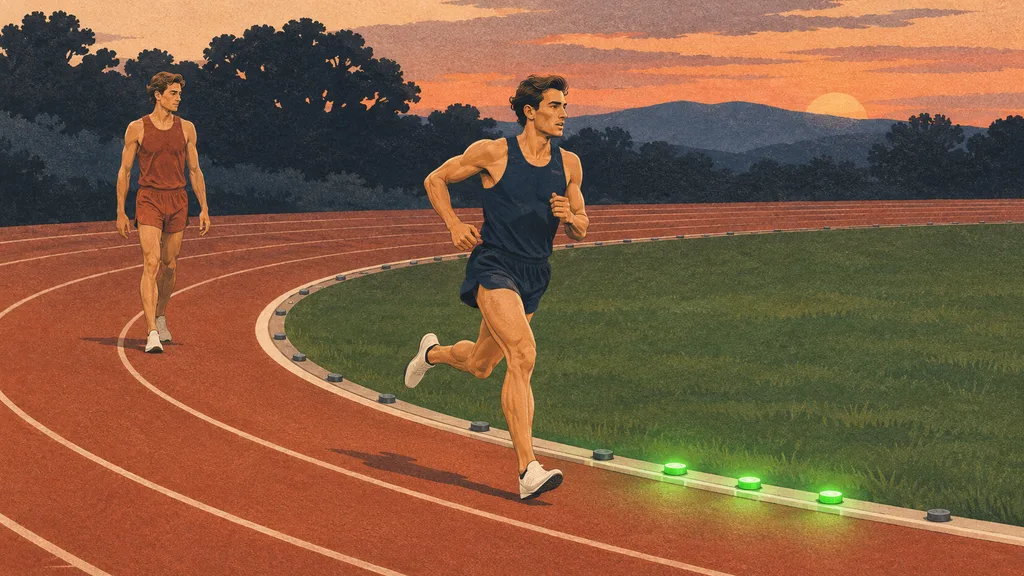
The familiar numbers in a pace calculation or lap-split table become a reference that travels around the track.
Why keep human pacers when you have lights?
A human pacer sets the rhythm and gives the athlete someone to follow. Running behind another athlete can also offer shelter from air resistance. But pacers have physical limits: they can tire, misjudge a lap or stop leading before the finish.
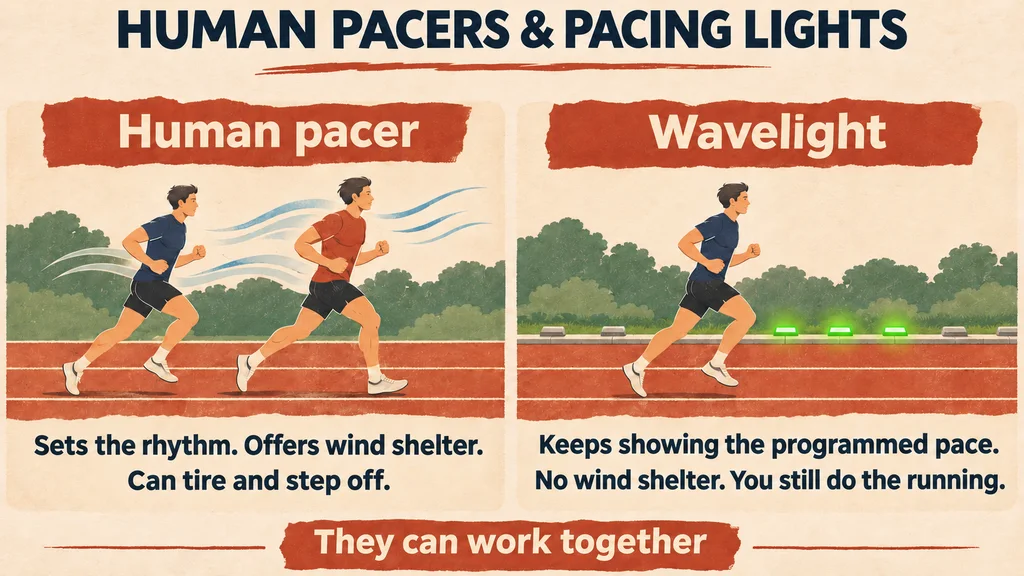
Wavelight can keep showing the programmed pace all the way to the line. It neither tires nor needs to judge its own effort. It also cannot block the wind, read an athlete’s fatigue or make a difficult pace sustainable. Human pacers can use the same lights, so the two often work together.
Valencia illustrates the limit as well as the appeal. The official report describes Cheptegei slowing slightly in the sixth kilometre despite the lights, before picking up again. A visible target is still a target someone has to run.
A better stopwatch, or a different kind of record?
In a 2024 viewpoint coauthored by Bekele, the authors argued that technology changes the conditions behind a performance. They proposed marking technology-paced records separately to preserve historical comparisons. Their concern was the extra feedback available to today’s athletes, rather than whether the effort was real.
Grannetia and Hoogkamer replied that pacing feedback had already evolved through stopwatches, trackside clocks and coaches calling splits. They also argued that everyone in a race can see the lights. Their reply addresses both shared access within a race and continuity with older technology. The dispute spans fairness today and comparisons across eras.
These are arguments, not an experiment measuring seconds gained. Grannetia disclosed contract work for Wavelight. The original viewpoint also discusses changes in footwear; racing-shoe technology belongs to the wider story, so a faster record cannot simply be assigned to the lights.
Sources & References
- (2020). Cheptegei and Gidey break world records in Valencia. World Athletics.
- . WaveLight’s Technology Keeps Setting a New Pace in Track & Field. Sports Business Journal, reproduced by Wavelight Technologies.
- (2024). Technological advances in elite sport: where does one draw the line?. Journal of Applied Physiology (Viewpoint).
- (2024). WaveLight Technologies’ lights are the fair 21st century’s equivalent of the stopwatch. Journal of Applied Physiology (Letter).
- (2026). Competition Rules & Technical Rules, 2026 edition. World Athletics.