Running Pace Calculator — Min/km, Finish Time & Pace Chart
Free running pace calculator for 5K, 10K, half marathon, and marathon. Get min/km or min/mile, your ...
Use Calculator →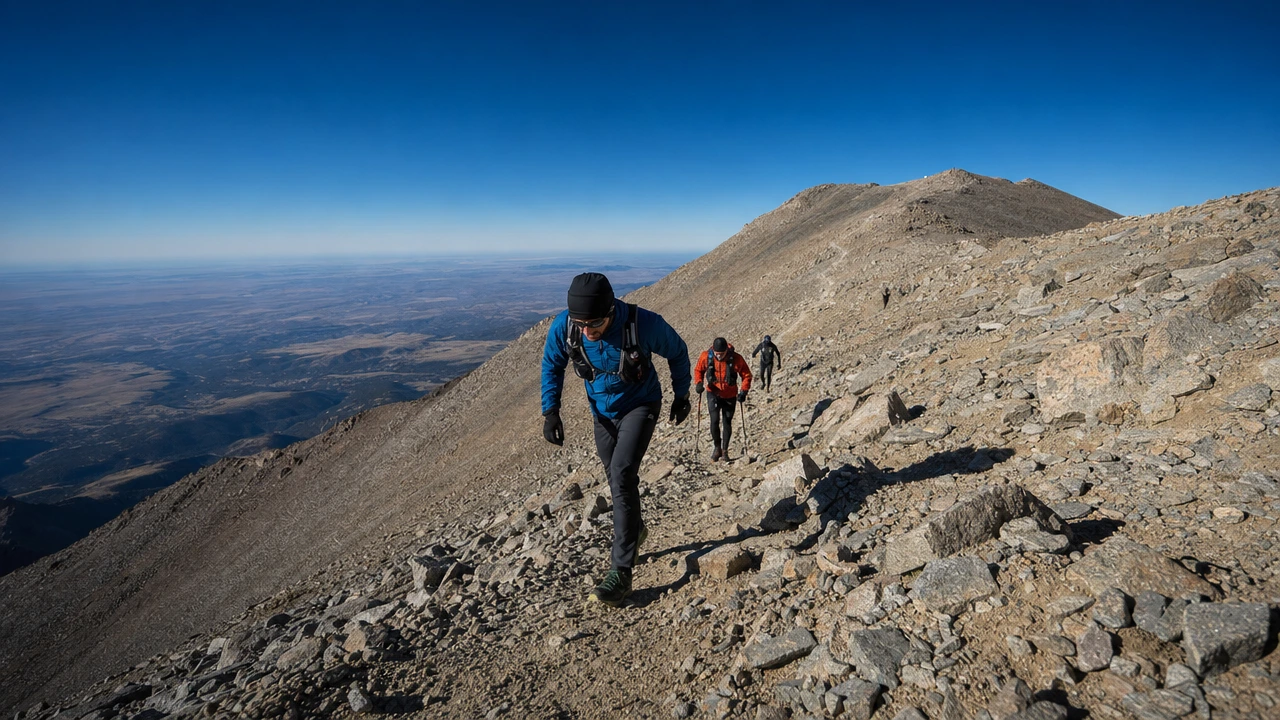
Race completed
Next-edition alertSee entry dates for other marathons →
| Race | 2026 Pikes Peak Marathon |
|---|---|
| Location | Manitou Springs |
| Date | |
| Time Limit | 10 hours · average 14:13/km |
| Course speed | Extreme course1 |
| Official site | Pikes Peak Marathon official website |
| Entry fee |
$263.5 · 2026 general entry
|
| Course Type | Out-and-back mountain trail (ascent then descent) |
|---|---|
| Elevation Gain | 2382m |
| Terrain | Mountain trail (Barr Trail single-track, loose gravel and rock above treeline) |
| Profile | One of the toughest marathons in America, and one of the oldest (first run in 1956). From the start in Manitou Springs at about 6,300 ft, the course climbs the Barr Trail for 13.1 miles to the 14,115 ft summit of Pikes Peak, gaining roughly 7,815 ft (2,382 m), then turns and descends the same trail back to town. The route passes Barr Camp (mile 7.6, 10,200 ft) and the A-frame shelter (mile 10.2, 12,000 ft) before breaking above treeline for the final loose-gravel and broken-rock push to the summit. This is a mountain ascent-and-descent on rugged single-track, not a road race — times are far slower than a flat marathon and the course is NOT Boston-qualifying. |
Use our free training tools to get race-ready:
Free running pace calculator for 5K, 10K, half marathon, and marathon. Get min/km or min/mile, your ...
Use Calculator →Free printable pace band for marathon, half marathon, or custom distance. Choose even, negative, or ...
Use Calculator →How much does a headwind actually slow you down? This free calculator turns wind speed and direction...
Use Calculator →How much will hills slow you down? Enter elevation gain, loss, and distance to see adjusted pace, di...
Use Calculator →Convert uphill or downhill running pace to flat-equivalent GAP in one click. Free grade adjusted pac...
Use Calculator →The 2026 Pikes Peak Marathon is on Sunday, September 20, 2026, with a 7:00 a.m. MDT start in front of City Hall in Manitou Springs, Colorado. The companion Pikes Peak Ascent (uphill only) is held the day before, on Saturday, September 19.
It is a mountain ascent-and-descent. From the start at about 6,300 ft in Manitou Springs you climb the Barr Trail 13.1 miles to the 14,115 ft summit of Pikes Peak, gaining roughly 7,815 ft (2,382 m), then descend the same trail. The high point is above treeline in thin alpine air. Map the brutal profile with our elevation profile tool.
Registration is first-come, first-served (not a lottery) and opens at 5:00 a.m. MST on March 1, 2026 via the official RunSignup page. For 2026 you do NOT need a qualifying time to enter the Marathon — a change from prior years. The early-bird fee is $200 (rising to $225 on April 1 and $250 on July 1); the race sells out and a waitlist may open.
No. This is a rugged mountain trail with about 7,815 ft of climbing to a 14,115 ft summit — it is not USATF/World Athletics course-certified for Boston qualifying, and finish times run far slower than a road marathon, so it is the opposite of a PR or BQ course. Come for the challenge and the alpine scenery. If a Boston time is your goal, pick a certified flat course and check the standards with our Boston Qualifying Calculator.
It is billed as America's Ultimate Challenge and is one of the hardest marathons in the country: high altitude, thin air above treeline, and a relentless 13-mile climb followed by a steep technical descent. The overall finish limit is 10 hours, with intermediate cutoffs at Barr Camp (3:00:00) and the A-frame (4:30:00), plus a summit turnaround cutoff of 6:15:00 — miss the summit deadline and you are turned back without an official finish.
Dress for two climates. The Manitou Springs start near 6,300 ft is mild, but the 14,115 ft summit can be near or below freezing with wind, even in September. Carry a windproof shell, gloves, and a stashable layer, plus trail shoes for loose gravel and rock up high. Arrive a few days early to acclimatize if you can, hydrate aggressively in the dry air, and run the climb by effort — altitude makes any pace feel harder.
First run in 1956, it is one of the oldest marathons in the United States. The course is a single out-and-back on the Barr Trail: 13.1 miles up to the summit, then back down the same path. It passes Barr Camp (mile 7.6, 10,200 ft) and the A-frame shelter (mile 10.2, 12,000 ft) before climbing the final 3 miles above treeline over loose gravel and broken rock to the 14,115 ft top.
Daily values within 7 days either side of 20 Sep, 2005–2024. Wet days had at least 1 mm of rain.
| Cooler | Typical | Warmer | |
|---|---|---|---|
| Temperature | 9.6°C | 14.6°C | 17.8°C |
| Dew point | -4.4°C | 0.6°C | 5.2°C |
Data: NASA POWER (MERRA-2 reanalysis), NASA Langley Research Center

Kyoto · 2027-02-21

Shizuoka · 2027-03-14
This race scores 1.69. For men and women separately, we compare up to five recent winning times with the median winning time for the same year in our database. We take the median of those ratios for each group, then average the two. A score of 0.95 or lower earns the “Fast course” label.
The series needs five recorded editions and at least three valid comparisons per group. Each annual comparison needs 60 results for that group. Shortened courses are excluded. Elite field strength, prize money and race conditions can influence winning times, so the score describes elite results and cannot predict an individual finish time.
Back to Course speed