Achilles Tendonitis and Running: Can You Run Through It?
You may not need to stop running: the 3-check pain rule, insertional vs mid-portion differences, and the 12-week loading rehab with the strongest evidence.
Key Takeaways
- You can usually keep running — an RCT found no significant difference vs 6 weeks without running or jumping (Silbernagel 2007); use the clinical 3-check rule.
- Location changes everything — same heel-drop program: 89% satisfaction mid-portion vs 32% insertional; the floor-level version lifted it to 67% (pilot).
- Rest alone doesn't rebuild capacity — pain fades before tendon function returns (only 25% regain it fully when symptoms resolve); rest-only cycles keep failing.
- Cut speed and hills first, not running — both drive deep dorsiflexion under load, spiking tendon force; flat easy running is usually the last thing to drop.
- Check your prescriptions — Fluoroquinolone antibiotics are an established Achilles risk factor. Tell your doctor you run before accepting one.
That familiar pattern — a stiff, sore Achilles for the first mile that "warms up" and disappears, then aches again the next morning — is the classic signature of Achilles tendinopathy. It is one of running's most common overuse injuries: about 1 in 10 running injuries (Kakouris 2021), and by one published figure about half of all distance runners deal with it at some point (Lieberthal 2019). Despite the name, it is usually not an inflammation problem. It is a load problem — the tendon can currently handle less than you are asking of it — which is why rest and anti-inflammatories alone keep disappointing people.
The good news is blunt: for most runners this is a manageable, keep-running injury, provided you follow rules instead of feelings. Here is the decision framework, the type distinction that changes your rehab, and the loading program with the strongest evidence.
Should You Stop Running? The 3-Check Rule
The strongest evidence says complete rest is not required. In a randomized trial of 38 runners, one group kept running and jumping under pain-monitoring rules; the other stopped for 6 weeks. Twelve months later there was no significant difference between them — continuing to run showed no negative effects (Silbernagel 2007, AJSM). Note what that does and doesn't say: continuing to run didn't help faster either. It means you can usually keep training if you stay inside the rules.
The self-check clinicians commonly use has three parts, and you need all three:
- During the run: pain stays at or below 3 out of 10.
- After the run: pain settles back down within an hour or two, not building through the day.
- Next morning: stiffness and pain are no worse than your current baseline.
The trial itself allowed pain up to 5/10, as long as it settled by the next morning. The 3/10 here is the stricter version most clinicians prefer. Break any one of the three, and the session was too much — cut speed, hills, and length before you cut running entirely. Track your weekly totals with the training load calculator so the adjustment is deliberate rather than vibes-based.
First, Find Out Which Type You Have
Achilles tendinopathy comes in two locations, and the distinction is not academic — it changes which exercises are safe:
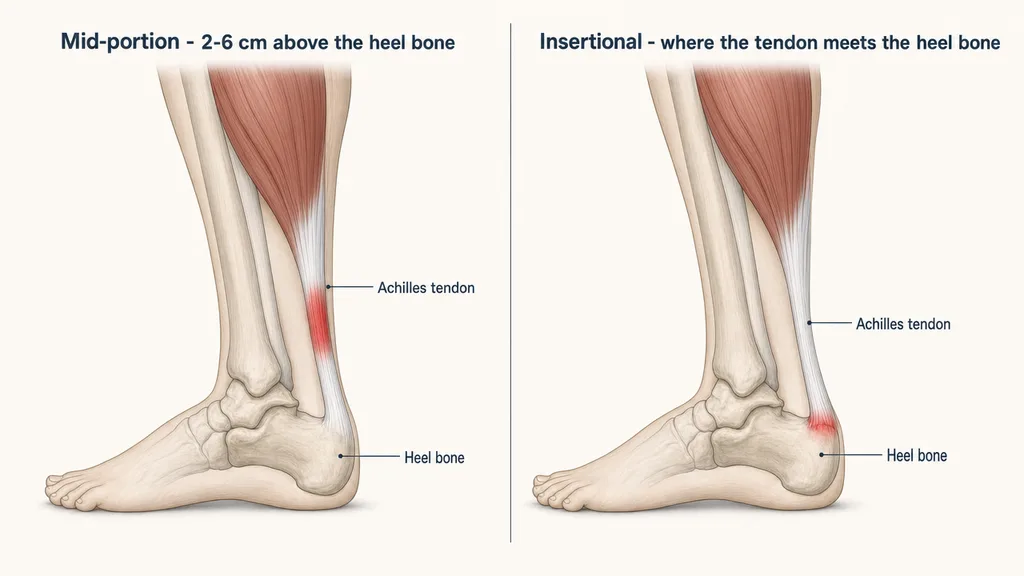
- Mid-portion: pain and often a tender thickening 2-6 cm above the heel bone, in the free span of the tendon (Fahlström 2003). This is the more common and more treatment-responsive type.
- Insertional: pain right where the tendon attaches to the back of the heel bone, often aggravated by shoe heel counters pressing on it.
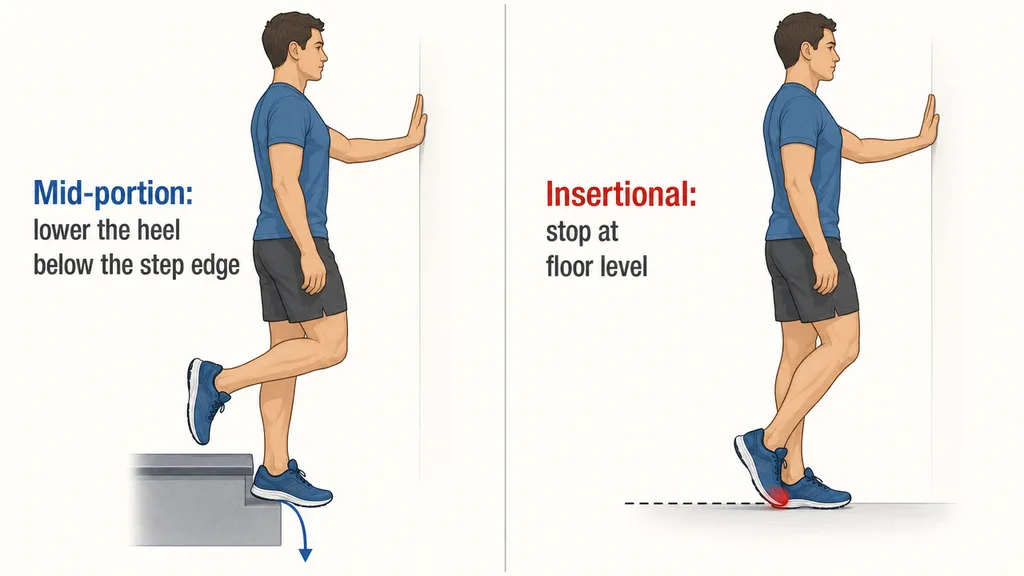
Why it matters: with the classic heel-drop exercise (heel dropping below a step edge), 89% of mid-portion tendons ended up satisfied — but only 32% of insertional ones (Fahlström 2003, 78+30 patients). Change one thing for insertional cases — stop at floor level instead of dropping below the step — and satisfaction rose to 67% in a pilot study (Jonsson 2008). The mechanics explain it: the deeper the ankle bends, the higher the force on the tendon and its attachment (Yeh 2021). Some modern rehab programs do treat both types with one unified loading plan — but the split results above are why this guide keeps the distinction.
Why Rest Alone Keeps Failing
Tendons are not muscles, and pain fading is not the same as load capacity returning. Researchers describe tendinopathy as a continuum — an early reactive stage, a failed-healing stage, then a degenerative stage — and what moves you along it is the gap between the load you apply and the load the tendon can currently handle (Cook & Purdam 2008). Managing that gap, not eliminating load, is the treatment: drop everything to zero and the gap is still waiting for you in your first week back.
Two more findings explain the frustration cycle runners describe:
- Anti-inflammatories and corticosteroid injections "may provide short-term relief but do not appear effective in the longer term" (Knapik & Pope, 2020, review). They dull the signal without changing tendon capacity.
- Feeling better is not the same as being rebuilt. A year after treatment, only 25% of patients whose symptoms had fully recovered had regained full tendon function (Silbernagel 2007, BJSM). If you stop rehab the week the pain stops, you are running on an under-rebuilt tendon — which is why it "comes back" after your first hard tempo. Plan the tail end of recovery with the recovery planner.
The Rehab That Works: Progressive Calf Loading
The foundational protocol is eccentric calf training — slow, loaded heel lowers. In the original 15-person study, every athlete was back at their pre-injury running level after 12 weeks. Every one of the 15 conventionally treated comparison patients (rest, NSAIDs, orthotics) eventually ended up in surgery (Alfredson 1998 — small study, landmark result). The commonly cited dosing, as used in the insertional follow-up study, is 3 sets of 15 slow reps, twice a day, 7 days a week, for 12 weeks (Jonsson 2008) — a real commitment, which is exactly where most self-treatment quietly fails.
| Protocol | How it works | Time cost | Evidence note |
|---|---|---|---|
| Eccentric heel drops (Alfredson-style) | Raise on both feet, lower slowly on the injured leg. Mid-portion: lower heel below step edge. Insertional: stop at floor level | 3×15, twice daily, 12 weeks | 89% satisfaction mid-portion; use the floor-level version for insertional (Fahlström 2003; Jonsson 2008) |
| Heavy slow resistance (HSR) | Loaded calf raises (e.g. seated/standing calf machine, slow tempo), progressively heavier | 2-3 gym sessions per week, 12 weeks | Equal 1-year results vs eccentrics in an RCT (mid-portion patients); compliance 92% vs 78%, so the best protocol is the one you'll finish (Beyer 2015) |
Progress load gradually and expect the timeline in months, not days — pain often improves ahead of tendon capacity (see the 25% finding above). If morning symptoms flare, hold your current level for a week instead of escalating.
Keep Running: How to Modify Training
While rehabbing, shrink the parts of running that spike Achilles load rather than running itself:
- Cut speed work and hills first. Both push the ankle deep into dorsiflexion under high force, and peak Achilles force rises with maximum dorsiflexion angle (Yeh 2021) — cutting them first follows directly from that. Flat, easy running is usually the last thing you need to remove.
- Reduce frequency before quitting. Alternate-day running with the 3-check rule beats consecutive loading days while the tendon's capacity is reduced.
- Swap, don't stop. Cycling and pool sessions hold aerobic fitness with minimal tendon load — the cross-training converter translates your usual runs into equivalent sessions.
- Rebuild volume slowly. When symptoms allow progression, use the mileage increase planner to schedule the ramp instead of jumping back to your old week. A history of tendinopathy plus higher weekly volume are both established risk factors (Knapik 2020), and the injury risk calculator will flag when your ramp gets greedy.
Runners who land very far forefoot — or who recently switched to aggressive forefoot form or much lower-drop shoes — put more of each stride's work through the calf-Achilles complex; if your pain started within weeks of a form or shoe change, that change is the first suspect. Our cadence and stride guide covers how to adjust mechanics without collecting a new injury, and the injury prevention guide covers the load-management principles that apply across every running injury, knee pain included (that one has its own guide).
Risk Factors Worth Acting On
From prospective studies (Knapik & Pope, 2020), the risk factors split cleanly:
- You can change: weekly running volume, calf (plantar-flexion) strength, training in very cold weather, ankle dorsiflexion range that is either restricted or excessive.
- You should know about: prior tendinopathy or fracture, female sex, higher BMI, more years of running, oral contraceptive or hormone replacement use.
- Almost nobody tells runners: fluoroquinolone antibiotics (names ending in -floxacin) are an established risk factor for Achilles tendon problems. If a doctor prescribes one, say you're a runner and ask whether an alternative is appropriate.
Sources & References
- (2007). Continued sports activity, using a pain-monitoring model, during rehabilitation in patients with Achilles tendinopathy: a randomized controlled study. American Journal of Sports Medicine.
- (2007). Full symptomatic recovery does not ensure full recovery of muscle-tendon function in patients with Achilles tendinopathy. British Journal of Sports Medicine.
- (1998). Heavy-load eccentric calf muscle training for the treatment of chronic Achilles tendinosis. American Journal of Sports Medicine.
- (2003). Chronic Achilles tendon pain treated with eccentric calf-muscle training. Knee Surgery, Sports Traumatology, Arthroscopy.
- (2008). New regimen for eccentric calf-muscle training in patients with chronic insertional Achilles tendinopathy. British Journal of Sports Medicine.
- (2015). Heavy Slow Resistance Versus Eccentric Training as Treatment for Achilles Tendinopathy: A Randomized Controlled Trial. American Journal of Sports Medicine.
- (2008). Is tendon pathology a continuum? A pathology model to explain the clinical presentation of load-induced tendinopathy. British Journal of Sports Medicine.
- (2021). A systematic review of running-related musculoskeletal injuries in runners. Journal of Sport and Health Science.
- (2019). Prevalence and factors associated with asymptomatic Achilles tendon pathology in male distance runners. Physical Therapy in Sport.
- (2020). Achilles Tendinopathy: Pathophysiology, Epidemiology, Diagnosis, Treatment, Prevention, and Screening. Journal of Special Operations Medicine.
- (2021). Maximum dorsiflexion increases Achilles tendon force during exercise for midportion Achilles tendinopathy. Scandinavian Journal of Medicine & Science in Sports.