CORE Body Temperature Sensor: Worth It for Runners?
Seven peer-reviewed tests of the CORE sensor, none supporting its accuracy claim. What USD 294.95 buys a runner today, and how to heat-adapt without it.
Key Takeaways
- Seven peer-reviewed tests, none of them kind — in a 5 km time trial readings sat 0.47 °C from a swallowed pill, low in some studies and high in others.
- Do not buy it as a heat-stroke guardrail — nothing has tested it for warning of heat illness, and in the one running study it sat 0.47 °C off a swallowed pill.
- Heat training itself is real — five days of exercise in the heat already shift heart rate and core temperature, and you lose about 2.5% of it per day off.
- The free version is layers and a sauna — CORE's own runner protocol needs no sensor, and a post-run sauna was worth about 1.9% in time-trial terms for six runners.
The CORE sensor clips to a chest strap and shows a number that looks like your core body temperature. It measures no such thing. It reads heat leaving your skin and models the rest. At USD 294.95 at the official store in September 2026, the question is whether the number is worth acting on. For heat training, sometimes. As a safety warning, no.
What the number actually is
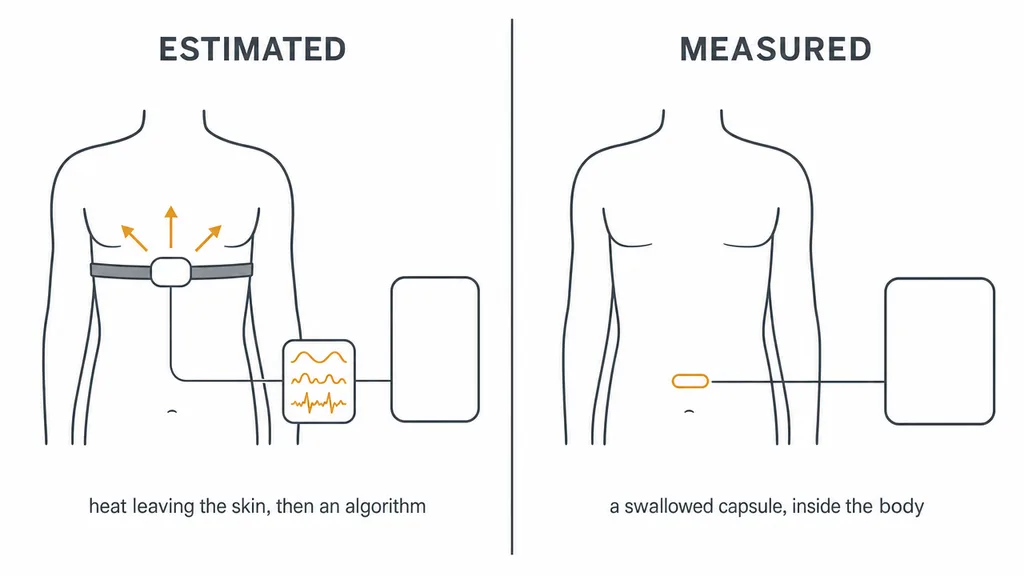
A heat-flux sensor and a skin-temperature sensor feed an algorithm that estimates core temperature. Two consequences follow, both from CORE's own documentation. It needs a 10-minute calibration from the moment it goes on, and 15 minutes of wear before the data-quality score tops out at 4. CORE calls pairing a heart rate monitor critical for accurate data and says that during sport the lack of a heart rate signal will cause inaccurate data; without one the session also earns no Heat Training Load.
Why runners buy one
Because heat training itself works. The 2015 international consensus statement on competing in hot conditions calls heat acclimatisation the most important intervention one can adopt to reduce physiological strain and optimise performance there, built from repeated exercise-heat exposures over one to two weeks. CORE's headline claim, cyclists 8% faster in a time trial after 10 days, matches a 2010 study of 12 trained cyclists — where that 8% was measured in the heat, and the cool-weather figure was 6%.
Two limits the marketing skips: no runner study has shown that gain in cool weather, and a review of 30 heat-adaptation studies in women found no change in plasma volume. Plan a heat block for a hot race, not a cool personal best; summer marathon training shows where it fits.
Evidence detail: what heat training has and has not been shown to do
The 8% figure. In Lorenzo et al. 2010 (Journal of Applied Physiology), 12 trained cyclists completed 10 days of heat acclimation at about 50% of VO2max in 40 °C, with 8 further cyclists as controls. Time-trial performance improved 8% in hot conditions and 6% in cool, VO2max rose 8% and 5% respectively, and plasma volume rose 6.5%. Twelve trained cyclists is a small, single-sport sample.
The cool-weather question is genuinely open. Supporting it: in a counter-balanced crossover of 10 men across two three-week interventions, mean time-trial power output rose significantly in both hot and cool conditions, by 20 W and 12 W, while cool-condition VO2peak did not change, and the authors wrote that the mechanistic pathways improving performance in cool conditions remain unclear. Against it: of 25 cross-country skiers, the 13 who added five weeks of heat-suit training gained 30 g more haemoglobin mass than the 12 controls, with no group differences in work economy, running velocity, VO2max or a 15-minute running performance trial. And in the one runner-specific trial below, cool-condition performance did not move at all.
Sex differences. A systematic review of 30 heat-adaptation studies in women, 22 of them pooled, found a large improvement in performance in the heat, an effect size of 1.00, but no change in plasma volume, at an effect size of -0.03. The dose associated with adaptation there was 451 to 900 minutes, or 8 to 14 days, taken daily.
The runner protocols. Six male distance runners sat in a humid sauna at about 90 °C for around 31 minutes immediately after exercise, on about 13 occasions across three weeks. Run time to exhaustion rose 32%, which the authors themselves converted to roughly 1.9% in an endurance time trial; plasma volume rose 7.1%; the red-cell figure of 3.5% had a confidence interval crossing zero, so treat it as unresolved. In a separate trial, 17 men ran 40 minutes at 65% of VO2max in temperate conditions and then either sat in a 40 °C bath or did not, daily for six days. Resting rectal temperature fell 0.27 °C and time-trial performance improved 4.9% at 33 °C but not at 18 °C. Sample sizes across all of this run from 6 to 25, in trained cyclists, skiers and laboratory men, so none of these figures is a promise for every runner.
The accuracy problem that is not on the box
At least seven peer-reviewed studies have compared CORE against a rectal probe or a swallowed pill, and not one supports its accuracy claim. The most relevant to you took twelve people through a 5 km running time trial at 30 °C: readings sat 0.47 °C from the pill on average, and CORE understated how fast the temperature was actually climbing. The authors call that a clinically relevant underestimation. The 2021 study that started this found the same shape on the bike and concluded, word for word, that the results obtained do not support the manufacturer's claim that the CORE sensor provides a valid measure of core body temperature. CORE publishes a rebuttal arguing that study proves the opposite, because its authors used a rectal probe rather than the swallowed pill CORE says it is calibrated against. But the running study used a swallowed pill, and so did the field-hockey study — both the reference class CORE says it is calibrated against, and both failed it.
The error does not even point one way. Two studies had CORE reading low, one had it reading high in the back half of a hot ride, and one had it low at rest and high at 55 minutes. An unpredictable offset is worse than a known one, because you cannot correct for it.
What none of it supports is the number itself. No study has tested CORE as a warning of heat illness, and it is not a cleared medical device. Warning is what runners want it for. A widely discussed thread in a running community was opened by a runner who collapsed from heat stroke in a marathon with no advance warning; the reply that resonated most came from an owner who said the readings "never felt reliable enough to place much value in them", and that they would never have felt comfortable using it to evaluate for heat stroke. If safety is your reason for being here, the hot-weather running guide and a dew point check serve better.
Evidence detail: what the validation studies actually did
The CORE validity study (Verdel et al. 2021, Sensors) ran two experiments: 12 men completed two identical 60-minute steady-state cycling bouts at 19 °C, and 13 men cycled for 90 minutes at 31 °C, with a rectal sensor as the reference. Reliability was strong, with a mean bias between the two identical trials of 0.02 °C that was not statistically significant, but approximately 50% of all paired measurements differed by more than the predefined threshold for validity of 0.3 °C or less.
The second study (Goulet et al. 2026, Sensors) followed 11 participants, two of them women, through a 120-minute seated period after a hyperhydration protocol designed to create a substantial heat sink. The gastrointestinal telemetry pill recorded a peak fall of 0.76 °C at minute 60, where CORE estimated 0.09 °C, and an intraclass correlation coefficient of 0.12 indicated poor agreement. Neither of those two was a running study, but others are: a 5 km time trial at 30 °C, an elite team's heat training camp, a night of monitored sleep, and an outdoor beach-volleyball match. The settings vary; the verdict on the absolute number does not.
A nuance in the manufacturer's favour, and one against. greenTEG also makes a research-grade sensor, CALERA, which is not the consumer CORE. Against a gastrointestinal pill in 15 cyclists riding at 32 °C, that research sensor was judged valid and reproducible, with an intraclass correlation of 0.98 and a bias of 0.01 °C, although the acceptance criterion was a wider 0.4 °C. In a second test, 15 participants completing a nine-day controlled-hyperthermia heat acclimation protocol, the same research sensor showed limited responsiveness against rectal temperature: wide limits of agreement, plus or minus 0.32 °C, proportional bias, an intraclass correlation of 0.18 or below, and 0.35 for the thermal dose. The authors concluded that it underestimates both the heat-acclimation changes and the thermal dose. That is the reason to trust a single session's data further than any adaptation percentage.
If you already own one
- Chest strap, torso below the armpit. CORE's stated best position; arm and wrist readings are less accurate; for the arm specifically, CORE's own CORE 1 arm-strap page says the reading tends to run slightly low. Adhesive patches with watch heart rate is the official alternative, 15 for USD 29.95.
- Pair a heart rate monitor every session. Required during sport; without one nothing counts towards Heat Training Load, and the strap is not in the box.
- Aim for the 3.0 to 6.9 heat-strain band. CORE's target zone on a scale to about 10. Above 7 is marked not recommended rather than better, and thresholds vary by person.
- Take it off before the sauna. Wearing it in a sauna, steam room or hot bath is forbidden; it works from -20 to 45 °C. Log those sessions by hand.
CORE's recommended dose: 10 to 14 heat sessions inside a 2 to 12 week window, 45 to 80 minutes in the target band each, then one to three a week to hold it. Trust a session's data over the adaptation percentage. The WHOOP guide asks the same validation question of another wearable.
How to get the adaptation without buying anything
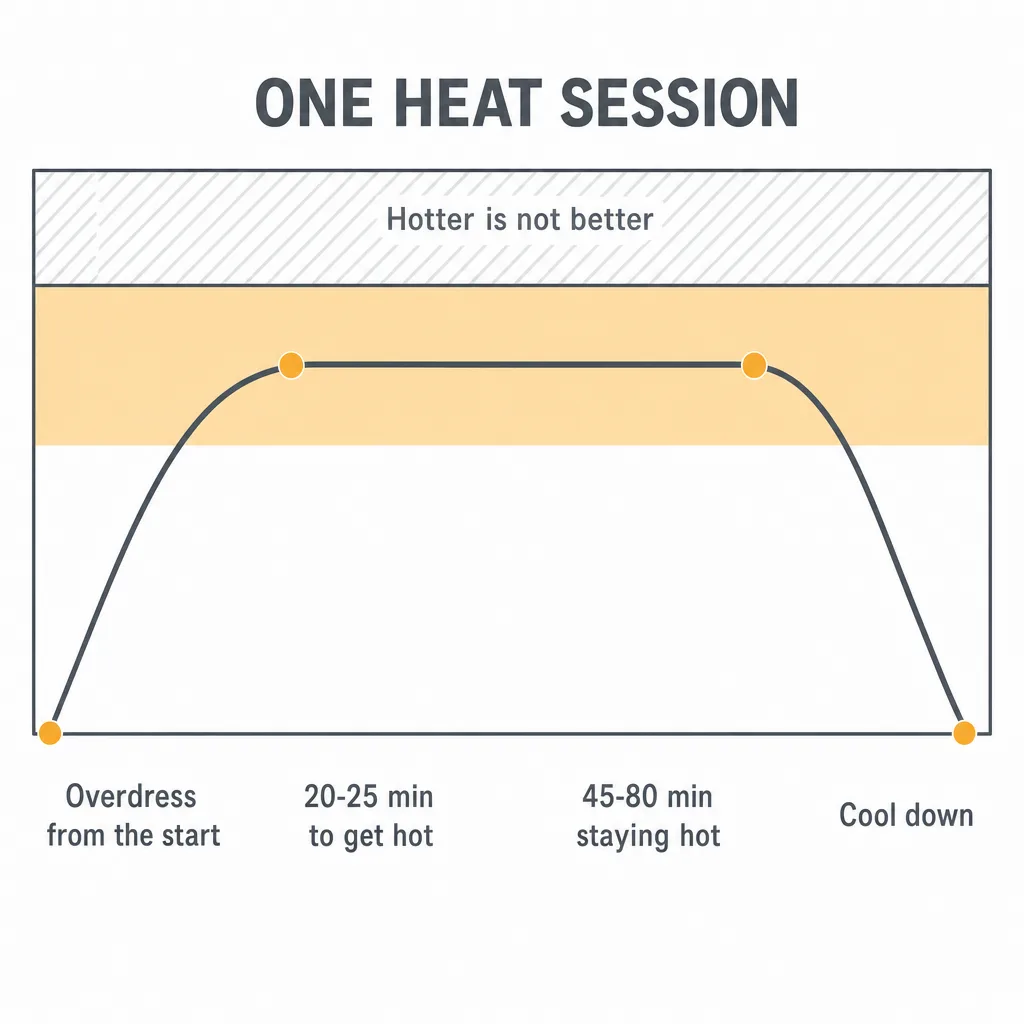
CORE publishes the runner protocol itself, and none of it needs the sensor. Two or three heat sessions a week. On easy runs, overdress from the start and expect 20 to 25 minutes before real heat strain builds. For tempo or intervals, run the fast part cool and add layers for a 30-minute jog afterwards. Below 15 °C it is hard to create enough heat stress; above 30 °C the extra clothing is unnecessary.
Without a temperature to watch, cap the session by heart rate: hold your usual easy heart rate zone and let the pace go; the heat adjustment calculator says how much slower to expect. Passive heat adds a little: for six male distance runners taking a post-run sauna about 13 times across three weeks, the authors put the gain at roughly 1.9% in time-trial terms.
So, is it worth it?
Buy it if you are building for a specific hot race and already train by numbers, accepting that it is a training dial, not a thermometer. Skip it if you want a heat-stroke warning, run three times a week, or are chasing a cool-weather best: layers and a sauna buy the same adaptation for nothing. One experienced runner described the middle path: used at first to learn how conditions really affect the body, then largely retired from decisions.
Sources & References
- (2021). Reliability and Validity of the CORE Sensor to Assess Core Body Temperature during Cycling Exercise. Sensors.
- (2023). CORE™ wearable sensor: Comparison against gastrointestinal temperature during cold water ingestion and a 5 km running time-trial. Journal of Thermal Biology.
- (2026). Validity of the CORE Wearable Sensor During Internal Cooling Induced by Hyperhydration with Cold Water at Rest. Sensors.
- (2010). Heat acclimation improves exercise performance. Journal of Applied Physiology.
- (2016). Post-exercise hot water immersion induces heat acclimation and improves endurance exercise performance in the heat. Scandinavian Journal of Medicine & Science in Sports.
- (2018). Heat Acclimation Decay and Re-Induction: A Systematic Review and Meta-Analysis. Sports Medicine.