Garmin CIRQA for Runners: Worth It vs WHOOP or a Watch?
No GPS, and 9-10 bpm low at the wrist in short reps, but chest-strap accurate on the biceps. Who should buy Garmin CIRQA, and who needs a watch.
Key Takeaways
- Biceps for intervals — in one interval test the wrist read roughly 9 to 10 bpm low at the start of reps; on the arm it sat within 0.3 bpm of a chest strap.
- It is not a running watch — no GPS chip, no screen, and Garmin puts manual laps and every structured workout behind a Connect+ subscription.
- The arm band is not in the box — $59.99 extra, black only, and both sizes showed a three to four month lead time on 7 September 2026.
- Cheaper than WHOOP, eventually — $259.98 with the arm band breaks even against WHOOP’s $199 annual plan in about 16 months, at prices seen on 7 September 2026.
- Buy it as an accessory, not a replacement — it earns its place next to a Garmin watch. Without one, buy the watch first.
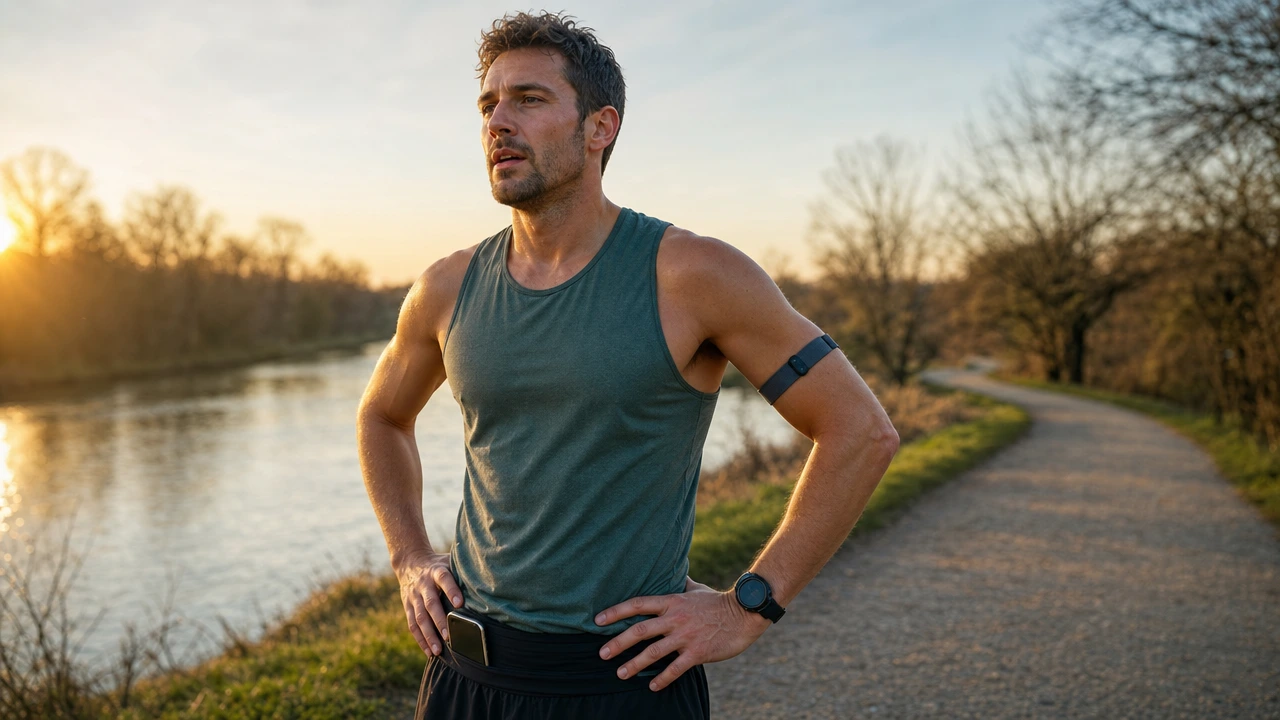
Garmin’s CIRQA is a screenless band that straps an optical heart-rate sensor to your wrist or upper arm, costs $199.99 as of 7 September 2026, and needs no subscription to work. For a runner the verdict is narrow. Buy it if you already own a Garmin watch and will wear it on your biceps for hard sessions, because that is where independent testers found chest-strap accuracy. Without a running watch, a watch still buys you more.
What CIRQA does on a run, and what it never will
Garmin’s spec sheet has a section headed Running Features. It contains exactly two rows: GPS-based distance, time and pace, and cadence. Both are marked “connected GPS”, so both need your phone. There is no GPS chip in the band.
What the sheet leaves out matters more. No ground contact time, no vertical oscillation, no stride length, no running power, no Hill Score, no race predictor, no lactate threshold estimate. VO2 max for running does survive.
Two limits matter more than any missing metric:
- One button, one activity. The side button starts and stops whichever activity you set as your favourite. Everything else starts from your phone.
- Auto Lap is free; pressing lap yourself is not. Garmin marks manual lap as Connect+ only, and every guided workout, from cardio and HIIT to yoga, carries the same tag.
With no screen your phone is not a second display but the only one, so no glancing at your heart rate mid-rep. The band also works from the generic five-zone model built off your maximum heart rate rather than threshold zones, so what it feeds your heart rate zones is as coarse as that model allows.
The wrist is where it falls down, and only sometimes
the5krunner ran five 3-minute reps with CIRQA on the wrist against a chest strap and several other optical sensors, then repeated the protocol on his biceps.
| Same tester, same interval protocol | Agreement in the same test |
|---|---|
| CIRQA on the wrist | About 9 to 10 bpm low at the start of four of the five reps |
| CIRQA on the biceps | Within 0.3 bpm of a WHOOP MG, a Polar arm band and a Garmin HRM 600, all rated excellent |
| WHOOP and Fitbit Air in the same session | Agreed with each other to about 1 bpm |
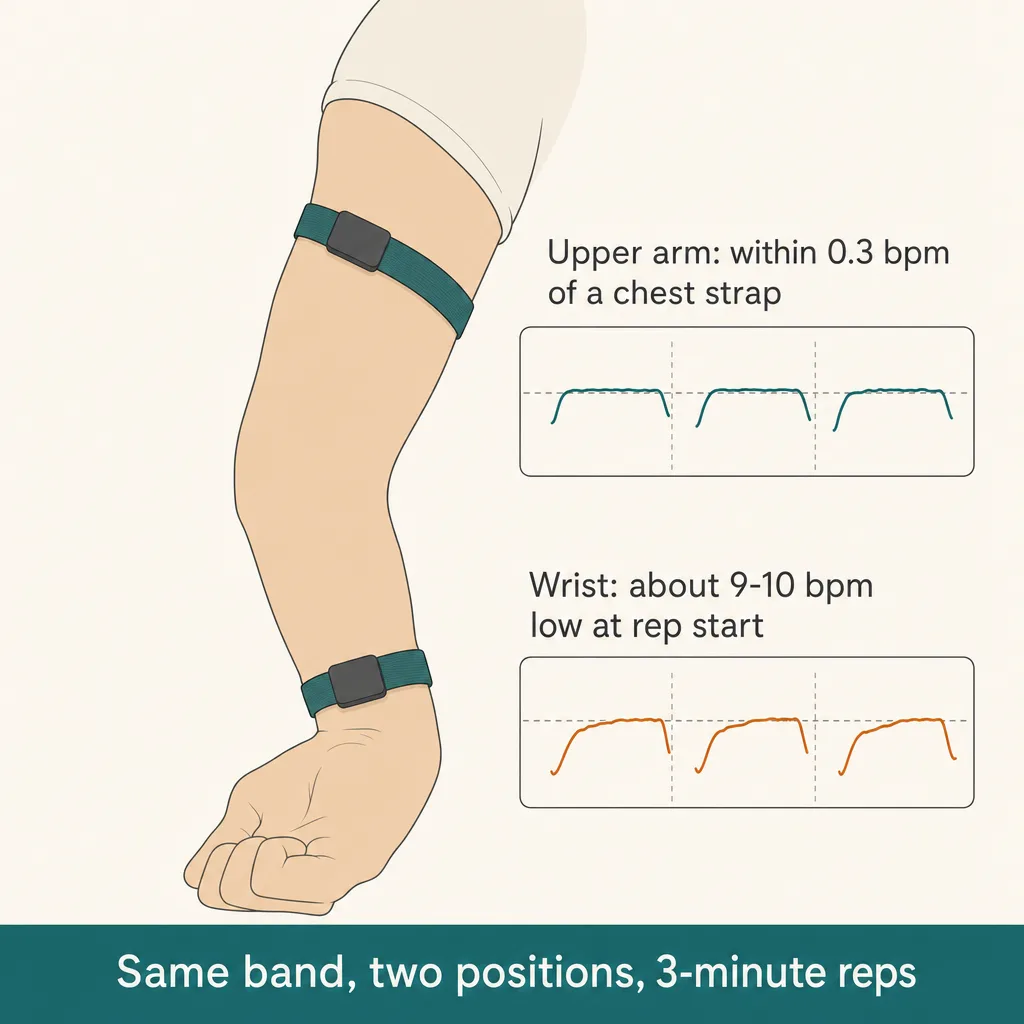
DC Rainmaker saw the same split on 400 m repeats: “Cirqa on the wrist really struggled here, yet on the bicep was perfectly fine.” Easy steady runs on the wrist gave him no trouble, and the arm band, he found, “will generally produce heart-rate strap level accuracy. In fact, it often exceeds it.”
The failure is a lag, not a blackout, which is why reviewers disagree. The sensor locks on slowly when effort jumps, so it misses the opening of a rep and recovers by the middle. Tom’s Guide, testing four 8-minute reps and twelve 600 m reps at the wrist, still came away impressed, so the disagreement is real; 400 m repeats never give the sensor that time.
So easy and steady running is fine on the wrist; short hard reps belong on the biceps or a chest strap. Garmin nowhere claims the upper arm is more accurate, so this is the testers’ finding, not an official one. Nor does Garmin treat the two positions as interchangeable: automatic rep counting is marked wrist-only, and the same effect runs through WHOOP’s numbers for runners.
Evidence detail: why the upper arm wins, and what has not been tested
No published study has tested CIRQA itself. A PubMed search returns zero papers, none of the Garmin studies published in 2026 mention it, and no study of any Garmin hardware has compared the upper arm against the wrist. Every physiological number on this page is therefore borrowed from other sensors or other brands.
The lag has a reference. A 2020 study in npj Digital Medicine (Bent et al., DOI 10.1038/s41746-020-0226-6) found that absolute heart-rate error during activity was on average 30% higher than at rest, and that devices differ specifically in how they respond to changes in activity.
Temperature appears to be part of it. DC Rainmaker failed the same 400 m session repeatedly at 17 to 18 °C (62 to 64 °F), while another tester running it at 29 °C (85 °F) was, in his words, “spot-on”. His own explanation was “some combination of the temp+terrain+pace”, and Garmin, told about the result, was surprised by it too. One session at each temperature is an observation, not a controlled finding.
For placement, the cleanest evidence comes from other brands. A 2025 study in Sensors (Moghaddam et al., DOI 10.3390/s26010176) put three identical WHOOP 4.0 units on the same 28 people at once and measured treadmill error of 5.95% at the wrist, 2.55% on the forearm and 1.92% on the upper arm. A 2025 JMIR Cardio study of 16 adults (Schweizer et al., DOI 10.2196/67110) compared Polar hardware across nine activities and found an arm-worn sensor at 1.35% error against 6.82% for a wrist-worn watch, concluding that “device selection and wearing position” both matter. Both used other manufacturers’ sensors, so read them as evidence about optical sensors on arms in general, not as measurements of CIRQA.
Running it alongside a Garmin watch
Two settings inside Garmin Connect decide how a band and a watch divide the work. Primary Training Device, in Garmin’s words, “sets the priority data source for training metrics like your training status and load focus”. Primary Wearable does the same for daily health metrics, and should be whichever device you wear most.
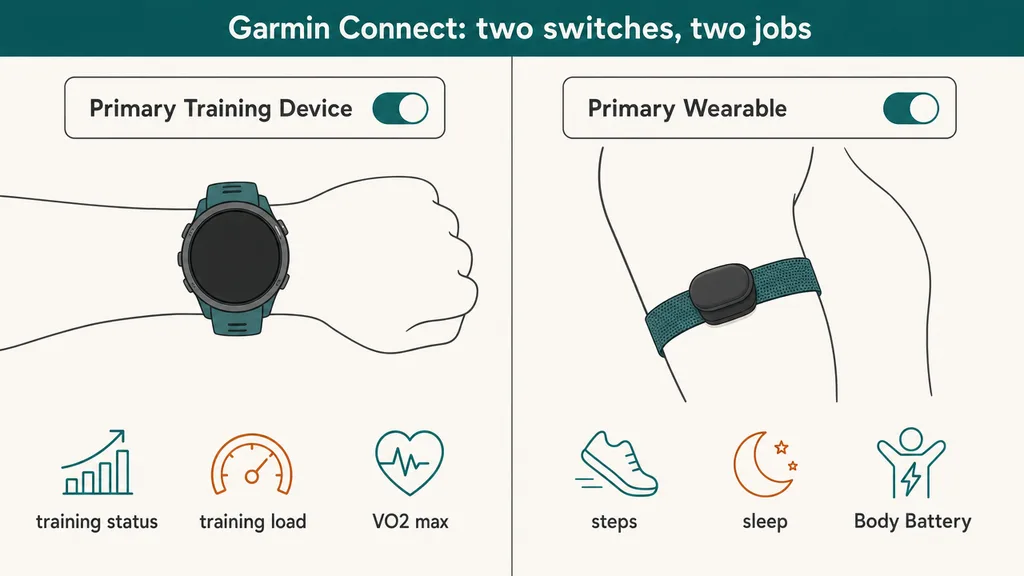
Your watch then owns training load and training status while the band owns steps, sleep and Body Battery. That also saves you from a second trap: the two devices disagree. One owner wearing CIRQA on the biceps overnight got a sleep score of 65 and a training readiness of 37 from the band. Their watch, the same night, said 44 and 14. Garmin has not explained the gap, so read one device and ignore the other. The same goes for training readiness.
The other runner job is heart-rate strap duty. Garmin lists broadcasting over ANT+ and Bluetooth; hold the button three seconds and the light flashes yellow. Owners pairing it with a Forerunner or Fenix report it works without duplicate entries; the safe habit is to never start an activity on the band itself.
Two cautions: broadcasting shortens battery life, which Garmin states outright, and owners reported firmware 2.5 stopping Bluetooth broadcast to other apps and devices, Garmin’s own Edge computers included, while ANT+ kept working. That is a user report, not a Garmin statement.
Sleep, HRV and Body Battery: what is safe to believe
The sleep tracking has one bias, and two testers found it pointing the same way. Over 15 nights against a bed sensor, CIRQA under-counted time awake by an average of 42 minutes. It over-counted REM sleep by 48 minutes. The direction held on 12 of the 14 nights compared. A reviewer using a smart ring saw the same direction.
That is the category’s flaw, not this band’s. Consumer trackers answer “asleep or awake” well, name the stage badly, and miss the minutes you spend lying awake. So believe your bedtime and roughly your sleep duration, and treat the stage breakdown as decoration. A sleep and recovery score built on duration and consistency is the part worth acting on, and what sleep does for recovery does not depend on your REM minutes.
Evidence detail: what the sleep and HRV studies measured
A 2022 study in Sensors (Miller et al., DOI 10.3390/s22166317) tested 53 adults for one night against clinical polysomnography. A Garmin Forerunner 245 Music agreed with the lab 89% of the time on sleep versus wake, and 50% of the time on the specific stage, the lowest staging score of the six devices tested. The authors concluded that all six were valid for the timing and duration of sleep but needed improvement for staging.
A 2025 study in Sleep Advances (Schyvens et al., DOI 10.1093/sleepadvances/zpaf021) found six consumer devices detected sleep with sensitivity above 90% while correctly identifying wakefulness only 29.4% to 52.2% of the time; an earlier study of a Garmin Vivosmart 4 (Mouritzen et al., DOI 10.1371/journal.pone.0243214) reported 0.28 on the same measure. That is the mechanism behind the missing awake minutes.
For heart-rate variability, a 2025 study in Physiological Reports (Dial et al., DOI 10.14814/phy2.70527) compared 13 people across 536 nights against ECG. A Garmin Fenix 6 reached a concordance correlation of 0.87 with 10.52% average error, behind an Oura ring at 0.99 and a WHOOP 4.0 at 0.94, and Garmin was excluded from the resting heart-rate analysis for methodological inconsistency. For the scores themselves, a 2025 documentation audit in Translational Exercise Biomedicine (Doherty et al., DOI 10.1515/teb-2025-0001) reviewed manufacturer materials rather than people and reported that “none of the manufacturers disclosed their exact algorithmic formulas, and few provided empirical validation or peer-reviewed evidence supporting the accuracy or clinical relevance of their scores”, naming Garmin’s Body Battery and Training Readiness among them.
HRV Status, Body Battery and Training Readiness deserve the same discount, for a blunter reason. Nobody outside Garmin has published a validation of them, and the one published test of overnight Garmin HRV against ECG put a Garmin watch last of the three brands compared.
Read them as trend lines. Your own HRV baseline across weeks carries information; one red morning does not, and reading an HRV number without an age chart is the skill worth having. Two flat days after a hard block are a reason to move a workout, and a day-by-day recovery plan beats improvising off an unvalidated score.
Adding up the price
CIRQA is $199.99 in the United States and £179.99 in the UK as of 7 September 2026, with no subscription needed to record and read your data. Two costs sit outside that: the arm band, and Connect+ for manual laps and workouts.
| Option, US prices on 7 September 2026 | Price | Recurring cost |
|---|---|---|
| Garmin CIRQA | $199.99 | None |
| CIRQA plus Garmin arm band | $259.98 | None |
| Garmin Connect+, for manual laps and workouts | $6.99 per month or $69.99 per year | Yes, after a 30-day trial |
| WHOOP One / Peak / Life | $199 / $239 / $359 per year | Yes, hardware comes with the plan |
| Fitbit Air | About $100, according to several reviews | None for core tracking |
| Polar Verity Sense, optical arm band | $104.95 | None |
| Garmin HRM-Pro Plus / HRM 600 chest straps | $129.99 / $169.99 | None |
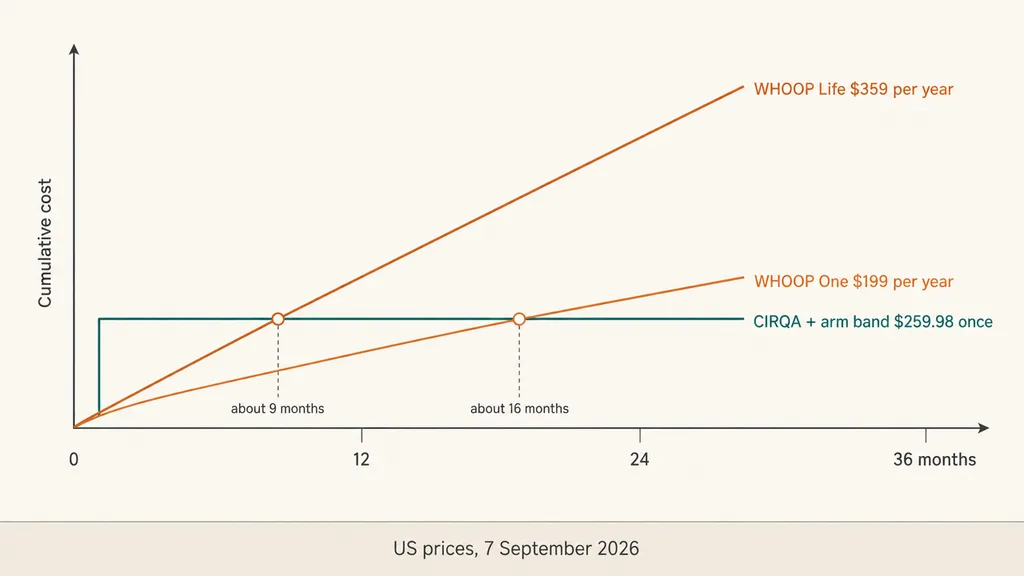
The comparison runners make is with WHOOP. CIRQA with the arm band is $259.98 once. Against WHOOP’s cheapest annual plan that breaks even in about 16 months, and against the most expensive in about nine. Over three years the mid-tier Peak plan comes to $717. That is arithmetic on prices seen on 7 September 2026, not a forecast.
On the same date, seven of eight colour and size options in Garmin’s US store showed an eight to twelve week wait.
So should a runner buy one?
Two honest notes. The launch has been rough: a month in, DC Rainmaker opened his bug section with “This is, by far, the buggiest launch of a Garmin product in years”, and on 23 August 2026 still had whole 30-minute rides going undetected. One owner in early September started a 5K with the button, pressed end, and found “IT DISCARDED MY RUN COMPLETELY, without any warning”.
Battery is the second: Garmin claims up to 10 days, but one reviewer averaged five to seven days across a month of use. Keep your phone with you too, because one reviewer who ran without phone GPS saw a 10.0 km run logged as 6.30 km.
One more telling detail: as of early September 2026 the advanced, trail and fitness running subreddits had no CIRQA thread at all, and the main running subreddit had one, its text since removed. The conversation lives in the Garmin subreddit, which is the accessory verdict in miniature.
Where that leaves you, by runner type:
- You own a Garmin watch and will wear it on your biceps. Buy it. Strap-grade heart rate for reps, sleep around the clock, and a watch that still owns your training data.
- You do not own a running watch. Buy the watch. No GPS, no screen and no manual laps without a subscription is too much for an only device.
- You are leaving WHOOP over the subscription. The arithmetic works, but budget $259.98 and expect a rougher few months.
- Your wrist measures under about 16.5 cm. One tester found the module overhangs at that size and lets light in at the sensor. Wear it on your arm.
- You swim. No. At the wrist in open water it read roughly 20 to 30 bpm below the reference devices.
If you buy one, do three things in week one. Set your watch as Primary Training Device and the band as Primary Wearable. Order the arm band for hard reps. And start any run that matters from your watch, not the band’s button.
Sources & References
- (2025). Wrist-Worn and Arm-Worn Wearables for Monitoring Heart Rate During Sedentary and Light-to-Vigorous Physical Activities: Device Validation Study. JMIR Cardio.
- (2020). Investigating sources of inaccuracy in wearable optical heart rate sensors. npj Digital Medicine.
- (2022). A Validation of Six Wearable Devices for Estimating Sleep, Heart Rate and Heart Rate Variability in Healthy Adults. Sensors.
- (2025). Validation of nocturnal resting heart rate and heart rate variability in consumer wearables. Physiological Reports.
- (2025). Readiness, recovery, and strain: an evaluation of composite health scores in consumer wearables. Translational Exercise Biomedicine.
- (2025). Impact of Anatomical Placement on the Accuracy of Wearable Heart Rate Monitors During Rest and Various Exercise Intensities. Sensors.
- (2025). A performance validation of six commercial wrist-worn wearable sleep-tracking devices for sleep stage scoring compared to polysomnography. Sleep Advances.