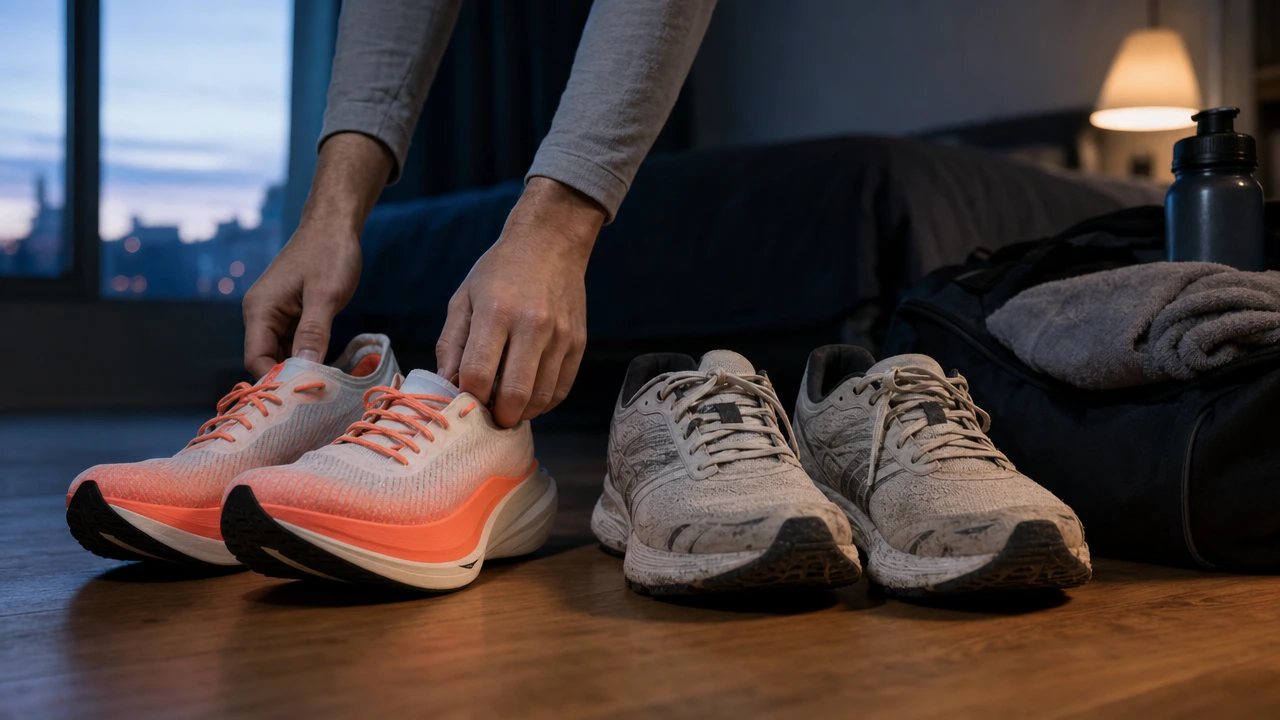
Race Day Shoes vs Daily Trainers: When to Wear Which
Your race shoes lose their edge before they wear out — 450 km crossover data shows why. Two mileage limits, a transition plan, and when to train in them.
Key Takeaways
- The advantage expires before the shoe does — after 450 km a PEBA racer's energy cost rose about 2.3%, matching an EVA shoe that had not measurably changed.
- Run two counters on one pair — total kilometres decide when it is finished; raced kilometres decide when it stops being a race shoe.
- Slow paces shrink the benefit, not erase it — the slowest tested speed, 9.4 km/h, still showed 3.9% lower oxygen consumption against an entry-level trainer.
- The group average is not your number — individual running economy responses in one study ran from -10.3% to +13.3%.
- Gradual transition is the only well-supported instruction — two independent papers recommend it, and neither specifies a distance.
You already know the race day shoe is faster. The expensive question is what to do with it the rest of the year: whether to train in it, how many kilometres it has before the advantage is gone, and whether the paces it hands you in workouts mean anything for your goal time. This guide is about allocation. For the evidence on how much the shoe itself is worth, see the carbon plate research.
The mileage habits and rotation patterns below are cross-checked against how runners discuss these shoes on r/AdvancedRunning and r/RunningShoeGeeks, and against peer-reviewed measurements of what wear does to the foam.
What Actually Separates the Two Shoes
Strip out the marketing and the difference comes down to what the midsole is made of, and what that midsole is being asked to survive.
| Dimension | Race day shoe | Daily trainer |
|---|---|---|
| US list price | $130-500 (30 models priced) | $120-200 (27 models priced) |
| Midsole | PEBA-class supercritical foam, usually with a carbon or nylon plate | EVA-class foam, usually unplated |
| What 450 km of wear does to that foam | PEBA: energy cost rose from 14.87 to 15.21 W/kg, about 2.3% | EVA: no significant change over the same distance |
| What it is for | The race, plus a small number of race-pace sessions | Everything else |
That third row is what the rest of this guide hangs on, and it is worth being precise about. Twenty-two trained men ran at 13 km/h in two advanced-footwear models that differed in midsole foam, each tested fresh and again after 450 km of wear. By 450 km the PEBA version and the EVA version had statistically similar running economy: the gap the buyer paid for had closed. Note what that does and does not establish — the researchers measured fresh and worn with nothing in between, so 450 km is the first point at which the advantage was gone, not a proven cliff edge you can schedule around.
When the Race Shoe Is Actually Worth Putting On
The famous number is 4%, and it arrives with four boundaries that almost always get dropped. Hoogkamer and colleagues tested 18 high-caliber athletes at 14, 16 and 18 km/h, which is 4:17 down to 3:20 per kilometre. The comparison was against two established marathon racing shoes, not daily trainers. Shoe mass was matched, so weight could not do the work. Inside those four conditions the prototype cut energy cost by 4.16% and 4.01%, and all 18 runners improved.
Change any condition and the number moves. The most relevant test for everyone else put 10 runners at 9.4 km/h, roughly 6:23 per kilometre, and measured oxygen consumption 3.9% lower in the super shoe, rising to 5.0% at 11.5 km/h, with a significant interaction between shoe and speed. At slow paces the benefit shrinks; it does not vanish. One caveat keeps that honest: the control there was an entry-level trainer rather than a racing flat, which is part of why the gap looks wider than Hoogkamer's. A separate study of 41 runners at 10 km/h measured 2-4%, with large differences between brands.
Then there is the number that never appears on a box. Across 18 runners, individual changes in running economy ranged from -10.3% to +13.3% — some people were measurably worse in the super shoe. In that same study, the difference between a Vaporfly and a conventional racing flat was not statistically significant.
Percentages of oxygen cost are not minutes, and the two get conflated in every argument about whether slower runners should bother. Put your goal time, shoe price and annual race count into the Carbon ROI Calculator and close the arithmetic instead of trading percentages.
One further result explains why race day feels different even when physiology does not change. Twenty-four female recreational runners ran in two pairs of the same Nike ZoomX Vaporfly Next% 2. One pair was described as the elite super shoe; the other was spray-painted black and called a knock-off.
Oxygen consumption and biomechanics showed no significant difference between them. Comfort did: the "super shoe" pair scored 14.6 mm higher on a 100 mm scale, and 87.5% of the runners preferred it. Belief is worth something on race day, just not the thing printed on the spec sheet.
Two Lifespans, Not One
Ask how long a super shoe lasts and the answers do not converge. The conventional figure in shoe forums sits around 100 miles, while the same threads carry reports of 266, 500 and even 800 miles on a single pair with no complaint. Both camps are describing something real, and the framework that reconciles them gives one pair two separate limits:
"I would race in Alphaflies to 100 miles, run in them to 250. Endorphin pros 1 and 2 and Adios Pro 3, I would race in to 150 and run in to 300."
What expires first is not the shoe, it is the advantage, which is exactly what the 450 km trial measured. A second study followed 33 runners in one model out to 700 km: pressure under the midfoot climbed from 387.8 to 590 kPa while every other zone held its pattern. The shoe was still working. It had stopped distributing load the way it did when new.
Turning that into practice takes three habits:
- Run two counters on one pair. Total kilometres decide when the shoe is finished; kilometres raced and run at race pace decide when it stops being a race shoe. Shoe Mileage tracks per-pair distance so the second number does not get lost inside the first.
- Treat 450 km as the outer edge of the racing window. It is the first measured point at which the advantage was gone, so it is a ceiling rather than a target, and it describes the PEBA-class foams used in most race day shoes rather than your trainers.
- Do not judge decay by feel. The spray-paint trial showed comfort ratings moving on belief alone. Foam fatigue is not something your feet report reliably.
One Pair, Three Jobs
The most useful thing runners do with the two-number model is turn it into a pipeline, where a pair gets demoted rather than discarded:
"when your existing race shoes hit 100-200 miles retire them to 'workout' duty and get a new pair of race shoes. Then you have a nice pair of shoes to use once a week or so on your quicker workouts. Which will give you a really good idea of how paces will feel on race day."
That last sentence quietly fixes a problem that comes up constantly: a runner gets a large pace jump from carbon shoes in a workout, then tries to reverse-engineer a marathon target out of it. The correction experienced runners give is that no single session is predictive, and that wind, rain and course profile usually moved that workout more than the shoe did. Project a goal from race results rather than shoe-assisted sessions with the Race Time Predictor, and let the demoted pair, not the fresh one, be what you run weekly workouts in, so the sensation you are calibrating against is the one you will actually have on race day. The Shoe Rotation Planner assigns which pair takes which session across a training block.
Breaking Them In Is About Your Legs, Not the Shoe
The most common physical complaint about plated racers is calves and soleus, and it usually comes with an adaptation story attached. As a cautionary account rather than an expected timeline, one runner's description is representative: "When I first used plated shoes, my lower legs would be in agony after a 5k. Now im going 30k+ regularly with no pain."
The laboratory measurements point the other way, which is worth sitting with rather than explaining away. In 19 recreational runners, cumulative tibial damage per kilometre was 12±9% lower in advanced footwear than in conventional shoes, with no significant difference in tibial bending moment during stance. In 15 runners, the same class of shoe reduced peak ankle joint reaction force by 1.84 body weights and peak soleus force by 1.10 body weights, without increasing demand on any joint. The one study that did measure higher loading used sprint spikes over a 30 m flying sprint, which is different footwear doing a different movement and does not transfer to a marathon.
Both of those studies measured load per stride in runners who were already adapted; neither followed anyone through their first weeks in an unfamiliar geometry. That gap is where the complaints live, and it points at the same instruction the injury literature gives.
The strongest actionable recommendation in this entire body of research is also the dullest: transition gradually. It arrives from two unrelated directions. A 2023 Sports Medicine Current Opinion paper, prompted by a case series of five navicular bone stress injuries in highly competitive runners, explicitly recommends a slow, gradual transition from habitual shoes into carbon plate footwear, while describing those injuries only as "possibly related" — a case series with no control group and no denominator, from which no risk rate can be derived. The sprint spike study reached the same recommendation from entirely separate data.
The Beginner Question, and the Gatekeeping That Comes With It
The standard advice — beginners should not race in carbon plates — was built on a price tag, and the price tag moved. Our shoe database holds 50 carbon-plated shoes across five of our six categories, from racers to trainers, 24 of them from Chinese brands. Eight of those carry US list prices between $130 and $320; the other 16 are priced only in CNY, at ¥399-2,299. Those are official prices. Separately, and not to be folded into the same figure, runners in English-language forums buy the same models through Taobao proxy services and report street prices of roughly $50-118 a pair before shipping.
At that level a plated racer stops being a graduation present, and threads now include people whose first ever running shoe was one. The lower price changes none of the biomechanics above: your individual response might be negative, and the transition still needs to be gradual. There is also a middle option the buying guides skip. A nylon plate delivers part of the effect with far less stiffness, and it is the standard recommendation experienced runners make to anyone who cannot tolerate a full carbon plate.
The other half of this question is not technical. Threads about who has earned a super shoe are common enough to have a stock joke: "Do you have to accomplish all 1000 before you get to be in the supershoe club?" There is no measured pace at which the benefit disappears — the slowest speed anyone has tested still produced one. The real limits are individual rather than social. To narrow the field by weight, pace and injury history, Shoe Match filters the database on those inputs; heavier runners carry an extra set of constraints covered in the guide for heavier runners, and the category-level framework sits in choosing running shoes.
Sources & References
- (2024). Influence of different midsole foam in advanced footwear technology use on running economy and biomechanics in trained runners. Scandinavian Journal of Medicine & Science in Sports.
- (2018). A Comparison of the Energetic Cost of Running in Marathon Racing Shoes. Sports Medicine.
- (2023). Recreational Runners Gain Physiological and Biomechanical Benefits From Super Shoes at Marathon Paces. International Journal of Sports Physiology and Performance.
- (2023). Bone Stress Injuries in Runners Using Carbon Fiber Plate Footwear. Sports Medicine.
- (2024). Technologically advanced running shoes reduce oxygen cost and cumulative tibial loading per kilometer in recreational female and male runners. Scientific Reports.
- (2025). Are super shoes a super placebo? A randomised crossover trial in female recreational runners. Footwear Science.