Running Pace Calculator — Min/km, Finish Time & Pace Chart
Free running pace calculator for 5K, 10K, half marathon, and marathon. Get min/km or min/mile, your ...
Use Calculator →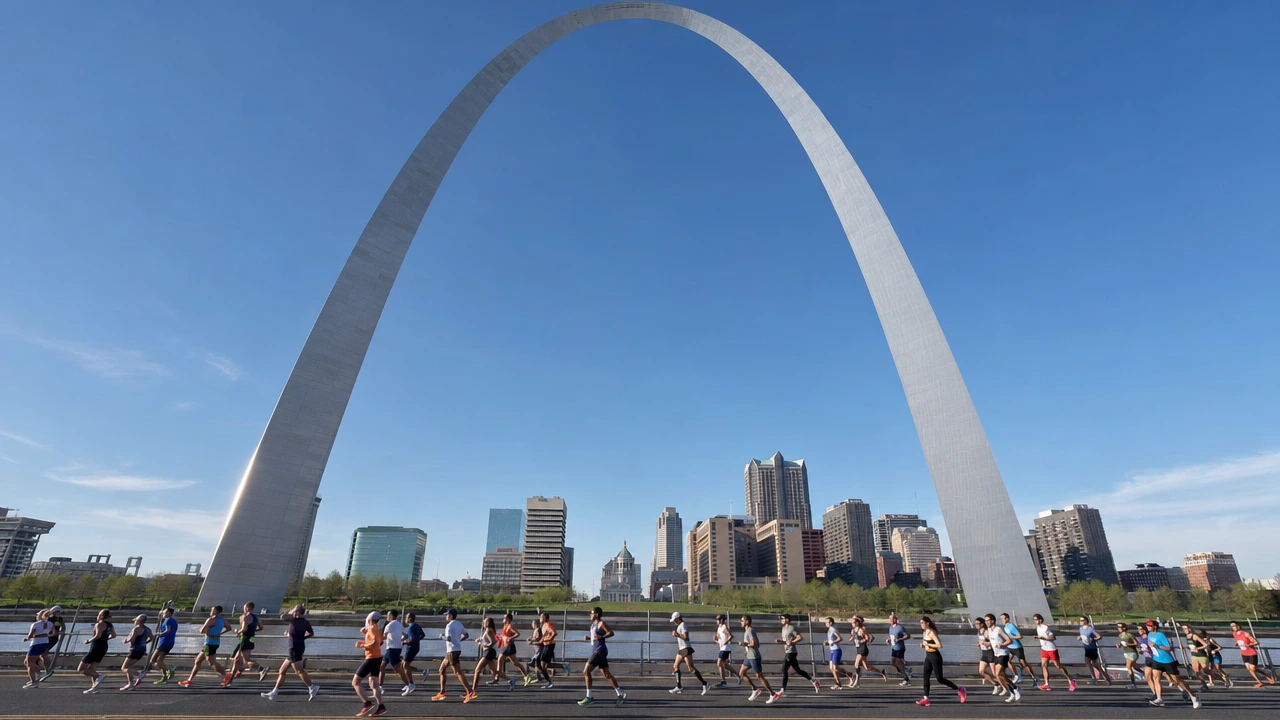
Want personality modes & weather integration? Try the full countdown experience
See entry dates for other marathons →
| Race | 2027 Greater St. Louis Marathon - Apr 3 |
|---|---|
| City | St. Louis |
| Date | 2027-04-03 at 07:00 |
| Field Size | ~1,409 runners |
| Time Limit | 6 hours 30 min |
| Cutoff pace | 9:15/km |
| Timezone | America/Chicago |
| Official Site | GO! St. Louis |
| Average Temperature | 12.3°C / 54°F |
|---|---|
| Humidity | 74% |
| Peak Wind | 23.2 km/h |
| Rain Chance | 34% |
| Typical Conditions | Cool, often-fresh early-April St. Louis morning — spring temperatures around 48 degrees F (9 degrees C) at the 7:00 a.m. start, warming through the morning |
What to Prepare: An April morning in St. Louis usually starts cool, around 48 degrees F (9 degrees C), and warms quickly once the sun is up — comfortable racing weather, but spring brings a real chance of rain or a gusty front off the Mississippi. Throwaway gloves and a long-sleeve you can shed early are smart, and check the forecast the week before for a rain layer.
Based on historical averages for race week. Use our Weather Score Calculator and What to Wear Guide for personalized advice.
Winds peaking around 23.2 km/h — the typical daily maximum for this date — can affect your pace by 5-15 seconds per kilometer in exposed stretches. Headwinds slow you down exponentially: a 20 km/h wind costs more than twice a 10 km/h wind.
Calculate your wind-adjusted pace →Based on 20 years of race-week weather (2005-2024), MERRA-2 reanalysis
| Cooler | Typical | Warmer | |
|---|---|---|---|
| Temperature | 5.1°C | 12.3°C | 19.2°C |
| Dew point | 0.3°C | 7.5°C | 16.1°C |
Data: NASA POWER (MERRA-2 reanalysis), NASA Langley Research Center
| Course Type | City tour |
|---|---|
| Elevation Gain | 300m |
| Terrain | Road (paved downtown and park streets, rolling hills) |
| Profile | A genuine city tour rather than a flat time-trial. The race starts on Market Street downtown and finishes a few blocks away on Chestnut Street, near the Gateway Arch. Its signature stretch comes early, when runners cross the Mississippi River into East St. Louis, Illinois and return over the city's historic bridges — so you briefly run in two states. From there the redesigned course threads recognizable St. Louis sights — the historic Soulard neighborhood, the Central West End, Tower Grove Park and the Missouri Botanical Garden — before reaching Forest Park, the 1,300-acre home of the 1904 World's Fair and Olympic Games, in the later miles. It is a rolling-hills course (about +300 m / 984 ft of gain, with nearly equal loss) on paved city streets, and the route has been reworked in recent years, so confirm the current course map. It is USATF-certified and a Boston qualifier, but the rolling terrain and a relatively small full-marathon field make it more of a scenic, history-rich race than a flat PR machine — plan for the undulations rather than expecting Berlin-flat splits. |
| Boston Qualifier | Yes — Check your BQ time |
Use our free training tools to get race-ready:
Free running pace calculator for 5K, 10K, half marathon, and marathon. Get min/km or min/mile, your ...
Use Calculator →Free printable pace band for marathon, half marathon, or custom distance. Choose even, negative, or ...
Use Calculator →7 AM race, wake at 3:45 AM? Enter the gun time; we work backward through meal, gear, bathroom, warm-...
Use Calculator →How much will hills slow you down? Enter elevation gain, loss, and distance to see adjusted pace, di...
Use Calculator →Convert uphill or downhill running pace to flat-equivalent GAP in one click. Free grade adjusted pac...
Use Calculator →Free marathon predictor — convert your 5K, 10K, or half marathon time into race-day estimates from R...
Use Calculator →The 2027 Greater St. Louis Marathon is Saturday, April 3, 2027, and the full marathon starts at 7:00 a.m. Central Time downtown. That is a full week earlier than the 2026 edition (April 11), so do not book flights or hotels off last year's weekend. Walkers and slower runners can take the optional 6:00 a.m. early start. Online registration runs until the evening of April 2, 2027, the day before the race.
It is a city tour that starts and finishes downtown near the Gateway Arch. A signature early stretch crosses the Mississippi River into East St. Louis, Illinois and returns over the city's historic bridges, before the course winds through the historic Soulard neighborhood, the Central West End, Tower Grove Park and the Missouri Botanical Garden out to Forest Park — home of the 1904 World's Fair and Olympics — in the later miles. The route has been reworked in recent years, so check the official course map for the current 2027 layout.
It is best described as rolling hills, not flat. The course has about +300 m (984 ft) of total climbing with nearly equal descent, so there is no single big hill but a steady series of undulations through the city and Forest Park. It is a scenic, history-rich course rather than a dead-flat PR track — run the early downhill sections sensibly and save energy for the rolling back half.
Yes. The course is USATF-certified and a Boston-qualifying race, so a qualifying time here counts toward Boston Marathon entry. Because it rolls rather than runs flat, it is a solid BQ attempt for runners who handle undulating terrain well, but it is not an aggressive net-downhill course. Check your target on the Boston qualifying calculator.
The full marathon has a 6.5-hour course time limit from the 7:00 a.m. start. Runners and walkers who expect to finish in roughly 6 to 7.5 hours can use the optional 6:00 a.m. early start, which effectively extends their time on course. That works out to about a 14:54 per mile (9:15 per km) pace to make the standard cutoff.
Registration is handled online through RunSignup via the GO! St. Louis race page; there is no lottery — entry is first-come, first-served until distances sell out (the half marathon has sold out in recent years). Prices rise as race day approaches, so registering early saves money. The marathon, half marathon, 10K, 5K and 1-mile family fun run are all part of the same weekend.
It is a mid-sized regional marathon. The full marathon drew about 1,400 finishers in 2026, while the full race weekend — marathon, half, 10K, 5K and fun run combined — brings around 10,000 participants downtown. Expect supportive crowds at the start, finish and through neighborhoods like Soulard, with quieter stretches on the out-and-back middle miles.
Yes — the race was long known as the GO! St. Louis Marathon and was rebranded the Greater St. Louis Marathon when the route was redesigned to span more of the region. It is still organized by the same nonprofit, GO! St. Louis, which has run St. Louis fitness events for over two decades. Older results and reviews under the GO! St. Louis name refer to the same event.

Memphis · 2026-12-05

Abingdon · 2026-10-18
Eastbourne · 2026-10-24
Blackpool · 2027-04-25

Dufftown · 2026-10-17

Llanelli · 2027-10-17