
Protein Calculator for Runners — Daily Intake in Grams

Protein Calculator for Runners

How much protein do runners need? Enter weight, weekly mileage and goal to get a daily gram target, a per-meal plan and food examples — research-backed.

How Much Protein Runners Actually Need

Most runners need 1.2–2.0 g of protein per kg of body weight per day — well above the 0.8 g/kg RDA, which was set for sedentary adults. Where you sit in that band depends on three things this calculator asks about: weekly volume, whether you are cutting calories, and age.

SituationDaily target68 kg runner
Under 30 km/week1.2–1.4 g/kg82–95 g
30–60 km/week1.4–1.6 g/kg95–109 g
60+ km or marathon build1.6–1.8 g/kg109–122 g
Add if losing weight+0.4 g/kg+27 g
Age 50+ (5-year steps)+0.05 to +0.2 g/kgup to +14 g

(The calculator rounds daily grams to the nearest 5, so its output can differ from this table by a few grams.)

The 1.2–2.0 band comes from the joint position stand of the American College of Sports Medicine, the Academy of Nutrition and Dietetics and Dietitians of Canada, which puts the protein needed for metabolic adaptation, repair and remodeling at 1.2–2.0 g/kg/d, with higher intakes indicated for short periods of intensified training or energy restriction. The upper tier is backed by direct measurement: using the indicator amino acid oxidation method, endurance athletes who ran 20 km needed an estimated average of 1.65 g/kg, with a recommended intake of 1.83 g/kg, on that training day (Kato et al. 2016) — the study was small (six athletes), but it measured requirements rather than estimating them from nitrogen balance.

Why 20–40 g Per Meal Beats One Big Dinner

Hitting 110 g with a giant dinner does not work like four spread-out doses. Muscle protein synthesis is maximally stimulated by about 20 g of quality protein after typical training (Moore et al. 2009), rising to ~40 g when far more muscle is worked at once — measured after whole-body resistance training (Macnaughton et al. 2016), a ceiling long-run days plausibly share, though that extrapolation has not been tested directly — beyond that, the surplus is increasingly oxidized rather than used for repair. When researchers gave athletes the same 80 g of protein in three patterns over 12 hours, 4 × 20 g every 3 hours beat both 2 × 40 g and 8 × 10 g for muscle protein synthesis (Areta et al. 2013).

What that means in practice:

  • Aim for ~0.3 g/kg per meal (about 20–30 g for most runners), 3–5 times a day, every 3–4 hours.
  • Breakfast is where most runners fall short — toast and coffee starts you at roughly 5 g. Eggs, Greek yogurt or milk fix it cheaply.
  • From age 50 the calculator steps your per-meal dose up in 5-year bands, from 0.30 toward ~0.40 g/kg at 65. This is advisory: dose-response data suggests older muscle needs a bigger per-meal dose (~0.40 vs 0.24 g/kg in ~71 vs ~22-year-olds, Moore et al. 2015), while trials in masters athletes specifically are still small and not conclusive.

The 30-Minute “Anabolic Window” Is Mostly a Myth

You do not need to chug a shake in the parking lot. A meta-analysis of protein-timing trials in resistance training — over 500 participants across 23 studies — found that once total daily protein was controlled for, consuming protein immediately around training had no significant effect on strength or muscle gain; the authors concluded the results “refute the commonly held belief that the timing of protein intake in and around a training session is critical” and that — for muscle gain — total daily intake is the strongest predictor (Schoenfeld et al. 2013).

For runners the practical rules are simpler than the supplement aisle suggests:

  • A normal meal within ~2 hours of finishing your run covers the protein side.
  • After long runs, carbohydrate comes first — glycogen refill is the endurance priority, with protein supporting muscle repair alongside it (ISSN position stand).
  • The “post-run” slot in this calculator exists because it is a convenient, appetite-friendly moment to bank 20–40 g — not because the window slams shut.

What 20–30 g of Protein Looks Like
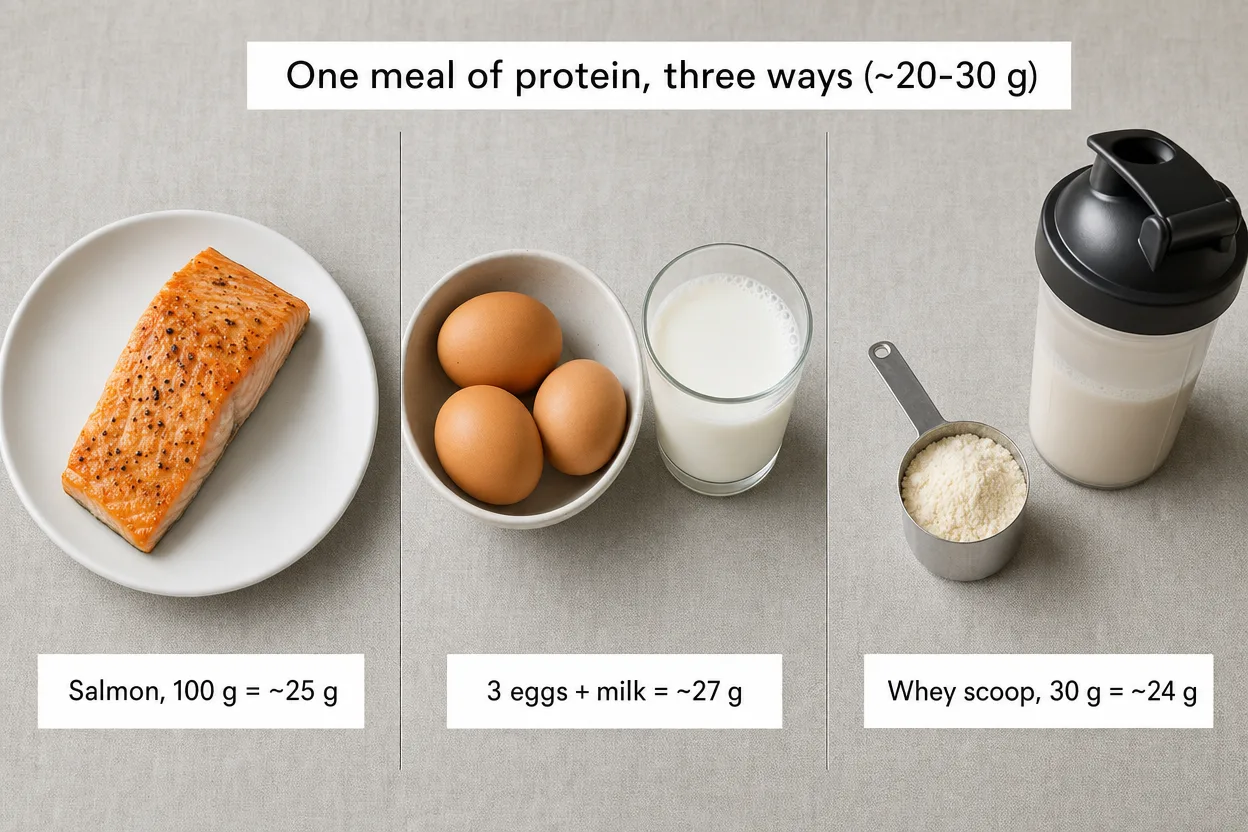
Three ways to eat one meal-sized dose of protein: a 100 g salmon fillet (~25 g), three eggs with a glass of milk (~27 g), and a 30 g whey scoop next to a shaker (~24 g).

Daily targets only matter if you can see them on a plate. Typical values from USDA FoodData Central (cooked weight where relevant):

FoodProtein
Chicken breast, 100 g cooked~31 g
Salmon, 100 g cooked~25 g
Whey protein, 1 scoop (30 g)~24 g
3 large eggs~19 g
Lentils, 1 cup cooked~18 g
Greek yogurt, 170 g tub~17 g
Milk, 250 ml~8 g

A 100 g target is therefore very reachable from food alone: eggs and yogurt at breakfast, a chicken or lentil lunch, a normal dinner and one snack gets you there. Plant-based runners hit the same g/kg numbers with legumes, tofu, tempeh and grains — variety across the day covers the amino acid profile. Track it against your calorie budget with the running calorie calculator if you are managing weight at the same time.

Frequently Asked Questions

How much protein do runners need per day?

Between 1.2 and 2.0 grams per kilogram of body weight per day, depending on training volume, goal and age — for a 68 kg (150 lb) runner that is roughly 82–136 g. The ACSM/AND/Dietitians of Canada position stand sets this band for athletes, and direct amino-acid tracer measurements place hard training days near the top of it. Runners logging under 30 km a week do fine at 1.2–1.4 g/kg; marathon-build mileage pushes the target to 1.6–1.8 g/kg.

Is the 0.8 g/kg RDA enough for runners?

No — the RDA of 0.8 g/kg was set to prevent deficiency in sedentary adults, not to support training adaptation. When researchers measured endurance athletes directly with the indicator amino acid oxidation method, requirements on a 20 km training day came out at 1.65–1.83 g/kg — about twice the RDA (Kato et al. 2016). Running breaks down muscle protein; repairing and adapting takes more raw material than sitting at a desk.

Do runners need protein powder?

No — protein powder is a convenience, not a requirement. If your meals already hit your daily target from foods like chicken, fish, eggs, dairy or legumes, powder adds nothing. It earns its place when you struggle to reach your number: a 30 g scoop of whey delivers ~24 g of protein with minimal calories and no cooking, which is practical right after a long run when appetite is low.

How much protein should I eat after a run?

Aim for 20–40 g (about 0.3 g per kg of body weight) in the meal or snack after your run — 20 g is enough to maximally stimulate muscle protein synthesis after typical sessions, while ~40 g works better after long or very hard efforts. Pair it with carbohydrate: for endurance recovery, refilling glycogen is the first priority and protein supports muscle repair alongside it. A normal meal within a couple of hours does the job.

Should I eat more protein while losing weight as a runner?

Yes — this is when protein matters most. Research on athletes in a calorie deficit recommends 1.6–2.4 g/kg per day, the higher end for bigger deficits, because extra protein protects muscle while fat is lost (Hector & Phillips 2018). This calculator adds 0.4 g/kg to your base range when you select the weight-loss goal. Cutting calories without raising protein is how runners lose muscle along with fat.

Can a high-protein diet damage your kidneys?

Not in healthy people — a meta-analysis of 28 randomized trials covering 1,358 adults found that higher-protein diets (≥1.5 g/kg) did not adversely affect kidney function compared with lower intakes (Devries et al. 2018). The kidney myth traces back to patients with pre-existing kidney disease, where protein restriction is a medical treatment. If you have a kidney condition, follow your doctor's guidance rather than any calculator.

Do older runners need more protein?

Probably — this calculator steps the target up from age 50 in 5-year bands, topping out at 65+. Boston qualifying times start adjusting at 35, but the protein evidence works differently: dose-response data has measured anchors only at the two ends — young men plateaued at ~0.24 g per kg per meal, ~71-year-olds at ~0.40 (Moore et al. 2015) — and no study shows requirements rising before 50. So the calculator stays flat until 49, then climbs +0.05 g/kg per band to +0.2 g/kg per day at 65+. Trials in masters athletes specifically remain small, so treat every band as a safe-direction nudge, not a hard rule.

References 10 peer-reviewed sources
  1. Thomas, D.T., Erdman, K.A., & Burke, L.M. (2016). Position of the Academy of Nutrition and Dietetics, Dietitians of Canada, and the American College of Sports Medicine: Nutrition and Athletic Performance. Journal of the Academy of Nutrition and Dietetics. doi:10.1016/j.jand.2015.12.006
  2. Jäger, R., Kerksick, C.M., Campbell, B.I., et al. (2017). International Society of Sports Nutrition Position Stand: protein and exercise. Journal of the International Society of Sports Nutrition. doi:10.1186/s12970-017-0177-8
  3. Kato, H., Suzuki, K., Bannai, M., & Moore, D.R. (2016). Protein Requirements Are Elevated in Endurance Athletes after Exercise as Determined by the Indicator Amino Acid Oxidation Method. PLoS ONE. doi:10.1371/journal.pone.0157406
  4. Hector, A.J., & Phillips, S.M. (2018). Protein Recommendations for Weight Loss in Elite Athletes: A Focus on Body Composition and Performance. International Journal of Sport Nutrition and Exercise Metabolism. doi:10.1123/ijsnem.2017-0273
  5. Moore, D.R., Churchward-Venne, T.A., Witard, O., et al. (2015). Protein ingestion to stimulate myofibrillar protein synthesis requires greater relative protein intakes in healthy older versus younger men. The Journals of Gerontology: Series A. doi:10.1093/gerona/glu103
  6. Moore, D.R., Robinson, M.J., Fry, J.L., et al. (2009). Ingested protein dose response of muscle and albumin protein synthesis after resistance exercise in young men. The American Journal of Clinical Nutrition. doi:10.3945/ajcn.2008.26401
  7. Macnaughton, L.S., Wardle, S.L., Witard, O.C., et al. (2016). The response of muscle protein synthesis following whole-body resistance exercise is greater following 40 g than 20 g of ingested whey protein. Physiological Reports. doi:10.14814/phy2.12893
  8. Areta, J.L., Burke, L.M., Ross, M.L., et al. (2013). Timing and distribution of protein ingestion during prolonged recovery from resistance exercise alters myofibrillar protein synthesis. The Journal of Physiology. doi:10.1113/jphysiol.2012.244897
  9. Schoenfeld, B.J., Aragon, A.A., & Krieger, J.W. (2013). The effect of protein timing on muscle strength and hypertrophy: a meta-analysis. Journal of the International Society of Sports Nutrition. doi:10.1186/1550-2783-10-53
  10. Devries, M.C., Sithamparapillai, A., Brimble, K.S., et al. (2018). Changes in Kidney Function Do Not Differ between Healthy Adults Consuming Higher- Compared with Lower- or Normal-Protein Diets: A Systematic Review and Meta-Analysis. The Journal of Nutrition. doi:10.1093/jn/nxy197