Creatine for Runners: Is the Weight Gain Worth It?
Creatine's measured wins are efforts under 3 minutes; the cost is about 1 kg — an estimated 2.4 min on a 4-hour marathon. Who it suits, and how to test it.
Key Takeaways
- The measured wins sit under three minutes — repeated sprints and end spurts. A 60-study meta-analysis wrote that time limit into the finding itself.
- One kilogram costs an estimated 2.4 minutes over a 4-hour marathon — built from load-carriage research, because nobody has measured creatine against a clock.
- Phosphocreatine up about 20%, VO2max unchanged — in trained decathletes the muscle changed measurably and the aerobic engine did not follow it.
- 3 g a day for 28 days reaches the same place as 20 g for six — loading only buys three weeks. Stop, and muscle stores fall back to baseline in about 30 days.
- A high creatinine reading is not kidney damage — it rises about 0.13 mg/dL while GFR stays put. Tell whoever reads your blood test that you take creatine.
Creatine is one of the best-evidenced supplements in sport, and almost none of that evidence is about running for an hour or more. The gains show up in efforts under three minutes, repeated sprints, and the surge at the end. The cost is about a kilogram you carry through every stride. That trade is the whole decision, and it lands differently on a 5K runner with a kick than on someone chasing a marathon time.
What creatine is actually good at
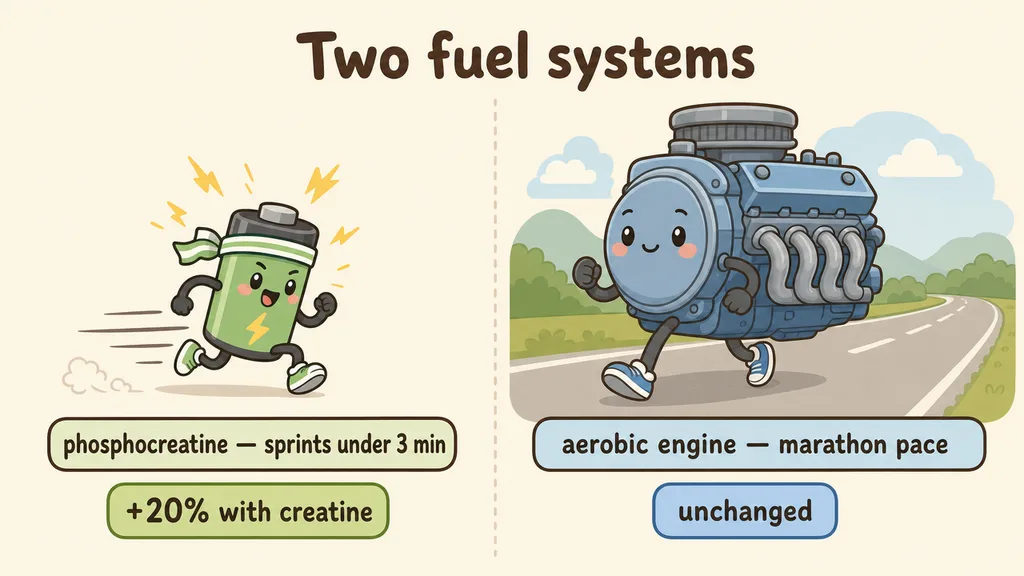
Creatine fills your muscles with phosphocreatine, the fuel you reach for first in the opening seconds of hard work — more of it means more hard efforts before quality drops. The trials find that, and only that:
- Efforts under three minutes. A meta-analysis of 60 studies found creatine effective for lower-limb strength performance in exercise lasting less than three minutes — the authors wrote that limit into the finding.
- Repeated sprints, not steady running. In a 17-athlete trial, creatine favourably affected repeated sprint performance while intermittent endurance performance was not affected — and inside the sprints, narrower still.
- The reps after the rest. A nine-person trial raised muscle phosphocreatine 4-6% and dynamic torque 10-23%, the gain largest right after the two-minute rest between bouts — the third and fourth reps of an interval session, not the first.
- Races decided by surges. A 2023 review finds creatine "appears to be more effective at improving performances that require multiple surges in intensity and/or during end spurts". Time-trial results, in the same review, are mixed.
Evidence detail: how narrow the sprint effect actually was
In that trial — 17 highly trained soccer players — the gain showed up over the first five metres — 0.95 seconds after supplementing against 0.97 before — while the difference over fifteen metres did not reach statistical significance. The authors report both halves plainly: repeated sprint performance was favourably affected, intermittent endurance performance was not.
On this page
- What creatine is actually good at
- The kilogram you carry to the finish
- Your muscles change. Your aerobic engine does not.
- How much weight, how fast, and whether it leaves
- The verdict, by what you actually race
- How to take it, if you decide yes
- The two safety questions runners actually ask
- A four-to-six-week test that answers it for you
The kilogram you carry to the finish
Every kilogram you add is a kilogram your legs lift, thousands of times, to the line. Nobody has ever measured what creatine’s water weight does to a running clock — so here is the arithmetic instead, with the source of every step named.
| Step | Number | What it rests on |
|---|---|---|
| Creatine adds roughly 1 kg | +1.4% of body mass | Loading trials in men, plus arithmetic |
| Carrying it costs energy | about +1.4% metabolic cost | Load-carriage study: metabolic rate rose slightly more than in direct proportion to the load |
| Energy cost converts into time | about 1% slower | Shoe-mass research: 1.11% in metabolic rate against 0.78% over 3,000 m — a ratio near 0.7 |
| 1% of your finishing time | +2.4 min on a 4:00 marathon; +1.8 min on a 3:00 | Arithmetic |
Evidence detail: why the shoe research supplies only the final conversion step
Shoe figures describe weight on your feet, which costs far more per gram than weight carried on your torso — comparing the two sets of published numbers points to something near fourfold. So the shoe study is borrowed here only for the ratio between an economy penalty and a time penalty, never for the size of the penalty itself.
The shoe study measured 100 g more per shoe costing 1.11% in metabolic rate and 0.78% over 3,000 m; the load-carriage study used ten recreational runners at 3 m/s.
The size comes from the load-carriage study instead, whose added-load condition is the closer match to mass sitting inside your muscles. That still leaves the chain resting on two extrapolations stacked on each other, which is why the output is an order of magnitude rather than a figure to plan around.
Your muscles change. Your aerobic engine does not.
The sharpest picture of that split comes from a double-blind trial in trained male decathletes. Eight weeks of creatine measurably changed the muscle — phosphocreatine in the quadriceps up about 20% — while treadmill VO2max did not move at all. The authors’ own summary: long-term creatine supplementation "does not enhance general or local aerobic capacity".
Read that as two findings rather than one verdict: the muscle genuinely changed, and the aerobic side did not follow.
Evidence detail: what the decathlete trial rests on, including its conflict of interest
Ten athletes, split five and five between creatine and placebo, double-blind. The protocol was six days of loading at 20 g/day, then 4 g/day for the remaining seven weeks. The supplement was supplied by its manufacturer, whom the authors thank in the paper.
Alongside the phosphocreatine rise, thigh cross-sectional area grew 6.5%. On the aerobic side nothing moved: not treadmill VO2max, not blood lactate five minutes after exercise, and not the rate at which phosphocreatine was rebuilt afterwards.
The subjects were university decathletes averaging 59 mL/kg/min — trained multi-event athletes, not recreational runners — and they trained with intervals. The researchers note in their own discussion that what happens under longer continuous training, marathon-style, is unknown. Published in Descente Sports Science, Vol. 20.
The pooled picture agrees. Across 19 randomised trials with 424 participants, VO2max improved in both groups — but less with creatine (a small pooled effect of -0.32). The authors put it harder than their numbers do, concluding creatine has "a negative effect on VO2max"; what they measured was a smaller improvement, not a decline.
One plausible reason is arithmetic rather than physiology: VO2max is scored per kilogram of body weight, so a heavier runner rates lower on an unchanged engine. If the lever you want is aerobic, the evidence sits elsewhere — see the beetroot juice guide.
Evidence detail: the weighted-load corroboration, and what the meta-analysis leaves unsaid
In a separate experiment, adding 5% of body weight lowered VO2max expressed per kilogram of total weight, but did not systematically change it in litres per minute or per kilogram of fat-free weight. That is the denominator effect on its own, with no creatine involved.
The meta-analysis does not report which way its own studies expressed VO2max, so the two findings cannot be joined into a demonstrated cause. The arithmetic stays a plausible explanation for part of the gap, not a proven one.
How much weight, how fast, and whether it leaves
Loading puts it on inside a week: in a trial of 12 men taking 21.6 g a day, body mass was up 0.88 kg by day seven. Call it about a kilogram in men — and distrust any confident decimal, because how much you appear to gain depends on the machine measuring it.

Women look different, at least across a loading week: in a randomised trial of 30 women, half of them taking 20 g a day for five days, there were no observed alterations in body weight, and fluid increases turned up only during the luteal phase.
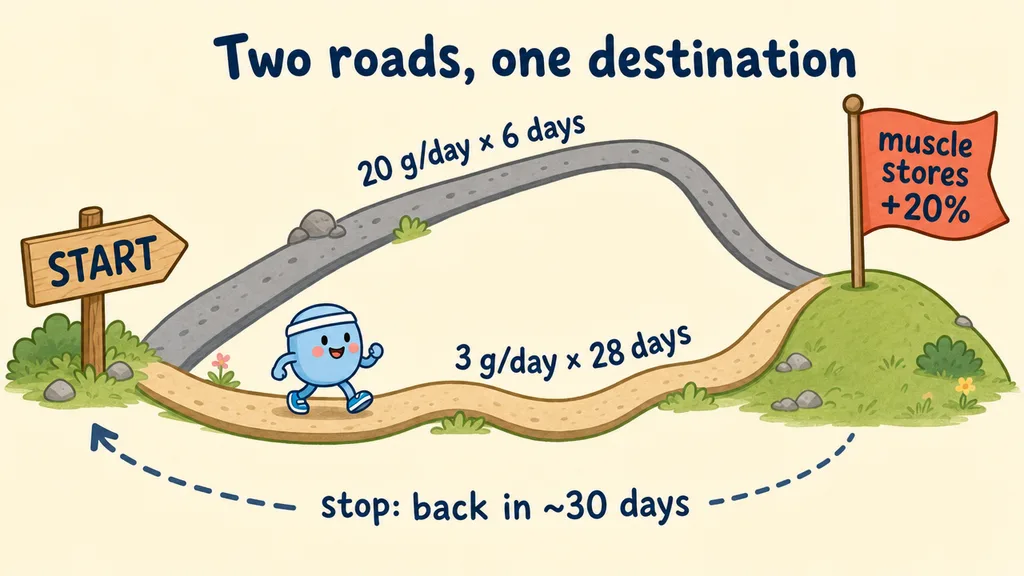
The slow route reaches the same place. Three grams a day for 28 days produced the same roughly 20% rise in muscle creatine as 20 g a day for six. Nobody has compared how the weight arrives on the two, so "more gradual" is an inference from the slower filling rate, not a measured result. The exit is measured: stop, and stores return to baseline in about 30 days.
Runners who describe a genuinely rough adjustment put it in the first two to six weeks, and say it settles after that.
Evidence detail: why these body-composition numbers are slippery — three devices, and a body-fat reading that also rose
One trial gave 0.3 g per kilogram for a week to 13 men and 14 women, and measured fat-free mass up by 1.2, 1.9 and 1.1 kg. Those are three readings of the same people by three different devices, not three time points, and they cannot be averaged into one number. Total body water rose 2%.
In the decathlete trial, body-fat percentage went from 9.5% to 10.6% — a rise of 1.1 points, statistically significant. It was measured by bioimpedance, a method that reads body water and is therefore sensitive to exactly the kind of shift creatine causes.
That is not enough to dismiss it as a measurement artefact, because imaging in the same study moved the same way: MRI thigh fat area rose from 48.6 to 54.3 cm², though that change did not reach significance, while the placebo group’s fat area fell. The honest reading is that the bioimpedance rise is real as a reading and the imaging shows a trend, not a confirmed gain in fat.
The verdict, by what you actually race
| If this is you | The case | What to do about it |
|---|---|---|
| Half or full marathon, chasing a time, no lifting | Weakest — every measured win sits outside your race. | If you want to be off it on race day, plan a month, not a taper week. |
| 5K, track, cross-country, or any race made of repeated surges — hills, obstacles, hybrid formats | Strongest running case: under three minutes is where the evidence lives. | Worth a trial block, run as the test below. |
| You also lift, or you are over 50 | Strongest overall, on one condition: 22 trials (average age 57-70) added 1.37 kg of lean tissue, every one alongside resistance training 2-3 times a week. | Lift, or the evidence does not apply to you. Get protein sorted first with the protein calculator. |
| Vegetarian or vegan | Most likely to notice it: vegetarians start about 10% lower (117 against 130 mmol/kg dry mass) and respond more. | Same 3-5 g a day; expect a clearer signal from the test. |
| A woman | Thinner evidence, hedged by the researchers — in pre-menopausal women creatine "appears to be effective" for strength and performance. After menopause, a 2026 review of seven trials found 0.37 kg more lean mass and 7.5 kg more on leg-press 1RM, but only at 5 g a day or more with resistance training. | At 3 g a day or less without lifting, that review found no measurable effect. Bone density was unchanged overall, an effect the authors still call unclear. |
How to take it, if you decide yes
- 3-5 g a day of creatine monohydrate, every day. The maintenance range in the sports-nutrition position stands, and the dose that reached full saturation in 28 days.
- Timing barely matters; consistency does. This is a saturation effect, not a pre-workout: taking it before a session and expecting something that day misreads how it works.
- Skip loading unless you need the effect this week. It compresses the same endpoint into six days and hands you the fastest version of the weight gain.
- If you carb-load, you are already stacking them. Creatine raised muscle glycogen about 16% in a trial where the same people carb-loaded twice. Both trials measured stored glycogen, not finishing times. The carb loading calculator handles the part of race week that moves your time most.
- Know the caffeine footnote. One nine-person trial — which used 0.5 g per kilogram a day, roughly ten times the dose on this page — saw the benefit "completely eliminated by caffeine intake", but later reviews call that evidence scarce. Something to know about, not a reason to give up coffee.
- Do not hire it for recovery. The evidence is genuinely mixed — two meta-analyses point opposite ways, and nobody has tested downhill running. If recovery is the job, the tart cherry juice guide covers better-matched evidence.
Evidence detail: the two glycogen trials, and the two recovery meta-analyses that disagree
In the first, the same participants completed a standard glycogen-loading protocol twice — once without creatine, once with. Muscle glycogen finished at 694 mmol/kg dry mass with creatine against 597 without. The two rounds were always run in that order, never reversed and never randomised, so a training or order effect cannot be excluded from the difference.
A second trial, on 20 g/day, found glycogen noticeably above placebo after a single day of supplementation and sustained thereafter, including through the first 24 hours of post-exercise recovery. The two papers disagree about why: the first proposed that cell swelling drives it, and the second concludes outright that another mechanism must be causative. Treat the observation as real and the explanation as open.
On caffeine: that nine-person trial ran creatine at 0.5 g per kilogram a day, roughly ten times the dose recommended here, alongside caffeine at 5 mg per kilogram. Later reviews describe the evidence as scarce and consider a pharmacokinetic interaction unlikely, so the mechanism remains unclear.
On recovery, the 13-study meta-analysis found no change in muscle strength, soreness, range of motion or inflammation at any of its five follow-up points after muscle-damaging exercise; creatine kinase alone was lower at 48 hours. The 23-study review is the one describing the acute-versus-chronic reversal. Neither looked at downhill running, so nothing here is running-specific.
The two safety questions runners actually ask
Your creatinine came back high
Creatine breaks down into creatinine, the marker a blood test uses to estimate kidney function — so supplementing nudges the reading without touching the organ. Two meta-analyses agree: serum creatinine rises about 0.13 mg/dL while GFR and urea show no difference — in the authors’ words likely due to metabolic turnover rather than renal impairment. Long-term users, from ten months to five years, showed no detrimental kidney effects.
Evidence detail: what the long-term creatine trials do and do not cover
The gap is specifically about kidney endpoints, not about long trials as such. One randomised 1,741 people with early Parkinson disease to placebo or 10 g of creatine a day, designed to run for a minimum of five years, and found no detectable differences in adverse and serious adverse events by body system.
Three limits stop that being a clean bill of health for a runner. The participants were Parkinson patients already receiving dopaminergic therapy, not healthy athletes. The safety endpoint was adverse events grouped by body system, not kidney biochemistry. And the trial was terminated early for futility, so median follow-up came to four years rather than the five-plus it was designed for.
Heat, cramp, and a benefit that was invented
A systematic review of ten studies found no evidence that creatine hinders the body’s ability to dissipate heat or negatively affects fluid balance at recommended dosages. That is a clean "no added risk" — not the same claim as the one pointing the other way.
The idea that the extra water helps you regulate temperature or prevents cramp has no research behind it. One widely shared version was traced back through its own citations by another runner: the papers it named showed no effect, or had combined creatine with other compounds. It was an AI chatbot’s invention. Build your hot-weather plan the ordinary way, with the hydration calculator.
Evidence detail: the heat trial behind that conclusion
Trained men were dehydrated by 2% and then exercised for 80 minutes at 33.5°C. Creatine did not increase the incidence of symptoms and did not compromise hydration status or thermoregulation in them. One limit travels with the review’s conclusion and is worth keeping attached to it: no adverse effects were found at recommended dosages, which is the range this page describes and not the range some people take.
A four-to-six-week test that answers it for you
Response is not uniform. In an 11-person study, three responded strongly, five partially and three barely at all — the strong responders being those who started with the least creatine in their muscles and the highest proportion of fast-twitch fibres. You cannot know your own baseline without a muscle biopsy, so run the test instead.
- Pick a base block, not a race build. The weight cost above lands on race day, the worst possible place to experiment.
- 3-5 g a day for four to six weeks, same time daily, no loading.
- Keep one repeatable hard session in the block — same intervals, same route, same conditions as far as you can. That session is your instrument.
- Track three weekly: morning weight as a seven-day average (single days are noise), session quality, gut comfort.
- Then stop, and keep watching for a month. Stores fall back to baseline in about 30 days, which turns stopping into a real control rather than a guess.
For calibration rather than expectation, one woman’s account in a women’s running community, from the far end of the distribution: about a 10 lb gain on the recommended 5 g dose, roughly 7 lb of it kept, with stomach pain and low-grade headaches. Far from typical — the men’s loading trials put it near a kilogram, and the one trial that loaded women recorded no measurable change. A test you can stop is why her outcome need not become yours.
Sources & References
- (2023). Creatine supplementation and VO2max: a systematic review and meta-analysis. Critical Reviews in Food Science and Nutrition.
- (2023). Creatine supplementation and endurance performance: surges and sprints to win the race. Journal of the International Society of Sports Nutrition.
- (2015). Creatine Supplementation and Lower Limb Strength Performance: A Systematic Review and Meta-Analyses. Sports Medicine.
- (1996). Muscle creatine loading in men. Journal of Applied Physiology.
- (2026). The effect of creatine supplementation on kidney function: a systematic review and meta-analysis of randomized controlled trials. Journal of Renal Nutrition.