Marathon Leg Cramps: What to Do When They Return
Stop running and gently stretch a cramping muscle. Find calf and thigh stretches, what to do when cramps return, and signs to seek medical help.
Key Takeaways
- Stop the activity that triggered the cramp. Move out of the runners’ path and gently stretch the affected muscle.
- Relief is not clearance to race. Severe, repeated or persistent cramps need medical attention.
- A cramp does not diagnose a salt shortage. Review your race and training rather than automatically taking extra supplements.
If your leg is cramping now
A sudden, painful tightening that will not relax can be a muscle cramp. The muscle may feel hard or visibly twitch. Persistent sharp pain, especially after a sudden injury, needs assessment rather than an assumption that it is “just cramp”.
- Stop running. Move safely out of the flow of runners. Ask a marshal for help if you cannot move safely.
- Gently lengthen the affected muscle. Choose the position below. Hold comfortably while the spasm eases; do not bounce, force the joint or ask someone to push hard.
- Reassess before doing anything else. If pain is severe, keeps returning or does not respond, ask the race medical team to assess you.
These actions follow AAOS guidance on muscle cramps. They are first-aid information, not a diagnosis or a return-to-running test.
Match the stretch to the muscle
Use a stable support and a safe place away from the course. Stop if the stretch increases pain. If you are unsure which tissue hurts, cannot get into the position comfortably or suspect an injury, get help instead of pulling harder.
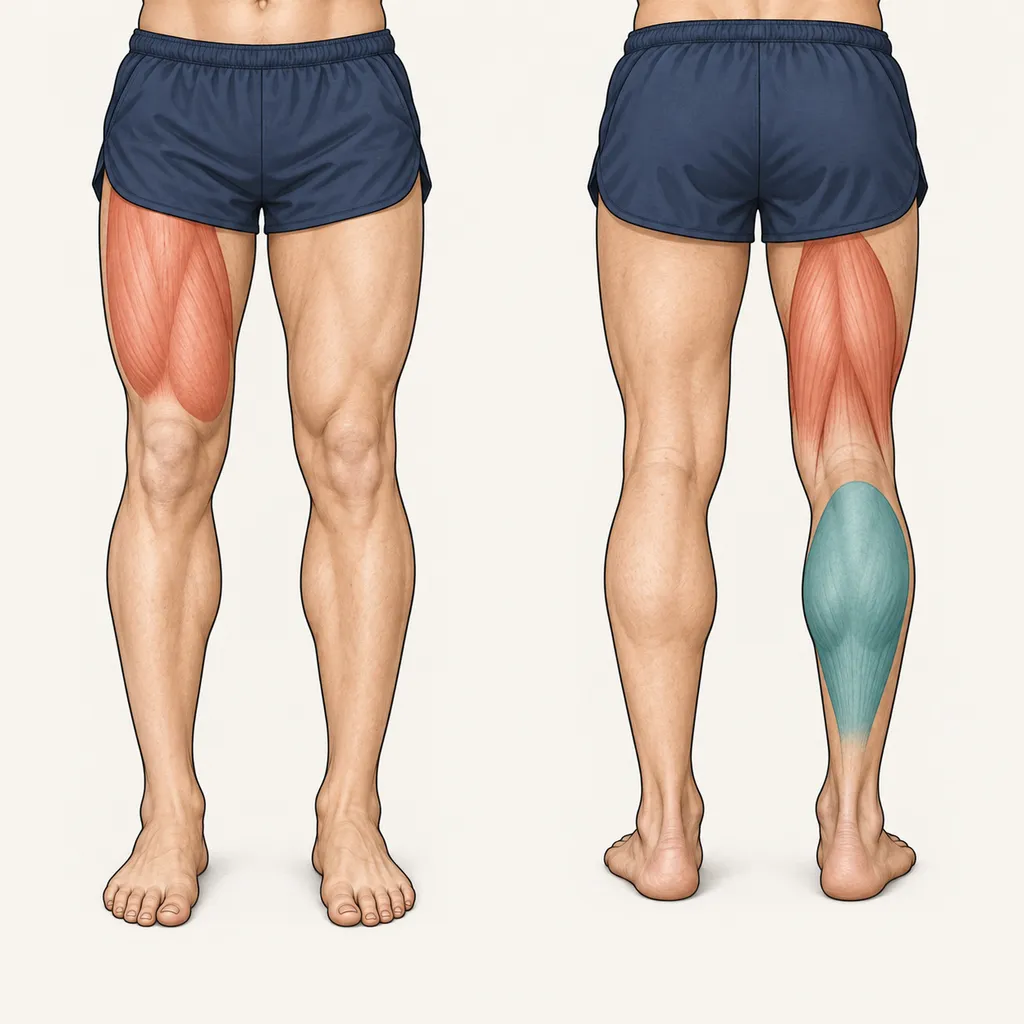
Calf: keep the rear heel down
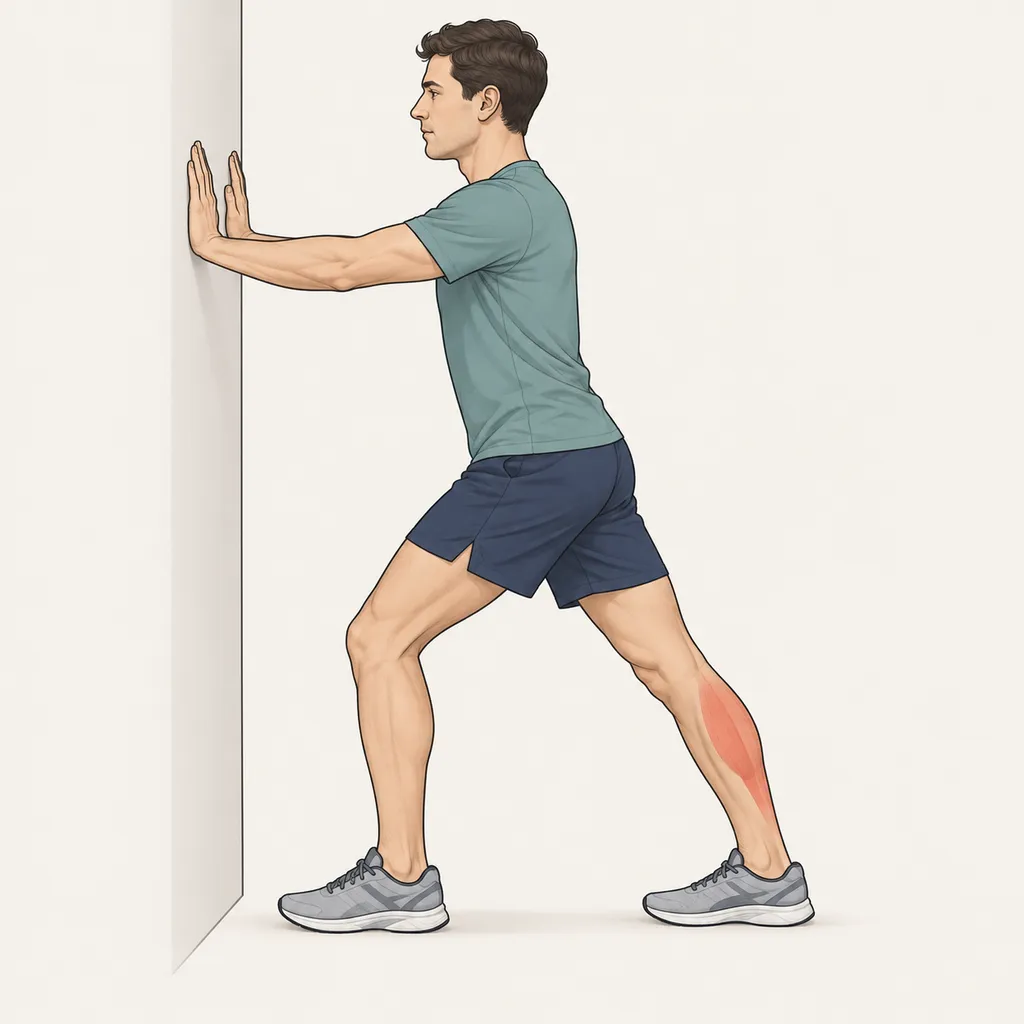
Face a wall, hands supported, with the affected leg behind you. Bend the front knee while keeping the rear leg straight and its heel on the ground. Lean forward gently until you feel a comfortable pull in the rear calf.
Hamstrings: hinge gently from the hips
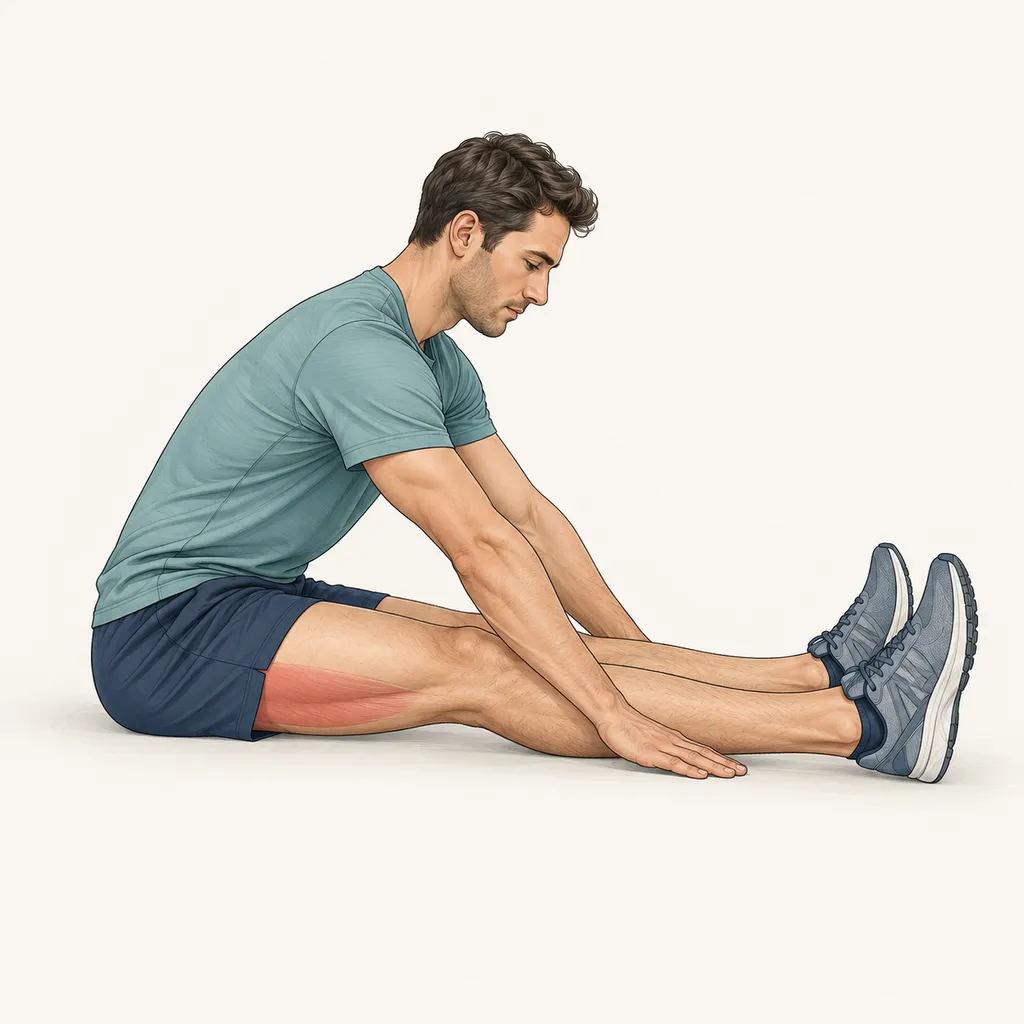
Sit with your legs extended and knees relaxed, not locked. Keeping your back long, lean a little forward from your hips and slide your hands along the ground. Stop when you feel the pull behind the thigh; reaching your toes is not the goal.
Quadriceps: hold a support for balance
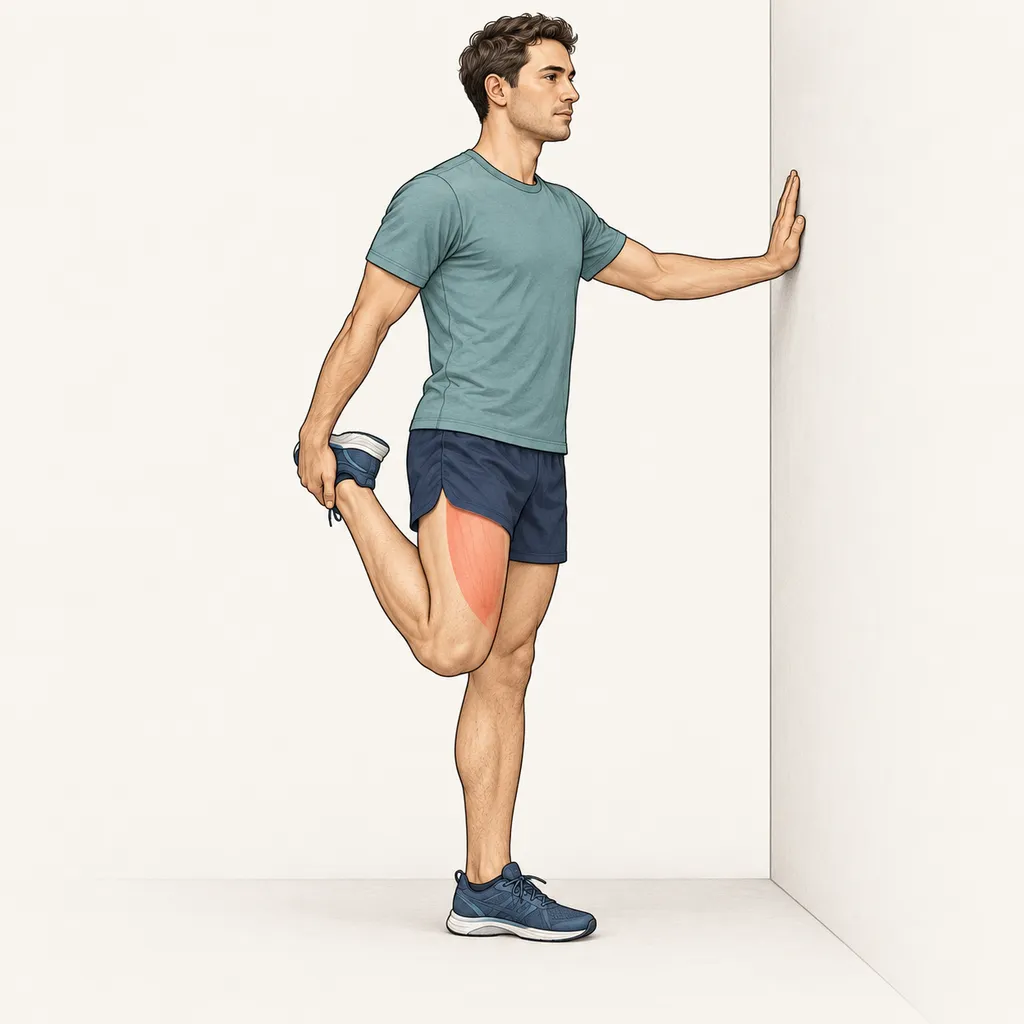
Stand beside a stable support. Bend the affected knee and gently bring that heel toward your buttock, holding the ankle. Keep the knees near each other and your trunk upright. Do not arch your back or pull into pain.
These are original illustrations of positions described by AAOS. The pictures do not show how much force to apply: use a gentle stretch, never a stronger pull to match a drawing.
It eased, then cramped again
Treat the new spasm as a reason to stop again, not as a signal to push through before it gets worse. Stretching can relieve the contraction without establishing that your leg can tolerate racing again. There is no return-to-racing clearance test in this guide.
- Still painful, limping or unable to move normally: stop trying to run and request medical assessment.
- Repeated or severe spasms: tell the medical team which muscles are affected and what happened after each restart.
- Symptoms have settled: do not use the remaining distance, your time goal or someone else’s finishing story as proof that restarting is safe.
When medical help takes priority
Severe, frequent or poorly responding cramps warrant medical attention. Tell a marshal immediately if you collapse or become confused; do not attempt to self-treat that situation with stretching.
After the race, unusually severe muscle pain, marked weakness or tea- or cola-coloured urine need immediate medical care. CDC guidance notes that serious muscle-breakdown symptoms can be delayed. You cannot rule it out simply because your urine looks normal.
Why electrolytes are not the whole answer
Taking gels and drinking does not guarantee a cramp-free race. Nor does cramping prove you were short of sodium. A review of exercise-associated cramps describes multiple contributing factors and recommends an individual history rather than a universal “drink more” solution.
The 2026 review of risk factors found the clearest association with previous cramps. Evidence for many hydration and training variables was limited or inconsistent. It examined risk factors, not whether a particular prevention programme works.
Keep nutrition and hydration in their proper roles. Plan them in training with the hydration guide and race-fuelling guide; do not turn an active cramp into an improvised supplement experiment.
Save these notes before the details fade
A useful debrief records what happened without deciding the cause in advance. Copy this checklist into your training log and bring it to a clinician if episodes recur:
- Onset: distance or time of the first warning and the first painful spasm; side and muscle involved.
- Response: what you did, whether it eased, and what happened when you tried to move again.
- Pacing: target pace, early splits and later effort. Use the pace calculator to compare the plan with the actual splits.
- Preparation: long runs, interruptions, recent illness, and whether race conditions differed from training.
- Conditions and intake: heat, what you drank and ate, and any supplements or medicines used. Record amounts you remember; do not invent precise totals.
Use that record to choose the next question with a coach or clinician: Was the goal realistic? Was the build-up consistent? Does a recurrent problem need assessment? It does not automatically mean “run more miles”, “do more strength work” or “take more salt”.
Sources & References
- (2022). An Evidence-Based Review of the Pathophysiology, Treatment, and Prevention of Exercise-Associated Muscle Cramps. Journal of Athletic Training.
- (2026). Risk Factors for Exercise-Associated Muscle Cramps: A Systematic Review With Meta-Analysis. Muscle & Nerve.
- (2020). Magnesium for skeletal muscle cramps. Cochrane Database of Systematic Reviews.
- . Muscle Cramps. OrthoInfo.
- (2025). Signs and Symptoms of Rhabdomyolysis. CDC.