Running in Nagoya: Routes, Shower Stations & Race Guide
Meijo Park 1.3 km loop with shower station, Shonai River 13 km gravel path, and Heiwa Park trail. Nagoya Women's Marathon entry and March race weekend...
Read City Guide →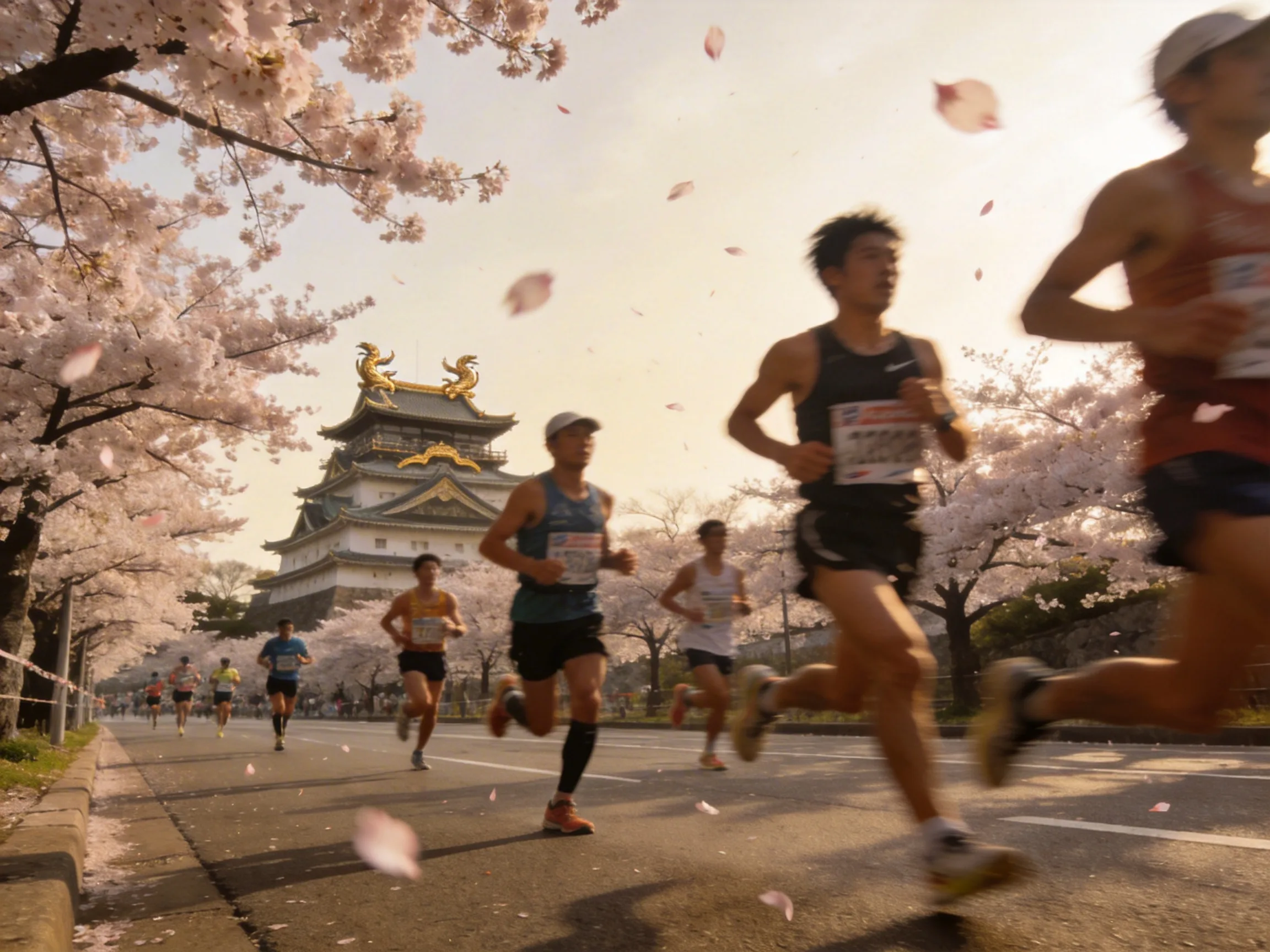
Want personality modes & weather integration? Try the full countdown experience
See entry dates for other marathons →
| Race | 2027 Nagoya Women's Marathon - Mar 14 |
|---|---|
| City | Nagoya |
| Date | 2027-03-14 at 09:10 |
| Field Size | ~22,000 runners |
| Time Limit | 7 hours |
| Cutoff pace | 9:57/km |
| Timezone | Asia/Tokyo |
| Official Site | Nagoya Women's Marathon Committee |
| Fee trend | 2023 ¥19,0002024 ¥17,0002025 ¥17,5002026 ¥19,0002027 ¥19,000(4-yr +0.0%)· in line with industry (+5.3% vs +4.8%/yr) |
| International | ¥25,000 · 1.3× domestic |
| Average Temperature | 8.4°C / 47°F |
|---|---|
| Humidity | 76% |
| Peak Wind | 25 km/h |
| Rain Chance | 36% |
| Typical Conditions | Cool and partly cloudy |
What to Prepare: Ideal spring racing conditions with comfortable temperatures. Light layers recommended at the start — a long sleeve you can tie around your waist works well. Cherry blossoms may be starting to bloom along parts of the route.
Based on historical averages for race week. Use our Weather Score Calculator and What to Wear Guide for personalized advice.
Winds peaking around 25 km/h — the typical daily maximum for this date — can affect your pace by 5-15 seconds per kilometer in exposed stretches. Headwinds slow you down exponentially: a 20 km/h wind costs more than twice a 10 km/h wind.
Calculate your wind-adjusted pace →Based on 20 years of race-week weather (2005-2024), MERRA-2 reanalysis
| Cooler | Typical | Warmer | |
|---|---|---|---|
| Temperature | 4.4°C | 8.5°C | 12.6°C |
| Dew point | -0.4°C | 3.7°C | 9.8°C |
Data: NASA POWER (MERRA-2 reanalysis), NASA Langley Research Center
| Course Type | Urban Loop |
|---|---|
| Elevation Gain | 40m |
| Terrain | Paved city roads |
| Profile | Flat course through central Nagoya with gentle undulations near Mizuho Athletic Stadium. Wide roads and enthusiastic crowds make this the world's largest women-only marathon. |
| Boston Qualifier | Yes — Check your BQ time |
The Nagoya Women's Marathon is the world's largest women-only marathon, with approximately 17,000 runners competing annually on a World Athletics Platinum Label course. The race starts and finishes at Vantelin Dome Nagoya (formerly Nagoya Dome), following a 42.195 km urban loop through seven wards of central Nagoya. With a total elevation range of just 16 meters (lowest point 1 m, highest 17 m) and cumulative gain of approximately 40 meters, this is one of the flattest major marathons in the world and a strong choice for runners targeting personal records.
The generous 7-hour cutoff time (approximately 10 min/km pace) attracts a wide range of participants from elite athletes to first-time marathoners, producing a consistently high completion rate above 96%. The 2025 edition recorded 97% finishers. Since 2012, when the event was reformed from an elite-only race into a mass marathon, the course has passed landmarks including Nagoya Castle, Atsuta Shrine, the Nagoya City Science Museum, and Nagoya TV Tower. Cherry blossoms may be blooming along sections of the route in mid-March, adding to the scenic experience.
Runners start inside Vantelin Dome and exit onto the surrounding roads. The first 2-3 km use narrow roads around the dome, creating significant congestion regardless of your start block. With 17,000 runners funneling through a limited space, expect a start loss of up to 30 minutes for rear blocks. Patience here is critical: do not weave aggressively or panic about your pace. The course opens up once you reach the Nagoya Ring Road (Kanjosen) near 3 km.
From 3 km to around 10 km, the route follows Hirokoji-dori westward through the city center. This section features a gentle downhill gradient that feels effortless early on. Resist the temptation to bank time here; runners consistently report that going out too fast in this section leads to trouble after 30 km. Crowd support is dense through the central shopping districts around Sakae and Fushimi, providing strong energy.
The route then turns south along Fushimi-dori and Wakamiya Odori, passing the Nagoya City Science Museum and Shirakawa Park between 10-15 km. Through 15-20 km, the course heads toward Atsuta Shrine (Atsuta Jingu) and the Horita Station turnaround point. This section remains largely flat and is where you should find your target rhythm. Water stations begin at 5 km and repeat every 2.5 km; sports drinks are available from 5 km onward (every 5 km in the first half, every 2.5 km after 20 km).
The second half heads north from Horita through the city center. Between 20-25 km, the route passes through Imaike and Chikusa areas. Crowd density decreases here compared to the first half, and runners report this as a mentally quiet stretch. Maintain your pace discipline; the challenging section is still ahead.
From 25 km to 30 km, the course turns westward toward Nagoya Castle. You can see the castle's distinctive green roofs in the distance around the 27-28 km mark. The approach to the castle involves the course's most notable gentle uphill section near 30 km. While the gradient is modest (the entire course has only 16 m of elevation range), the uphill arrives precisely when glycogen depletion hits many runners. This is the signature difficulty of the Nagoya Women's Marathon: a physically gentle climb that becomes a mental wall at 30 km.
After 30 km, the route follows Sakura-dori back eastward through Marunouchi and continues via the ring road toward the dome. Food stations at 22.5 km, 27.5 km, 32.5 km, and 37.5 km provide chocolate, salt tablets, and uiro (a Nagoya specialty rice cake). The final 5 km follows the ring road back to Vantelin Dome. Crowd support builds again as you approach the dome, and the finish inside the stadium is legendary: runners enter the dome to the sound of ABBA's "Dancing Queen" blasting through the speakers as tuxedo-clad attendants wait to present your finisher's gift.
Nagoya's flat profile and cool March weather (average 5-12 degrees C at race time, though wind can be a factor) make it ideal for a negative split strategy. The 2026 winner Sheila Chepkirui noted that "the wind was really strong" during her 2:21:54 victory. For recreational runners, the key risk is not terrain but wind exposure on the wide boulevards.
Pacing plan: Run the first 10 km 10-15 seconds per km slower than your target pace. The gentle downhill and crowd excitement in the opening kilometers tempt faster running, but every second saved here compounds as fatigue after 30 km. Use the 15-25 km flat stretch to settle into goal pace, then commit to maintaining effort (not pace) through the 30 km castle section. If you have energy remaining after 35 km, that is when to push.
Fueling: Water stations are every 2.5 km from 5 km onward. Carry your own gels if you have specific nutrition needs, but the on-course food stations at 22.5, 27.5, 32.5, and 37.5 km offer adequate support. Take nutrition before 25 km rather than waiting for the wall. The wind-chill factor in March means you may underestimate sweat loss: drink consistently even if you feel cool.
For pace planning, use RunDida's calculator to set your target splits. The marathon predictor can estimate your finish time from recent half marathon or 10K results. First-time marathoners should use the marathon countdown to track training milestones leading up to race day.
Arriving early? Explore daily running routes and local tips.
Meijo Park 1.3 km loop with shower station, Shonai River 13 km gravel path, and Heiwa Park trail. Nagoya Women's Marathon entry and March race weekend...
Read City Guide →Use our free training tools to get race-ready:
Free running pace calculator for 5K, 10K, half marathon, and marathon. Get min/km or min/mile, your ...
Use Calculator →Free printable pace band for marathon, half marathon, or custom distance. Choose even, negative, or ...
Use Calculator →7 AM race, wake at 3:45 AM? Enter the gun time; we work backward through meal, gear, bathroom, warm-...
Use Calculator →Enter temperature, wind, and rain to get specific clothing picks for head, torso, legs, hands, and f...
Use Calculator →Free running shoe finder quiz. Answer 6 questions, get 3 spec-matched picks from 15 brands (155 SKUs...
Use Calculator →Free marathon predictor — convert your 5K, 10K, or half marathon time into race-day estimates from R...
Use Calculator →The overseas quota for 2027 is 3,500 spots, first-come, first-served on the official site womens-marathon.nagoya: early entry runs August 11-24, 2026 at 24,000 JPY, regular entry August 25 - September 23 at 25,000 JPY plus a handling fee — a steep rise from 2026's 18,000-19,000 JPY. You need a valid passport and an email address. Domestic runners instead enter a general lottery of 5,500 places (expanded from 3,500), held September 17-24 at 19,000 JPY. Bib pickup is in-person only at Vantelin Dome Nagoya on the Friday or Saturday before the race — no race-day or proxy collection. Plan to arrive in Nagoya at least two days before the race.
The overall time limit is 7 hours from the 9:10 AM start gun (final cutoff at 4:10 PM). Course closure checkpoints are enforced at 6 km, 10.4 km, 15.7 km, 21.5 km, 26.2 km, 29.9 km, 35 km, 38.6 km, and 41.7 km. The 7-hour limit translates to approximately 10:00 min/km average pace. Runners who fall behind the pace car at any checkpoint are removed from the course. Start loss can reach 30 minutes for rear blocks, but the cutoff is based on the gun time, not chip time, so position yourself in an appropriate start block based on your expected pace.
Yes. The Nagoya Women's Marathon is exclusively for female runners aged 19 and older on race day. It is the world's largest women-only marathon, recognized by Guinness World Records (21,915 runners in 2018). Male participants can enter the Nagoya City Marathon, a separate race held on the same day that shares some course sections and includes a half marathon option. Male guide runners are permitted for visually impaired participants under specific conditions.
No. From 2012 to 2024, every finisher received a Tiffany & Co. sterling silver pendant, which became the race's most iconic draw. Starting in 2025, the finisher gift changed to a Baccarat crystal tumbler (8.5 cm tall, with the race logo etched into the base). The finish ceremony is unchanged: runners pass through a Tiffany-blue gate where men in tuxedos hand out gift boxes. A commemorative T-shirt and skincare products are also included.
The course's flat profile supports negative splitting. The main challenge is the gentle uphill near Nagoya Castle at 30 km, which coincides with typical glycogen depletion. Run the opening 10 km conservatively (the gentle downhill and crowd energy tempt faster starts), settle into goal pace between 15-25 km, and maintain effort through the 30 km section. Wind is often stronger than expected on the wide boulevards; the 2026 race saw steady winds at 9 degrees C. Use on-course food stations (22.5, 27.5, 32.5, 37.5 km) and begin fueling before 25 km. Use the negative split calculator to plan your splits.
Vantelin Dome Nagoya is in Higashi-ku, Nagoya. The nearest stations are Nagoya Dome-mae Yada (Meijo Subway Line or Yuutorito Line, 5-minute walk) and Ozone Station (JR Chuo Line / Meitetsu Seto Line, 15-minute walk). On race morning, the dome opens early for bag drop and block assembly. Runners are assigned to blocks A through N based on expected finish time; rear blocks may experience a start loss of up to 30 minutes. Bring warm throwaway layers for the wait, as March mornings in Nagoya average 3-5 degrees C. After the race, the finish area is inside the same dome, so post-race logistics are straightforward.
Mid-March in Nagoya averages 5-12 degrees C (41-54 degrees F) with morning lows around 3-5 degrees C at the 9:10 AM gun. Conditions are generally ideal for marathoning, but wind is the main variable: March is Nagoya's windiest month, and the wide boulevards offer limited shelter. Rain probability is about 30%. Cherry blossoms may be starting to bloom along the course. Dress in light throwaway layers for the start wait — a windbreaker or arm sleeves are more useful than heavy warmth for most runners.
Barcelona · 2027-03-14
Chongqing · 2027-01-10
Los Angeles · 2027-03-07
Wuxi · 2027-03-28
Manchester · 2027-04-18
Big Sur · 2027-04-25