Running Pace Calculator — Min/km, Finish Time & Pace Chart
Free running pace calculator for 5K, 10K, half marathon, and marathon. Get min/km or min/mile, your ...
Use Calculator →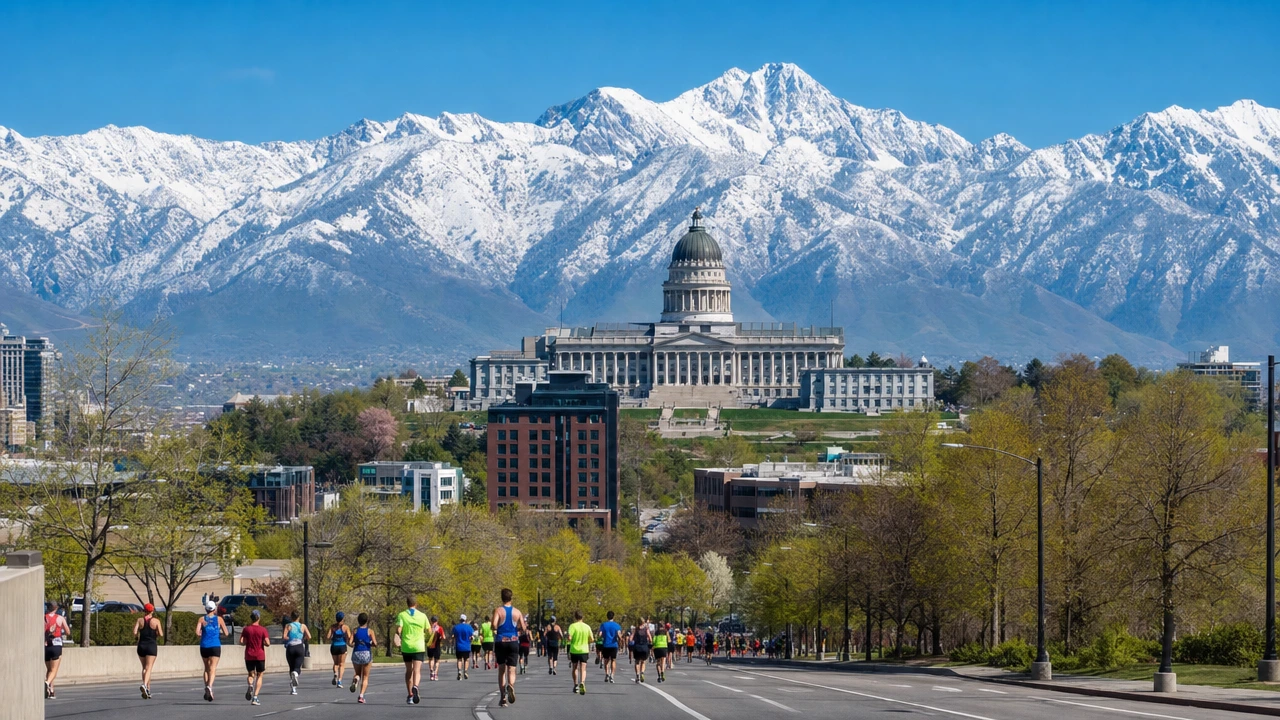
Want personality modes & weather integration? Try the full countdown experience
See entry dates for other marathons →
| Race | 2027 Salt Lake City Marathon - Apr 24 |
|---|---|
| City | Salt Lake City |
| Date | 2027-04-24 at 07:00 |
| Field Size | ~1,931 runners |
| Time Limit | 6 hours 30 min |
| Cutoff pace | 9:15/km |
| Course speed |
Challenging courseSpeed index 1.14 — median of the last 4 winners' times against the global same-year median. Winner times track elite fields and prize money, so this reads the course as a proxy, not a pure measurement. |
| Timezone | America/Denver |
| Official Site | University of Utah Health Salt Lake City Marathon |
| Registration | Register |
| Average Temperature | 7.7°C / 46°F |
|---|---|
| Humidity | 58% |
| Peak Wind | 14.1 km/h |
| Rain Chance | 34% |
| Typical Conditions | Crisp, bright late-April Salt Lake City morning at ~4,800 ft, snow still on the Wasatch peaks |
What to Prepare: A 7:00 a.m. start in the foothills is cold — expect around 44°F / 6-7°C climbing to the low 60s°F / mid-teens°C by late morning. Throwaway gloves and a long-sleeve you can shed early are smart, and the high-desert altitude means dry air, so carry your own fluids between aid. April is one of the windier months here, so plan for a breeze in the open valley stretches.
Based on historical averages for race week. Use our Weather Score Calculator and What to Wear Guide for personalized advice.
Winds peaking around 14.1 km/h — the typical daily maximum for this date — can affect your pace by 5-15 seconds per kilometer in exposed stretches. Headwinds slow you down exponentially: a 20 km/h wind costs more than twice a 10 km/h wind.
Calculate your wind-adjusted pace →Based on 20 years of race-week weather (2005-2024), MERRA-2 reanalysis
| Cooler | Typical | Warmer | |
|---|---|---|---|
| Temperature | 2.2°C | 7.5°C | 13°C |
| Dew point | -5.5°C | -0.3°C | 3.2°C |
Data: NASA POWER (MERRA-2 reanalysis), NASA Langley Research Center
| Course Type | Point-to-point (city) |
|---|---|
| Elevation Gain | 277m |
| Terrain | Road (paved city avenues and foothill neighborhood streets) |
| Profile | A net-downhill point-to-point that starts high at the Olympic Legacy Bridge near the University of Utah in the eastern foothills (around 4,800 ft / 1,460 m) and finishes at Library Square in downtown Salt Lake City, dropping roughly 650 ft (about 200 m) net. Don't mistake 'net downhill' for easy, though — the early miles give back most of the elevation fast, then the middle of the race rolls and climbs along the base of the Wasatch Mountains through the Millcreek and Holladay neighborhoods before tipping back down toward the city. Cumulative numbers run about +910 ft (277 m) of gain against roughly -1,495 ft (455 m) of loss. The Wasatch Range frames the entire valley, with the Utah State Capitol and the city skyline in view near the finish. It's USATF-certified and a Boston qualifier; the net descent helps PR-chasers, but the rolling middle section and ~4,300-4,800 ft altitude mean it's a smart-pacing course rather than a pure downhill freebie. |
| Boston Qualifier | Yes — Check your BQ time |
Use our free training tools to get race-ready:
Free running pace calculator for 5K, 10K, half marathon, and marathon. Get min/km or min/mile, your ...
Use Calculator →Free printable pace band for marathon, half marathon, or custom distance. Choose even, negative, or ...
Use Calculator →7 AM race, wake at 3:45 AM? Enter the gun time; we work backward through meal, gear, bathroom, warm-...
Use Calculator →How much will hills slow you down? Enter elevation gain, loss, and distance to see adjusted pace, di...
Use Calculator →Convert uphill or downhill running pace to flat-equivalent GAP in one click. Free grade adjusted pac...
Use Calculator →Free marathon predictor — convert your 5K, 10K, or half marathon time into race-day estimates from R...
Use Calculator →The 2027 Salt Lake City Marathon is on Saturday, April 24, 2027, with the full marathon starting at 7:00 a.m. MDT from the Olympic Legacy Bridge near the University of Utah. The point-to-point course finishes at Library Square in downtown Salt Lake City. Confirm the exact start corral and gun time on the official race site closer to race week, as logistics can shift slightly year to year.
It's a net-downhill point-to-point, dropping roughly 650 ft (about 200 m) from the foothill start to the downtown finish. That helps with a PR, but it isn't a pure plunge: most of the descent comes in the early miles, then the course rolls and climbs along the base of the Wasatch Mountains through the middle before dropping back to the city. Cumulative gain is about +910 ft against roughly -1,495 ft of loss. Pace the early downhill conservatively to save your quads. You can model a target with our pace calculator.
Yes. The course is USATF-certified and accepted as a Boston qualifier. The net descent makes it a realistic BQ target for runners on the bubble, though the rolling middle section and the ~4,300-4,800 ft altitude mean it rewards smart pacing rather than an all-out early effort. Check your required time with our Boston qualifying calculator.
The full marathon has a 6 hour 30 minute course limit. If you run slower than roughly a 16-minute-per-mile pace (about 9:57 per km), streets are reopened to traffic and on-course aid stations begin closing around 1:30 p.m., after which you may be asked to move to the sidewalk to finish. If you expect to be near that limit, train to comfortably hold the cutoff pace.
Salt Lake City sits at roughly 4,300-4,800 ft (1,300-1,460 m), so the air is thinner and drier than at sea level. Runners coming from low elevation often feel the effort is a touch harder and recovery between hard segments is slower, especially on the climbs. The dry high-desert air also speeds dehydration, so drink deliberately. If you can, arrive either a few days early or as late as possible before the race to manage the adjustment.
Late April mornings in the foothills are cold at the 7:00 a.m. start — around 44°F / 6-7°C — warming to the low 60s°F / mid-teens°C by late morning. Dress in layers you can shed: throwaway gloves and a long-sleeve over your race kit work well. April is one of the windier months in the valley, so factor in a breeze on the open downtown stretches.
Official results are posted on the race website and its RunSignUp results page shortly after the event, searchable by name and distance. Splits and finisher certificates are typically available there too. Recent fields have grown year over year, so check the official results portal for the most current finisher data.
Hartford · 2026-10-10
Madison · 2026-11-15
St. Louis · 2027-04-03
Memphis · 2026-12-05
Abingdon · 2026-10-18
Eastbourne · 2026-10-24