Running Pace Calculator — Min/km, Finish Time & Pace Chart
Free running pace calculator for 5K, 10K, half marathon, and marathon. Get min/km or min/mile, your ...
Use Calculator →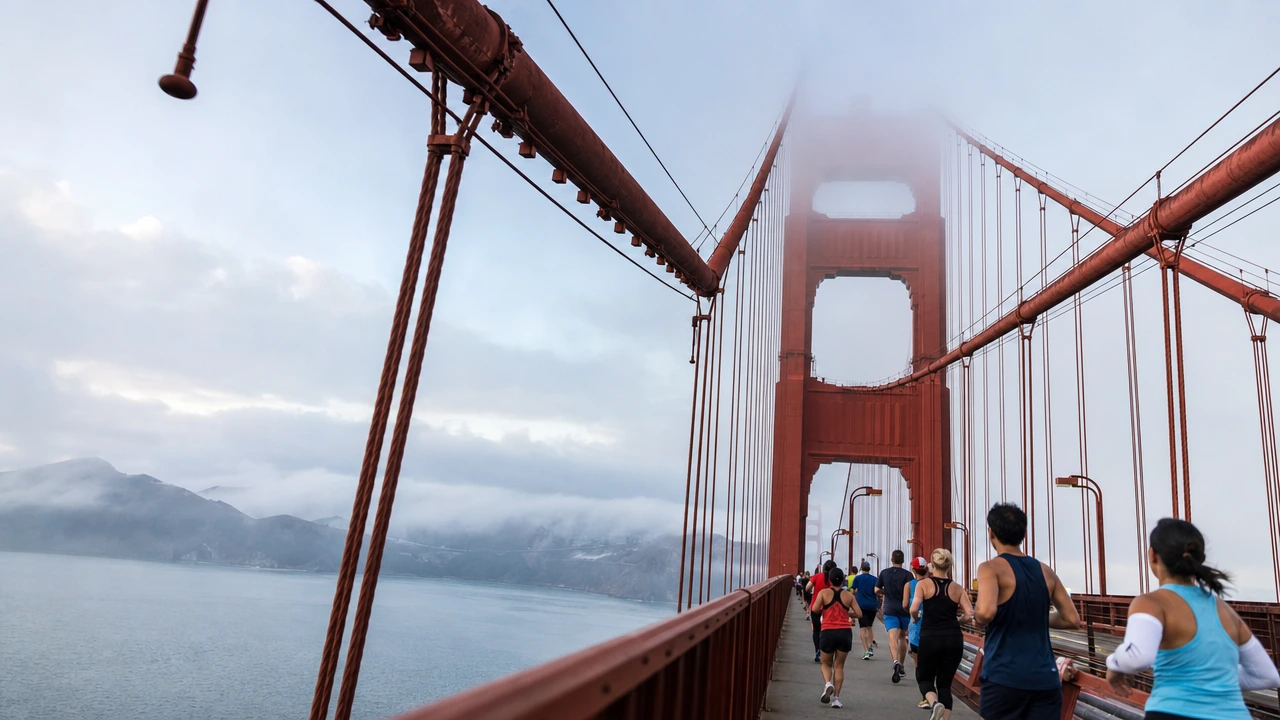
Race Completed
This marathon has finished. Check back for next year's edition.
Finished this one? Turn your result into a keepsake:
Finisher certificate ·
Virtual race bib ·
Achievement card
See entry dates for other marathons →
| Race | 2026 San Francisco Marathon - Jul 26 |
|---|---|
| City | San Francisco |
| Date | 2026-07-26 at 05:15 |
| Field Size | ~6,536 runners |
| Time Limit | 6 hours |
| Cutoff pace | 8:32/km |
| Course speed |
Challenging courseSpeed index 1.07 — median of the last 5 winners' times against the global same-year median. Winner times track elite fields and prize money, so this reads the course as a proxy, not a pure measurement. |
| Timezone | America/Los_Angeles |
| Official Site | The San Francisco Marathon |
| Average Temperature | 17.1°C / 63°F |
|---|---|
| Humidity | 75% |
| Peak Wind | 17.5 km/h |
| Rain Chance | 1% |
| Typical Conditions | Cool, foggy summer dawn — counterintuitively cold for July |
What to Prepare: Late July in San Francisco is famously cool, not hot — the 5:15 a.m. start is usually around 54°F / 12–13°C with thick marine-layer fog ('Karl the Fog') hanging over the bay and the Golden Gate Bridge. The fog often burns off into the 60s°F by late morning, and it can be breezy and damp crossing the bridge. Dress for a cool, humid coastal morning with a throwaway top, not a summer heat race.
Based on historical averages for race week. Use our Weather Score Calculator and What to Wear Guide for personalized advice.
Winds peaking around 17.5 km/h — the typical daily maximum for this date — can affect your pace by 5-15 seconds per kilometer in exposed stretches. Headwinds slow you down exponentially: a 20 km/h wind costs more than twice a 10 km/h wind.
Calculate your wind-adjusted pace →Based on 20 years of race-week weather (2005-2024), MERRA-2 reanalysis
| Cooler | Typical | Warmer | |
|---|---|---|---|
| Temperature | 15.3°C | 16.8°C | 19.4°C |
| Dew point | 10.4°C | 11.7°C | 13.1°C |
Recent actuals: 2023 16.6°C / 2024 14.2°C / 2025 13.7°C (morning avg)
Data: NASA POWER (MERRA-2 reanalysis), NASA Langley Research Center
| Course Type | City loop |
|---|---|
| Elevation Gain | 397m |
| Terrain | Road (city streets, bridge, and park paths) |
| Profile | A scenic, hilly bucket-list loop famous for running across the Golden Gate Bridge. Starting on the Embarcadero at Market, the route heads along the bay through Fisherman's Wharf, the Marina and Crissy Field, then climbs to and over the Golden Gate Bridge (the signature ascent around mile 6–7), dropping toward Sausalito before returning under the bridge through the Presidio, the Richmond District and Golden Gate Park, and finishing back on the Embarcadero. Total climbing is about +1,303 ft (397 m) — distinctly hillier than Boston or CIM but well short of Big Sur — with three notable climbs near miles 7, 12 and 16; the first and last two miles are nearly flat. USATF certified and a Boston qualifier, but the rolling profile and fog make it a scenery-and-challenge race, not a PR course. |
| Boston Qualifier | Yes — Check your BQ time |
| Year | Finishers | vs prev. |
|---|---|---|
| 2024 | 5,672 | — |
| 2025 | 6,537 | +15.3% |
Runners who crossed the line, not the registered field size.
Use our free training tools to get race-ready:
Free running pace calculator for 5K, 10K, half marathon, and marathon. Get min/km or min/mile, your ...
Use Calculator →Free printable pace band for marathon, half marathon, or custom distance. Choose even, negative, or ...
Use Calculator →7 AM race, wake at 3:45 AM? Enter the gun time; we work backward through meal, gear, bathroom, warm-...
Use Calculator →Enter temperature and humidity to calculate dew point and its impact on your running pace. 7-zone ch...
Use Calculator →How much does a headwind actually slow you down? This free calculator turns wind speed and direction...
Use Calculator →How much will hills slow you down? Enter elevation gain, loss, and distance to see adjusted pace, di...
Use Calculator →The full marathon is on Sunday, July 26, 2026, with a wave start beginning around 5:15 a.m. PT on the Embarcadero at Market. The race weekend runs July 25–26 (the 1st Half and shorter distances are on Saturday the 25th), but the 26.2-mile marathon itself is the Sunday event. It is the 49th running of the race.
Registration is open entry (no lottery) through the official site at thesfmarathon.com, processed on Race Roster. There is no qualifying time — you sign up first-come until the field fills. The 2025 full marathon sold out for the first time in race history, so the 2026 race added a wait list; full marathon entry runs roughly $200 and up with fees, rising as the event nears. An Affirm 'pay later' option is offered at checkout.
Yes — its crossing of the Golden Gate Bridge is the signature reason runners put it on their bucket list. You run out and back across the bridge in the first half (around miles 6–9), often in morning fog, with the bay and the city skyline on either side. The bridge crossing is the centerpiece of an iconic San Francisco landmark tour that also takes in Fisherman's Wharf, the Presidio and Golden Gate Park.
It is a genuinely hilly course with about +1,303 ft (397 m) of total climbing — the organizers note it is hillier than Boston (≈815 ft) and CIM (≈663 ft), though less than Big Sur (≈2,182 ft). The three biggest climbs sit near miles 7, 12 and 16, with most of the steep work in the first half; the first and last two miles are nearly flat. It is challenging but scenic, so plan a conservative early pace rather than chasing the climbs.
The course is USATF certified and an official Boston Marathon qualifier (and an Abbott World Marathon Majors Wanda qualifier), so a fast time here counts. But it is not an easy BQ course — the +1,303 ft of climbing and frequent fog make it slower than a flat or downhill race. Runners chasing a Boston time usually pick a flatter course; people run San Francisco for the bridge and the views. Check the time you need with our Boston Qualifying Calculator.
The full marathon has a 6-hour time limit — about a 13:44-per-mile pace — so that city streets and the bridge can reopen on schedule. The early 5:15 a.m. start gives the field a head start on the cutoff, but runners who fall well behind pace may be moved to the sidewalk or shuttled forward to keep the course on its reopening timeline.
Counterintuitively, late-July San Francisco mornings are cold and foggy, not hot. The dawn start is usually near 54°F / 12–13°C with a thick marine layer ('Karl the Fog') over the bay and bridge, often warming into the 60s°F as the fog burns off later. It can be breezy and damp on the bridge. Dress for a cool, humid coastal morning — a throwaway top you can shed plus shorts and a tee usually works — and do not pack for summer heat.

Munich · 2026-10-11
Amsterdam · 2026-10-18

Lisbon · 2026-10-10

Beijing · 2026-10-18
Yokohama · 2026-10-25
Kanazawa · 2026-10-25