Running Pace Calculator — Min/km, Finish Time & Pace Chart
Free running pace calculator for 5K, 10K, half marathon, and marathon. Get min/km or min/mile, your ...
Use Calculator →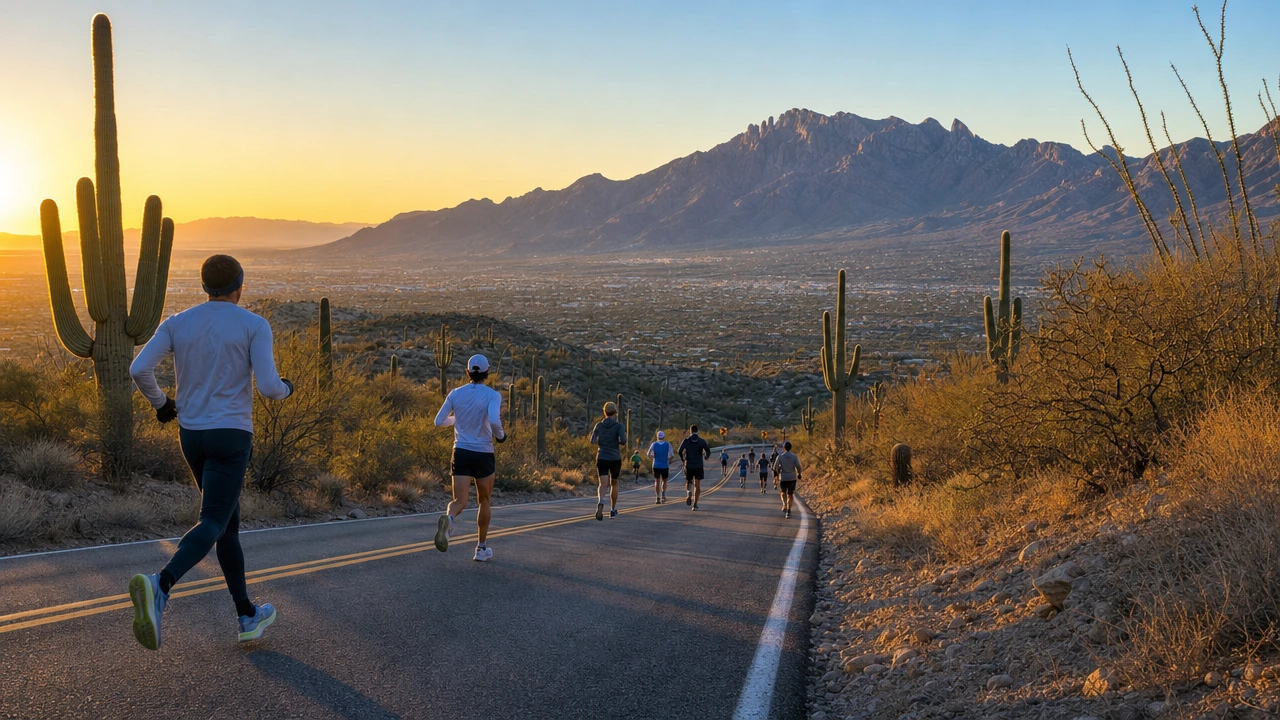
Want personality modes & weather integration? Try the full countdown experience
See entry dates for other marathons →
| Race | 2026 Tucson Marathon - Dec 13 |
|---|---|
| City | Tucson |
| Date | 2026-12-13 at 07:20 |
| Time Limit | 7 hours 30 min |
| Cutoff pace | 10:40/km |
| Timezone | America/Phoenix |
| Official Site | Tucson Marathon (Aravaipa Running) |
| Average Temperature | 10.5°C / 51°F |
|---|---|
| Humidity | 44% |
| Peak Wind | 21.3 km/h |
| Rain Chance | 13% |
| Typical Conditions | Cool, dry mid-December Sonoran Desert morning — prime fast-running and BQ weather |
What to Prepare: Mid-December in the Tucson area is cool and very dry: a race-morning low near 40°F / 4°C climbing to a high around 64°F / 18°C, with little chance of rain. The 7:20 a.m. start up at Biosphere 2 (elevation ~3,900 ft) is the coldest point of the day, so wear throwaway gloves and a long-sleeve layer you can shed on the early downhill. The dry desert air can dehydrate you faster than the cool temps suggest — drink to plan.
Based on historical averages for race week. Use our Weather Score Calculator and What to Wear Guide for personalized advice.
Winds peaking around 21.3 km/h — the typical daily maximum for this date — can affect your pace by 5-15 seconds per kilometer in exposed stretches. Headwinds slow you down exponentially: a 20 km/h wind costs more than twice a 10 km/h wind.
Calculate your wind-adjusted pace →Based on 20 years of race-week weather (2005-2024), MERRA-2 reanalysis
| Cooler | Typical | Warmer | |
|---|---|---|---|
| Temperature | 6.4°C | 10.6°C | 15°C |
| Dew point | -9.7°C | -2.6°C | 4.5°C |
Data: NASA POWER (MERRA-2 reanalysis), NASA Langley Research Center
| Course Type | Point-to-point (net downhill) |
|---|---|
| Elevation Gain | 89m |
| Terrain | Road (paved desert highway and valley streets, downhill throughout) |
| Profile | One of the fastest Boston-qualifying courses in the country and the fastest in Arizona. The point-to-point route starts at the iconic Biosphere 2 near Oracle, around 3,900 ft of elevation, and descends through the Sonoran Desert — past towering saguaro cacti with the Santa Catalina Mountains as a constant backdrop — down through Catalina and Oro Valley to finish at Pima Community College Northwest Campus near Tucson. The net elevation loss is about 1,493 feet (roughly 455 m) with only ~292 ft (89 m) of climbing. For 2025 the organizer fine-tuned the route to bring the net drop just under Boston's 1,500-foot (3.3 ft/mi) net-loss limit, so finish times count toward Boston qualifying with NO downhill adjustment. The descent is steepest in the first half and eases as you reach the valley floor, so banking smart early splits without trashing the quads is the key tactic. Cool, dry December air and a generally gentle grade make this a perennial PR and BQ destination: about 17.3% of finishers qualified for Boston in 2025 (14.7% in 2024). USATF-certified. |
| Boston Qualifier | Yes — Check your BQ time |
Use our free training tools to get race-ready:
Free running pace calculator for 5K, 10K, half marathon, and marathon. Get min/km or min/mile, your ...
Use Calculator →Free printable pace band for marathon, half marathon, or custom distance. Choose even, negative, or ...
Use Calculator →7 AM race, wake at 3:45 AM? Enter the gun time; we work backward through meal, gear, bathroom, warm-...
Use Calculator →How much does a headwind actually slow you down? This free calculator turns wind speed and direction...
Use Calculator →Free marathon predictor — convert your 5K, 10K, or half marathon time into race-day estimates from R...
Use Calculator →Predict your race finish time from pace, or set a goal time to find required pace. Free instant calc...
Use Calculator →The 2026 Tucson Marathon is on Sunday, December 13, 2026, with the full marathon starting at 7:20 a.m. MST at Biosphere 2 near Oracle, AZ. The point-to-point course finishes at Pima Community College Northwest Campus near Tucson. The half marathon starts separately in Catalina, and a 50K and marathon relay share the full-marathon start.
It is a genuine net-downhill point-to-point with an overall net loss of about 1,493 feet (roughly 455 m), against only ~292 ft (89 m) of climbing. The start at Biosphere 2 sits around 3,900 ft and the course descends through the desert toward Tucson. The descent is steepest in the first half, so control your early pace to save your quads.
Yes — it is one of the fastest Boston-qualifying marathons in the US and the fastest course in Arizona. It is USATF-certified and a Boston Marathon Qualifier, and about 17.3% of finishers qualified for Boston in 2025 (14.7% in 2024). For 2025 the organizer trimmed the net drop to just under Boston's 1,500-foot limit, so times count with no downhill adjustment. Check your target with our Boston qualifying calculator.
No. The Boston Athletic Association adjusts qualifying times only when a course's net elevation loss exceeds 1,500 feet (about 3.3 ft per mile). Tucson's net drop is about 1,493 feet — deliberately fine-tuned in 2025 to stay just under that threshold — so your finish time counts toward Boston qualifying with no downhill penalty.
The official course time limit is 7.5 hours (7 hours 30 minutes), which works out to roughly a 17:10 per mile average pace — generous for a downhill course. Plan your splits with our pace calculator so you bank time on the early descent without going out too hard.
Mid-December in the Sonoran Desert is cool and very dry — a race-morning low near 40°F (4°C) warming to a high around 64°F (18°C), with little chance of rain. It is excellent fast-running weather. Dress for a cold, high-elevation start at Biosphere 2 and shed layers on the descent; the dry air dehydrates faster than the cool temps suggest, so hydrate to plan.
The marathon starts at Biosphere 2 near Oracle, AZ, north of the city, and runs the point-to-point route down through Catalina and Oro Valley to finish at Pima Community College Northwest Campus near Tucson. Because it is point-to-point and starts at elevation, plan to use the organizer's pre-dawn shuttle buses from the finish area up to the Biosphere 2 start.
Registration is handled online through RaceRoster, with tiered pricing that rises as race day approaches (roughly $129 early up to about $179 race week for the full marathon). English-language online registration is straightforward for international runners. The race is organized by Aravaipa Running; register early because the field is capped.

Lincoln · 2027-05-02

Ojai · 2027-04-18
Scranton · 2026-10-11

Cary · 2027-03-14

Tulsa · 2026-11-22

Bar Harbor · 2026-10-18