
Running for Fat Loss — Science-Backed Strategies
Why slow runs maximize fat oxidation, what Fatmax actually means for trained vs untrained runners, and a weekly protocol that beats EPOC and fasted hype.
Key Takeaways
- Fatmax depends on training status, not gym posters. Trained runners hit it at about 64% VO2max / 74% HRmax; untrained at about 48% VO2max / 62% HRmax. Use the talk test, not the lumped "fat-burning zone."
- Slow running's value is volume, not magic. Slow runs and faster runs burn roughly the same total calories per distance — but you can run slowly more often without injury, and weekly mileage drives body composition more than single-run intensity.
- Fasted training changes the fuel mix, not the total fat lost. Schoenfeld 2014 settled this: total fat loss depends on daily caloric balance, not on whether you ate before the run.
- EPOC adds 6-15%, not "hours of afterburn." For a 500-kcal run, that's about 30-75 bonus calories (LaForgia 2006). Meaningful long-term, nowhere near the marketing claim.
- Underfueling is the most common failure mode. Lost periods, repeated stress fractures, or weight loss exceeding 0.5-1% of body weight per week are RED-S warning signs — fuel for the training you actually do, not the training you wish you were doing.
For all the "fat-burning zone" posters at your gym, running's relationship with fat loss is harsher and more nuanced than fitness marketing suggests. Months of weekly mileage with no scale movement is one of the most common frustrations in running communities — and the cause is almost never "wrong heart rate zone." Running can transform body composition, but the caloric math is sobering: you cannot outrun a bad diet. This guide separates what the metabolic research actually shows from the EPOC, fasted-cardio, and Fatmax-zone claims that crowd out the underlying physiology.
How your body burns fat during running
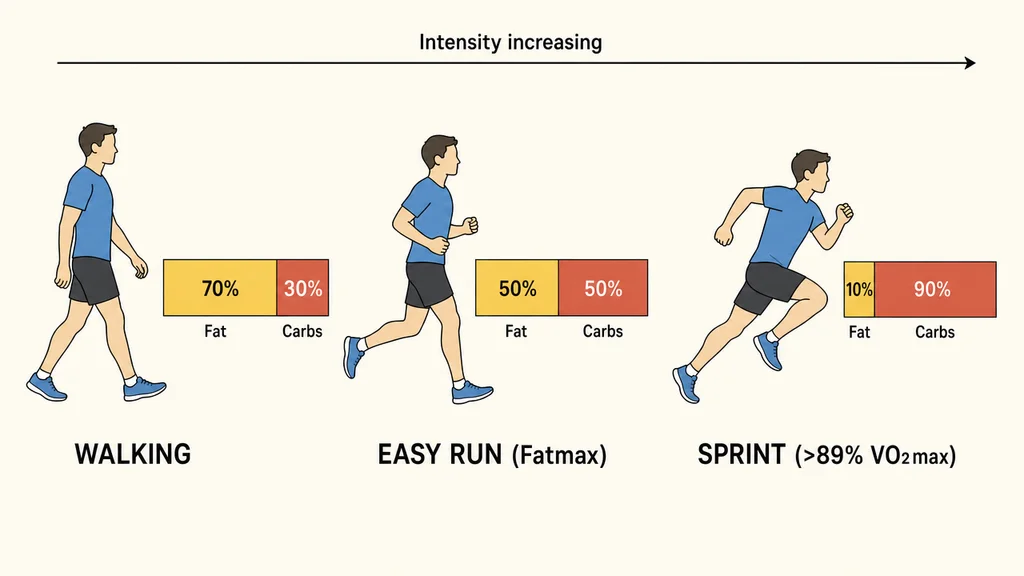
During any physical activity, the body draws energy from two primary fuel pools: carbohydrates (stored as glycogen in muscle and liver, plus glucose in the bloodstream) and fats (stored as intramuscular triglycerides and adipose triglycerides). Both fuels run simultaneously — only the ratio between them shifts with exercise intensity.
At rest and very low intensities, fat contributes roughly 60-70% of total energy expenditure. As intensity rises, the body progressively shifts toward carbohydrate oxidation, because carbohydrate is faster per unit of oxygen consumed — a critical advantage when ATP demand outpaces aerobic capacity. By approximately 89% of VO2max, fat contribution approaches zero [1].
The shift is driven by mechanism: at higher intensities, sympathetic activation rises, lactate accumulates, and muscle fiber recruitment shifts from slow-twitch (fat-friendly) to fast-twitch (glycolytic). The mitochondrial enzymes that import and oxidize fatty acids — primarily CPT-1 and the β-oxidation pathway — saturate at a relatively narrow intensity band. That band is called your Fatmax.
The Fatmax zone — trained vs untrained ranges
Fatmax is the exercise intensity at which fat oxidation reaches its peak rate. The critical detail almost every fat-burning-zone poster gets wrong: this range varies dramatically by training status.
For trained endurance runners [1]: Fatmax averaged 64 ± 4% of VO2max, corresponding to 74 ± 3% of maximum heart rate. In practical terms: a comfortable, conversational pace where full sentences are possible without breath pauses.
For untrained or recreationally active people [2]: Fatmax averaged 48.3% VO2max, or roughly 61.5% of maximum heart rate. This is dramatically lower — closer to a brisk walk than the conventional "fat-burning zone."
The split matters because most fat-burning-zone charts cite the trained-runner range and apply it to beginners. New runners then push to 70-75% HRmax, sail well past their actual Fatmax, and shift fuel use toward carbohydrate — exactly the opposite of the goal.
Individual variation is also large. A 2025 analysis[6] found the coefficient of variation across Zone 2 markers ranged from 6 to 29% across runners — meaning two people with identical resting heart rates can differ substantially in their true Fatmax. The most reliable field proxy is the talk test: at Fatmax, full sentences should be possible without pausing for breath, but singing strains. If you're gasping every few words, you're well above Fatmax.
Why slow runs maximize fat oxidation
At Fatmax intensity, the mitochondrial pathways for fat oxidation are saturated — fatty acid uptake via CPT-1, then β-oxidation in the matrix, run at their peak rate. Push intensity higher and glycolysis (anaerobic carbohydrate breakdown) dominates, because it produces ATP roughly 100x faster per substrate molecule, even though it's less efficient per oxygen consumed.
There's a running-specific advantage to highlight here. Achten 2003[3] compared fat oxidation rates at the same %VO2max during running and cycling, and found running elicited approximately 28% higher peak fat oxidation than cycling. The difference likely reflects greater eccentric muscle loading and total muscle mass recruitment.
This does not mean slow runs are magical fat-burners that obliterate calories. A slow 10K burns roughly the same total calories as a faster 10K — in fact, faster running often burns slightly more total kcal. What slow running offers is a different fuel mix and a sustainable training stimulus. The reason slow runs feature heavily in fat-loss training is volume: you can run slowly more often without injury or recovery debt, and weekly mileage — not single-run intensity — drives most body composition adaptations.
Fasted running — the honest answer
Fasted running acutely increases fat oxidation during the run, because glycogen stores are lower and the body relies more heavily on adipose fuel. The harder question is whether this acute shift translates to greater total fat loss.
The cleanest answer comes from Schoenfeld 2014[4], a 4-week RCT comparing fasted versus fed aerobic exercise: "body composition changes associated with aerobic exercise in conjunction with a hypocaloric diet are similar regardless whether or not an individual is fasted prior to training."
Fasted runs increase fat use during the session, but the body compensates over the 24-hour window. Total daily caloric balance is what determines body composition, not the pre-run feeding state.
There are real reasons to do some fasted easy running: metabolic flexibility (mitochondria adapt to oxidize fat more efficiently), mitochondrial density, and simple logistics (some runners prefer not to eat early). These are training adaptations, not weight-loss shortcuts.
Avoid fasted running for: high-intensity sessions (you will bonk and the workout suffers), any session over about 90 minutes (glycogen depletion compromises the work), and athletes already in low energy availability (RED-S risk — see below).
EPOC — the honest framing of "afterburn"
EPOC (Excess Post-exercise Oxygen Consumption) — popularly the "afterburn effect" — is real, but the marketing version is wildly inflated. The most cited review [5] is unambiguous: "EPOC comprises only 6-15% of the net total oxygen cost of the exercise."
For a 500-kcal easy run, that translates to roughly 30-75 kcal of additional post-exercise burn. Meaningful over months of consistent training, but nowhere near the "hours of elevated metabolism" claims that crowd fitness marketing.
The same review reached an honest conclusion the fitness industry prefers to ignore: "the earlier research optimism regarding an important role for the EPOC in weight loss is generally unfounded."
Where EPOC matters more: high-intensity interval training elicits a larger relative EPOC than steady-state, but in absolute terms the difference is small. If hard intervals help you stay consistent, do them — just don't expect them to "torch fat for hours after."
Five myths real runners hold
Myth 1: Only the "fat-burning zone" burns fat
Every aerobic intensity burns some fat. Fat oxidation peaks at Fatmax but never zeros out except at near-maximal efforts. Running outside Zone 2 still burns fat — just with a different fuel mix.
Myth 2: Fasted is always better than fed
Schoenfeld 2014 settled this for total fat loss. The marginal benefits of fasted training are mitochondrial, not body-composition.
Myth 3: EPOC means hours of bonus calories
6-15% of exercise total, per LaForgia 2006[5] — not an all-day metabolic boost. For a 500-kcal run, that's a snack-sized bonus, not a meal.
Myth 4: You need 30 minutes before fat starts burning
Fat oxidation begins at minute one. The ratio of fat to carbohydrate shifts gradually over the first 20-30 minutes (because catecholamines and lipolytic hormones take time to ramp up), but there is no ignition threshold. A 25-minute run burns fat too.
Myth 5: Running builds muscle that masks fat loss
For most runners this is glycogen and water weight, not muscle. A single hard training day can increase muscle glycogen by 100-300 g, and each gram of glycogen binds 3-4 g of water — shifting scale weight by 1-2 kg without any change in fat or lean mass. A common pattern: scale weight bounces up after a rest week as glycogen rebounds. That's a sign of recovery, not muscle gain.
A weekly protocol for fat-loss running
A sustainable structure that aligns with the metabolic research:
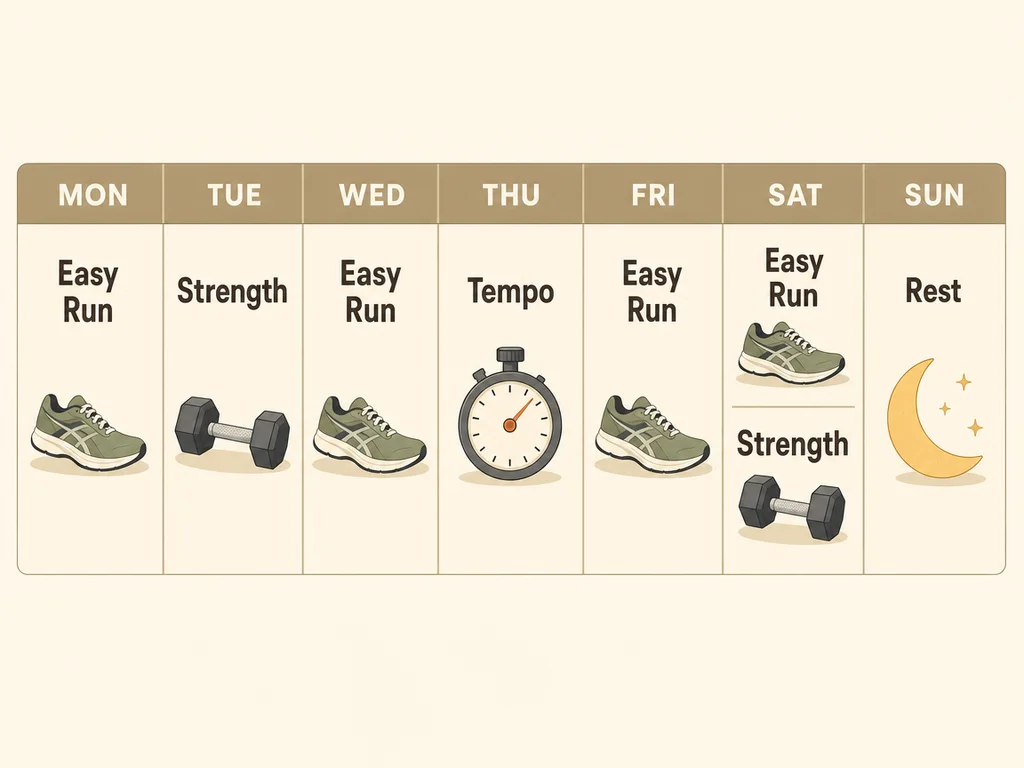
Weekly template (intermediate runner):
- 3-4 easy or long runs at Fatmax intensity (Zone 2, conversational pace)
- 1 tempo or hard interval session (20-40 min of hard work, including warm-up and cooldown)
- 2 strength-training sessions (compound lifts, 45-60 min each)
- 1 full rest day
Low-impact volume option. Incline walking is a joint-sparing way to add aerobic minutes on recovery days: a steady 10-12% treadmill grade at walking speed sits around 60-70% of VO2max -- the conversational fat-oxidation range this guide is built around -- while burning roughly 2.5x the calories of a flat walk. The treadmill incline calculator shows the burn for your weight and pace.
Volume threshold matters. Community consensus and emerging research suggest that exercise alone struggles to drive significant body composition change below approximately 45 miles per week (72 km/week) without a corresponding dietary intervention. Below that volume, running supports body composition primarily through metabolic adaptation, modest appetite regulation, and the dietary discipline that often accompanies training — not through caloric expenditure alone.
Pair with a moderate caloric deficit. A 300-500 kcal/day deficit is the broadly evidence-based recommendation for body composition change in training athletes. Aggressive deficits (above 700 kcal/day) routinely backfire through performance loss, compensatory eating, elevated injury risk, and increased dropout rates. Our running for weight loss guide covers the deficit math, an 8-week beginner walk-run plan, and how to break through plateaus.
Strength training is non-negotiable. Without resistance work, caloric deficits drive both fat and lean mass loss. Lean mass loss degrades running economy, lowers resting metabolic rate, and makes the next deficit harder. Two short sessions per week protect lean mass with minimal time cost.
Sleep is the underrated lever. Restricting sleep while in a caloric deficit accelerates lean mass loss — a well-established interaction in sleep and nutrition research. Free, underused, and outperforms most supplements.
RED-S and the underfueling trap
The most common failure mode of "running for weight loss" is not laziness — it is overdoing the deficit. Relative Energy Deficiency in Sport (RED-S, formerly the Female Athlete Triad before it was extended to include men) describes the cluster of consequences when energy intake falls persistently below the body's needs for training plus baseline function.
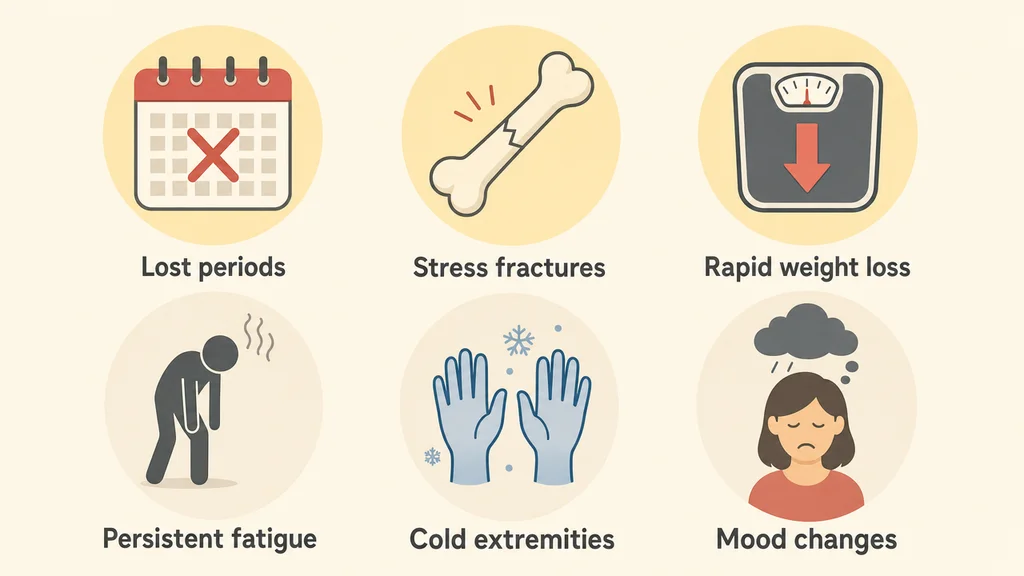
Warning signs across genders:
- Lost or irregular menstrual periods (women)
- Repeated stress fractures or unusually slow injury healing
- Weight loss exceeding 0.5-1% of body weight per week
- Persistent fatigue, poor sleep quality, declining performance despite stable training
- Loss of libido, brittle hair, cold extremities, low resting heart rate without aerobic explanation
- Mood changes — irritability, low motivation, depressive symptoms
If menstrual periods stop or become irregular, see a physician. This is not a "training response" to celebrate — it is the body suppressing reproductive function to conserve energy. The same neuroendocrine pathway impairs bone remodeling, immune function, and recovery.
The hardest-won lesson in running communities: underfueling masquerades as discipline. The runner most likely to be in RED-S is often the one perceived as having the most controlled diet — restrictive, athletic-looking — until performance collapses, stress fractures appear, or amenorrhea sets in. Fuel for the training you actually do, not the training you wish you were doing.
Closing — and what to do next
Fat loss running works, but its rules are unforgiving: weekly volume matters more than session-by-session intensity, total daily caloric balance trumps fasted-versus-fed timing, and underfueling derails progress far more often than overeating does. The runners who succeed long-term treat the scale as one signal among many, optimize sleep and strength, and stay patient enough to let the metabolic adaptations compound.
References
- Achten J, Gleeson M, Jeukendrup AE. Determination of the exercise intensity that elicits maximal fat oxidation. Med Sci Sports Exerc. 2002;34(1):92-97.
- Venables MC, Achten J, Jeukendrup AE. Determinants of fat oxidation during exercise in healthy men and women. J Appl Physiol. 2005;98(1):160-167.
- Achten J, Venables MC, Jeukendrup AE. Fat oxidation rates are higher during running compared with cycling. Metabolism. 2003;52(6):747-752.
- Schoenfeld BJ, Aragon AA, Wilborn CD, Krieger JW, Sonmez GT. Body composition changes associated with fasted versus non-fasted aerobic exercise. J Int Soc Sports Nutr. 2014;11:54.
- LaForgia J, Withers RT, Gore CJ. Effects of exercise intensity and duration on the excess post-exercise oxygen consumption. J Sports Sci. 2006;24(12):1247-1264.
- Meixner et al. Zone 2 marker variability in trained runners. 2025.
Related tools:
- Heart Rate Zones Calculator — translate HRmax into your trained-vs-untrained Fatmax window
- Running Calories Calculator — realistic per-session caloric expenditure by pace and weight
- Max Heart Rate Calculator — set the Fatmax band correctly before applying it
- Pace Calculator — convert Fatmax HR into a sustainable training pace
- Weight-Adjusted Pace Calculator — how body weight changes your effort-pace relationship
Related guides:
Sources & References
- (2004). Optimising fat oxidation through exercise and diet. Nutrition.
- (2014). Body composition changes associated with fasted versus non-fasted aerobic exercise. Journal of the International Society of Sports Nutrition.
- (2002). Fat metabolism during exercise: a review. International Journal of Sports Medicine.
- (2002). Effect of exercise intensity on fat oxidation in trained and untrained subjects. Medicine & Science in Sports & Exercise.
- (2005). Determinants of fat oxidation during exercise in healthy men and women: a cross-sectional study. Journal of Applied Physiology.
- (2003). Fat oxidation rates are higher during running compared with cycling over a wide range of intensities. Metabolism.
- (2006). Effects of exercise intensity and duration on the excess post-exercise oxygen consumption. Journal of Sports Sciences.