Running Pace Calculator — Min/km, Finish Time & Pace Chart
Free running pace calculator for 5K, 10K, half marathon, and marathon. Get min/km or min/mile, your ...
Use Calculator →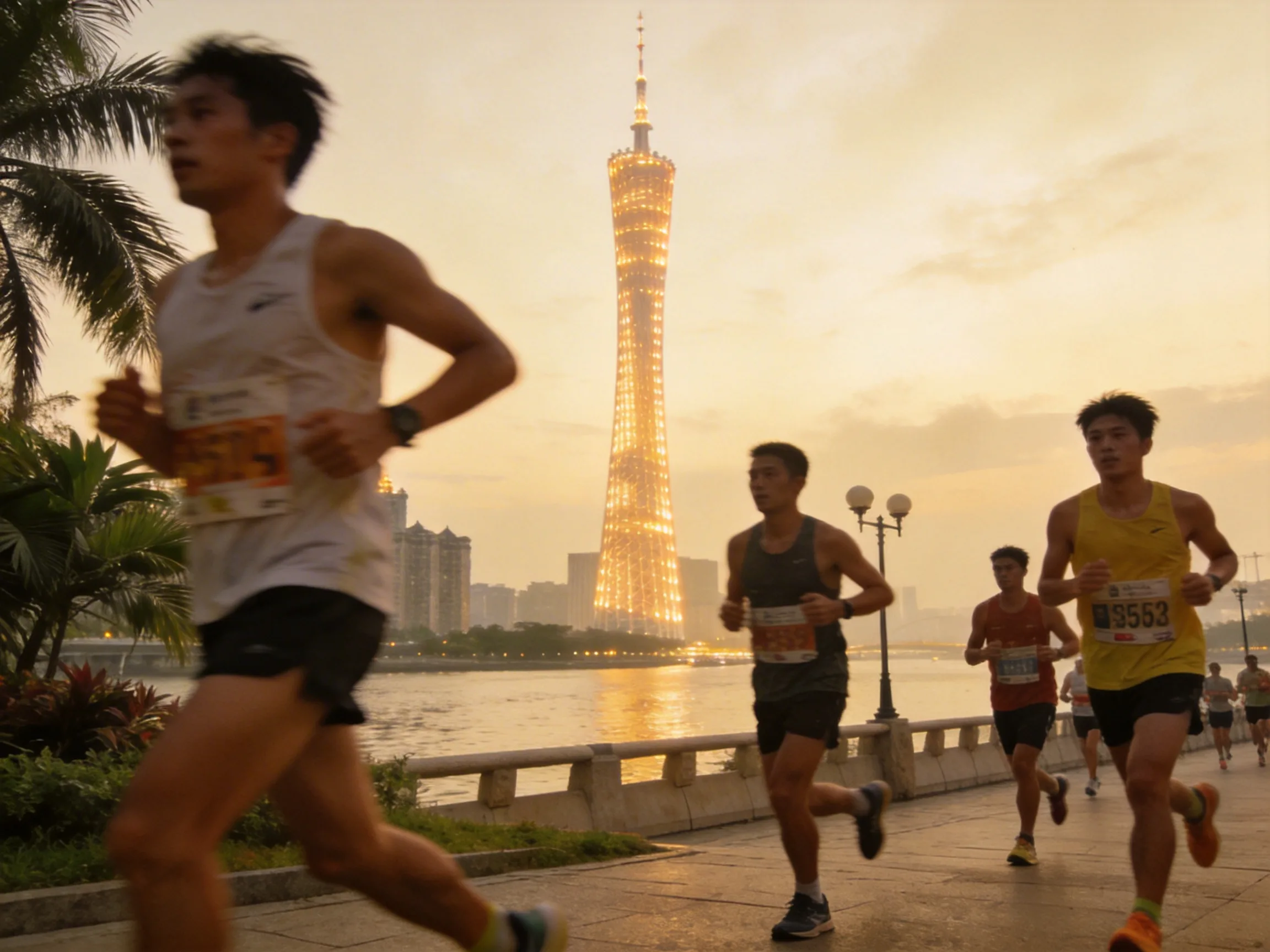
Want personality modes & weather integration? Try the full countdown experience
See entry dates for other marathons →
| Race | 2026 Guangzhou Marathon - Dec 20 |
|---|---|
| City | Guangzhou |
| Date | 2026-12-20 at 07:30 |
| Field Size | ~30,000 runners |
| Time Limit | 6 hours 15 min |
| Cutoff pace | 8:53/km |
| Timezone | Asia/Shanghai |
| Official Site | Guangzhou Municipal People's Government |
| Fee trend | 2023 ¥1602024 ¥1602026 ¥180(3-yr +12.5%)· below industry avg (+4.0% vs +4.8%/yr) |
| Average Temperature | 14.8°C / 59°F |
|---|---|
| Humidity | 67% |
| Peak Wind | 19.5 km/h |
| Rain Chance | 13% |
| Typical Conditions | Mild and humid, not cold — warm-weather December racing |
What to Prepare: Despite being a December marathon, Guangzhou is subtropical and runs warm, not cold. Race mornings typically sit around 12-22C (54-72F) with roughly 65% humidity — comfortable for spectators but warmer and stickier than most northern-hemisphere winter marathons. Plan as a temperate-to-warm race, not a cold one: light racing kit, a deliberate hydration plan, and a small pace buffer if the day climbs toward 20C. Rain is unlikely (December is Guangzhou's driest month, around 32mm average).
Based on historical averages for race week. Use our Weather Score Calculator and What to Wear Guide for personalized advice.
Winds peaking around 19.5 km/h — the typical daily maximum for this date — can affect your pace by 5-15 seconds per kilometer in exposed stretches. Headwinds slow you down exponentially: a 20 km/h wind costs more than twice a 10 km/h wind.
Calculate your wind-adjusted pace →Based on 20 years of race-week weather (2005-2024), MERRA-2 reanalysis
| Cooler | Typical | Warmer | |
|---|---|---|---|
| Temperature | 10°C | 14.8°C | 19.5°C |
| Dew point | 0.2°C | 8.2°C | 15.1°C |
Recent actuals: 2023 22.9°C / 2024 14.8°C (morning avg)
Data: NASA POWER (MERRA-2 reanalysis), NASA Langley Research Center
| Course Type | Point-to-point |
|---|---|
| Elevation Gain | 30m |
| Terrain | Road |
| Profile | A flat, fast 'one river, two banks' course through central Guangzhou. From the recent route, runners start at Tianhe Sports Center, head south to the Pearl River, then run both banks past Liede Bridge, the Canton Fair complex and Canton Tower, crossing the four central districts of Tianhe, Haizhu, Liwan and Yuexiu before finishing on Haixinsha island. |
| Boston Qualifier | Yes — Check your BQ time |
The Guangzhou Marathon is the marquee December road race of southern China and one of the country's World Athletics Gold Label events. First run in 2012, it is organized around the city's 'one river, two banks' (一江两岸) route along the Pearl River, and since 2024 it has been a marathon-only event — the half marathon was dropped, so all roughly 26,000 entrants run the full 42.195 km.
The course is flat and fast. Based on the most recent editions, runners set off from Tianhe Sports Center, drop south to the Pearl River, then spend most of the day tracing both banks of the river before finishing on Haixinsha island. The route passes a roll-call of Guangzhou landmarks — the Tianhe Road shopping district, Huacheng (Flower City) Square, Liede Bridge, the Canton Fair complex and the Canton Tower — and threads through the four central districts of Tianhe, Haizhu, Liwan and Yuexiu.
It is a genuinely quick course. The men's event record stands at 2:06:28 (Gebise Lelisa Debele of Ethiopia, set in 2024), and the women's at 2:25:13 (Anchialem Haymanot of Ethiopia, 2024). For international runners, the real story is the climate: this is a warm-weather December marathon, not a cold one, which changes how you should pace and hydrate. Note the date — the exact 2026 race day had not been published as of mid-2026; historically the race lands on a Sunday in early-to-mid December (December 10 in 2023, December 8 in 2024), though the 2025 edition moved later to December 21, so confirm the official date before booking travel.
Guangzhou's signature is the Pearl River, and the marathon is built around it. After the opening miles out of Tianhe, the course descends to the water and runs the two banks of the river, giving long stretches of waterfront and skyline views — the illuminated Canton Tower across the river is the highlight, and the riverside parks make for some of the most scenic kilometres of any major Chinese marathon.
The terrain is flat road throughout, with the only undulation coming from the river bridges. The most prominent is Liede Bridge (猎德大桥), a cable-stayed crossing on the route; bridge approaches are the closest thing this course has to a hill, and they are short. Recent editions deliberately reduced the out-and-back (折返) sections to keep the field flowing, and the closing kilometres run out to Haixinsha — the Asian Games island park — before the finish, a flat, fast, spectator-heavy finale.
Atmosphere is a strength here. The organizers stage 30-plus music and cheer stations along the route, mixing Cantonese pop, Greater Bay Area heritage performances and live bands, so the second half rarely feels lonely. Because the course can be adjusted year to year, treat the specific landmark order above as a recent-edition guide and check the official route map once the 2026 course is published.
The single most important thing for a first-time runner here is that 'December marathon' does not mean cold. Guangzhou is subtropical, and race-day conditions typically run around 12-22C (54-72F) with roughly 65% relative humidity. That is comfortable for watching but warmer and more humid than the crisp winter marathons of Beijing, Tokyo, or the northern US and Europe.
The upside is that rain is unlikely — December is Guangzhou's driest month, averaging only about 32mm — and a cool, dry morning near the low end of that range is a fast, pleasant day. The risk is the warm end: if the temperature climbs toward 20C, the combination of heat and humidity slows the back half and raises dehydration risk. The organizers respond to this directly: in 2025 they moved the start earlier to 7:00 a.m. and added misting (喷淋) stations and fog cannons to keep runners cool.
Pace accordingly. Build your goal splits with our Pace Calculator, but check race-week weather and apply our Heat Adjustment Calculator to set a realistic warm-day target rather than chasing a cold-weather PR pace. With humidity around 65%, dial in fluids ahead of time using our Hydration Calculator — undershooting hydration is the classic mistake on a humid Guangzhou afternoon.
Demand far outstrips supply, so entry is by lottery (抽签). For the 2024 race, 112,987 applicants from 34 countries and regions chased roughly 26,000 places, an overall acceptance rate of about 23% (the public-draw rate was lower still, near 19%, once direct-entry and sponsor places were removed). The 2025 edition drew a comparable field, with reporting again citing well over 100,000 applicants and a ~23% overall pass rate. In short, plan on roughly a one-in-four chance and have a backup race.
How to enter: registration runs on the official site (guangzhou-marathon.com), the official WeChat account, and partner apps including 马拉马拉 (Malamala) and 数字心动. The application window has historically opened in September (late September for 2024 and 2025) and stayed open about a week, with the lottery result announced in October; only after you are drawn do you pay the entry fee. The entry fee is 160 RMB for the full marathon — by global standards an exceptionally cheap World Athletics Gold Label race. Applicants must complete a health commitment and meet the event's medical/eligibility requirements.
For international runners: the entry process and apps are China-based and primarily in Chinese, so allow extra time or use a tour operator. On the travel side, China's 240-hour (10-day) visa-free transit applies to citizens of 55 countries (including the UK) entering through designated ports such as Guangzhou Baiyun Airport — but it is a transit scheme that requires an onward ticket to a third country, not a blanket tourist exemption, so verify current rules and your eligibility before relying on it.
Pacing. This is a flat course, so the limiter is the weather, not the hills. Run the first half by feel and effort rather than chasing a fixed split, especially if the morning is warm — the flatness tempts you to go out hard, and the humidity punishes it after 30 km. The bridge approaches (Liede Bridge above all) are the only place your pace will naturally dip; do not surge to 'make up' the few seconds. Lock in your target with our Finish Time Calculator and treat it as a ceiling on a warm day.
The cutoff. The course time limit is 6 hours 15 minutes from your start. Because the field starts in two waves — elite and A/B/C corrals at 7:00 a.m., D/E/F corrals at 7:20 a.m. in the recent edition — the absolute course-closing times are staggered (roughly 13:15 for the early corrals and 13:35 for the later ones). At 6h15 the cutoff is tighter than the 6h30-7h00 limits at many Western majors, so a back-of-pack runner needs to bank a buffer early rather than relying on the late kilometres.
Plan for warmth. The defining variable is heat, so rehearse your fueling and fluids in similar conditions and start the day already hydrated. Estimate your warm-day fluid needs with the Hydration Calculator, and if you have applied for the lottery, our Lottery Calculator can frame your draw odds at roughly the historical ~23% pass rate while you wait for the October result.
Use our free training tools to get race-ready:
Free running pace calculator for 5K, 10K, half marathon, and marathon. Get min/km or min/mile, your ...
Use Calculator →Free printable pace band for marathon, half marathon, or custom distance. Choose even, negative, or ...
Use Calculator →7 AM race, wake at 3:45 AM? Enter the gun time; we work backward through meal, gear, bathroom, warm-...
Use Calculator →Is it safe to run outside right now? Enter your AQI to get EPA/WHO-based safety ratings, max exercis...
Use Calculator →Free running shoe finder quiz. Answer 6 questions, get 3 spec-matched picks from 15 brands (155 SKUs...
Use Calculator →Free marathon predictor — convert your 5K, 10K, or half marathon time into race-day estimates from R...
Use Calculator →The exact 2026 date had not been officially announced as of mid-2026. The Guangzhou Marathon is always held on a Sunday in December, but the specific Sunday has varied — December 10 in 2023, December 8 in 2024, and December 21 in 2025 — so it is not a fixed 'second Sunday' race. Registration and the date are typically confirmed in September, with the lottery drawn in October. Check the official site (guangzhou-marathon.com) or its WeChat account before booking travel. The date shown on this page is a projected placeholder and will be updated when the official date is announced.
Entry is by lottery (抽签) because applications far exceed the roughly 26,000 places. For the 2024 race, 112,987 people from 34 countries and regions applied, for an overall acceptance rate of about 23% — and the open public draw was nearer 19% once direct-entry and sponsor places were excluded. The 2025 edition again drew well over 100,000 applicants with a similar ~23% overall pass rate. Plan on roughly a one-in-four to one-in-five chance and have a backup race. Only runners who are drawn pay the entry fee.
You register online through the official website (guangzhou-marathon.com), the official WeChat account, and partner apps including 马拉马拉 (Malamala) and 数字心动. The application window has historically opened in late September and stayed open about a week, with the lottery result announced in October; you only pay after being drawn. Applicants must complete a health commitment and meet the event's medical and eligibility requirements. The platforms are China-based and primarily in Chinese, so international runners should allow extra time or use a tour operator.
The full-marathon entry fee is 160 RMB (about 22 USD), unchanged across the 2024 and 2025 editions. That makes Guangzhou one of the cheapest World Athletics Gold Label marathons anywhere — a fraction of the cost of the Abbott World Marathon Majors. The fee is only charged after you win a place in the lottery; applying costs nothing.
Yes — it is a flat, fast course built around the Pearl River, with the only undulation coming from river bridges such as Liede Bridge. The men's event record is 2:06:28 (Gebise Lelisa Debele, Ethiopia, 2024) and the women's is 2:25:13 (Anchialem Haymanot, Ethiopia, 2024), set on this layout. The catch is the weather, not the profile: Guangzhou's warm, humid December can take more out of you than the flat course suggests, so a fast time depends on a cool morning.
No. Guangzhou is subtropical, so despite the December date the race is warm, not cold. Race mornings typically run around 12-22C (54-72F) with about 65% humidity — warmer and stickier than northern winter marathons. Rain is unlikely, as December is Guangzhou's driest month (around 32mm average). Treat it as a temperate-to-warm race: light kit, a real hydration plan, and a pace buffer if the day pushes toward 20C. The organizers start early (7:00 a.m. in 2025) and run misting stations to help manage the heat.
The course time limit is 6 hours 15 minutes from your start, tighter than the 6h30-7h00 cutoffs at many Western majors. The field starts in waves — in the recent edition, elite runners and the A/B/C corrals went off at 7:00 a.m. and the D/E/F corrals at 7:20 a.m. — which staggers the absolute course-closing times (roughly 13:15 for the early corrals and 13:35 for the later ones). A back-of-pack runner should bank time early rather than rely on the closing kilometres.
Yes — the field is genuinely international (the 2024 lottery drew applicants from 34 countries and regions). The main hurdle is that registration runs on China-based platforms primarily in Chinese, so allow extra time or use a tour operator. On the travel side, China's 240-hour (10-day) visa-free transit applies to citizens of 55 countries (including the UK) entering through designated ports such as Guangzhou Baiyun Airport — but it is a transit scheme that requires an onward ticket to a third country, not a general tourist visa waiver. Verify the current policy and your own eligibility before relying on it.
Kunming · 2026-12-13
Honolulu · 2026-12-13
Taipei · 2026-12-20
Shenzhen · 2026-12-06
Xiamen · 2027-01-10

Houston · 2027-01-17