Running in Osaka: 6 Routes, Night Running & Marathon Prep
Osaka Castle 3.5 km loop, Nagai Park marathon course, Yodo River 50+ km. Running Base showers, night safety tips, and Osaka Marathon lottery guide.
Read City Guide →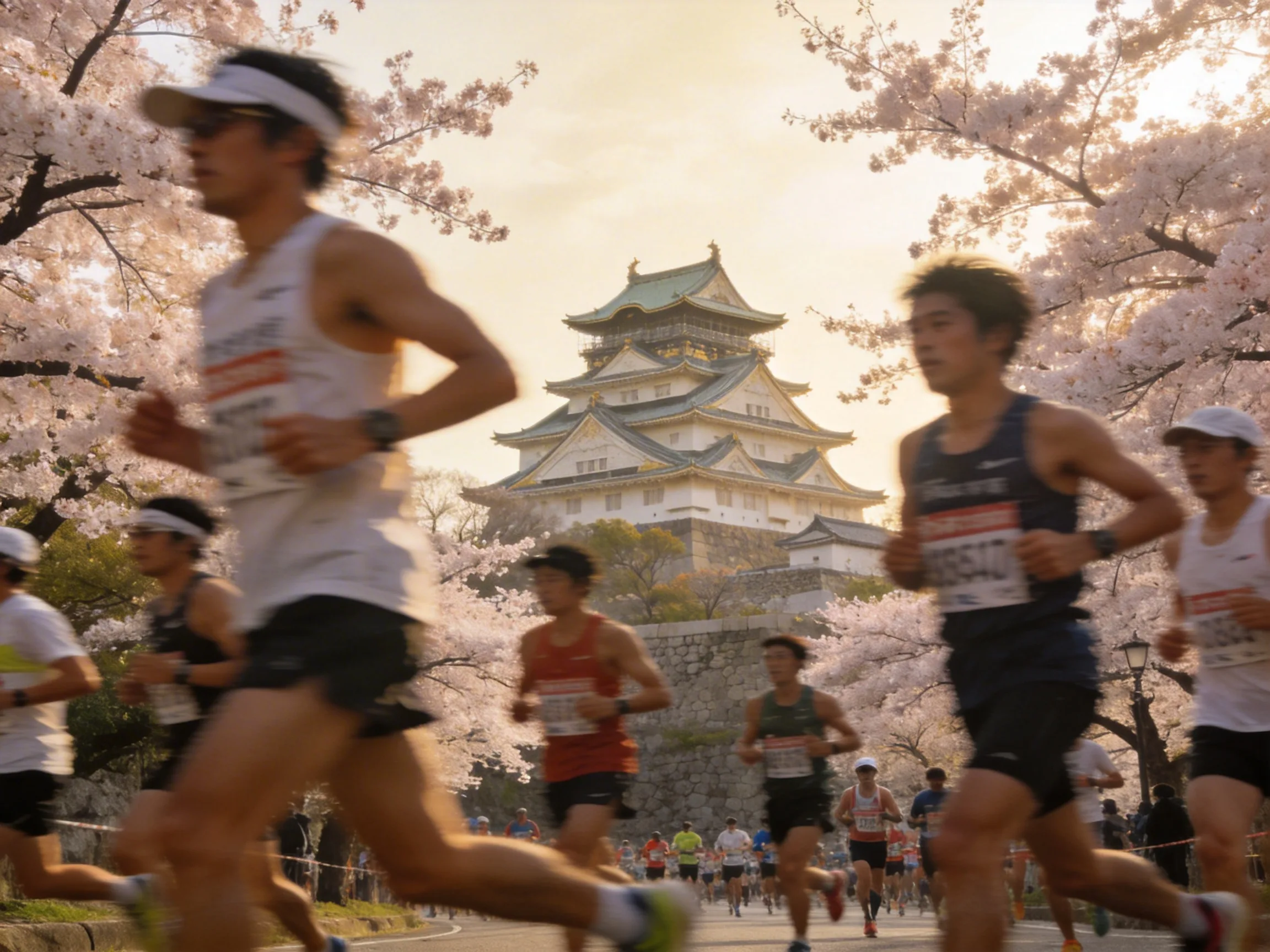
Want personality modes & weather integration? Try the full countdown experience
See entry dates for other marathons →
| Race | 2027 Osaka Marathon - Feb 28 |
|---|---|
| City | Osaka |
| Date | 2027-02-28 at 09:15 |
| Field Size | ~31,970 runners |
| Time Limit | 7 hours |
| Cutoff pace | 9:57/km |
| Course speed |
Fast courseSpeed index 0.93 — median of the last 4 winners' times against the global same-year median. Winner times track elite fields and prize money, so this reads the course as a proxy, not a pure measurement. |
| Timezone | Asia/Tokyo |
| Official Site | Osaka Marathon Committee |
| Fee trend | 2019 ¥10,8002023 ¥17,2002024 ¥17,0002025 ¥16,0002026 ¥16,000(7-yr +48.1%)· below industry avg (+3.6% vs +4.8%/yr) |
| International | ¥21,460 · 1.3× domestic |
| Average Temperature | 5.3°C / 42°F |
|---|---|
| Humidity | 81% |
| Peak Wind | 18.8 km/h |
| Rain Chance | 34% |
| Typical Conditions | Cold winter weather with possible rain or snow |
What to Prepare: February in Osaka averages 3-9°C at race time — throwaway layers and gloves are essential. The 2025 edition saw snow in the final quarter. Dress for cold but expect to warm up after 15 km. Headwinds on Sennichimae-dori (10-15 km) and Imazato-suji (37-40 km) can add challenge.
Based on historical averages for race week. Use our Weather Score Calculator and What to Wear Guide for personalized advice.
Winds peaking around 18.8 km/h — the typical daily maximum for this date — can affect your pace by 5-15 seconds per kilometer in exposed stretches. Headwinds slow you down exponentially: a 20 km/h wind costs more than twice a 10 km/h wind.
Calculate your wind-adjusted pace →Based on 20 years of race-week weather (2005-2024), MERRA-2 reanalysis
| Cooler | Typical | Warmer | |
|---|---|---|---|
| Temperature | 1.3°C | 5.2°C | 9.5°C |
| Dew point | -2.6°C | 1.6°C | 7.6°C |
Data: NASA POWER (MERRA-2 reanalysis), NASA Langley Research Center
| Course Type | Urban Loop |
|---|---|
| Elevation Gain | 21m |
| Terrain | Paved city roads |
| Profile | Mostly flat city course starting from Osaka Prefectural Government Building and finishing at Osaka Castle Park. The only significant climb is the Uemachi Plateau at 30 km (400 m, 15 m gain). Three turnarounds. Iconic Midosuji Boulevard, Namba, and Nakanoshima along the route. Osaka's famously energetic Kansai-style cheering — approximately 1 million spectators line the course. |
| Boston Qualifier | Yes — Check your BQ time |
| Year | Finishers | vs prev. |
|---|---|---|
| 2025 | 31,334 | — |
| 2026 | 30,680 | -2.1% |
Runners who crossed the line, not the registered field size.
The Osaka Marathon is a flat, fast urban course with only ~21 m of elevation change (max), starting from the Osaka Prefectural Government Building and finishing at Osaka Castle Park. The 2024 course redesign reduced turnaround points from five to three, making the route faster and smoother than previous editions. With 34,000 participants (31,970 marathon + 2,030 in the 7.2 km Naniwa Run), it is Japan's second-largest marathon after Tokyo.
The course showcases Osaka's vibrant urban character — from the grand Midosuji Boulevard to the neon-lit Namba district, historic Nakanoshima, and the dramatic finish beneath Osaka Castle. Approximately 1 million spectators line the route, cheering in Osaka's distinctive Kansai dialect: "Ganbariya!" (Keep it up!) and "Ato chotto yade!" (Just a little more!). It is a designated MGC Series 2026-27 race (men's G1, women's G2) — part of Japan's Olympic marathon selection series — drawing a strong elite field.
The race begins with a gentle downhill from the Prefectural Government Building — the highest point on the course. With 34,000 runners funneling out, expect significant congestion for the first 3-5 km. Rear-wave runners may lose 10-15 minutes just reaching the start line (the race uses net timing, so this does not affect your result).
From 5 km, the course opens onto Midosuji Boulevard — Osaka's iconic tree-lined avenue with four lanes of open road. This is the most exhilarating section: wide roads, dense crowds, and an overwhelming temptation to push pace too early. Discipline here pays dividends after 30 km.
The route passes through the Namba/Dotonbori area around 12 km, then heads toward Kyocera Dome (14-19 km). A subtle but consistent headwind from Osaka Bay on Sennichimae-dori (10-15 km westbound) catches many first-timers by surprise. Between 15-27 km, the course follows a quieter stretch on Naniwasuji — flat and monotonous, with less spectator energy. Use this section to settle into rhythm and conserve energy for what comes next.
The defining challenge arrives at 30 km: the Uemachi Plateau climb. A 400-meter ascent gaining 15 meters of elevation — modest on fresh legs, but devastating after 30 km of flat running. Runners universally describe this as the hardest point on the course. The route plays a psychological trick: you see the hill ahead, then do a short out-and-back before actually climbing it. "People died around me and started walking," wrote one experienced runner.
At 32.8 km, the legendary "Maido Aid" station provides a uniquely Osaka experience: 15 booths spanning 500 meters, serving 24 different local specialties from Osaka's shopping districts — takoyaki, cream puffs, hamo tempura, croquettes, and more (212,200 pieces total). For slower runners (5+ hours), popular items may be depleted.
From 35-40 km on Imazato-suji, the course flattens but becomes a mental battle. Sparse crowds, a long straight road, and accumulated fatigue make this the loneliest stretch. Headwinds can compound the difficulty. The final 2 km climb toward Osaka Castle is demanding but emotional — the sight of the illuminated castle and the sound of the finish-line announcer carry runners home. Use our Negative Split Planner to prepare for this back-loaded course.
Pacing: The Osaka Marathon rewards patience. Run the first half 30-60 seconds slower than goal pace — the congested start and flat opening make it tempting to bank time, but the 30 km hill and 37-40 km headwind will claw it back. Target a slight positive split: most finishers run the second half 2-4 minutes slower than the first.
Nutrition: Aid stations offer water and Aquarius sports drink every 2.5 km from 5 km onward. Food stations appear at 18, 23, 27, and 38 km — but there is a critical 10 km gap from 27 to 37 km (aside from the Maido Aid snacks at 32.8 km, which are treats rather than fuel). Carry 2-3 gels for this stretch. Japanese runners recommend salt tablets every 10 km to prevent cramping.
Cold weather: Race-day temperatures typically range from 3-9°C. Wear throwaway layers at the start — disposable gloves and a trash bag poncho are popular. Arm sleeves and light gloves may be needed for the entire race in colder years. The 2025 edition saw snow, and the 2024 edition had persistent rain. Check conditions with our Weather Score Calculator.
Crowd energy tip: The Kansai-dialect cheering is distinctive and infectious. Namba (12 km), the Maido Aid area (32.8 km), and the Osaka Castle approach (40+ km) have the highest spectator density — save your emotional energy for the quieter Naniwasuji (20-27 km) and Imazato-suji (35-40 km) stretches.
Arriving early? Explore daily running routes and local tips.
Osaka Castle 3.5 km loop, Nagai Park marathon course, Yodo River 50+ km. Running Base showers, night safety tips, and Osaka Marathon lottery guide.
Read City Guide →Use our free training tools to get race-ready:
Free running pace calculator for 5K, 10K, half marathon, and marathon. Get min/km or min/mile, your ...
Use Calculator →Free printable pace band for marathon, half marathon, or custom distance. Choose even, negative, or ...
Use Calculator →7 AM race, wake at 3:45 AM? Enter the gun time; we work backward through meal, gear, bathroom, warm-...
Use Calculator →London ~1.5%, Chicago ~35%, Berlin ~30%, Tokyo ~10%, NYC ~1-3% (2026 ballots) — real odds and wait t...
Use Calculator →Enter temperature, wind, and rain to get specific clothing picks for head, torso, legs, hands, and f...
Use Calculator →How much does a headwind actually slow you down? This free calculator turns wind speed and direction...
Use Calculator →Entry is by lottery, roughly 5x oversubscribed (about a 20% success rate on the 2024-cycle figures our lottery calculator uses; the organiser itself does not publish odds). The total field is 34,000 (31,970 marathon + 2,030 Naniwa Run), and the 2026 edition had 32,746 marathon starters with a 94.0% finish rate. The smaller 7.2 km Naniwa Run is even more competitive. The 2027 general lottery closed on August 28, 2026, and results go out by email on September 28, 2026. Weigh a future edition with our lottery calculator. Applications run through the official website at osaka-marathon.com, and international runners enter via JTB Sports Station or overseas travel agencies.
A guaranteed charity entry is still open first-come until October 19, 2026, 17:00 JST — three weeks after lottery results land: the entry fee ($145 USD) plus a $475+ USD donation. Charity runners receive branded gear, a lounge, separate baggage storage, and additional support — many past participants call it "well worth it."
The course is mostly flat with one significant hill. Starting from the Prefectural Government Building, the route runs through central Osaka on paved city roads with three turnaround points. The only real climb is the Uemachi Plateau at 30 km — a 400-meter ascent with 15 meters of elevation gain. After 30 km of flat running, it feels much steeper than it is. The final 2 km to Osaka Castle also trend uphill. Total elevation change is only about 21 meters (max) — essentially flat since the 2024 redesign. Osaka is a designated MGC Series 2026-27 race, part of Japan's Olympic marathon selection series.
The Maido Aid (毎度エイド) at 32.8 km is the Osaka Marathon's signature experience and unlike anything at other world marathons. Fifteen booths from Osaka's famous shopping districts stretch over 500 meters, serving 24 different local specialties — takoyaki, cream puffs, Billiken-shaped cakes, hamo tempura, crab sticks, croquettes, pufferfish jelly, inari sushi, and more. Over 212,200 pieces of food are prepared. The organizers publish a pre-race "menu" so you can plan which booth to target. Note: if you're on pace for 5+ hours, popular items may run out — carry your own nutrition as backup.
Race-day temperatures typically range from 3-9°C, and conditions can be harsher — the 2025 edition saw snow, and the 2024 race had cold rain throughout. Essentials: throwaway layers (a garbage bag poncho is popular) for the long wait before start, running gloves (buy at the expo if needed), and arm sleeves. Many Japanese runners wear calf sleeves and use hand warmers tucked into waistbands. Apply body glide thoroughly — chafing is severe in wet cold conditions, especially the inner knee area. Light long-sleeve or vest options work for the race itself; you'll warm up by 15 km.
Hotels near Osaka Castle are ideal — the New Otani Hotel is a popular choice with views of the changing area and walking distance to both start and finish. The Nihonbashi/Namba area is also convenient (close to the expo train to INTEX Osaka). Runners receive a 2-day Osaka Metro/bus free pass, making transit easy.
Race morning: Arrive by 7:00 AM for the 9:15 start. Toilet lines can reach 30-40 minutes — use station facilities before arriving. Baggage drop at Osaka Castle Hall closes at 8:30 AM. Wave starts are staggered: Wave 1 at 9:15, Wave 2 at 9:30, Wave 3 at 9:45. The finish at Osaka Castle Park has good transit access via JR Osaka-jo Koen and Morinomiya stations.
Osaka is significantly easier to enter — its lottery runs roughly 5-10x oversubscribed, versus Tokyo's far longer odds (acceptance rate often just 3-4%). Both are well-organized Japanese marathons with enthusiastic crowds, but Osaka offers a more local, Kansai-flavored atmosphere versus Tokyo's international feel. The Osaka course is flatter overall (one hill at 30 km vs Tokyo's rolling profile). Osaka's February date means colder racing conditions (3-9°C vs Tokyo's 5-12°C in March). Many international runners treat Osaka as their "backup" after failing the Tokyo lottery — but those who run both often prefer Osaka for the Kansai warmth, the Maido Aid experience, and the Osaka Castle finish.
The time limit is 7 hours from Wave 1 (9:15 AM, finish by 4:15 PM). There are 10 intermediate checkpoints along the course. Key gates: 11.8 km by 2h29m, 22.6 km by 4h04m, 30.5 km by 5h14m, 37.4 km by 6h15m, and 41.4 km by 6h52m. The required pace is approximately 9:00/km after the initial generous first checkpoint. The completion rate is consistently around 94% — remarkably high for a field of 34,000. Plan your target finish with our Pace Calculator.
Seoul · 2027-03-21
Tokyo · 2027-03-07
Nagoya · 2027-03-14
Barcelona · 2027-03-14
Chongqing · 2027-01-10
Los Angeles · 2027-03-07