Running Pace Calculator — Min/km, Finish Time & Pace Chart
Free running pace calculator for 5K, 10K, half marathon, and marathon. Get min/km or min/mile, your ...
Use Calculator →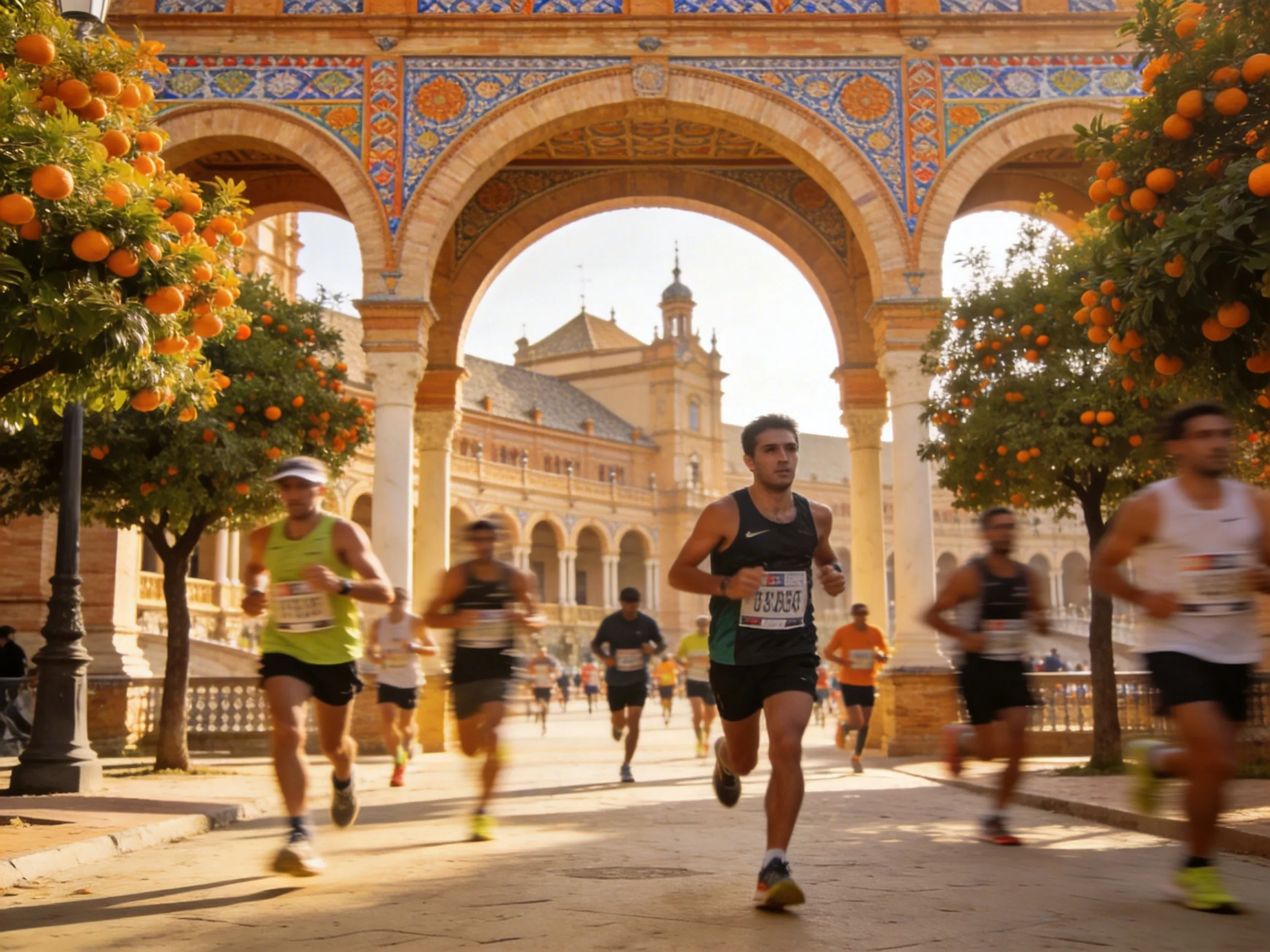
Want personality modes & weather integration? Try the full countdown experience
See entry dates for other marathons →
| Race | 2027 Seville Marathon - Feb 21 |
|---|---|
| City | Seville |
| Date | 2027-02-21 at 08:30 |
| Field Size | ~20,000 runners |
| Time Limit | 6 hours |
| Cutoff pace | 8:32/km |
| Course speed |
Fast courseSpeed index 0.91 — median of the last 4 winners' times against the global same-year median. Winner times track elite fields and prize money, so this reads the course as a proxy, not a pure measurement. |
| Timezone | Europe/Madrid |
| Official Site | Instituto Municipal de Deportes (IMD), Ayuntamiento de Sevilla |
| Average Temperature | 10.7°C / 51°F |
|---|---|
| Humidity | 77% |
| Peak Wind | 19.2 km/h |
| Rain Chance | 23% |
| Typical Conditions | Cool, dry February morning warming into the high teens by early afternoon |
What to Prepare: AEMET's 1981-2010 normals for the Sevilla Aeropuerto station put February at a 12.5°C mean, an 18.1°C average daily high and a 7.0°C average daily low, with 50 mm of rain spread over about 5.8 wet days. An 8:30 gun therefore usually lands in single digits and the finish sits near the high teens, so dress for the cool start you will race in rather than the warmer walk back — a throwaway layer in the corral covers the wait. Two caveats: these are climate normals, not a forecast, and the station is at the airport, so the city-centre course tends to run slightly warmer. And if the two averages on this page look inconsistent, they measure different things: the weather card above is a race-window figure (the week either side of 21 February, 2005-2024), while these AEMET numbers are 1981-2010 normals for the whole of February — different window, different reference period, hence the roughly 1.8°C gap.
Based on historical averages for race week. Use our Weather Score Calculator and What to Wear Guide for personalized advice.
Winds peaking around 19.2 km/h — the typical daily maximum for this date — can affect your pace by 5-15 seconds per kilometer in exposed stretches. Headwinds slow you down exponentially: a 20 km/h wind costs more than twice a 10 km/h wind.
Calculate your wind-adjusted pace →Based on 20 years of race-week weather (2005-2024), MERRA-2 reanalysis
| Cooler | Typical | Warmer | |
|---|---|---|---|
| Temperature | 7.4°C | 11°C | 13.5°C |
| Dew point | 0.3°C | 6.6°C | 10.1°C |
Data: NASA POWER (MERRA-2 reanalysis), NASA Langley Research Center
| Course Type | City course with repeated sections |
|---|---|
| Elevation Gain | 10m |
| Terrain | Road (flat city streets with repeated sections) |
| Profile | A flat city course that doubles back on itself rather than running a single lap: it starts on Avenida de María Luisa and finishes on Paseo de las Delicias at the Glorieta de Buenos Aires, and the official street list in the regulations covers the northern Capuchinos corridor (María Auxiliadora – Ronda de Capuchinos – Muñoz León – Parlamento de Andalucía) three times, with short out-and-backs on Avenida de Kansas City, Avenida de la Palmera and Avenida de Isabel la Católica. The organiser's own race report puts the course at 38 turns and 10 metres of height difference — the Spanish original says desnivel, meaning net height difference rather than cumulative climb, so a GPS watch will log more total gain than that. The route takes in both banks of the Guadalquivir, Triana and Los Remedios, the Cartuja island, the eastern avenues, Plaza de España and the Avenida de la Constitución beneath the Cathedral. AIMS- and RFEA-certified, so a qualifying time run here is accepted. |
| Boston Qualifier | Yes — Check your BQ time |
The XLII Zurich Maratón de Sevilla runs on Sunday 21 February 2027 at 8:30, and it is already full. The organiser announced on 24 April 2026 that all 20,000 bibs had gone in ten days, against 28 days for the previous edition, which offered 3,000 fewer places. That is roughly ten months before race day, so every practical question about Seville now starts with how to get in rather than when to enter.
Scale and depth explain the speed of the sell-out. The 2026 edition fielded 17,000 runners, 200 of them elite, and 8,954 international entrants from more than 100 countries — 53.07% of the field, so a foreign runner here is in the majority rather than a curiosity. That race was decided on a photo finish in 2:03:59, which the organiser recorded as the fastest marathon run anywhere in the world to that point in the year, with 23 men under 2:10 and 14 women under 2:28. The course record is 2:03:27, set by Deresa Geleta in 2024. The event is held under World Athletics and RFEA road-race rules and appears on the AIMS calendar.
The gun goes on Avenida de María Luisa beside the park, with wheelchair athletes away at 8:29. The route heads north-east through Recaredo and María Auxiliadora, arcs around the Ronda de Capuchinos, then drops back to the water along Avenida Torneo and Paseo de Cristóbal Colón before crossing the Guadalquivir on the Puente de San Telmo into Plaza de Cuba.
The whole west-bank block — Los Remedios, the Ronda de Triana, then the Camino de los Descubrimientos on the Cartuja island — is wide, modern and exposed, and it is where the field finally strings out. You return east over the Puente de la Barqueta. Note that the organiser publishes the street sequence rather than landmark kilometre markers, so treat this geography as order, not distance.
Aid is unusually dense. At the 2026 edition the first seven stations sat at km 4.6, 7.3, 9.4, 11.8, 15.3, 18 and 20.7 — water and isotonic drink throughout, first gels at 20.7 — which works out at one roughly every 2 to 2.7 km, far tighter than the nominal five-kilometre grid printed in the regulations. The 2027 layout has not been published. Set a first-half target you can actually hold with our pace calculator.
The second half is the plainest part of the course and the part that decides your time. After the northern block around Avenida Sánchez Pizjuán and a second pass down the Capuchinos corridor, the route swings back south and heads east on Luis Montoto and Avenida de Kansas City, through Gran Plaza and Avenida Eduardo Dato, before turning south-west down Avenida de la Palmera — long, straight, lightly shaded avenues with thinner crowds than the centre.
The scenery is deliberately saved for the end. The course reaches Plaza de España late, makes a third pass up the Capuchinos corridor, then drops through the Alameda de Hércules, Plaza Nueva and the Avenida de la Constitución beneath the Cathedral and the Giralda, before turning back down Avenida de María Luisa to finish on Paseo de las Delicias at the Glorieta de Buenos Aires. In 2026 sponge points came at km 22.7 and 32.7 and the final aid station at km 40.3.
Because there is no hill to blame and the organiser describes the course as sea-level and wind-sheltered, Seville exposes an aggressive first half more plainly than a rolling course does — the fade shows up as pace, not as terrain. Our negative split planner is the right tool for a profile like this.
Pace flat, run the tangents. With 38 turns across the course, the gap between a tight line and a wandering one is real distance, and there is no climb anywhere to justify a surge. Even pacing is the entire tactical problem here.
Work out which wave you are in before you trust the cutoff. The regulations give 6 hours from the start of the last runner and close the finish at 15:00. In 2026 the five waves went at 8:30, 8:34, 8:40, 8:47 and 8:52 by declared time; the 2027 waves are not published yet. The arithmetic runs the wrong way round: a first-wave runner has about 6 hours 30 of clock time before the finish shuts, while the last wave — where the 3:45-and-slower declarations sit — gets close to the nominal 6 hours. The buffer goes to the fast, not the slow, so anyone targeting 5:30 or beyond should plan against 6 hours.
Corrals are earned at entry, not on the day. To start in a seeded corral (World Elite, Sub Elite, sub-2:45, sub-3:00, sub-3:15, sub-3:30, sub-3:45, sub-4:00 and over 4:00) you must nominate it when you register and supply a verified personal best from a certified marathon or half marathon run in the previous two years. Note that this is the 2026 procedure: the corral list and the two-year rule come from the organiser's FAQ page for that edition, and the 2027 regulations contain no corral clause at all. Sanity-check what your current fitness supports with our race time predictor.
Race week. Bibs are issued only at the expo at the FIBES centre, Friday 19 and Saturday 20 February 2027, 10:00 to 20:00 non-stop, against your entry receipt and an ID card or passport; nothing is handed out on race morning. If you cannot get to the expo yourself, the organiser allows collection by proxy: your stand-in needs the receipt or a copy of your registration, a photocopy of your ID and an authorisation signed by you. A medical certificate is not required — the regulations only recommend a check-up, which is a real difference from races that demand paperwork. Runners without an Andalusian or Spanish federation licence or a Runner Plus card pay a 5 EUR RFEA day licence on top of the entry fee at checkout.
Use our free training tools to get race-ready:
Free running pace calculator for 5K, 10K, half marathon, and marathon. Get min/km or min/mile, your ...
Use Calculator →Free printable pace band for marathon, half marathon, or custom distance. Choose even, negative, or ...
Use Calculator →7 AM race, wake at 3:45 AM? Enter the gun time; we work backward through meal, gear, bathroom, warm-...
Use Calculator →Free running shoe finder quiz. Answer 6 questions, get 3 spec-matched picks from 15 brands (155 SKUs...
Use Calculator →Free marathon predictor — convert your 5K, 10K, or half marathon time into race-day estimates from R...
Use Calculator →Predict your race finish time from pace, or set a goal time to find required pace. Free instant calc...
Use Calculator →Yes. The organiser announced on 24 April 2026 that all 20,000 bibs for the XLII edition had sold out in ten days; the previous edition, with 17,000 bibs, took 28 days. General entry closed with that announcement, around ten months before the 21 February 2027 race date, and a waiting list opened in its place. The regulations still print a nominal entry window running to 15 February 2027, but that window is academic while the 20,000 cap is full.
It is not a queue for extra places. The official wording is that once the 20,000 bibs sell out, the waiting list opens for the spots released by runners who use the cancellation guarantee — the optional 15 EUR add-on bought at the moment of entry, which refunds the entry fee in full up to 17 January 2027. Every place that reaches the list therefore comes from someone who paid for that guarantee and then withdrew, and the channel feeding it closes when that refund deadline passes, about five weeks before race day. The organiser does not publish how many places are released or what your odds are, so treat the list as a real but unquantified chance rather than a plan.
Two official routes into the marathon remain besides the waiting list, and one widely suggested route does not exist here. (1) Hotel plus bib packages through the race's official tour operator, from 517.10 EUR for two nights in a single room with the bib included, on sale until 31 January 2027 — the one-night tier is already marked sold out at both hotels that offered it. (2) GOLD entry, 30 places at 995 EUR, bundling two nights at the elite hotel, a preferred corral immediately behind the elite pens, bib collection at the hotel and a 5K entry. Separately, the 5K Breakfast Run on Saturday 20 February is still open on the official entry platform and listed at 12 EUR with that price flagged as valid to 31 August 2026 — that is not the marathon, but it is a way to run the weekend. What does not work: charity places do not exist for 2027 (the official page reads "Coming soon."), and under the regulations a place may under no circumstances be passed to another runner, so buying someone else's entry breaks the rules and is explicit grounds for disqualification.
Standard general entry for anyone not registered in a municipality of Seville province is 82.10 EUR with management costs included, plus the 5 EUR RFEA day licence charged to runners without a Spanish or Andalusian federation licence or a Runner Plus card — so 87.10 EUR in practice for most international runners in a normal entry window. Seville-province residents pay a tiered 20.85 / 41.74 / 62.61 EUR instead. For waiting-list places the two official figures disagree, and both come from the organiser: the regulations state 97.10 EUR (management fees included), while the entry platform linked from the race homepage shows 82.10 EUR. Budget for the higher number and check the total before you pay.
The hard figure, from the organiser's own race report, is 38 turns and 10 metres of height difference across the loop. The Spanish original uses desnivel — net height difference, not cumulative climb — so your watch will still log more total gain than 10 m from road camber and the two bridge crossings. Seville markets itself as the flattest course in Europe; that is the organiser's claim rather than an independently verified one, and cross-race elevation comparisons are shaky in any case because races measure by different methods. The practical consequence is the same either way: there is no hill to plan around, so even pacing and clean tangents are the whole job.
The limit is 6 hours from the start of the last runner, with the finish line closing at 15:00. The 2027 wave times are not published; at the 2026 edition the five waves left at 8:30, 8:34, 8:40, 8:47 and 8:52, sorted by declared finishing time. That makes the real cutoff uneven: an early-wave runner has roughly 6 hours 30 of clock time before the finish shuts, while the last wave — the 3:45-and-slower group — gets close to the nominal 6 hours. If you are aiming at 5:30 or beyond, plan against 6 hours, not 6:30.
Yes. The regulations state that the course measures 42.195 km and is duly certified, that the race is held under World Athletics road-race regulations and those of the RFEA, and that it is included in the AIMS calendar — the certification chain the Boston Athletic Association looks for. The race also appears among World Athletics label road races, and World Athletics does publish the tier: it listed the 2026 edition in its Elite category. What does not exist yet is the 2027 label list, so we do not claim a tier for this edition. Check the standard for your age group with our Boston qualifying calculator, and weigh it against the other big flat winter target in Spain in our Seville versus Valencia comparison.
Close to ideal for a fast marathon. AEMET, the Spanish national weather service, gives February at its Sevilla Aeropuerto station a mean of 12.5°C, an average daily high of 18.1°C and an average daily low of 7.0°C across the 1981-2010 normals, with 50 mm of rain over about 5.8 wet days — roughly one February day in five sees measurable rain. In practice the 8:30 start is usually in single digits and the finish sits in the high teens, which is a large part of why the race is sold as a time-trial venue. Two caveats: normals are not a forecast, and the station is at the airport, so the city-centre course typically runs a little warmer. Compare conditions against your target with our weather score tool.

Osaka · 2027-02-28

Seoul · 2027-03-21
Tokyo · 2027-03-07

Nagoya · 2027-03-14
Barcelona · 2027-03-14

Chongqing · 2027-01-10