Running Pace Calculator — Min/km, Finish Time & Pace Chart
Free running pace calculator for 5K, 10K, half marathon, and marathon. Get min/km or min/mile, your ...
Use Calculator →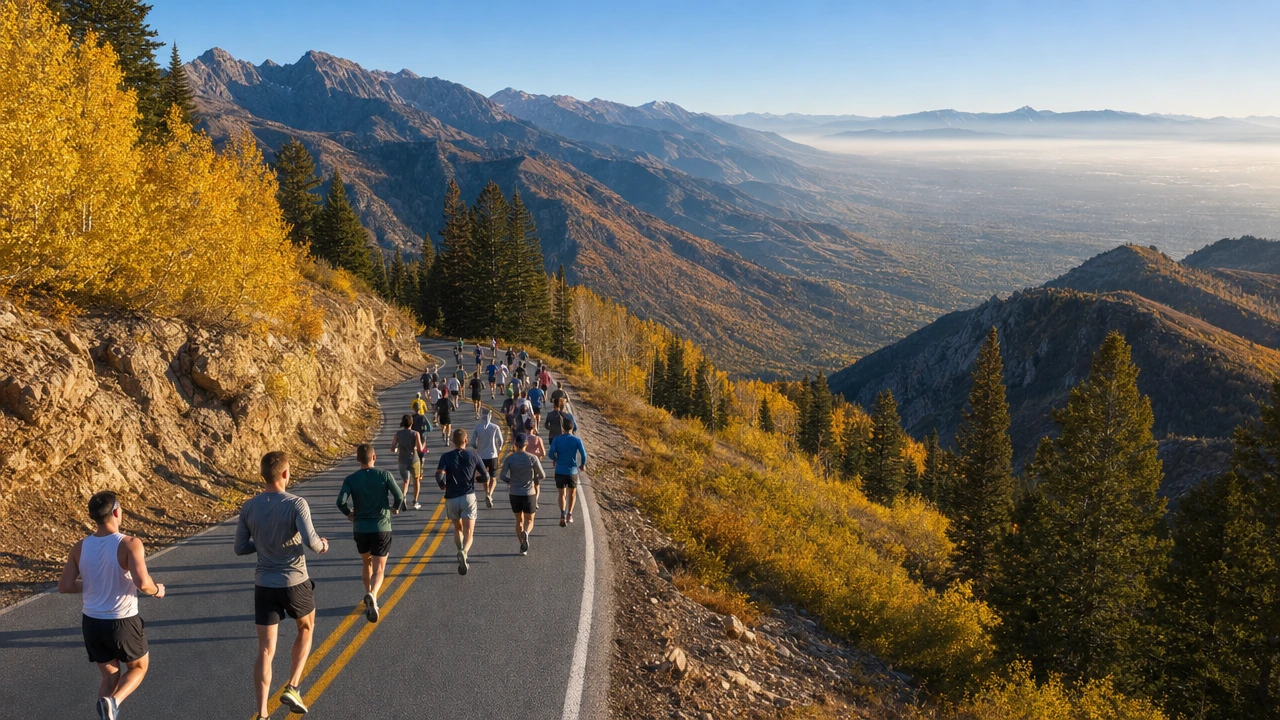
Race Completed
This marathon has finished. Check back for next year's edition.
Finished this one? Turn your result into a keepsake:
Finisher certificate ·
Virtual race bib ·
Achievement card
See entry dates for other marathons →
| Race | 2026 REVEL Big Cottonwood Marathon - Sep 12 |
|---|---|
| City | Murray |
| Date | 2026-09-12 at 06:45 |
| Field Size | ~1,179 runners |
| Time Limit | 6 hours 33 min |
| Cutoff pace | 9:19/km |
| Timezone | America/Denver |
| Official Site | REVEL Race Series |
| Average Temperature | 18.7°C / 66°F |
|---|---|
| Humidity | 38% |
| Peak Wind | 15.2 km/h |
| Rain Chance | 21% |
| Typical Conditions | Cool, dry, mostly clear mid-September Wasatch morning — the 6:45 a.m. start sits near 9,600 ft at Guardsman Pass, running roughly 20-30°F colder than the Salt Lake valley below |
What to Prepare: You start cold and high in the alpine (often the 40s°F / ~4-9°C, sometimes near freezing at the pass) and finish far warmer on the valley floor in Murray. Dress in throwaway layers, gloves and a beanie you can shed as you descend; skies are usually clear and the air dry. The real demand is the sustained downhill on your quads, not the weather.
Based on historical averages for race week. Use our Weather Score Calculator and What to Wear Guide for personalized advice.
Winds peaking around 15.2 km/h — the typical daily maximum for this date — can affect your pace by 5-15 seconds per kilometer in exposed stretches. Headwinds slow you down exponentially: a 20 km/h wind costs more than twice a 10 km/h wind.
Calculate your wind-adjusted pace →Based on 20 years of race-week weather (2005-2024), MERRA-2 reanalysis
| Cooler | Typical | Warmer | |
|---|---|---|---|
| Temperature | 13.5°C | 19.2°C | 22.8°C |
| Dew point | -3.1°C | 2.7°C | 8.9°C |
Data: NASA POWER (MERRA-2 reanalysis), NASA Langley Research Center
| Course Type | Point-to-point (downhill) |
|---|---|
| Elevation Gain | 75m |
| Terrain | Road / pavement, sustained downhill canyon grade |
| Profile | One of the fastest marathons in the United States — a steep net-downhill point-to-point that plunges down Big Cottonwood Canyon in the Wasatch Mountains. It begins at the very top of the canyon at Guardsman Pass, near 9,600 ft of alpine terrain often ringed by early-autumn golden aspens, and descends roughly 5,200 ft (about a 5,248 ft net drop per findmymarathon) to finish at Cottonwood High School in Murray, around 4,400 ft and about 15 miles from Salt Lake City International Airport. The bulk of the drop comes on a long, near-steady canyon downgrade averaging about 5% for nearly 15 miles, so the course is built for chasing a fast time. The honest trade-off is twofold. First, all that descent pounds the quads — pace control and downhill-specific training matter more here than aerobic fitness, and runners who blast the early miles often blow up late. Second, the net drop now triggers Boston's downhill adjustment: because the loss exceeds 1,500 ft, the B.A.A. adds a +10:00 time adjustment to qualifying results from courses dropping 3,000-5,999 ft (effective for the qualifying window that opened September 13, 2025) — so you must finish 10 minutes faster than your raw Boston standard for the time to count. It is USATF-certified and still Boston-eligible (well under the 6,000-ft cutoff that bans a course outright), with a high but weather-sensitive BQ rate — about 4.3% of finishers qualified in 2025 (a warm, off year) versus 11.3% in 2024 and 21-27% in 2021-2023. |
| Boston Qualifier | Yes — Check your BQ time |
Use our free training tools to get race-ready:
Free running pace calculator for 5K, 10K, half marathon, and marathon. Get min/km or min/mile, your ...
Use Calculator →Free printable pace band for marathon, half marathon, or custom distance. Choose even, negative, or ...
Use Calculator →7 AM race, wake at 3:45 AM? Enter the gun time; we work backward through meal, gear, bathroom, warm-...
Use Calculator →Free marathon predictor — convert your 5K, 10K, or half marathon time into race-day estimates from R...
Use Calculator →Predict your race finish time from pace, or set a goal time to find required pace. Free instant calc...
Use Calculator →What heart rate should you train at? Enter your age and resting HR to get personalized 5-zone traini...
Use Calculator →The 2026 REVEL Big Cottonwood Marathon is on Saturday, September 12, 2026, with the full marathon starting at 6:45 a.m. Mountain Time at the top of Big Cottonwood Canyon. Because the start is high on the mountain at Guardsman Pass, full-marathon shuttle buses load early — roughly 4:00 to 5:00 a.m. — from the finish area in Murray, so plan for a pre-dawn ride up the canyon.
It is a steep net-downhill point-to-point. The course drops roughly 5,200 feet overall — findmymarathon lists about a 5,248 ft net descent, from a start near 9,600 ft at Guardsman Pass down to a finish around 4,400 ft at Cottonwood High School in Murray. Most of that loss comes on a long canyon downgrade averaging about a 5% grade for nearly 15 miles, which is why it is billed as the fastest marathon in Utah.
Yes, it is USATF-certified and still Boston-eligible, but the new B.A.A. downhill rule applies. Because the net drop (about 5,248 ft) falls in the 3,000-5,999 ft band, a +10:00 time adjustment is added to your finish before it is compared to the Boston standard — so you effectively need to run 10 minutes faster than your raw qualifying time. The rule took effect for the qualifying window that opened September 13, 2025. The course stays eligible because it is under the 6,000-ft limit that disqualifies a race entirely. Check your adjusted target with our Boston qualifying calculator.
Historically very high for a downhill race, but swingy with the weather. About 4.3% of finishers qualified for Boston in 2025 — a warm, off year — compared with 11.3% in 2024 and roughly 21-27% across 2021-2023. Note those rates are based on raw times; with the new +10:00 downhill adjustment now in force, the effective qualifying rate will be lower, so it rewards smart, even-effort downhill pacing rather than just showing up.
Aerobically it is easy to run fast, but the relentless downhill is the real difficulty. A sustained ~5,200-ft net drop eccentrically loads the quads for the better part of the race, and runners who attack the early miles often cramp or fade badly in the final 10K. The smart approach is downhill-specific training in the weeks before and disciplined, even effort on race day — set realistic splits with our pace calculator.
The marathon enforces a 15:00-per-mile pace limit, which works out to a finish cap of about 6 hours 33 minutes. That pace is described as a very light jog or brisk power walk, and runners who fall behind it are picked up and shuttled to the finish so the canyon road can reopen.
Register at runrevel.com/bcm. Entry is tiered by date — the 2026 full marathon opened around $130 and rises toward $179 in the weeks before race day, so signing up early saves money. English-language online registration is straightforward for international runners, and the popular early-autumn date can fill, so do not wait until race week.
Mid-September in the Wasatch is typically cool, dry and clear. The high-altitude start near 9,600 ft can sit in the 40s°F (around 4-9°C) and occasionally near freezing, running 20-30°F colder than the valley, while the Murray finish warms to a daytime mean around 57°F (13°C) with highs near 70°F (21°C). Wear throwaway layers and gloves for the alpine start and shed them as you descend into warmer air.

Guangzhou · 2026-12-20

Kunming · 2026-12-13

Honolulu · 2026-12-13

Taipei · 2026-12-20

Shenzhen · 2026-12-06

Xiamen · 2027-01-10